










Duck Painting: A Complete Guide to Capturing Waterfowl in Art
The Timeless Appeal of Duck Painting
Duck painting has captivated artists for centuries, from the ancient Egyptians who depicted waterfowl in tomb murals to the celebrated wildlife artists of the 19th and 20th centuries. There is something undeniably magnetic about ducks as subjects — their iridescent plumage, their graceful movement across still water, and the rich natural environments they inhabit all combine to create an endlessly rewarding artistic challenge. Whether you are a seasoned painter or a curious beginner, exploring duck painting opens a doorway into the broader world of wildlife and nature art.
The genre carries with it a rich tradition rooted in both fine art and the functional world of sporting culture. Decoy carving and decorative waterfowl painting grew hand in hand with hunting traditions in North America and Europe, producing an entire folk art movement that still thrives today. Meanwhile, naturalist illustrators like John James Audubon elevated bird painting to scientific and artistic heights that influenced generations of painters. This dual heritage — utilitarian and fine art — gives duck painting a uniquely broad appeal that spans galleries, sporting lodges, and living room walls alike.
Beyond tradition, ducks offer painters an extraordinary range of visual complexity. The mallard’s emerald-green head shimmers with structural iridescence that changes depending on the angle of light. The wood duck, often described as the most beautiful bird in North America, presents a mosaic of colors and patterns that would challenge even the most skilled portraitist. Even the modest female mallard, dressed in mottled brown and buff tones, rewards careful observation with subtle variations that demand genuine painting skill. Duck painting, at its heart, is a study in patience, observation, and technical mastery.
Essential Materials and Tools for Duck Painting
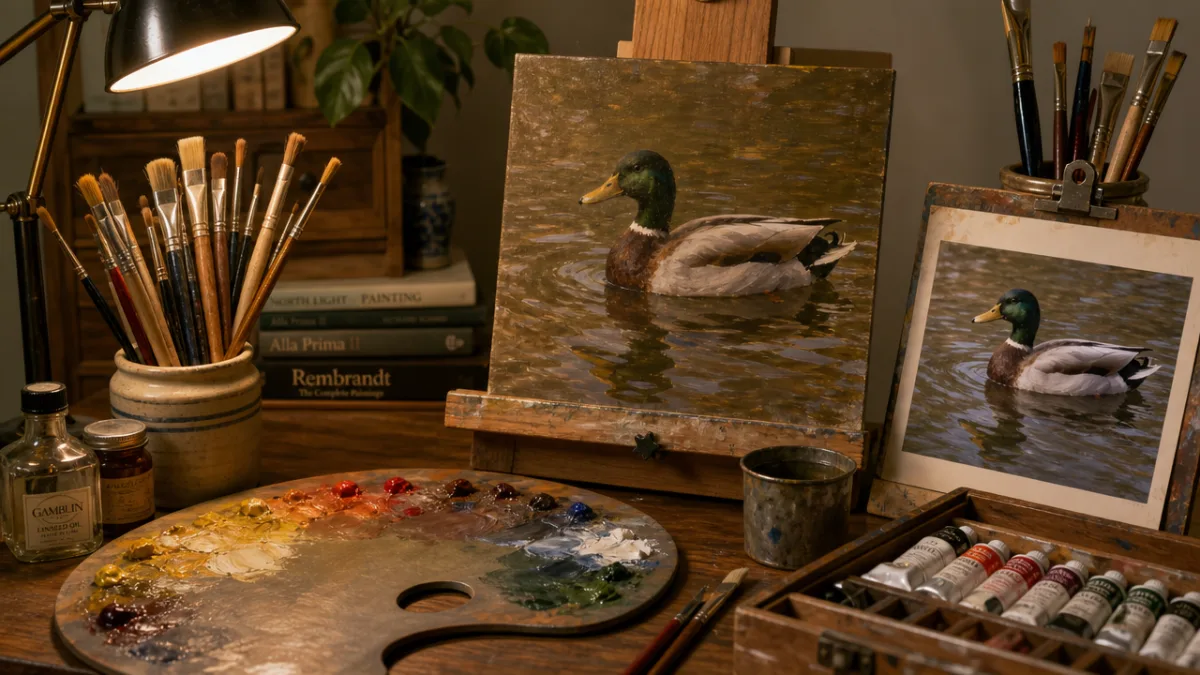
Choosing the right materials is one of the most important decisions a duck painter will make, and the choice often comes down to personal preference and the specific effect you want to achieve. Oil paints remain the traditional medium of choice for wildlife artists because of their slow drying time, which allows for blending and reworking, and their ability to build rich, luminous layers of color. The slow drying time is particularly valuable when painting iridescent feathers, where subtle transitions between colors must be handled with care and precision.
Watercolor, by contrast, offers transparency and a lightness that suits the reflective, watery environments ducks typically inhabit. A skilled watercolorist can capture the shimmering surface of a pond or the soft diffused light of a misty morning with techniques that oil simply cannot replicate in the same way. Acrylic paints offer a middle ground — faster drying than oils, more forgiving than watercolor, and capable of both transparent washes and opaque, layered coverage. Many contemporary wildlife artists work primarily in acrylics precisely because of this versatility.
Beyond paint, the quality of your brushes will significantly affect the outcome of your work. For detailed feather work, fine rounds in sizes 0 through 4 are essential, while larger flats and fans help lay in broad background washes and suggest clusters of body feathers without painting each one individually. A rigger or liner brush is invaluable for painting the fine, hair-like details of wing edges and facial markings. Investing in quality brushes from reputable manufacturers will pay dividends in control and longevity, especially when working on the delicate detail work that duck painting demands.
- Oil paints: ideal for rich blending, glazing, and traditional wildlife rendering
- Watercolor: perfect for transparent washes, reflections, and atmospheric effects
- Acrylic: versatile, fast-drying, and capable of layered texture
- Fine round brushes (sizes 0–4): essential for feather detail and eye rendering
- Large flat or fan brushes: useful for background washes and broad feather masses
- Rigger or liner brush: critical for fine edge work and delicate markings
- Gessoed canvas or watercolor board: provides the ideal painting surface for most duck subjects
Understanding Duck Anatomy and Plumage
Successful duck painting begins with a deep understanding of avian anatomy. Unlike painting a landscape, where approximate shapes can be convincingly suggested, painting a bird well requires knowing how feathers are grouped, how wings fold, how the neck connects to the body, and how the bill relates proportionally to the head. Artists who skip this foundational study often produce paintings that look stiff or anatomically implausible, even if the colors and textures are otherwise accomplished. The investment in learning duck anatomy pays off immediately in more confident, convincing work.
Ducks are covered in distinct groups of feathers, each with its own texture, scale, and orientation. The head feathers are short, tight, and smooth, almost scale-like in their fine detail. The breast and flank feathers are larger and softer, with gentle curves that follow the body’s contour. The speculum — that distinctive colored patch on the secondary wing feathers — is one of the most visually striking features of many duck species, often a vivid blue, green, or purple bordered by white. Understanding that the speculum is visible both when the wing is folded and in flight helps artists place it accurately in compositions of all kinds.
Bill structure is another area that requires careful study. Different duck species have dramatically different bills, from the broad, flat bill of the mallard to the narrow, serrated bill of the merganser. The color and markings of the bill are often species-specific identification features, making accuracy here essential for any artist wishing to paint recognizable portraits. The eye, typically a small, dark jewel set within a ring of colored skin, is the single most important feature for conveying life and personality. Getting the eye right — its size, placement, highlight, and subtle coloring — can make the difference between a painting that breathes and one that feels flat.
Composition and Setting: Placing Your Duck in the World
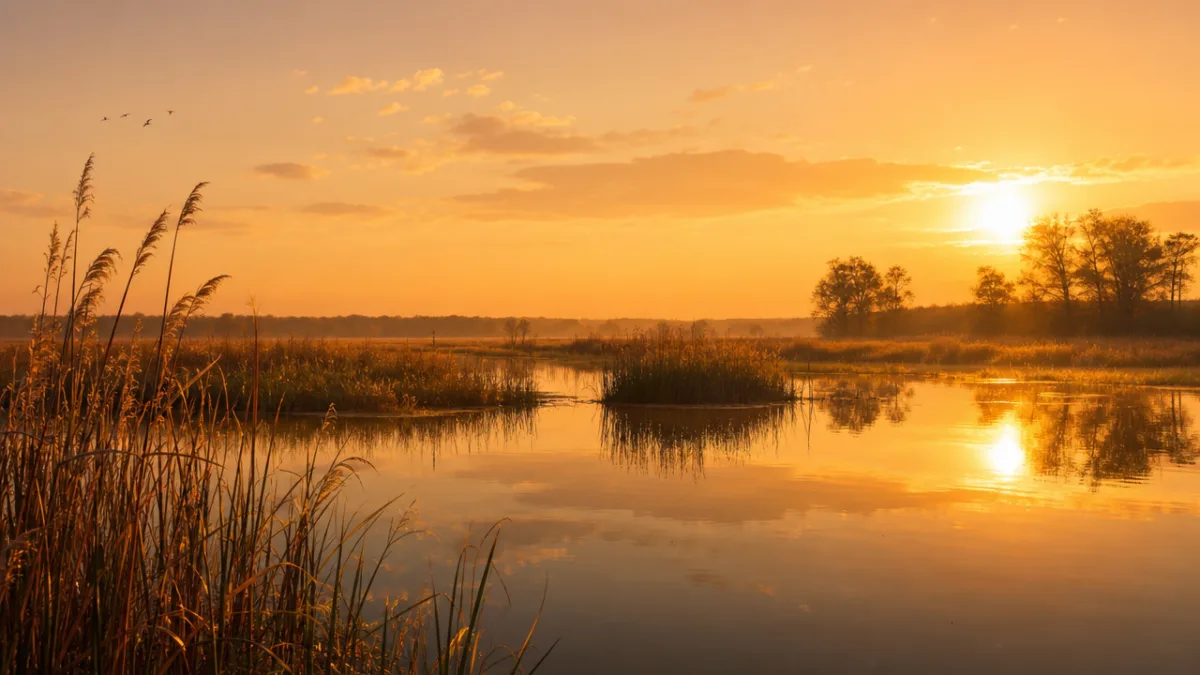
A technically perfect duck floating against a plain background can feel cold and lifeless compared to a simpler painting that places the bird convincingly within a believable environment. Composition is arguably as important as technical skill in wildlife painting, because it is composition that creates mood, narrative, and emotional resonance. The setting you choose for your duck — whether a still, mirror-like pond in early morning, a rushing river, a marshland at dusk, or an open coastal bay in winter — fundamentally shapes the story your painting tells and the emotional response it evokes in the viewer.
The rule of thirds, while not a rigid law, provides a useful starting framework for duck paintings. Placing your main subject slightly off-center, at one of the four intersecting points of a three-by-three grid, creates a naturally balanced yet dynamic composition. The direction the duck is facing also matters enormously — a bird looking into the picture plane draws the viewer’s eye into the composition, while one looking out can create a sense of tension or departure. Negative space, the area around and between subjects, is just as intentional as the subjects themselves and must be handled thoughtfully.
Reflections on water are one of the most rewarding compositional elements in duck painting. When a duck floats on calm water, its reflection creates a visual echo that doubles the color, pattern, and presence of the bird. Painting reflections well requires understanding that they are never exact mirror images — they are always slightly distorted, compressed vertically, and affected by any movement in the water’s surface. The colors in reflections are typically slightly darker and more muted than the object being reflected, and even the smallest ripple will fragment and elongate the reflected image in ways that add dynamism and life to the composition.
- Establish your primary light source before beginning and remain consistent throughout the painting.
- Sketch thumbnail compositions to explore placement and proportion before committing to a full painting.
- Consider the habitat — choose a setting that is ecologically accurate for the species you are painting.
- Use atmospheric perspective to push background elements back in space with cooler, lighter colors.
- Plan your negative space intentionally, treating it as a positive design element rather than empty filler.
- Paint the environment first in many cases, then integrate the duck into the finished setting.
Step-by-Step Techniques for Painting Iridescent Feathers
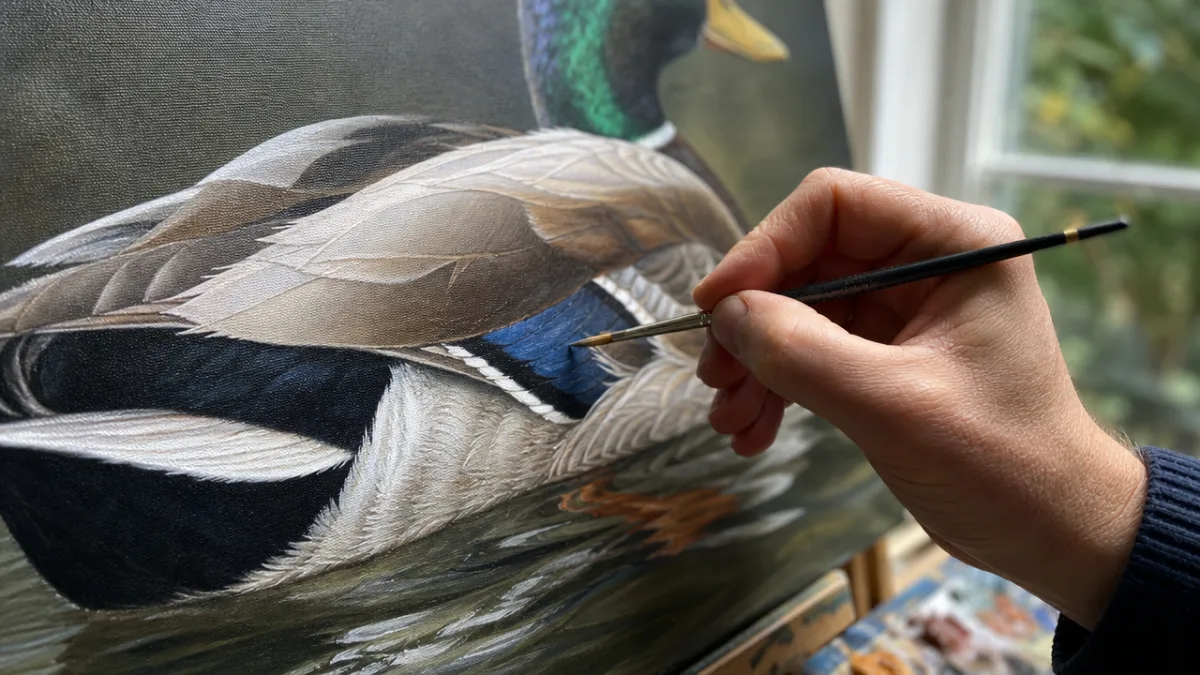
Iridescent plumage is among the most technically challenging elements in all of wildlife painting. The green head of a mallard drake, for example, is not simply green — it shifts from deep blue-green in shadow to brilliant emerald in direct light, and may take on almost teal or turquoise qualities at certain angles. This structural iridescence is caused not by pigment but by the microscopic structure of the feather barbs themselves, which scatter and reflect light in wavelength-specific ways. Understanding this physics, even intuitively, helps painters make more convincing color choices rather than simply mixing a flat, opaque green.
The most effective approach to iridescent feathers typically begins with a dark, neutral underpainting. Establishing the darkest values first gives subsequent layers of color something to push against, creating depth and luminosity. Over this base, transparent glazes of color are built up gradually — warm yellows and greens first, then cooler blues and teals in the lighter areas. Each layer must be completely dry before the next is applied if working in oils or acrylics, and the glazes should be thin enough to remain genuinely transparent. The cumulative effect of four or five glazed layers is dramatically richer than any single mixed color could achieve on its own.
Final highlights are the last element to be added and must be applied with restraint. A small, carefully placed stroke of near-white or pale yellow on the crown of a mallard’s head can suggest the brightest point of light catching the feathers without overpowering the subtler color variations built up in the layers beneath. These highlights should follow the direction of the feather growth and the curve of the underlying form — a highlight that fights the form will flatten the painting rather than enhance it. Stepping back regularly from the work and assessing the overall value structure helps ensure that no single area becomes distractingly bright or dark relative to the whole.
Reference, Study, and Developing Your Own Style
Every accomplished wildlife artist relies heavily on reference material, and there is no shame in this — the alternative, painting from memory alone, almost invariably produces inaccurate, generic results. The best reference combines your own field observations and photographs with museum specimens, published field guides, and the work of established wildlife artists. Spending time observing ducks in the wild — watching how they move, how they hold their wings, how the light strikes them at different times of day — builds a visual vocabulary that no amount of photograph-gazing can fully replace. First-hand observation adds life and authenticity to the work in ways that are hard to quantify but easy to perceive.
Photography is an invaluable tool for the modern duck painter. A good telephoto lens allows you to capture detailed images of birds at rest and in motion, freezing wing positions and lighting conditions that would be impossible to observe and memorize in real time. However, photographs have inherent limitations — they compress values, flatten colors, and can introduce distortions that will produce stiff, photographic-looking paintings if traced or copied too literally. The best approach is to use photographs as one reference among many, combining photographic detail with field sketches, color notes, and anatomical knowledge to create something more alive than any single source provides.
Developing a personal style in duck painting is a gradual process that emerges naturally from sustained practice and genuine engagement with the subject. Some artists gravitate toward tight, hyperrealistic rendering that celebrates technical precision. Others prefer a looser, more impressionistic approach that captures mood and atmosphere over strict accuracy. Both are valid, and both have distinguished practitioners. The key is not to impose a style consciously at the outset but to paint consistently, study your influences thoughtfully, and allow your natural sensibilities and strengths to emerge over time. Style, when genuine, is simply the accumulation of thousands of individual decisions made in honest response to the subject in front of you.
The Cultural and Sporting Heritage of Waterfowl Art
Duck painting occupies a unique cultural position at the intersection of fine art, natural history, and sporting tradition. In the United States, the Federal Duck Stamp program, established in 1934, has been one of the most consequential conservation programs in history — and it has been funded almost entirely through the sale of decorative stamps featuring original duck art selected through an annual juried competition. Since its inception, the program has generated hundreds of millions of dollars for wetland conservation and has elevated waterfowl painting to a nationally recognized art form with its own exhibitions, competitions, and dedicated collector community.
The tradition of decoy carving — creating wooden duck replicas used to lure birds within range of hunters — produced an extraordinary body of folk art that is now collected, studied, and displayed in museums. Master carvers like Lem and Steve Ward of Maryland, whose work spans the early to mid-20th century, are regarded as among the finest sculptors of their era regardless of medium. Their work, which began as purely functional objects, evolved into detailed, hand-painted sculptures of extraordinary beauty that now sell at auction for hundreds of thousands of dollars. The line between craft and fine art, never particularly clear in the world of waterfowl, essentially dissolves when examining their legacy.
Today, waterfowl art exists within a thriving community of artists, collectors, conservationists, and enthusiasts who gather at annual shows, competitions, and exhibitions across North America and Europe. Organizations like Ducks Unlimited actively support wildlife art as both a cultural expression and a conservation fundraising tool, and their print and collectibles programs have brought original duck art into millions of homes. For the artist entering this world, there is a welcoming and passionate community ready to offer mentorship, critique, competition, and camaraderie — a reminder that duck painting, for all its solitary hours at the easel, is ultimately a deeply communal tradition.








What do you think?
It is nice to know your opinion. Leave a comment.