










13 Button Crafts for Adults That Look Surprisingly Elegant
The Unexpected Beauty of Button Crafting
There’s something really satisfying about taking something as simple and everyday as a button and turning it into a piece of art that makes people stop and say, “Wait, did you make that?” Buttons have been around for thousands of years — originally just holding our clothes together — but today they’re honestly one of the most versatile and affordable crafting materials out there. And the variety is staggering. Vintage pearl buttons, chunky resin ones, tiny seed buttons, oversized coat buttons — you could spend a lifetime exploring the possibilities.
A lot of people write off button crafts as a kids’ activity — something you do with construction paper and a jar of paste in second grade. But honestly, that couldn’t be more wrong. When you approach button art with a clear vision, a thoughtful color palette, and some intentional arrangement, the results can genuinely look gallery-worthy. Interior designers and craft artists have caught on to this, embracing buttons as a medium that brings real texture, dimension, and that irreplaceable handmade warmth that no mass-produced décor piece can fake.
Part of what makes button crafting so appealing for adults is how accessible it is. Chances are you already have a jar or tin of stray buttons sitting somewhere in your house right now — maybe inherited from a grandparent, maybe accumulated over years of buying new clothes. Those overlooked little discs are just waiting to become something worth showing off. Whether you’re a seasoned crafter or someone who’s never picked up a glue gun, button crafting meets you where you are and consistently produces results that surprise people with how elegant they look.
Stunning Button Art Frames and Wall Décor
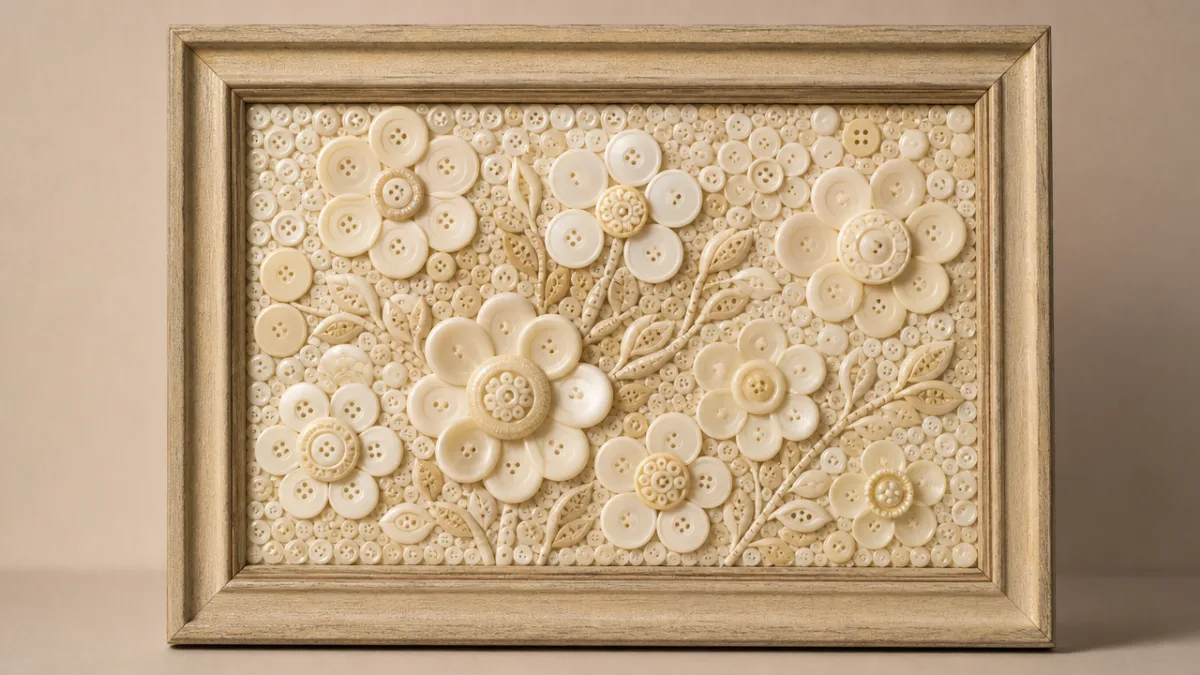
If you want to make a real statement with buttons, framed wall art is one of the best places to start. Take a dark canvas and arrange white and cream buttons across it in a monochromatic pattern — the result has the kind of tonal elegance you’d expect to find in a boutique home goods store, not a craft room. The key to pulling it off is sorting your buttons carefully by size and tone before you touch the glue, then arranging them with intention: concentric circles, geometric shapes, or flowing organic designs all work beautifully.
Button mosaic portraits are another project that consistently surprises people with how achievable — and spectacular — they are. You start by sketching or printing a simple silhouette onto a canvas or wooden board (a tree, an animal, a vase of flowers all work great), then fill the outlined shapes with layers of coordinating buttons. The way those overlapping buttons catch the light gives the finished piece a sculptural, three-dimensional quality that paint or paper just can’t replicate. And the result looks far more complicated than the process actually is.
For a more minimalist approach, try covering a painted wooden letter form with buttons in a single color family — all shades of navy and cobalt, say, or varying tones of blush and rose. These monogram pieces work wonderfully as personalized gifts or as part of a gallery wall, and there’s a quiet, polished elegance to them when they’re hung against a neutral backdrop. They feel personal without being fussy, which is a hard balance to strike.
Jewelry and Wearable Button Creations
Button jewelry might be the most underrated category in this whole craft space, and when it’s done well, the results are genuinely striking. Vintage buttons — especially ones made from real shell, Bakelite, or glass — have an inherent beauty and a bit of history to them that makes them perfect for jewelry. Wire a cluster of mismatched pearl buttons together and hang them from simple silver ear hooks, and you’ve got earrings with real heirloom appeal. The kind of thing someone receives as a gift and actually keeps for years.
Button bracelets and bangles hit a lovely sweet spot between playful and sophisticated. Sewing or wiring a series of matched buttons onto elastic cord or a leather band creates something that reads as carefully curated rather than thrown together. If you lean into a theme — like a collection of 1950s amber glass buttons — the bracelet takes on a thematic coherence that elevates it into something people genuinely ask about when they see it on your wrist. These make exceptional gifts because they feel considered and personal in a way that anything store-bought simply doesn’t.
Statement necklaces using buttons as pendants or component beads are also having a real moment in artisan jewelry circles. A single large vintage button — one of those gorgeous gilded brass military coat buttons, for instance — hung on a velvet ribbon or fine chain makes a pendant with serious, intentional drama. If you want something more elaborate, threading graduated shell buttons onto silk cord produces a piece that could genuinely pass for a designer creation, which is remarkable given how modest the materials actually are.
Home Décor Accents with Refined Button Detailing
Wall art and jewelry are just the beginning. Buttons can completely transform everyday home objects into something you’d actually want to put on display. Imagine a plain pillow cover with a grid of evenly spaced buttons in a contrasting color, or a radiating starburst pattern using buttons in graduating sizes. The tactile quality of a button-embellished pillow changes the whole feel of a room — it’s that subtle handmade quality that makes people reach out and touch things when they walk by.
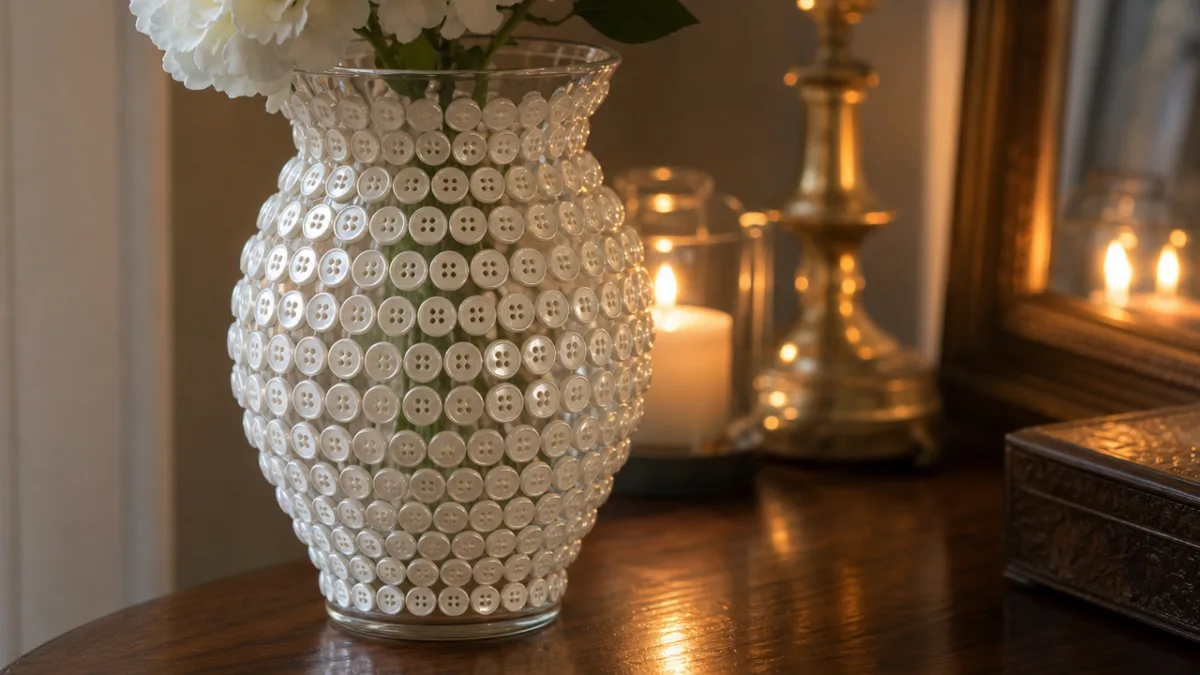
Button-covered vases are another project where the results tend to genuinely surprise people. Take a plain glass cylinder or a simple terracotta pot and cover the exterior in a mosaic of buttons, and you end up with a completely different object than what you started with. The most sophisticated versions commit to a strict color palette — all whites for a clean, Hamptons-style look, or rich jewel tones for something more bohemian. Adhered with strong craft glue or a combination of glue and grout, the finished piece has a weight and permanence that makes it feel substantial and intentional rather than crafty.
Decorative trays, shadow boxes, and small framed mirrors are all great candidates for button embellishment too. A plain wooden tray painted in a deep moody color and edged with a row of carefully chosen vintage buttons becomes a coffee table piece worth styling around. Shadow boxes let you go even more creative — a miniature button bouquet, a tiny button landscape — creating whimsical but elegant curiosities that draw people in for a closer look. The throughline across all of these is restraint: choosing buttons that actually work together rather than just grabbing whatever’s in reach.
Button-wrapped candle holders are one more elegant option that also happens to be wonderfully functional. Wrap the outside of a glass votive or pillar holder with rows of flat, iridescent buttons, and when you light it, the glow filters through and around the buttons in the most beautiful, dappled way. These make incredible centerpieces and genuinely thoughtful gifts — the kind of thing you’d bring to a housewarming and have people immediately ask you about.
Functional Button Crafts That Are Both Useful and Beautiful
Some of the most satisfying button projects are the ones you actually use — where you encounter the craft again and again in daily life rather than just glancing at it on a wall. Button bookmarks are a perfect example. A length of silk ribbon with a carefully chosen button sewn or glued at one end feels like a small luxury every time you reach for your book. Paired with a book as a gift, it’s one of those small handmade touches that people genuinely remember long after more expensive presents have faded from memory.
Button-embellished stationery and journals are another lovely avenue to explore. A small cluster of coordinating buttons glued to the cover of a plain notebook, or a single beautiful button used as a closure on a handmade card or envelope, turns ordinary paper goods into something that feels celebratory. This effect is especially powerful when the buttons themselves carry some history — from a grandmother’s sewing kit, or picked up at an estate sale — because they bring a sense of story to whatever you make with them.
Button magnets might sound simple, but done thoughtfully, they’re genuinely refined. Choose beautiful vintage buttons — a faceted glass one, a carved shell one, a tiny gilded metal one — attach a strong neodymium magnet to the back of each, and you have a set of refrigerator or memo board magnets that are actually lovely to look at. Package them together in a small tin or glass jar and you’ve got a gift that people consistently describe as one of the most charming things anyone has ever made for them. It’s a low bar to clear in theory, but hard to replicate in practice.
Tips for Sourcing and Organizing Your Button Collection
A good button collection is the foundation of everything, and building one is a genuinely enjoyable process. Craft store button cards are fine, but the really interesting finds are elsewhere. Estate sales and antique markets are where you’ll discover genuine shell, glass, metal, and early plastic buttons with the kind of craftsmanship that modern production rarely matches. Thrift stores are another great source — buying an entire secondhand shirt or jacket just for its buttons is a completely reasonable trade in the crafter’s economy, and you usually come out ahead.
Online marketplaces have made it easier than ever to source specific buttons in the quantities you actually need. Etsy sellers who specialize in vintage buttons often sort their stock by color, material, or era, so if you need fifty matching cobalt glass buttons for a vase project, you can usually find them. Joining online communities or local crafting groups focused on button collecting also opens up opportunities for trading and swapping that feel more personal and a lot more fun than just adding things to a cart.
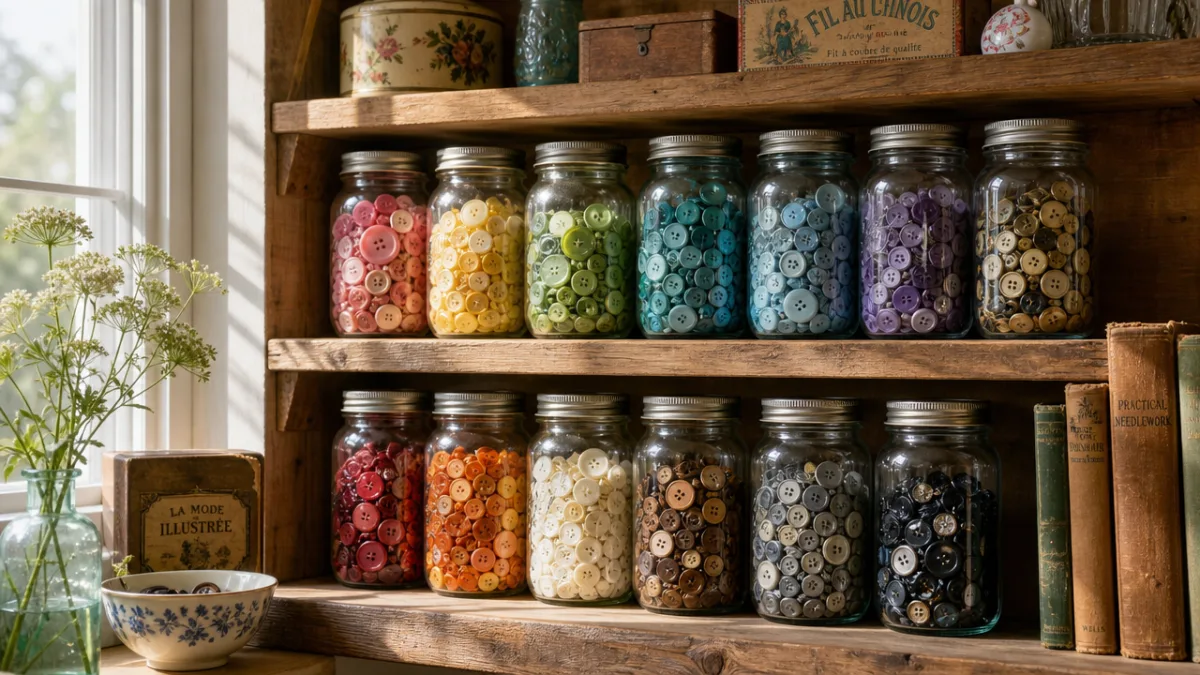
Organizing your collection might sound like a chore, but it genuinely transforms how much you enjoy working with buttons. Sorting by color into glass jars or compartmentalized boxes means you can see exactly what you have at a glance and pull a palette together quickly when an idea strikes. Many button crafters find the sorting process itself to be meditative — a tactile, visually satisfying ritual that functions as both preparation and creative warm-up. And keeping your collection displayed in glass vessels on a shelf rather than buried in a box means the buttons are part of your home décor even before they become something new.
- Sort buttons by color family first, then by size within each color group for easy access during projects.
- Store vintage and especially valuable buttons separately in individual compartments to prevent scratching or damage.
- Keep a small selection of neutral buttons — whites, creams, grays, and blacks — in a dedicated easily accessible container, as these are the workhorses of most button craft projects.
- Label storage containers with the button’s approximate era, material, or source to maintain provenance for pieces where that history adds meaning.
- Photograph your collection periodically, especially after significant new acquisitions, so you can reference what you have when planning projects away from home.
Getting Started: A Beginner’s Path into Elegant Button Crafting
If you’re new to all of this and not sure where to begin, here’s the most useful advice: start small. Pick a project you can finish in one sitting. The feeling of holding a completed object in your hands — something you made — is the most powerful motivator there is for wanting to make the next thing. A set of three button magnets, a single bookmark, or a small framed arrangement the size of a postcard are all ideal starting points. They let you experiment with arrangement, color, and adhesive without any overwhelming pressure to produce something perfect.
A few key tools will make the whole process smoother and your results noticeably better. A quality glue gun with fine-tip sticks gives you real precision when placing individual buttons. Tweezers let you position tiny buttons exactly where you want them without nudging everything else out of place. If you’re interested in jewelry, a basic set of round-nose pliers, wire cutters, and a couple of gauges of craft wire opens up a whole new world of possibility. None of this is expensive, but having the right tools removes the frustration that comes from trying to work without them.
Most importantly, give yourself permission to experiment and to not be great at it right away. Button crafting, like any creative practice, develops through repetition. Your tenth arrangement will be more confident than your first, and by your thirtieth you’ll have developed a genuine aesthetic sensibility — a personal style — that’s entirely your own. The elegance you see in the most beautiful button craft work isn’t the product of expensive materials or unusual talent. It comes from patience, attention, and the willingness to keep making things, keep noticing what works, and keep letting your creative instincts grow sharper with every project.








What do you think?
It is nice to know your opinion. Leave a comment.