










Pipe Cleaner Jellyfish Tutorial: A Complete Guide to Making Adorable Ocean Creatures
Introduction to Pipe Cleaner Jellyfish Crafting
Pipe cleaner jellyfish are one of the most delightful and accessible crafts you can make at home, whether you are a seasoned crafter or just getting started with simple DIY projects. These whimsical little creatures capture the graceful, flowing nature of real jellyfish while being incredibly easy to construct from inexpensive materials available at any craft store. Their charm lies in the way they can be customized with an endless variety of colors, sizes, and embellishments, making each one truly unique and personal.
The beauty of this craft project is that it requires almost no prior crafting experience and can be completed in under thirty minutes. Children and adults alike find tremendous satisfaction in watching a handful of colorful pipe cleaners transform into a three-dimensional, wiggly ocean creature that looks impressive enough to display or give as a gift. Teachers, parents, and party planners have long embraced this project as a go-to activity because it is mess-free, budget-friendly, and endlessly entertaining for groups of all ages.
Beyond their visual appeal, pipe cleaner jellyfish serve a wonderful creative purpose. They can be hung from ceilings to create an underwater-themed room decoration, used as gift toppers, incorporated into school science projects about marine life, or simply kept as charming desk ornaments. Once you master the basic technique outlined in this tutorial, you will find yourself making them in bulk and dreaming up new color combinations with every batch. Let this guide walk you through everything you need to know to create your very own pipe cleaner jellyfish masterpiece.
Materials You Will Need
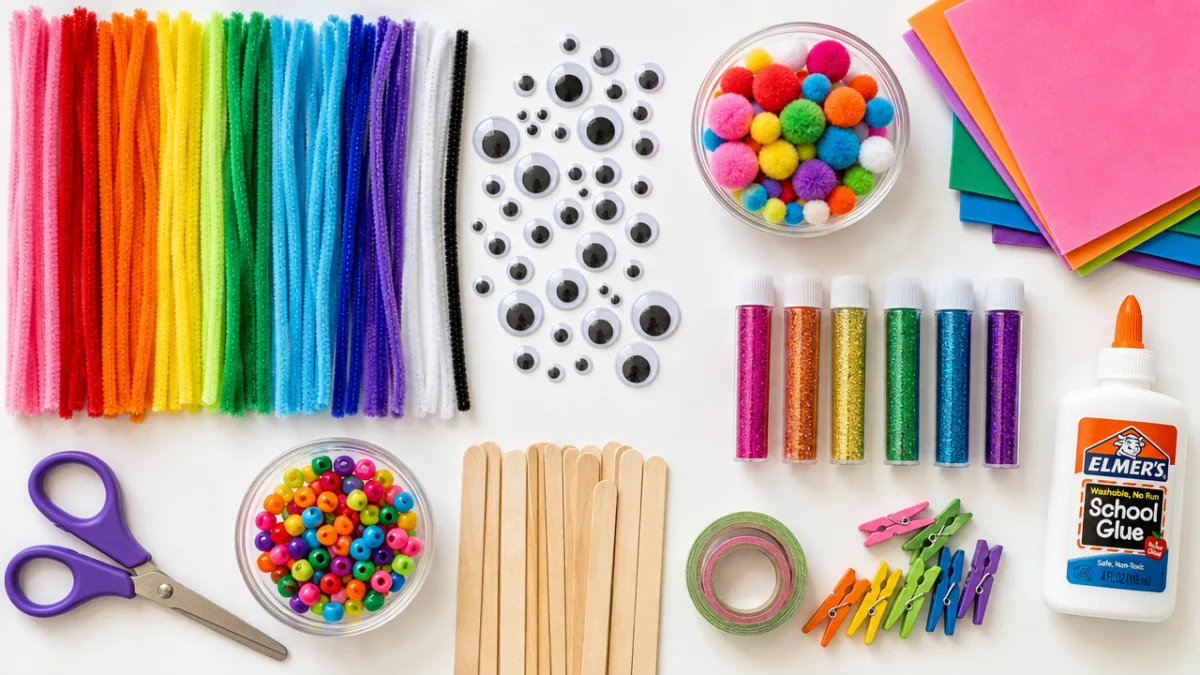
Before diving into the construction process, gathering all of your materials ahead of time will make the entire crafting experience smoother and more enjoyable. The good news is that pipe cleaner jellyfish require very few supplies, and most of them are either already in your craft drawer or can be purchased for just a few dollars at any arts and crafts retailer. Having everything laid out on a clean, flat surface before you begin helps you stay organized and keeps the creative momentum going once you start.
The star of this project is, of course, the pipe cleaner itself, also known as a chenille stem. These fuzzy, flexible wires come in an enormous range of colors, including metallics, neons, pastels, and classic rainbow hues. For a single jellyfish, you will typically need between eight and twelve pipe cleaners depending on how full and fluffy you want the finished piece to look. Selecting a cohesive color palette or going wild with a mix of contrasting shades will both produce beautiful results, so trust your instincts and have fun with the color selection process.
In addition to the pipe cleaners themselves, a few optional but highly recommended embellishments can elevate your jellyfish from simple to spectacular. Googly eyes add instant personality and a playful touch that both children and adults adore. Iridescent or holographic pipe cleaners mixed in with standard ones give the creature a magical, shimmery quality that mimics the bioluminescent glow of real deep-sea jellyfish. You may also want to have scissors on hand for trimming any uneven tentacles, as well as thin ribbon or monofilament fishing line if you plan to hang your finished jellyfish as a mobile or ceiling decoration.
- 8 to 12 pipe cleaners in your chosen colors
- 2 googly eyes in a size appropriate to your jellyfish
- Craft glue or a low-temperature glue gun for attaching eyes
- Scissors for trimming tentacles to even lengths
- Thin ribbon, yarn, or fishing line for hanging
- Optional: iridescent or metallic pipe cleaners for shimmer effects
- Optional: beads or sequins threaded onto tentacles for extra sparkle
Step-by-Step Instructions for Building the Bell
The bell, or dome-shaped cap of the jellyfish, is the most structurally important part of the entire craft and the foundation upon which everything else is built. To begin forming the bell, take one pipe cleaner and bend it into a circle, twisting the ends together securely so the loop holds its shape without springing apart. This initial loop should be roughly two to three inches in diameter depending on how large you want your finished jellyfish to be. A larger loop produces a fluffier, more impressive bell, while a smaller loop creates a daintier, more delicate-looking creature.
Once you have your foundational loop, take a second pipe cleaner and thread it through the first loop at its midpoint, then bend both halves downward and twist them around the base of the original circle. Repeat this process with four to six more pipe cleaners, spacing them evenly around the circle as you go, always bending the new pipe cleaner in half over the ring and securing it with a twist at the base. As you add more pipe cleaners, you will start to see the dome shape of the bell begin to emerge naturally as the fuzzy stems fan outward and then curve downward.
After securing all of your pipe cleaners around the base ring, gently cup your hand around the bundle and begin shaping the bell by pushing the free ends upward and inward to create a rounded, dome-like top. Work slowly and evenly, adjusting a few stems at a time and rotating the piece as you go to ensure the shape is symmetrical from all angles. If any individual pipe cleaners seem unruly or out of place, simply tuck them beneath a neighboring stem or give them a gentle bend to coax them into the overall rounded silhouette. The bell does not need to be perfectly smooth since the fuzzy texture of the pipe cleaners gives it a wonderfully organic, natural look.
Creating the Tentacles
The tentacles are what give a pipe cleaner jellyfish its iconic, flowing character and are arguably the most fun part of the entire construction process. To create the tentacles, take the remaining downward-hanging ends of the pipe cleaners you secured to the bell and gently pull them downward and apart so they hang freely beneath the dome. At this stage, they will simply be straight stems, but with a few simple techniques you can transform them into elegantly curling, lifelike appendages that truly capture the graceful movement of a real jellyfish swimming through the ocean.
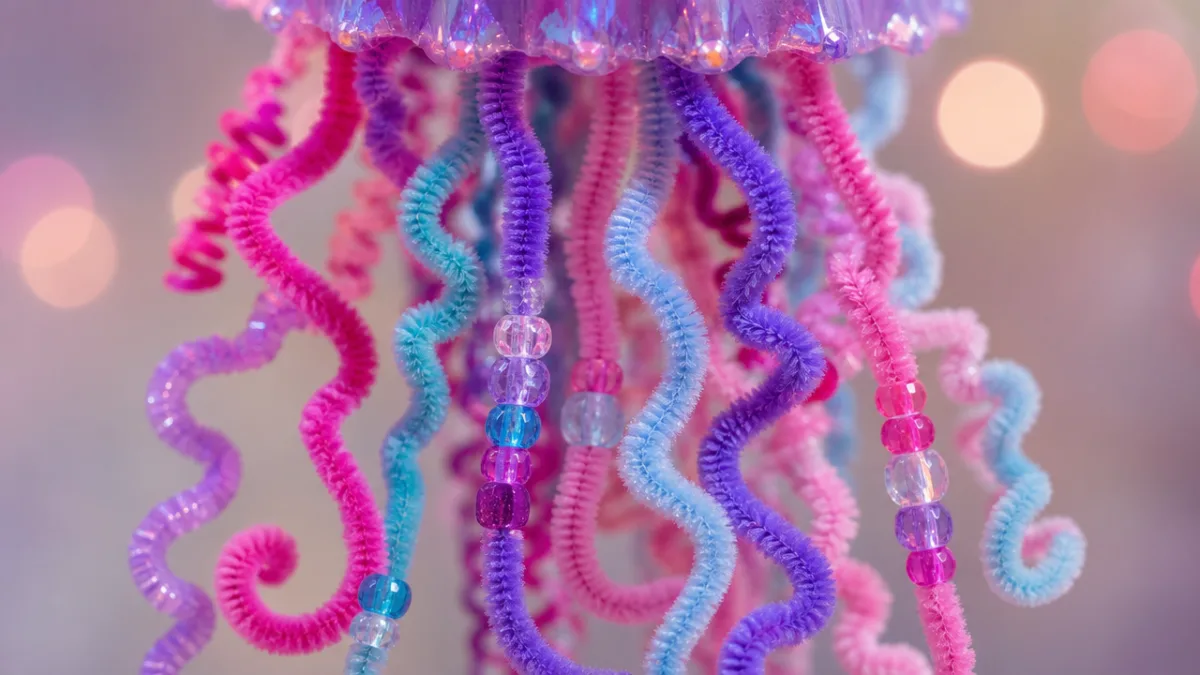
To create the classic curling tentacle effect, wrap each individual stem tightly around a pencil, a thin dowel rod, or even your finger, and then gently slide it off to reveal a beautifully spiraled coil. For a looser, more natural wave, wrap the stem loosely rather than tightly, which produces gentle undulating curves instead of tight spirals. Alternating between tightly coiled and loosely waved tentacles on the same jellyfish creates a wonderfully dynamic and textured look that adds visual interest from every angle. You can also mix in a few tentacles left completely straight to simulate the longer, trailing stinging tendrils that many real jellyfish species possess.
If you purchased beads or sequins to add to the tentacles, now is the perfect time to incorporate them. Simply slide small beads onto each stem before or after curling, spacing them at irregular intervals for a natural effect, or clustering them near the tips for an elegant finishing touch. Metallic or pearl beads work especially well and catch the light beautifully when the jellyfish is hung near a window or light source. Once you are satisfied with the shape and embellishment of each tentacle, take your scissors and trim any that are significantly longer than the others to create a more uniform, polished finished product, though leaving a few slightly longer than the rest adds to the organic, asymmetrical charm of the piece.
- Separate the downward-hanging stems evenly around the underside of the bell.
- Wrap each stem around a pencil or finger to create spiral curls.
- Alternate between tight coils, loose waves, and straight tentacles for variety.
- Thread decorative beads onto tentacles if desired, spacing them naturally.
- Trim any excessively long tentacles with scissors for a balanced look.
- Gently tug and adjust all tentacles until you are satisfied with the overall drape.
Adding Details and Finishing Touches
With the bell shaped and the tentacles curled to your satisfaction, it is time to bring your jellyfish to life by adding the finishing details that transform it from a craft project into a genuine work of art. The most impactful detail you can add is a pair of googly eyes, which instantly give the creature personality and expression. Apply a small dot of craft glue or a tiny amount of hot glue to the back of each eye, then press them firmly onto the front of the bell in a position that feels right to you. Placing them slightly lower on the dome and closer together creates a wide-eyed, innocent look, while positioning them higher and wider apart gives a more alert, curious expression.
Beyond the eyes, there are numerous other ways to personalize and embellish your pipe cleaner jellyfish to make it truly your own. Cutting small pieces of iridescent cellophane and tucking them into the upper layers of the bell creates a gorgeous translucent glow effect reminiscent of actual jellyfish anatomy. Twisting a single metallic pipe cleaner into a small spiral and attaching it to the very top of the bell creates an elegant little swirl that looks both intentional and whimsical. Some crafters even use fabric paint or nail polish to add tiny dots, stripes, or swirl patterns to the surface of the bell, giving their jellyfish a painted, illustrated quality that makes each one even more distinctive.
For a group craft session or classroom activity, encouraging participants to give their jellyfish a name and a backstory is a wonderful way to extend the creative experience beyond the physical construction of the piece. Children especially love deciding whether their jellyfish lives in the Arctic Ocean or the warm Caribbean Sea, what it likes to eat, and who its underwater friends are. This imaginative extension turns a simple craft project into a rich storytelling and play opportunity that deepens engagement and makes the finished creature even more precious to its creator. Display the finished jellyfish proudly alongside its named label for an adorable classroom ocean exhibit.
Display Ideas and Creative Variations
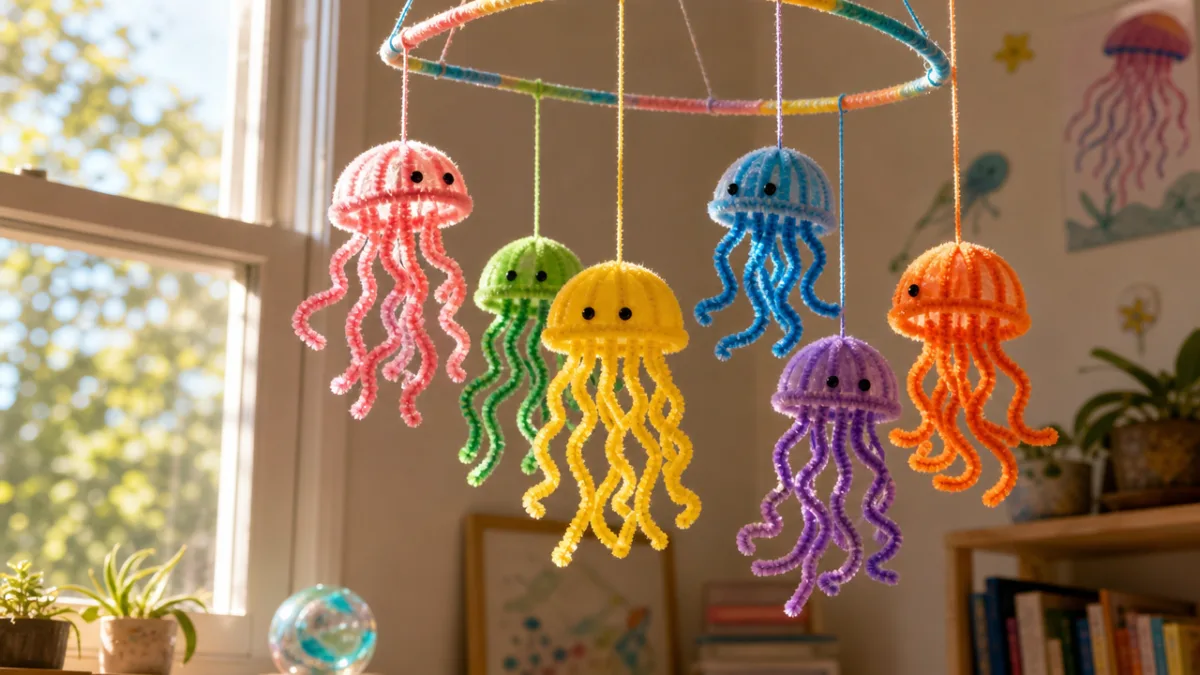
One of the most enchanting ways to display a collection of pipe cleaner jellyfish is to create a hanging mobile that mimics a real jellyfish bloom drifting through open water. To assemble a mobile, cut varying lengths of monofilament fishing line or thin ribbon and tie one end to the top of each finished jellyfish bell. Then tie the other ends at different heights along a length of driftwood, a wooden dowel, or even a wire coat hanger that has been bent into a horizontal bar. When hung near an open window or air vent where there is a gentle airflow, the jellyfish will sway and rotate mesmerizingly, their tentacles drifting and curling in a way that is genuinely hypnotic to watch.
For themed parties, birthday celebrations, or classroom events with an ocean or under-the-sea theme, pipe cleaner jellyfish make perfect decorations and party favors simultaneously. A group of children can each make their own during a craft station activity and then take their creation home as a personalized memento of the event. Hanging dozens of completed jellyfish at varying heights from a party canopy or ceiling creates a truly spectacular immersive effect that transforms any space into a magical underwater environment. Pairing the jellyfish display with blue and green streamers, paper fish, and ocean-colored tablecloths amplifies the visual impact exponentially.
Beyond the standard jellyfish form, the fundamental technique of building a dome bell and adding trailing tentacles can be adapted to create a whole menagerie of related sea creatures. By adjusting the shape of the bell and the arrangement of the tentacles, you can create sea anemones, octopuses, and even abstract coral formations using the same basic pipe cleaner methods. Mini jellyfish made from half-length pipe cleaners can be clustered into a glass bowl or vase filled with blue cellophane shreds to create a stunning tabletop centerpiece that looks far more elaborate and expensive than it actually was to make. The creative possibilities genuinely are limitless once you have the core technique down.
Tips for Success and Common Troubleshooting
Even the simplest craft projects come with their own set of small challenges, and pipe cleaner jellyfish are no exception. One of the most common issues first-time makers encounter is a bell that refuses to hold its rounded dome shape and instead collapses flat or splays outward awkwardly. This typically happens when too few pipe cleaners are used or when the foundational loop is too large relative to the number of stems attached to it. The solution is straightforward: add two or three more pipe cleaners to the bell, spacing them evenly around the loop, which will provide additional structural support and allow the dome to hold its curvature more reliably.
Another frequent challenge involves tentacles that curl unevenly or spring back to a straight position after being coiled around a pencil. Pipe cleaners with a higher wire gauge tend to hold their shape much better than thinner, floppier varieties, so whenever possible it is worth spending slightly more on better-quality chenille stems from a reputable craft supplier rather than the very cheapest option available. If your tentacles do spring back, try coiling them more tightly and holding the coil in place for a full thirty seconds before releasing. You can also lightly pinch and crimp the stem at intervals along its length before coiling, which creates memory in the wire that helps the curl hold more effectively.
For crafters working with young children, there are a few simple adaptations that make the project safer and more manageable for small hands. Pre-forming the bell structure yourself before the activity begins lets children focus on the more accessible and rewarding steps of curling tentacles and adding googly eyes, which are the parts they will enjoy most and find most achievable. Always use low-temperature glue guns rather than standard ones when working with children, or substitute craft glue that requires no heat whatsoever. Keeping spare pipe cleaners on hand is also wise since children often want to add more tentacles than the original design calls for, and having extra materials available prevents frustration and keeps the creative energy positive throughout the activity.
Why Pipe Cleaner Crafts Remain Timeless
Pipe cleaners, or chenille stems, have been a staple of craft rooms and art classrooms for well over a century, and their enduring popularity speaks to something genuinely special about this humble material. Unlike many modern crafting supplies that require specialized tools, technical knowledge, or significant financial investment, pipe cleaners are universally accessible, endlessly forgiving, and require nothing more than your own two hands to manipulate into virtually any shape imaginable. They occupy a rare sweet spot in the crafting world where the barrier to entry is extremely low but the ceiling of what can be achieved with skill and creativity is remarkably high.
The sensory experience of working with pipe cleaners also contributes significantly to their appeal across all age groups. The soft, fuzzy texture of the chenille fibers is deeply satisfying to touch and manipulate, and the gentle resistance of the wire interior as it bends and holds a new shape provides a pleasing tactile feedback that more passive craft activities simply cannot replicate. Occupational therapists frequently incorporate pipe cleaner activities into fine motor skill development programs for children and adults alike, recognizing that the pinching, twisting, coiling, and shaping motions required to work with these materials provide excellent exercise for the small muscles of the hands and fingers in a way that feels like play rather than therapy.
In an era increasingly dominated by digital entertainment and screen-based hobbies, the quiet, focused pleasure of working with physical materials to create a tangible object you can hold in your hands feels more valuable than ever. Pipe cleaner jellyfish represent everything that is best about traditional handcraft: they are inexpensive to make, impossible to replicate exactly, deeply satisfying to complete, and genuinely beautiful to display. Whether you are making one on a rainy afternoon for the pure joy of it or leading a classroom of eager young crafters through their first ocean-themed art project, this simple tutorial opens the door to an activity that has brought creative joy to generations of makers and will continue to do so for generations to come.








What do you think?
It is nice to know your opinion. Leave a comment.