










Retazos del Paisaje: The Art of Landscape Collage and the Vision of Ane Gomez
The Language of Fragmentation: What Landscape Collage Means
Landscape collage is one of the most evocative and intellectually rich forms of contemporary visual art. Unlike traditional landscape painting, which seeks to render a unified, coherent view of the natural world, collage deliberately breaks that unity apart — gathering fragments, textures, and torn edges to reassemble them into something entirely new. The result is not a copy of nature but a meditation on how we perceive and remember it. Each piece carries within it the ghost of its origin, whether that is a printed photograph, a scrap of colored paper, or a weathered map, and that history becomes part of the meaning.
The word “retazos” in Spanish means scraps or remnants — pieces left over from something larger. When Ane Gomez chose this title for her Saatchi Art collage series, she was making a precise artistic declaration. The landscape is not shown to us whole and intact. Instead, we are given what remains after the act of looking: impressions, fragments, partial memories. This reflects something deeply true about the human experience of being in nature. We do not absorb a mountain or a coastline in one clean visual gulp. We experience it in moments, in shifting light, in the peripheral glimpse before we turn away.
Collage as a medium has a long and storied history, from the cubist experiments of Picasso and Braque to the political photomontages of Hannah Höch and the lyrical abstractions of Romare Bearden. But landscape collage occupies a particularly tender corner of that tradition. It combines the grandeur of the natural sublime with the intimacy of handmade assemblage. When an artist cuts and pastes fragments of sky, earth, and vegetation into a new configuration, they are performing an act of creative geology — layering strata of meaning just as time layers rock.
Ane Gomez and Her Artistic Identity
Ane Gomez is a collage artist whose work has found an appreciative and growing audience on platforms like Saatchi Art, one of the world’s leading online galleries for contemporary art. Her series “Retazos del Paisaje” — Scraps of the Landscape — demonstrates a refined and distinctive visual sensibility. Her work is characterized by an unusual balance between restraint and abundance: she does not overwhelm the viewer with chaotic layering, but neither does she leave the composition so spare that it loses energy. The result is a series of images that feel both carefully considered and intuitively assembled.
What sets Gomez apart from many collage artists working today is her evident relationship with the landscapes she depicts. Her work does not feel like a secondhand engagement with nature derived purely from stock imagery. There is an emotional directness in the way she selects her materials and arranges her forms. The torn edges feel honest rather than decorative. The color relationships — earthy ochres alongside cool blues, deep forest greens against pale parchment tones — speak of a genuine attentiveness to the chromatic life of the natural world at different hours and seasons.
Artists who exhibit on Saatchi Art represent an extraordinarily wide range of styles, media, and geographic backgrounds. Gomez stands out within that breadth as someone committed to the slow, tactile practice of analog collage at a time when many artists have migrated toward digital tools. There is a philosophical position implied by this commitment: that the physical act of cutting, tearing, and gluing carries meaning in itself, and that the material resistance of paper and adhesive is part of the artistic conversation rather than an obstacle to it.
Materials and Methods: The Craft Behind the Work
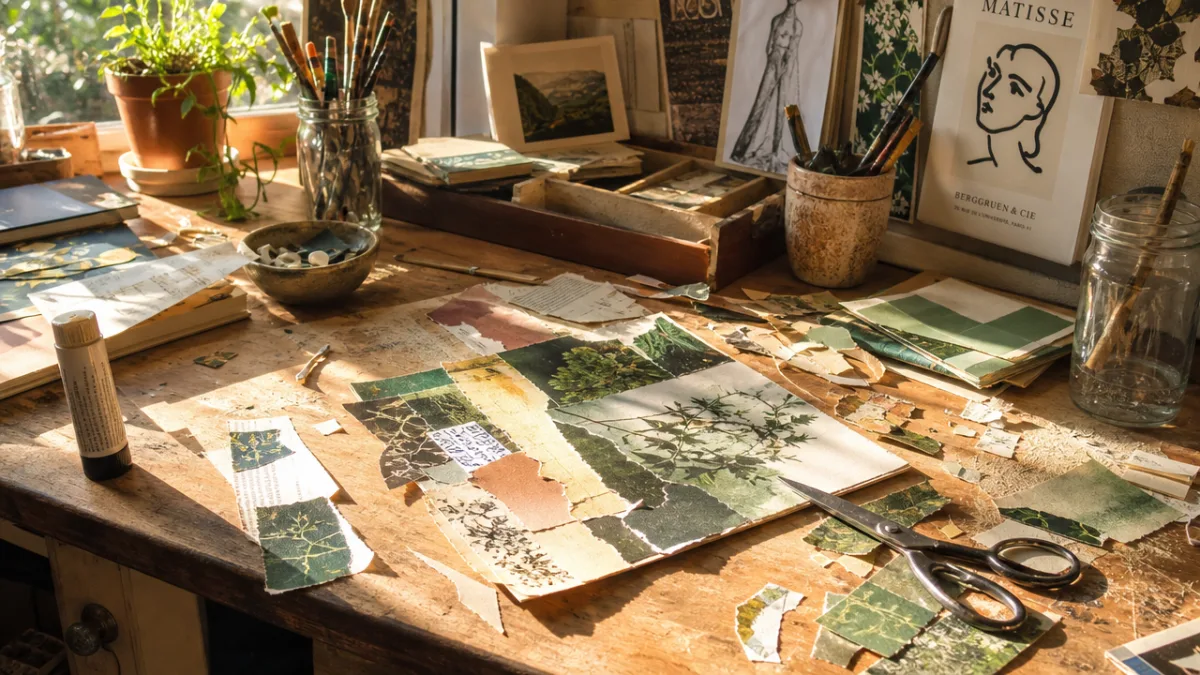
The creation of a landscape collage like those in the “Retazos del Paisaje” series begins long before any cutting or gluing takes place. It begins with a process of collection — the slow accumulation of papers, textures, and printed images that will eventually be pressed into service. Collage artists are by nature gatherers and archivists. Old magazines, discarded books, handmade papers from craft suppliers, painted sheets prepared in the studio, found ephemera from travel and daily life — all of these become potential raw material. The studio of a working collage artist is typically a wonderfully organized kind of controlled chaos, with papers sorted by color, tone, and texture rather than by subject matter.
Once the materials are assembled, the process of composition begins. For landscape collage in particular, the challenge is one of translation: how do you render the depth and vastness of an outdoor space on a flat surface using only fragments? Artists typically address this through careful management of tonal value — placing darker, more saturated tones in the foreground and lighter, cooler tones in the distance to create a sense of atmospheric recession. They also exploit the natural behavior of torn paper edges, which create soft, irregular lines that can evoke the indistinct boundary between a hillside and the sky more convincingly than any precisely cut contour.
The adhesives and supports used in collage work also shape the final outcome in significant ways. Many artists work on heavyweight watercolor paper or stretched canvas, using PVA glue or gel mediums that can be layered and that dry to a flexible finish. Some incorporate additional painting or drawing with pencil, ink, or acrylic to bridge the transitions between collaged elements. The final surface of a mature collage often tells the story of its own making — wrinkled edges where paper was coaxed into place, slight variations in the reflectivity of the glue, ghost impressions from pages that were torn away.
The technical vocabulary of collage is worth understanding because it helps the viewer engage more deeply with the finished work. Key techniques used by landscape collage artists include:
- Decoupage layering — applying multiple transparent or semi-transparent layers of paper to create depth and luminosity within the picture plane.
- Torn-edge gradation — using the soft, fibrous edge of torn paper to create smooth tonal transitions between landscape elements such as sky, water, and earth.
- Collage drawing — adding gestural marks in pencil or ink on top of the assembled papers to reinforce form, add texture, or create linear detail that the paper alone cannot provide.
- Impasto collage — embedding collage materials into thick layers of gel medium or modeling paste to create a genuinely three-dimensional surface that interacts dramatically with light.
- Negative space use — leaving areas of the ground support visible as an active compositional element rather than covering every inch of the surface.
The Landscape as Memory and Feeling
There is a long philosophical tradition of treating the landscape not simply as an external reality to be recorded but as a mirror of inner life. The Romantic painters of the eighteenth and nineteenth centuries — Friedrich, Turner, Constable — understood that what we see when we look at a horizon or a storm-lit valley is inseparable from what we feel. The landscape does not exist independently of the mind that perceives it. This insight is not merely poetic; it is supported by contemporary neuroscience and environmental psychology, which have shown that our perceptual experience of space is deeply shaped by memory, emotion, and expectation.
Collage is perhaps the perfect medium for expressing this truth, because it is inherently a medium of memory. The materials that make up a collage have their own prior lives — they were printed for other purposes, torn from other contexts, colored by other hands. When they are reassembled into a landscape image, they bring those histories with them invisibly. The viewer may not know that a particular blue fragment was once the sky in a travel magazine photograph, or that a strip of textured brown paper was handmade by a craftsperson in a specific region, but those origins are present nonetheless, like the genetic memory encoded in living cells. The collage landscape is always, at least in part, a landscape of layered time.
Ane Gomez’s title “Retazos del Paisaje” speaks directly to this dimension of the work. A retazo — a scrap or remnant — is by definition something incomplete, something that once belonged to a larger whole. By building landscape images from such materials, Gomez invites the viewer to consider their own experience of landscape as similarly fragmentary and reconstructed. We do not remember a forest walk as a continuous film but as a series of sensory fragments: the particular quality of green light through leaves, the sound of water before we saw it, the surprising softness of moss underfoot. Collage externalizes this internal structure of experience.
Saatchi Art and the Contemporary Art Market for Collage
Saatchi Art occupies a significant position in the contemporary art market, having created a genuinely accessible platform for artists who might otherwise struggle to reach an international audience. Founded by the Saatchi family with a mission to democratize art collecting, the platform now hosts the work of thousands of artists from around the world, spanning every conceivable medium and style. For artists working in less commercially dominant forms like collage, Saatchi Art has been particularly important, providing visibility and sales opportunities that traditional gallery representation rarely offers to emerging and mid-career practitioners.
The market for original collage work has grown considerably in the past decade, driven in part by a broader cultural shift toward appreciating craft, texture, and the handmade in an era of overwhelming digital saturation. Collectors who spend their professional lives staring at screens have shown increasing appetite for works with obvious physical presence — works that bear the traces of a human hand, that have weight and texture and a surface that rewards close examination. Collage satisfies this appetite particularly well. A well-executed landscape collage has a richness of surface detail that reproduces poorly and that rewards the kind of slow, attentive looking that digital images tend to discourage.
Pricing for original collage work on platforms like Saatchi Art varies enormously depending on the artist’s reputation, the scale of the work, and the complexity of the materials involved. Emerging artists may price works in the range of a few hundred dollars, while established names command several thousand. What the platform does particularly well is provide context for pricing by showing the artist’s full body of work, their exhibition history, and reviews from previous collectors. This transparency helps build the trust that is essential when asking someone to invest in an original artwork sight unseen.
For artists considering whether to list their work on platforms like Saatchi Art, there are several factors worth weighing:
- International reach — the platform’s collector base spans dozens of countries, giving artists access to buyers who would never encounter their work in a local or regional gallery context.
- Portfolio presentation — Saatchi Art’s listing format allows artists to present high-quality images, written statements, and biographical information in a professional format that rivals traditional gallery presentation.
- Commission structure — as with any gallery, Saatchi Art takes a percentage of sales, and artists should factor this into their pricing strategy from the outset.
- Community and discovery — the platform’s editorial features, curated collections, and social sharing tools create genuine discovery pathways that can significantly expand an artist’s audience.
How to Look at — and Live With — Landscape Collage
Buying and living with original art is one of the most rewarding investments a person can make in their daily environment, and landscape collage offers particular advantages as a form of domestic or workplace art. Unlike figurative art that places a specific human presence in your field of vision, landscape imagery creates a sense of expansive space — a kind of visual breathing room that can be deeply calming in busy environments. The fragmentary, layered quality of collage adds a further dimension of interest, because the work reveals new details to the attentive eye over time. What appears at first as a simple arrangement of color and texture gradually resolves into a rich accumulation of marks, edges, and material choices.
When considering how to display landscape collage, lighting deserves particular attention. Unlike oil paintings, which often benefit from raking directional light that emphasizes the texture of brushwork, collage surfaces can be disrupted by light that is too harsh or too directional, creating distracting glare or shadows across the surface elements. Soft, even illumination — whether natural or artificial — typically serves collage work best, allowing the eye to move freely across the surface without being anchored by a single bright spot. If the work is glazed behind glass, care should be taken to use anti-reflective glass, which eliminates the mirror-like interference that standard glazing can create.
The emotional and psychological benefits of living with landscape art have been explored extensively by researchers in the field of environmental aesthetics. Studies have consistently shown that exposure to natural imagery — even mediated through art — can reduce cortisol levels, lower blood pressure, and improve reported feelings of wellbeing. Landscape collage adds an additional layer to this effect through its material warmth. The presence of paper, textile, and organic textures in a domestic environment creates a tactile visual field that is qualitatively different from the cold smoothness of a digital screen or the formal distance of a large canvas painting. It invites proximity and intimacy.
Caring for original collage work requires some specific attention. Collage is generally more sensitive to environmental conditions than traditional media because it incorporates a wider variety of materials, each with its own response to humidity, temperature, and light exposure. Recommended care practices include:
- Keeping the work away from direct sunlight and strong artificial lighting, which can cause fading and discoloration in paper-based materials over time.
- Maintaining stable humidity levels in the room where the work is displayed, since dramatic fluctuations can cause paper materials to expand, contract, and eventually delaminate.
- Having the work professionally framed with archival-quality materials, including acid-free matting and backing boards that will not degrade and transfer harmful compounds to the artwork.
- Dusting the surface gently with a soft brush rather than a cloth, which can catch on raised surface elements and cause damage.

The Wider Tradition: Landscape Collage in Contemporary Art
Ane Gomez’s “Retazos del Paisaje” exists within a rich and growing conversation in contemporary art about landscape, ecology, and the human relationship to the natural world. Across the globe, artists working in collage, assemblage, and mixed media are turning to landscape imagery as a way of processing urgent questions about climate, belonging, and the boundaries between the human and the non-human. The choice of collage as a medium for this inquiry is not incidental. By making images from fragments and remnants, these artists are formally enacting the condition of a world in which landscapes are themselves fragmentary — threatened, altered, and memorialized even as they continue to exist.
Contemporary landscape collage artists working in a broadly similar spirit to Gomez include figures like Teis Albers, whose work uses vintage natural history prints to construct eerily beautiful ecological assemblages, and Klari Reis, who has created installation-scale works that explore the surfaces and textures of the natural world through accumulation and repetition. Further afield, artists in Japan have long worked with paper collage techniques derived from the traditional practice of chigiri-e, in which torn washi paper is layered to create images of extraordinary delicacy and tonal complexity. These traditions and contemporary practices are not separate streams but part of a continuous river of artistic inquiry into what it means to represent and respond to the natural world.
What all of these practitioners share, and what Gomez demonstrates with particular clarity in “Retazos del Paisaje,” is a commitment to the idea that art about landscape is never merely descriptive. It is always interpretive, always emotional, always inflected by the specific sensibility and cultural position of the artist. A Spanish artist making collages from landscape fragments brings to that work a visual culture shaped by the particular light of the Iberian peninsula, by the ochres and terracottas of its built environment, by the cool blues of its northern coastlines and the burning yellows of its southern plateaus. These are not generic landscapes. They are specific, located, personal — and that specificity is precisely what makes them resonant for viewers far beyond their geographic origin.
As the art world continues to reckon with questions of ecological responsibility and the representation of a changing natural world, the fragmented, material, handmade quality of collage offers a mode of engagement that is both politically and aesthetically meaningful. It refuses the fantasy of a pristine, complete, and unchanging nature. It embraces instead the reality of a landscape that is always partial, always in process, always made of remnants and possibilities. In this sense, “Retazos del Paisaje” is not only a beautiful series of artworks — it is a lucid and timely artistic statement about how we see, remember, and cherish the world we inhabit.








What do you think?
It is nice to know your opinion. Leave a comment.