










Jaipur Stencil: The Art of Indian Inlay Furniture and Floor Craft for Modern Interiors
The Ancient Origins of Indian Inlay Artistry
The tradition of inlay craft in India stretches back more than five centuries, rooted deeply in the opulent courts of Mughal emperors and the grand palaces of Rajasthan. Artisans working under royal patronage developed extraordinary techniques for embedding precious stones, metals, and intricate geometric patterns into marble, wood, and ivory surfaces. These techniques were not merely decorative exercises but represented a convergence of spiritual symbolism, mathematical precision, and breathtaking aesthetic vision. The city of Jaipur, known as the Pink City of India, became one of the most celebrated centers for this refined craft tradition.
What distinguished Rajasthani inlay work from other regional traditions was its remarkable complexity and its deeply symbolic visual language. Patterns were often drawn from Islamic geometric traditions, Hindu iconography, and the natural world, combining floral motifs, latticework known as jali, and tessellated star forms into compositions of staggering beauty. Craftsmen would spend months on single pieces, cutting tiny fragments of colored stone or shell and setting them by hand into carved recesses to create seamless, jewel-like surfaces. The result was furniture and architectural elements that seemed to glow from within, as if lit by an inner light entirely their own.
This heritage has not disappeared; it has transformed. Today, the design vocabulary of Indian inlay craft lives on not only in traditional workshops but in a growing global movement toward artisanal, culturally rich interior design. The Jaipur stencil represents a brilliant democratization of this tradition, allowing homeowners, decorators, and artists around the world to bring authentic Indian aesthetic principles into their living spaces without requiring decades of specialized training. By translating the geometry and grace of inlay patterns into a precise, repeatable stencil format, designers have made this visual heritage accessible to a genuinely wide audience.
Understanding the Jaipur Stencil Design and Its Visual Language
The JAIP01 Jaipur stencil is built around a design vocabulary that is immediately recognizable to anyone familiar with Mughal or Rajasthani decorative arts. At its core, the pattern typically features a central medallion or focal motif radiating outward into intricate border geometries, echoing the compositional logic found in antique rugs, pietra dura marble inlays, and carved wooden screens from the region. Every line, curve, and angle in such a design carries aesthetic weight, and the overall effect when the stencil is applied to a surface is one of extraordinary richness and visual depth that far exceeds the simplicity of the application process itself.
What makes these stencil designs particularly compelling from an artistic standpoint is their inherent versatility. The same geometric motifs that look magnificent rendered in warm terracotta and gold on a salon floor can appear equally striking in deep indigo and silver on a piece of furniture, or in monochromatic chalk white on a dark wall. The design contains internal logic that allows it to scale gracefully and repeat seamlessly, meaning a skilled user can cover large surfaces like floors or feature walls with a continuous pattern that appears hand-painted by a master artisan. This adaptability is one of the defining strengths of the Jaipur stencil range.
The specific geometry embedded in Indian inlay-inspired stencils often incorporates elements like the eight-pointed star, interlocking diamonds, cusped arches, and botanical tracery derived from stylized lotus and cypress motifs. Each of these elements carries historical and cultural resonance: the eight-pointed star, for example, appears across Islamic architecture from Andalusia to Central Asia and represents cosmic order and the meeting of the earthly and divine. When applied to a floor or tabletop, these symbols do more than decorate a surface; they bring centuries of accumulated meaning and beauty into a contemporary space, creating an atmosphere of depth and narrative that purely modern design often struggles to achieve.
Furniture Applications: Transforming Pieces with Stenciled Inlay Effects
One of the most exciting applications for the Jaipur stencil is on furniture surfaces, where the inlay effect can transform even humble or worn pieces into statement objects of considerable beauty. A plain wooden dresser, a simple blanket box, a coffee table, or a set of dining chairs can all be elevated dramatically through the careful application of an inlay stencil pattern. The technique involves preparing the surface, applying a base coat in the chosen ground color, positioning the stencil with precision, and then applying paint through the stencil openings with a dry brush, sponge, or roller. With patience and practice, the result convincingly mimics the appearance of genuine inlay work.
Color selection is crucial when stenciling furniture with an Indian inlay design, and the choices made at this stage will determine whether the finished piece reads as authentically Rajasthani, broadly global, or distinctly contemporary. Traditional Jaipur color schemes include combinations like deep lapis blue with white and gold, rich forest green with ivory and brass, and warm terracotta with burnt sienna and bronze. However, the design works equally well in more restrained palettes for interiors that favor a calmer, more Nordic or Japandi aesthetic. Consider soft sage green on a warm grey ground, or pale blush pink against a deep charcoal, for a version of the pattern that feels fresh and thoroughly modern while retaining its essential character.
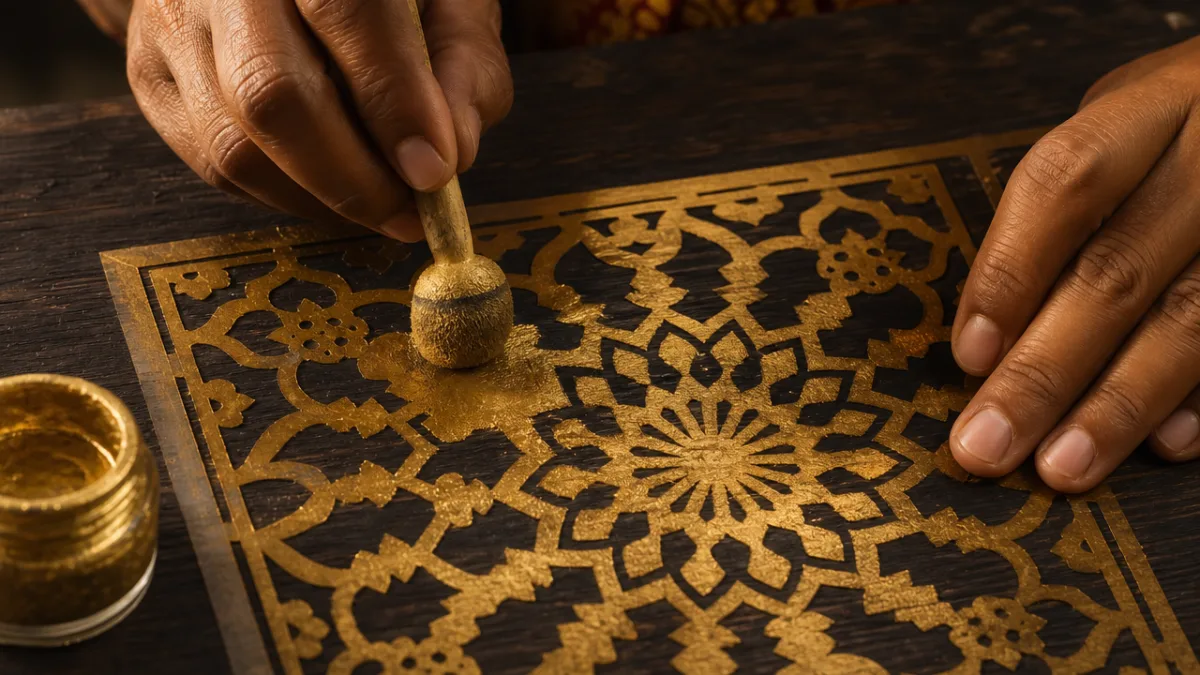
Beyond flat painted surfaces, stenciling can be combined with other decorative techniques to add further dimension and authenticity to the inlay effect. Metallic waxes or gilding pastes can be rubbed over dry stenciled areas to add shimmer and highlight the raised visual quality of the design. Distressing techniques, such as light sanding over edges and corners after the paint has fully cured, can give the piece an aged, collected quality that suggests genuine antique inlay work. Some decorators also experiment with layering two or more stencil applications in slightly offset colors to create a shadowed, three-dimensional quality reminiscent of the depth found in actual stone or shell inlay.
Floor Craft: Creating Stunning Stenciled Floors with the Jaipur Pattern
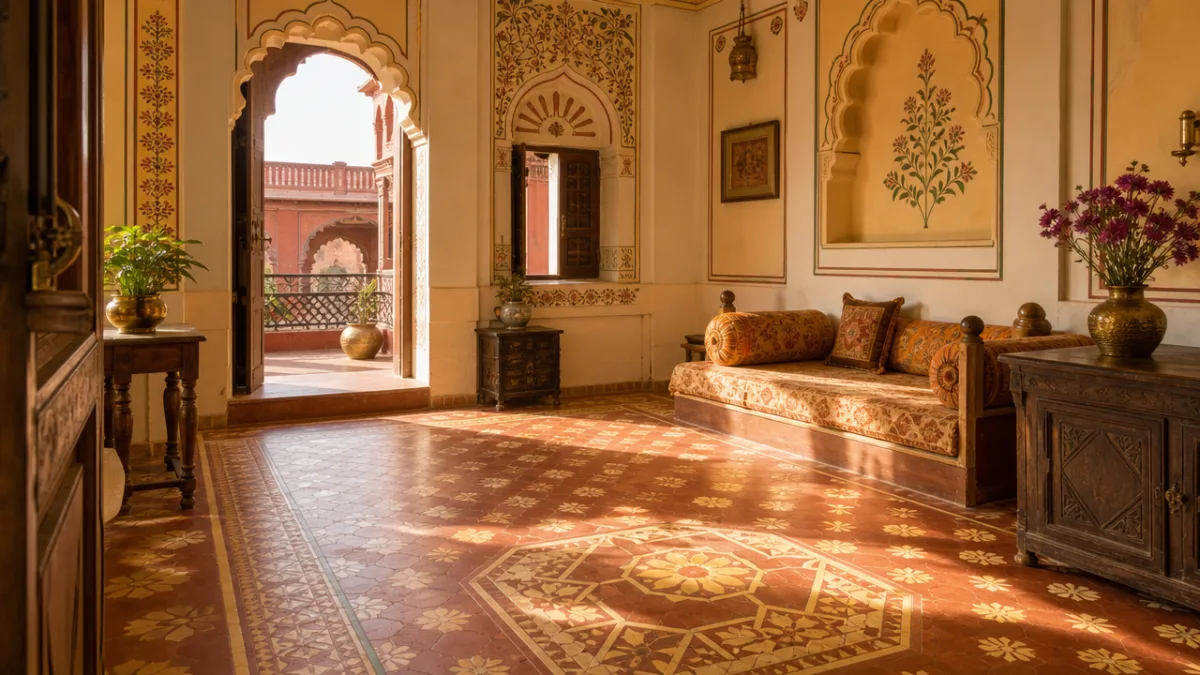
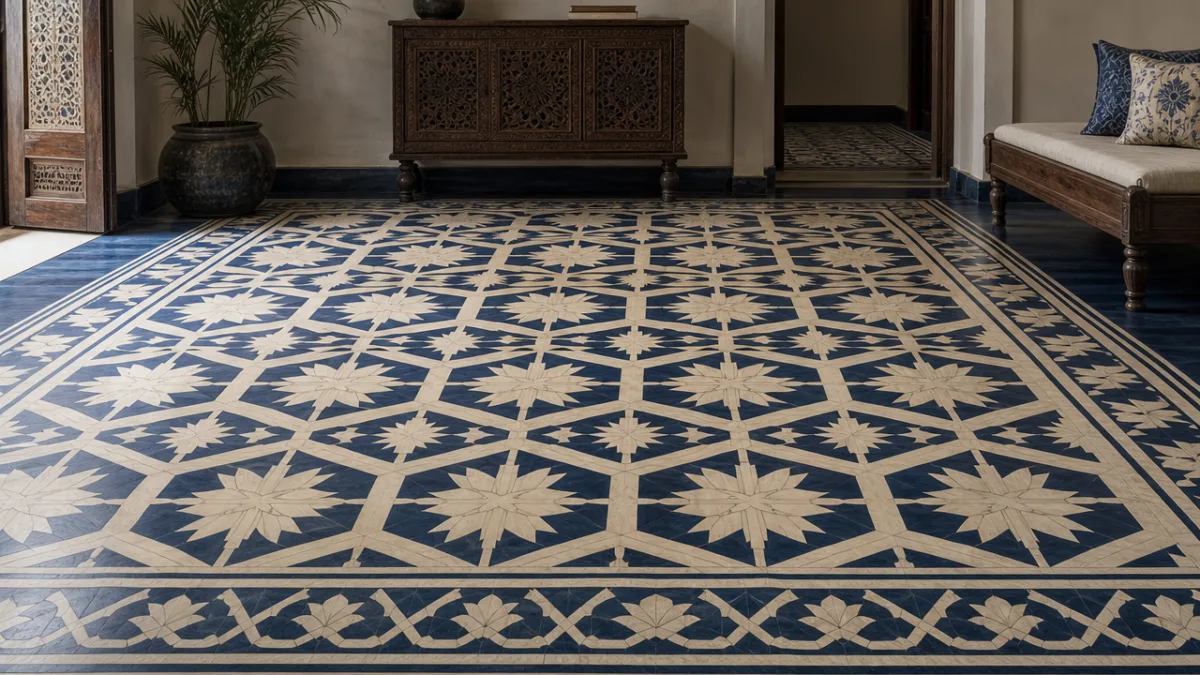
Perhaps the most dramatic application of the Jaipur stencil is on floors, where a full repeat of the inlay pattern across an entire room can create an effect that transforms the space completely and instantly. Floor stenciling has a long and distinguished history in European decorative arts, particularly in Scandinavia and Colonial America, where painted floors substituted for expensive rugs and tiles. The Indian inlay stencil brings this tradition into dialogue with the equally long history of hand-painted and tiled floors found throughout South Asia and the Middle East, producing a hybrid practice that feels both historically grounded and refreshingly new.
The practical process of floor stenciling with the Jaipur pattern requires careful planning and preparation. The floor must be clean, smooth, and properly primed before any paint is applied. Laying out the pattern correctly is essential: the central point or starting alignment should be identified and marked carefully, and the stencil should be secured with low-tack tape at each position to prevent slippage, which would blur the crisp edges that give the design its characteristic precision and elegance. Working in a systematic sequence across the floor, stepping back regularly to check alignment and overall effect, will produce the cleanest and most professional results.
Once the stenciling is complete and fully dry, floor applications require a robust protective finish to ensure longevity and resistance to foot traffic. Multiple coats of a hard-wearing floor varnish or polyurethane sealer applied over the entire surface will protect the painted design and allow it to remain beautiful for many years with normal cleaning and maintenance. Many decorators choose a satin or semi-gloss finish that enhances the richness of the colors without the harshness of a high-gloss surface, and this finish level also does the best job of replicating the lustrous appearance of genuine polished stone inlay. A well-executed and properly sealed Jaipur stencil floor can genuinely rival the beauty of far more expensive tiled or inlaid alternatives.
Integrating the Jaipur Stencil into Contemporary Interior Design Styles
The enduring appeal of Indian inlay-inspired design lies partly in its remarkable ability to harmonize with a wide range of contemporary interior aesthetics, from maximalist global eclectic to restrained minimal. In a salon or living room conceived around a rich, layered approach to decoration, the Jaipur stencil on a floor or feature wall becomes an anchor point for the entire composition, providing a geometric backbone around which textiles, furniture, lighting, and objects can be arranged with confidence. The design’s internal structure is strong enough to hold its own against bold colors, patterned fabrics, and decorative objects without creating visual chaos.
For interiors that lean toward a more minimal or contemporary sensibility, the key to successfully incorporating the Jaipur stencil lies in restraint and careful editing elsewhere in the space. Applied in a single color on a contrasting ground, perhaps charcoal grey on warm white, or natural linen on deep slate, the pattern reads as a sophisticated graphic element rather than an overtly ethnic or decorative statement. Surrounded by clean-lined furniture, simple textiles, and a limited palette of natural materials, the stencil contributes texture, cultural depth, and visual interest without overwhelming the overall calm of the space. This approach is particularly effective in dining rooms, entrance halls, and home offices where an atmosphere of considered elegance is the primary goal.
The Jaipur stencil also integrates beautifully into specific design movements that have gained considerable momentum in recent years. The global maximalist interior, inspired in part by the richly layered rooms of designers like Martyn Lawrence Bullard and Justina Blakeney, actively celebrates the mixing of cultural influences and the layering of pattern upon pattern. In such a context, a Jaipur stencil floor beneath a Moroccan lantern, surrounded by Indian block print cushions, West African textiles, and mid-century modern furniture, feels entirely at home. Similarly, the biophilic design movement’s emphasis on natural materials, earthy colors, and organic forms finds a natural partner in Indian inlay’s botanical motifs and warm, earth-derived color palette.
Practical Guide: Materials, Techniques, and Tips for Success
Achieving a beautiful result with the Jaipur stencil requires not only the right design but also the right materials and a clear understanding of technique. The quality of paint used will significantly affect the final appearance of the work, and for most applications, a chalk-based or mineral paint offers excellent opacity, ease of blending, and a beautiful matte finish that reads as appropriately artisanal. For metallic accents, a quality gilding paste or metallic acrylic in gold, bronze, or silver can be applied sparingly with a fine brush or fingertip to highlight specific elements of the design, adding luminosity and a sense of luxury to the finished surface.
Before beginning any stenciling project with the Jaipur pattern, it is worth gathering and preparing the following essential materials and considering each carefully:
- The stencil itself, cleaned and stored flat to prevent warping, which would compromise the crispness of the applied design
- Low-tack repositionable adhesive spray or painter’s tape for securing the stencil to the surface without damaging the base coat beneath
- A stencil brush, dense foam roller, or cosmetic sponge for applying paint through the stencil openings with controlled, minimal pressure
- High-quality chalk paint, mineral paint, or floor paint in the chosen color palette, with sufficient quantity for the scale of the project
- A palette or plate for loading and offloading paint from the applicator to prevent bleeding beneath the stencil edges
- A spirit level and long ruler or chalk line for establishing accurate registration and alignment across large surfaces
- Appropriate sealer or varnish matched to the surface type and traffic level the finished piece will experience
The single most important technical principle in stencil painting, and the one that most separates professional-looking results from amateur ones, is the use of a nearly dry applicator with minimal paint. Overloading the brush or sponge with paint is the most common cause of bleeding beneath stencil edges, which destroys the crispness of the design and can ruin hours of careful work. Load the applicator generously, then offload most of the paint onto a spare piece of paper or palette until almost no color is transferring, and then apply to the stencil surface with light, stippling pressure. Multiple thin layers will always produce a cleaner, richer, more professional result than a single heavy application.
Cultural Appreciation and the Responsible Use of Design Heritage
As the global market for world craft traditions and culturally inspired design products continues to grow, it is increasingly important for consumers, designers, and manufacturers to engage with design heritage in a spirit of genuine appreciation, education, and respect. The artisanal traditions of Rajasthan and Jaipur are not merely aesthetic resources to be mined for commercial product development; they represent living cultural practices sustained by skilled craftspeople and their communities, many of whom continue to work within the traditional structures of hereditary craft guilds known as karigar communities. An informed engagement with these traditions means acknowledging their origins, learning their history, and wherever possible, supporting the source communities directly.
Using a Jaipur stencil thoughtfully means taking the time to understand the cultural context of the designs it reproduces, and sharing that understanding with others who encounter the finished work in your home or studio. It means crediting the tradition from which the design draws its inspiration, and ideally complementing the stencil work with other authentic pieces from the region: genuine block-printed textiles, handmade ceramic vessels, original artisan objects that support living craftspeople. This approach transforms the act of interior decoration from a purely aesthetic exercise into a form of cultural conversation and stewardship, enriching both the space and its inhabitant’s understanding of the world’s extraordinary diversity of creative traditions.
The global popularity of Indian design motifs, from the paisley pattern that traveled from Kashmir to Scotland to become one of the most ubiquitous prints in Western fashion, to the mandala that has become a symbol of wellness culture worldwide, demonstrates the extraordinary capacity of Indian visual traditions to speak across cultural and geographic boundaries. The Jaipur inlay stencil participates in this long history of cultural exchange, offering a contemporary vehicle for the ancient human impulse to surround ourselves with beauty, meaning, and the evidence of extraordinary human skill. Used with awareness and appreciation, it is not merely a decorating tool but a connection to one of the world’s great artistic legacies, brought into the intimate spaces of everyday life.








What do you think?
It is nice to know your opinion. Leave a comment.