










Button Under the Water: Exploring the Enchanting World of Underwater Button Art
The Origins and Concept of Underwater Button Art
Underwater button art is one of those creative genres that shouldn’t work on paper but absolutely does. It takes two things that have no obvious business being together — the humble, everyday button and the vast, mysterious ocean — and somehow makes them feel like they were always meant to share the same world. The movement grew out of a desire among artists to take ordinary objects and drop them into extraordinary settings, letting that contrast do all kinds of interesting work. And it caught on fast. Scroll through Pinterest for five minutes and you’ll find thousands of people collecting, sharing, and obsessing over this stuff.
At its core, this is found-object art — the tradition of rescuing overlooked, discarded things and giving them new life through creative vision. Buttons are perfect for this. Pulled from old coats, sewing boxes, and estate sales, they already carry a certain weight to them, a Texture that feels loaded with history. Put one underwater — or imagine it there — and it becomes something else entirely: a glowing orb, a piece of coral, a tiny jewel drifting across an imagined ocean floor. That transformation is the whole point, and it’s genuinely hard to look away from.
Buttons have shown up in folk art, collage, and textile work for centuries, but the specific idea of placing them underwater is a more recent invention, born from digital art tools and the creative communities that grew up around them. Around the early 2010s, artists started experimenting with Photoshop and mixed-reality photography, layering buttons over underwater scenes and playing with what they could make. As high-resolution underwater photography got cheaper and editing software got easier to use, the whole thing took off into its own recognizable niche — one that’s still growing and evolving today.
Techniques Used to Create Underwater Button Art
Making underwater button art well takes both technical skill and a good eye for composition. Digital artists usually start by photographing buttons against clean, neutral backgrounds, then carefully cutting them out and placing them into underwater scenes. The hardest part, honestly, is getting the light right. Real underwater light does strange and beautiful things — it scatters, refracts, throws caustic patterns across everything. Getting that to look convincing around each button is what separates a great piece from one that just looks like a button pasted onto an ocean photo.
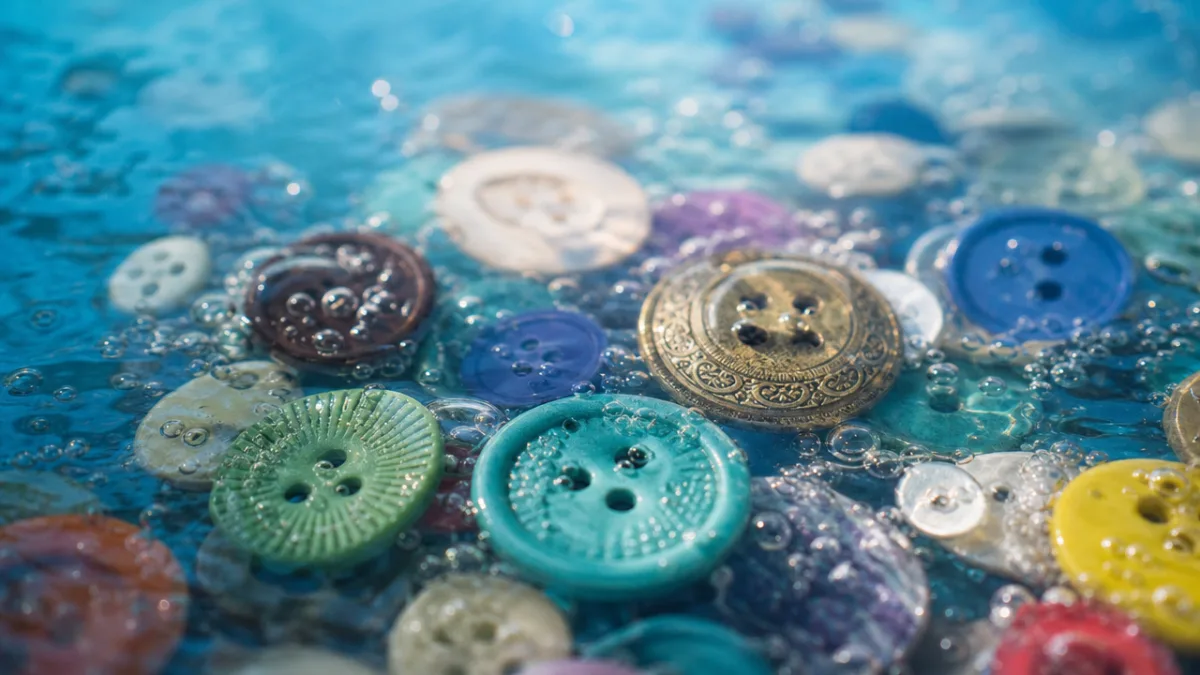
Physical installations take a totally different approach, and many artists prefer it precisely because you can’t fully predict what you’ll get. Some fill shallow tanks or glass containers with water, arrange buttons underneath, and photograph them through the surface. The way natural light plays through the water creates effects that no software quite manages to replicate. Macro photography is especially popular here — shoot close enough and you start seeing things in those buttons that you’d never notice otherwise: tiny carved edges, subtle painted details, hole patterns that suddenly look architectural when magnified.
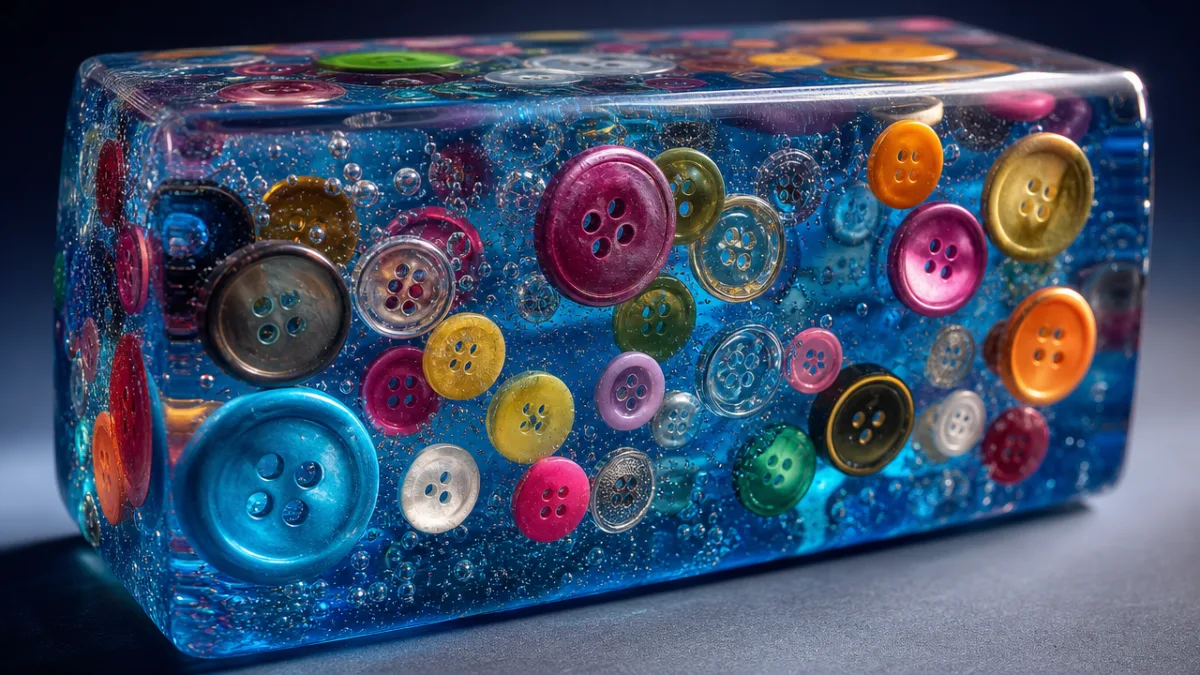
Mixed-media artists pull from both worlds, combining scanned fabrics and photographed buttons with underwater footage or stills, ending up with something that feels more dimensional than pure digital work. And then there’s resin casting, which is its own wonderful rabbit hole — embedding buttons in clear or colored resin to create sculptures that look like a single luminous underwater moment frozen in time. Each approach has its own appeal, and plenty of artists eventually try all of them.
- Digital compositing: Layering button photographs with underwater imagery using tools like Adobe Photoshop or Procreate to achieve seamless, believable underwater scenes.
- Macro aquatic photography: Placing physical buttons in water tanks or shallow dishes and photographing them with macro lenses to capture light refraction and reflection naturally.
- Resin casting: Embedding buttons in colored or clear resin to simulate a frozen, underwater aesthetic in three-dimensional sculptural form.
- Watercolor and illustration: Hand-painting underwater button scenes using traditional watercolor techniques to evoke soft, dreamlike aquatic environments.
The Symbolism and Emotional Resonance of Buttons in Water
Good art is rarely just about how it looks, and underwater button art is no different. There’s real symbolic weight here, whether or not you consciously register it when you’re looking at a piece. Buttons are tied to clothing, and clothing is tied to people — specific people, specific moments. An old button might have fastened a coat worn to a wedding, or kept a child’s uniform together through a long, hard school year. When you imagine that button slowly sinking to the ocean floor, resting there in silence, something in it feels like archaeology. Like finding a small, beautiful remnant of a life that was fully lived.
Water carries its own symbolic freight across pretty much every culture on earth — the unconscious mind, transformation, emotion, the relentless passing of time. Put buttons and water together and you get a visual metaphor that works on several levels at once: the familiar made strange, the small made vast, the personal dissolved into something almost eternal. A lot of people describe an immediate emotional reaction to this kind of work — a mix of nostalgia and wonder, like stumbling across something precious that’s been quietly waiting beneath the surface of ordinary life all along.
What keeps it from getting too heavy is the cheerfulness that buttons naturally carry with them. They’re colorful, domestic, a little playful. When they fill up an imaginary seabed, the mood shifts — suddenly you’re somewhere fantastical, where the household and the oceanic coexist in surprisingly delightful harmony. That balance between tenderness and wonder, between the tiny and the immense, is probably the biggest reason underwater button art connects with such a wide range of people. It doesn’t ask too much of you, but it gives you a lot to feel.
The Role of Color and Composition in Underwater Button Art
Color is usually the first thing that hits you in underwater button art, and the artists who do it best clearly know their color theory inside and out. Real ocean light behaves in specific ways — it absorbs warmer wavelengths as you go deeper, so reds and oranges fade while blues and greens take over. Artists who actually replicate this in their work achieve something that feels genuinely immersive rather than just decorative. Dropping a vivid red or warm gold button into that cool aquatic world creates a natural focal point, a little burst of visual tension that your eye goes straight to.
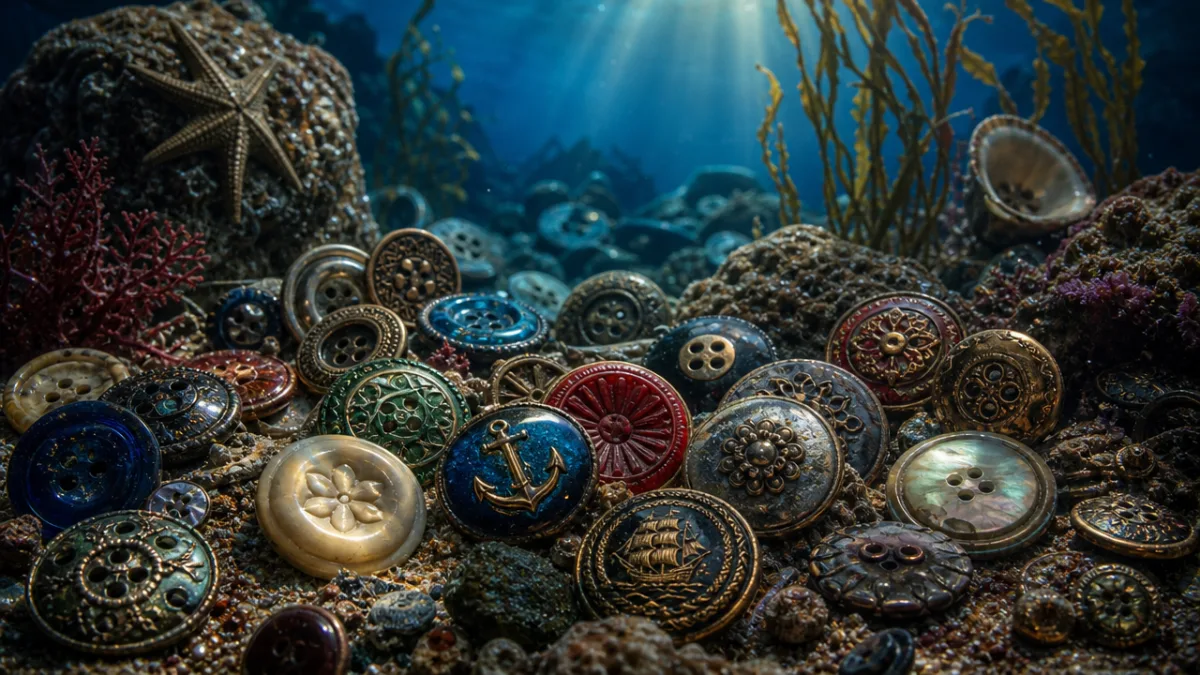
Composition-wise, this genre borrows from fine art photography and marine science illustration in equal measure. You’ll often see buttons arranged to suggest coral colonies, or a single button drifting through open water like a jellyfish, or dense clusters that evoke the busy richness of a reef. Artists lean on leading lines, the rule of thirds, and negative space to move the viewer’s eye through the scene and build a real sense of depth in what is, after all, a flat image.
Texture is just as important, and it’s where buttons really earn their place in this genre. Their surfaces — threading holes, carved patterns, metallic shanks, painted details — interact with the visual texture of water in ways that are genuinely unpredictable. Caustic light patterns rippling down from a water surface break everything up differently every time, which means no two photographs of the same button in water will ever look quite identical. That variability is a big part of why artists keep coming back to it. There’s always something new to discover in the same materials.
The Community and Culture of Underwater Button Art on Social Media
Pinterest, Instagram, and Etsy are where this community actually lives, and between them they’ve built something genuinely international. Pinterest is a particularly natural fit — the whole platform is built around visual bookmarking, and underwater button art is nothing if not visually arresting. Dedicated boards accumulate thousands of pins over time, becoming something between an inspiration archive and a meeting place for artists at every level, from someone who just tried their first resin cast to illustrators with thousands of followers and a full product line.
The culture in this corner of the internet is refreshingly generous. You don’t find a lot of gatekeeping or competition here — instead, artists openly share their techniques, explain where they source their buttons, and walk people through their lighting approaches in real detail. Instagram hashtag communities pull in contributors from everywhere: home studios in rural England, apartments in Seoul, spare bedrooms across North America. What ties it all together is a shared affection for something that most of the world has never thought twice about.
The commercial side has grown right alongside the creative community. Prints, greeting cards, phone cases, fabric patterns, and home décor featuring underwater button imagery sell steadily on Etsy and Society6. Interior designers have picked up on the aesthetic — it brings color and a quiet sense of whimsy to spaces without demanding too much attention. A handful of independent galleries have even hosted group shows exploring the overlap between textile heritage and marine imagery, which suggests the art form is finally starting to get the wider recognition that its online community has known it deserved for a while.
- Start a dedicated Pinterest board to collect reference images, color palettes, and compositional ideas that inspire your work.
- Join Instagram hashtag communities such as #buttonart and #underwaterart to connect with fellow artists and receive feedback on your creations.
- Participate in themed challenges posted by community organizers, which provide creative prompts and deadlines that help artists push their skills forward.
- Share your process, not just your results — behind-the-scenes posts showing your technique tend to generate strong engagement and meaningful creative conversations.
- Explore Etsy and Society6 to find established artists whose work you admire and from whom you can draw both stylistic inspiration and business insight.
Getting Started: Your Own Underwater Button Art Journey
Getting into underwater button art is more accessible than you might think, and the starting point for almost everyone is the same: start collecting buttons. This part is genuinely fun. Thrift stores, antique markets, haberdasheries, and online vintage sellers are full of them, and the variety is remarkable once you start looking. Glass buttons, shell buttons, Bakelite, modern plastic — each material catches and responds to light differently, and building up a diverse collection gives you a lot to work with as you figure out what draws you in.
If you’re leaning toward digital work, the technical barriers are lower than ever. Free and affordable apps like GIMP, Canva, and Procreate have layering and masking tools capable of producing genuinely convincing underwater composites. YouTube has extensive free tutorials on underwater light simulation, color grading for depth, and clean button cutout techniques that you can put to use right away. An excellent first project is exactly what it sounds like: one well-photographed button, one good underwater image, and the task of blending them together convincingly. Simple scope, real learning.
Developing your own style is the part that takes longer, but it’s also the most rewarding. Underwater button art covers a huge range — from hyper-realistic photographic composites to loose watercolor interpretations, from bright and playful to moody and atmospheric. Pulling inspiration from marine photography, textile art, and jewelry design will help you discover the visual voice that actually feels like yours. The community is welcoming, the creative territory is genuinely wide open, and the ocean floor of possibility, to push the metaphor as far as it’ll go, goes pretty deep.
- Gather a starter button collection from thrift stores, sewing boxes, and online vintage marketplaces to explore different textures and materials.
- Practice macro photography with everyday household items before progressing to water-based shots, to develop your eye for light and detail.
- Experiment with resin kits designed for beginner jewelry makers, which are inexpensive and produce beautiful first results when combined with buttons and pigment.
- Study marine photography by following ocean photographers on social media, absorbing lessons in underwater light, color, and composition.
What keeps people coming back to this art form, ultimately, is what it does to the ordinary. A button that fell off a winter coat and ended up in a junk drawer becomes, through nothing more than creative attention, a glowing jewel suspended in an imagined sea. That’s a small kind of magic, but it’s a real one — and it’s available to anyone willing to pick up a button, look at it fresh, and wonder what might be hiding just beneath its surface. The answer, pretty reliably, is more than you expected.








What do you think?
It is nice to know your opinion. Leave a comment.