










A Centuries-Old Decorative Tradition Inspires Michelle Robinson’s Vibrant Weavings
The Ancient Roots of a Living Art Form
Weaving is among the oldest of all human crafts, with a history stretching back thousands of years across nearly every culture on earth. From the intricately patterned textiles of pre-Columbian Peru to the luminous silk brocades of Tang Dynasty China, the act of interlacing threads has long served both practical and deeply expressive purposes. These traditions were never merely about creating cloth — they encoded cosmologies, marked social hierarchies, commemorated events, and expressed a people’s relationship with color, pattern, and the natural world. Understanding that heritage is essential to appreciating contemporary weavers who draw from it.
Decorative weaving as a distinct artistic tradition — one aimed primarily at beauty and meaning rather than utility — flourished in countless forms across Europe, Asia, Africa, and the Americas. Tapestry weaving in medieval Europe produced monumental narrative works that hung in cathedrals and castles, telling biblical stories and celebrating courtly life in rich wool and silk. Meanwhile, West African kente cloth used bold geometric patterns woven in vivid color to communicate status and identity in ways that transcended language. Each tradition developed its own vocabulary of form, and that vocabulary has never stopped evolving.
What links these diverse practices is the fundamental act of building an image or pattern one thread at a time — a process that demands patience, precision, and an intimate understanding of how color and texture interact. Contemporary artists who engage with these traditions are not simply nostalgic; they are participants in a living conversation that spans centuries. When Michelle Robinson picked up her first loom, she entered that conversation, bringing with her a modern sensibility and a hunger for vibrant, unapologetic color that would become the hallmark of her practice.
Michelle Robinson and the Discovery of Her Craft
Michelle Robinson’s journey into weaving was not a straightforward one. Like many contemporary textile artists, she arrived at the loom through a winding path that passed through painting, drawing, and an abiding fascination with the material world. She was drawn to the physical quality of textiles — their weight, their warmth, the way light plays differently across a woven surface than it does across a painted canvas. Where painting felt to her like an act of marking, weaving felt like an act of building, and that difference mattered enormously to how she thought about making art.
Her early experiments were exploratory and sometimes frustrating. Weaving demands a different kind of thinking than most visual art forms — decisions made at the beginning of a piece constrain what is possible at the end, and the relationship between the warp threads (those strung tightly on the loom) and the weft threads (those woven through them) creates a structure that must be understood before it can be transcended. Robinson has spoken candidly about the steep learning curve she faced, and about the crucial role that studying historical examples played in accelerating her understanding. Visiting museum collections and studying antique textiles gave her an intuitive feel for what the loom could do.
Over time, her technical confidence grew, and with it her willingness to push against the conventions she had studied so carefully. She began to see the grid of the woven structure not as a limitation but as a kind of musical staff — a framework on which she could compose with color in ways that felt both disciplined and wild. Her work started to attract attention in local craft circles and then in broader art communities, as viewers responded to the unusual combination of traditional technique and intensely contemporary visual language that her pieces displayed.
Color as the Central Language
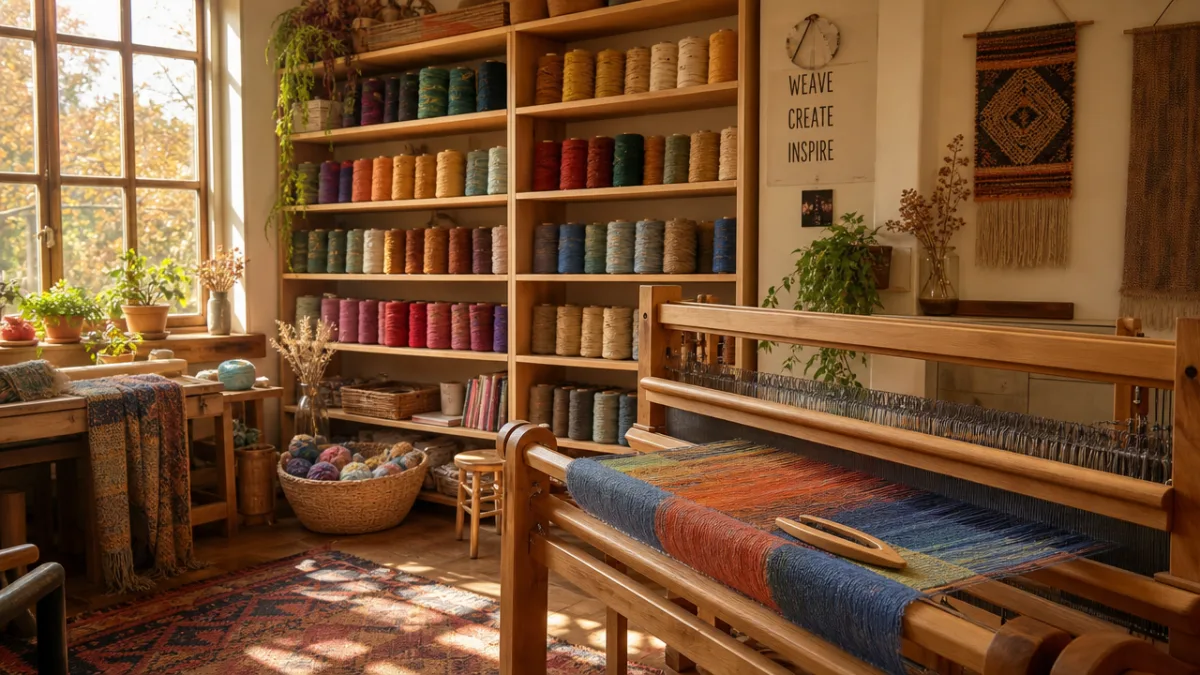
If there is one element that defines Michelle Robinson’s weavings above all others, it is her fearless, exuberant use of color. Her palettes do not whisper — they shout, sing, and sometimes argue with themselves in ways that create a kind of visual tension that draws the eye relentlessly across the surface of a piece. She works with a range of fibers that include wool, cotton, and silk, each of which absorbs and reflects color differently, and she exploits those differences deliberately to create depth and luminosity within a single composition. A wool thread dyed the same hue as a silk thread will read as an entirely different color once they are woven side by side, and Robinson knows how to use that phenomenon.
Her color choices are influenced by a remarkable range of sources. She has cited the saturated tones of Mexican folk textiles, the electric contrasts of Guatemalan huipiles, and the jewel-like intensity of Byzantine mosaics as touchstones. But she is equally attentive to the colors she encounters in everyday life — the particular orange of a market stall at dusk, the accidental harmony of a cracked wall beside a flowering vine, the way a city street looks after rain. For Robinson, color is a form of emotional notation, and her works can be read as records of states of feeling as much as formal compositions.
She often works through extensive color studies before beginning a major piece, winding yarns around cards and placing them in different combinations to see how they interact. This preparatory process can take weeks, and Robinson considers it as much a part of the artwork as the weaving itself. The discipline behind all that vibrancy is something that surprises people who encounter her work for the first time — the freedom it communicates is the product of enormous, careful thought. That combination of apparent spontaneity and underlying rigor is one of the qualities that gives her weavings their distinctive energy.
- Wool: Provides matte depth and warmth, absorbing dye in ways that produce rich, slightly variable tones with natural texture and visual weight.
- Silk: Introduces luminosity and sheen, catching light at different angles and making colors appear to shift subtly as the viewer moves.
- Cotton: Offers clean, reliable color with a crisp visual quality that provides contrast against the organic irregularity of natural fibers.
- Linen: Adds structural integrity and a cooler, more restrained tone that Robinson uses to give the eye a resting place within busy compositions.
The Decorative Traditions That Shaped Her Vision
To understand Robinson’s work fully, it is necessary to understand the specific historical traditions she has engaged with most deeply. Chief among these is the tradition of tapestry weaving as it developed in Europe from the medieval period through the Arts and Crafts movement of the late nineteenth century. The great Flemish and French tapestry workshops of the fifteenth and sixteenth centuries created works of staggering complexity and beauty, and Robinson has studied them with the eye of someone who understands the technical challenges they represent. She is particularly drawn to the way these works handle the transition between color areas — the subtle blending techniques known as hatching that create the illusion of form and shadow within the rigid grid of the woven structure.
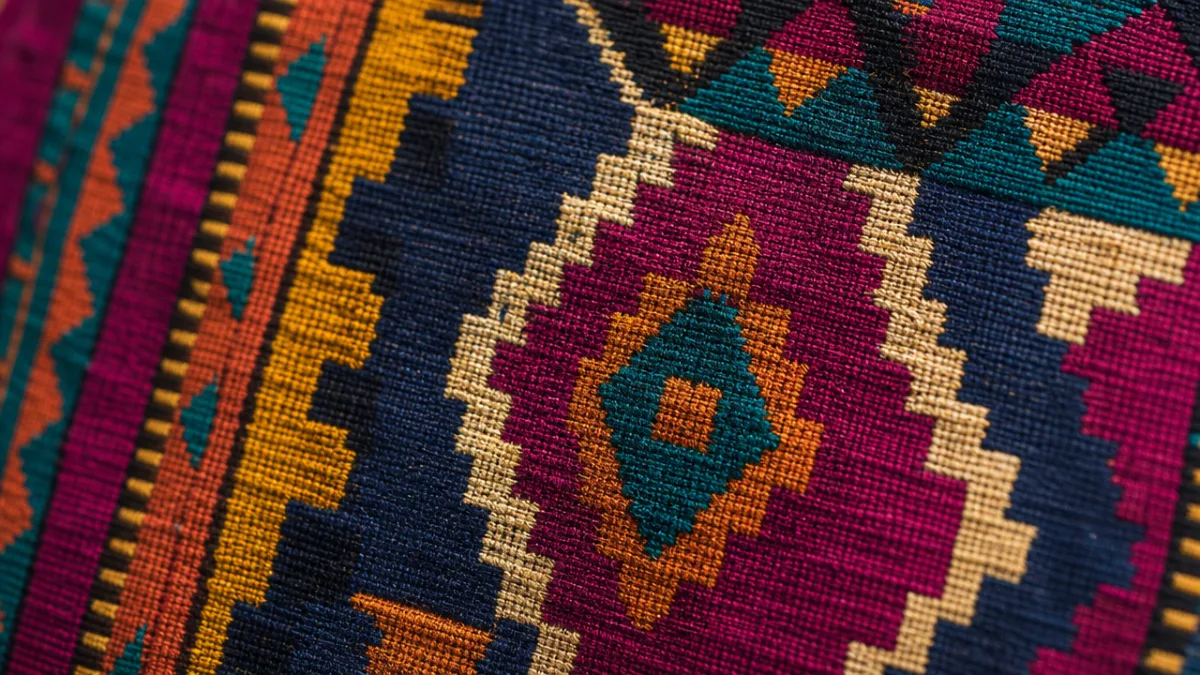
Equally important to her practice is the tradition of Navajo weaving, particularly the bold geometric compositions of the Classic and Transitional periods of the nineteenth century. Navajo weavers developed an extraordinarily sophisticated visual language using simple geometric forms — stepped diamonds, zigzags, terraced lines — that creates works of remarkable dynamism despite, or perhaps because of, their formal constraints. Robinson has written about the way these textiles taught her to think about positive and negative space, and about how a composition can feel in motion even when it consists entirely of static shapes. The influence is visible in the structured geometry that underlies even her most coloristically complex pieces.
She has also engaged deeply with the ikat traditions of Central Asia, Southeast Asia, and Latin America — traditions in which the yarn itself is dyed in patterns before weaving begins, creating a characteristic blurred, feathered edge where colors meet that is impossible to achieve by any other means. While Robinson does not always use ikat technique itself, she frequently seeks to recreate the visual quality of ikat’s soft transitions through careful manipulation of color placement and fiber choice. This borrowing across traditions — taking a visual effect developed in one cultural context and finding new ways to achieve it within another technical framework — exemplifies the kind of creative synthesis that characterizes her work at its best.
- Medieval European tapestry weaving, particularly Flemish and French workshop traditions of the fifteenth and sixteenth centuries, provided her foundational grammar of pictorial weaving.
- Navajo weaving of the Classic and Transitional periods taught her how geometric abstraction can generate dynamic visual energy from formal simplicity.
- Central Asian and Latin American ikat traditions showed her how the dyeing and preparation of yarn before weaving could become an expressive tool in itself.
- West African strip-woven cloth, particularly kente, informed her thinking about how pattern and color can carry cultural meaning beyond pure decoration.
- The Arts and Crafts movement’s elevation of textile work to the status of fine art gave her a theoretical framework for her own practice as both craft and art.
Process, Materials, and the Making of a Weaving
Watching Michelle Robinson work is to witness a process that moves between careful planning and intuitive improvisation in ways that are not always easy to distinguish from the outside. She begins each significant work with a period of research and sketching — gathering images, making color studies, drawing compositional ideas in a sketchbook that she keeps covered in loose notes and swatches of yarn. The sketchbook is not a blueprint so much as a thinking space, a place where ideas can be tried and discarded without commitment. She estimates that for every finished weaving, she has filled several pages with approaches that ultimately proved unworkable or uninteresting.
The technical preparation of the loom is a process she takes very seriously, because errors made at this stage are extremely difficult to correct once weaving begins. Setting up the warp — measuring, cutting, threading, and tensioning the foundation threads of the piece — can take a full day or more for a large work, and Robinson performs this task with the focused attention of someone who knows that every decision made now will constrain or enable everything that follows. She has a particular approach to warp color that is unusual among contemporary weavers: rather than using a single neutral warp, she often works with a multi-colored warp that contributes its own visual complexity to the finished piece, showing through the weft in subtle ways that add depth and variation to the surface.
The weaving itself proceeds slowly and with great deliberateness, particularly in passages where she is working out a complex color transition or experimenting with a new combination of fibers. Robinson works primarily on floor looms, which allow her to work at a larger scale than is possible with tabletop equipment, and she is attentive to the physical rhythms of the process — the repetitive motion of passing the shuttle, beating the weft, advancing the warp — in a way that she describes as almost meditative. This quality of attention shows in the finished work, where the surface repays close examination with a level of detail and variation that is invisible from a distance.
The Wider Context: Textile Art in the Contemporary World
Michelle Robinson works at a moment when textile art has never been more widely respected within the broader art world, and when the conversation about craft, labor, and materiality has never been more urgent. For much of the twentieth century, fiber arts occupied an awkward position — admired by some as a serious artistic practice, dismissed by others as mere craft, and burdened by the gendered associations that have historically attached to needlework and textile making. The feminist art movement of the 1970s worked to challenge those associations, and artists like Sheila Hicks, Magdalena Abakanowicz, and Lenore Tawney produced works of such ambition and power that they could not be ignored by the mainstream art world. Robinson is a beneficiary of that shift, and she acknowledges it explicitly.
At the same time, she is conscious of the way contemporary interest in traditional crafts can sometimes tip over into a kind of aestheticized nostalgia that strips those crafts of their living cultural contexts. The weaving traditions she draws from are not dead museum artifacts — they are living practices embedded in specific communities with their own ongoing histories of innovation, adaptation, and resistance. Robinson is careful to distinguish between respectful engagement with and learning from those traditions, on the one hand, and appropriation or superficial borrowing on the other. She has made it a practice to seek out and support weavers from the communities whose traditions have influenced her, both through purchasing their work and through finding opportunities to amplify their voices.
Her work has found audiences in both craft-focused and fine art contexts, which is itself a statement about the false nature of that division. Her pieces have been exhibited in textile galleries and contemporary art spaces alike, and she has spoken at both craft conferences and fine art institutions. That crossover is something she actively cultivates, because she believes that the conversation between these two worlds — one with deep technical knowledge and one with a different set of critical frameworks — makes both richer. In that sense, her practice is not only about the objects she makes but about the broader cultural conversations those objects help to sustain.
- Her work challenges the historical division between fine art and craft by excelling on both technical and conceptual levels simultaneously.
- She supports contemporary weavers from the communities whose traditions have influenced her, recognizing the ongoing vitality of those practices.
- Her exhibitions span both craft-focused and contemporary art venues, actively bridging institutional divides that have too often isolated textile art from broader artistic discourse.
- She engages with questions of cultural exchange and appropriation with thoughtfulness and transparency, making these concerns part of her public artistic conversation.
Legacy, Influence, and the Future of Her Practice
As Robinson’s reputation has grown, so has her engagement with the next generation of weavers. She has taught workshops at craft schools and art residencies across the country, and she describes teaching as one of the most important parts of her practice — a way of thinking through problems and articulating tacit knowledge that has deepened her own understanding of her work. Her students often comment on the generosity with which she shares not only technical knowledge but the harder-to-quantify wisdom about how to build a practice, how to develop a visual language, and how to sustain the commitment that serious artistic work requires over the long term.
Her influence is already visible in the work of younger weavers who have studied with her or encountered her work at formative moments in their own development. What they tend to carry forward is not so much any specific technique or motif as a general orientation — a willingness to engage deeply with historical traditions without being bound by them, to use color with confidence and intention, and to think about weaving as a form of expression as capacious and serious as any other. That orientation is perhaps the most important thing Robinson has contributed to the field, and it is a contribution that will outlast any individual piece she makes.
Looking forward, Robinson has spoken about wanting to push her work in directions that engage more explicitly with the contemporary moment — with questions of ecology, with the accelerating pace of technological change, and with the ways in which slowness and handwork carry a particular kind of meaning in a culture defined by speed and digital dematerialization. For her, the act of weaving thread by thread is not an escape from the present but a way of being fully present to it — a practice of attention in a distracted age. Whatever forms her future work takes, it seems certain to continue the dialogue between ancient tradition and living experience that has always been its animating force.
In the end, what makes Michelle Robinson’s weavings matter is not simply that they are beautiful, though they are undeniably that. It is that they embody a way of thinking about time, labor, and visual meaning that feels both ancient and urgently contemporary. Each piece is an argument — made in color and fiber rather than words — for the value of slow, careful, materially grounded creative work. In a world that often seems to be moving too fast to notice what it is losing, that argument is more necessary than ever, and Robinson makes it with a vibrancy and conviction that few artists in any medium can match.








What do you think?
It is nice to know your opinion. Leave a comment.