










24 Lovely Garden Bridge Ideas To Make Your Space Magical
The Timeless Charm of Garden Bridges
Garden bridges have been a staple of beautiful outdoor spaces for centuries, and it’s easy to see why. Whether you’re spanning an actual stream, a dry creek bed, or just a pretty cluster of plantings, a well-placed bridge does something almost magical — it turns an ordinary yard into somewhere that feels intentional, romantic, and worth wandering through. Landscape designers love them, home gardeners love them, and honestly, once you understand what a bridge can do for a space, you’ll probably love them too.
What makes a garden bridge so special is that crossing one — even if it’s only a few steps — actually changes how you feel in the space. Japanese garden designers have known this for ages. They place bridges deliberately to slow you down, make you notice your surroundings, and signal that you’re moving from one part of the garden into another. That quiet sense of transition is something any garden can use, whether it’s a sprawling estate or a modest backyard.
And beyond all that poetic stuff, garden bridges just work really well from a practical design standpoint. They add height to gardens that might feel a little flat, they give people a natural place to stop and take in the view, and they help guide visitors along a clear path through your landscape. In a smaller garden especially, a bridge can actually make the whole space feel bigger — it draws the eye forward and through rather than letting it hit a wall. It’s one of the most versatile things you can add to a garden, full stop.
Choosing the Right Material for Your Garden Bridge
The material you go with will shape everything about your bridge — how it looks, how long it lasts, and how much upkeep you’ll be doing down the road. Wood is still the most popular choice for home gardens, and it makes sense. It’s warm, it’s natural, and it fits into almost any planting scheme without feeling out of place. Cedar and redwood are both great picks because they have natural oils that fend off rot and insects without needing chemical treatment, which means they look good and stay manageable.
Pressure-treated pine is easier on the budget, though you’ll want to seal or stain it regularly to keep it looking sharp and structurally sound. If you love a more weathered, storied look, reclaimed timber is hard to beat — those worn surfaces have a character that fresh-cut lumber just can’t fake. On the higher end, hardwoods like teak and ipe are incredibly tough and develop a gorgeous silver patina if you leave them untreated, though the price tag can give you pause if you’re watching your spending.
If you want something that requires even less fuss over the years, stone and metal are worth a serious look. A natural stone bridge — granite, slate, fieldstone — has a solid, ancient quality that suits formal and cottage gardens beautifully. Wrought iron and weathering steel bring a sort of industrial elegance that pairs really well with modern gardens and bold plantings like ornamental grasses. And composite materials have come a long way — today’s options genuinely look like wood but stand up much better to moisture, UV rays, and general wear.
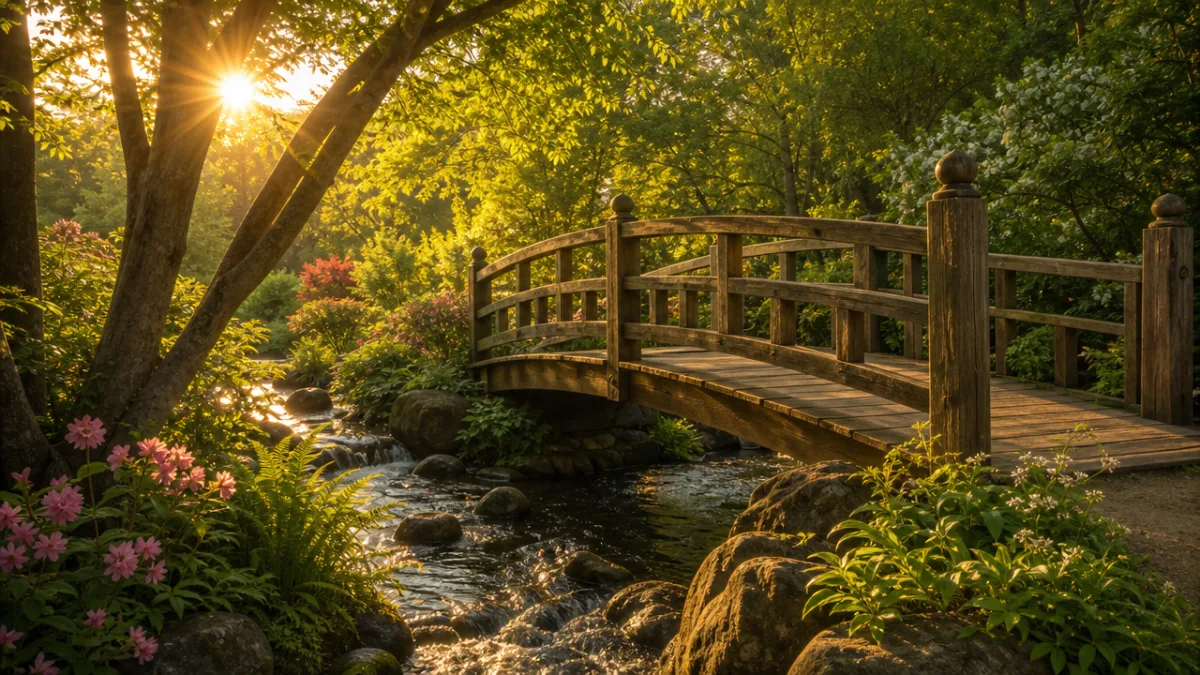
Classic Wooden Bridge Designs That Never Go Out of Style
If there’s one garden bridge design that just about everyone loves, it’s the simple flat wooden plank bridge. Straight timber decking laid across two solid beams — it sounds almost too basic, but that simplicity is exactly what makes it work in so many different settings, from cottage gardens to woodland paths to clean-lined contemporary landscapes. Add a set of handrails and it goes from purely functional to genuinely finished-looking, with the bonus of making the crossing safer for kids and older family members.
Arched wooden bridges are a step up in both craftsmanship and visual impact. That gentle curve reflects beautifully in still water and gives the whole structure a satisfying sense of proportion, whether it’s a cozy three-footer or something much grander. Japanese moon bridges push the arch to the extreme — they rise so steeply that the bridge and its reflection make a perfect circle in the water below. They’re not the easiest things to climb, but they might be the most photographed garden feature on the planet, and they bring a real sense of occasion to any garden that has room for one.
Railings are where you can really put your own stamp on a wooden bridge. Turned balusters give it a traditional, cottage-garden feel, while simple square posts with horizontal rails lean more contemporary. Threading lattice panels with climbing roses or clematis turns the whole structure into something living, where the line between the garden and the architecture starts to blur in the best way. Rope railings strung between timber posts, meanwhile, give off an easy, coastal vibe that works wonderfully in seaside gardens or anywhere with a relaxed, naturalistic feel.
Creative Bridge Ideas for Small Gardens and Dry Landscapes
One of the best ideas to come out of modern garden design is that your bridge doesn’t actually need water under it to work. Dry creek beds — built from gravel, river stone, and a few well-placed boulders — can look surprisingly convincing as a watercourse, especially when you plant moisture-loving species like ornamental grasses, ferns, or ligularia along the edges. Put a small bridge over it and suddenly the whole thing reads as though a stream runs through your garden, past or present. That little bit of narrative does a lot for a planting scheme.
When space is genuinely tight, a stepping-stone bridge across a shallow pond or bog garden gives you most of the visual effect of a full timber structure with a much smaller footprint and a lower price tag. You pick out broad, stable flat stones, space them at a comfortable stride apart, and let visitors find their own path across. There’s something physically engaging about that process — you have to pay attention, pick your footing — and that makes stepping-stone bridges a real hit in family gardens where both kids and adults enjoy the mild adventure of getting across.
Raised bed and container gardens can get in on the action too. A narrow plank walkway running between two raised beds brings a sense of order and division to a kitchen or cutting garden. Elevated walkways made from composite decking can turn a sloped garden into a series of connected terraces, with little bridges between them that make the changes in grade feel purposeful rather than awkward. Even something as simple as an arched trellis straddling a path carries a hint of that bridging magic — the suggestion of a threshold — without requiring any real construction at all.
In dry climates and xeriscaped gardens, a corten steel bridge spanning a dry wash planted with agave, desert willow, and penstemon is a genuinely striking combination. It doesn’t pretend there’s a permanent stream — it simply acknowledges that water passes through occasionally and that this invisible watercourse is worth marking. That kind of design, honest about its environment and responsive to it, is some of the most satisfying garden work you can do anywhere.

Incorporating Plants to Enhance Your Garden Bridge
A garden bridge really comes into its own when the planting around it is thoughtfully done. The classic approach — and honestly still one of the best — is training climbing roses over a pergola-style bridge so that visitors walk through a tunnel of blooms in early summer. Rosa ‘Bobbie James’ with its huge clusters of creamy white flowers, and the soft peachy-pink Rosa ‘Albertine’, are both vigorous enough to cover a good-sized structure quickly. Pair them with clematis varieties that flower at different times and you can keep the show going from late spring well into autumn.
Planting around the base of the bridge is just as important as what grows over it. Hostas, astilbes, and Japanese iris are all at home in the moist, partly shaded conditions near a water feature, and their different leaf shapes — broad and glossy, feathery, strappy and upright — combine to create a richness that makes even a plain plank bridge look established and settled. A weeping willow nearby, or even a compact Salix caprea ‘Kilmarnock’, gives the scene an overhead frame that really pulls everything together.
For bridges over dry features or garden paths, the approach shifts a little. Low-growing thyme, chamomile, and creeping jenny tucked along bridge edges or between stepping stones release fragrance when brushed, which turns a simple crossing into a full sensory moment. Ornamental grasses flanking either side of the bridge entrance work like a soft gateway — their movement in any breeze makes the whole approach feel alive in a way that static plants can’t quite manage. And bamboo, if you can keep it contained, adds incredible atmosphere to an Asian-inspired garden scheme.
Lighting and Finishing Touches for a Magical Garden Bridge
If you haven’t seen a lit garden bridge after dark, you might be surprised by what a difference it makes. Solar post cap lights on bridge railings cast a warm amber glow that makes the whole structure feel like a lantern floating in the garden. Submersible LEDs in the water below can throw shifting patterns of light up through the gaps in the decking and onto surrounding leaves, which sounds theatrical but actually looks completely natural — almost like moving water light on a summer evening.
String lights along the railings or looped between posts add a festive, welcoming quality that’s perfect when you’re entertaining outdoors. Warm white bulbs strung loosely between timber posts feel like a Mediterranean terrace or a country farmhouse garden. Cooler LED strips mounted under the deck create more of a contemporary floating effect for modern spaces. Either way, the rule of thumb is restraint — the lighting should highlight the bridge and its setting, not turn the garden into a car park. Night gardens have their own mystery and intimacy, and good lighting works with that rather than against it.
The finishing details people often overlook are the ones that quietly make or break the whole thing. Even the direction of your decking boards matters more than you’d think — laid perpendicular to travel looks traditional and classic, laid diagonally feels a bit more dynamic and modern. Color and finish are worth sitting with too: deep charcoal or black makes a bridge almost disappear into its surroundings in an elegant way, while natural teak oil preserves the warmth of the wood grain and ages into silver beautifully. For cottage or heritage gardens, verdigris green and soft white are perennial favorites for very good reason.
And then there’s seasonal decoration, which honestly doesn’t get enough credit. Lanterns hung from bridge posts on a midsummer evening, autumn leaves woven through the railings, a simple wreath at the entrance in winter — these small gestures are a way of saying that this bridge is more than just a way to get from A to B. It’s a place of crossing, a little ritual, a moment of arrival. That’s worth marking, in every season, in every garden.

Planning and Building Your Own Garden Bridge
A little planning upfront will save you a lot of headaches — and money — once the project gets going. The first question to answer is what the bridge actually needs to do. Is it purely decorative, or does it need to handle the weight of a wheelbarrow, garden machinery, or a crowd of people? For regular pedestrian use in a home garden, a well-built timber bridge with properly spaced joists and the right decking thickness will handle anything you’re realistically going to throw at it. If heavier use is on the cards, it’s worth talking to an engineer or buying a purpose-built kit from a reputable supplier.
Take a good look at the site before you commit to anything. Think about drainage, how stable the soil is, and what the landscape looks like on both sides of the crossing. The abutments — the supports that rest on the bank or ground — need to sit on firm, level footings, or you’ll end up with a bridge that shifts, heaves with frost, or slowly tilts to one side over the years. If you have an actual watercourse, check your local planning or building regulations before you build anything over it — permits may be required, and you’ll want to make sure your bridge doesn’t accidentally dam the flow and cause flooding further downstream.
If you’re handy with a saw and comfortable with basic carpentry, a simple flat plank bridge is a very manageable DIY project. The main steps are cutting and treating your support beams, anchoring them to stable footings or posts, and laying the decking with even gaps so water drains freely. Adding handrails takes careful measuring and solid joinery, but it’s very doable and the result looks and functions so much better than a bridge without them. There are plenty of detailed plans online and in garden design books, and many timber suppliers offer pre-cut kits that take a lot of the guesswork out of it.
Once your bridge is built, a bit of regular maintenance is all it takes to keep it looking great and staying safe for years. A quick annual check of all the structural connections, decking boards, and handrail fixings — maybe an hour of your time — can catch early signs of rot, rust, or loosening before they turn into real problems. Scrubbing off algae and moss with a stiff brush keeps the surface from getting slippery and stops it from eating into the timber. Reseal or restain every couple of years and your bridge will keep its good looks through every season without much fuss at all.








What do you think?
It is nice to know your opinion. Leave a comment.