










Pine Forest Scented Candles: Bringing the Wilderness Indoors
The Timeless Appeal of Pine Forest Fragrances
There’s something almost instinctive about the way a pine forest smells. Long before scented candles were ever a thing, humans were living among coniferous trees, breathing in that sharp, resinous air every day. Over time, that scent became tangled up with feelings of safety, freshness, and a kind of quiet awe at the natural world. So when you light a pine candle, you’re not just adding a nice smell to a room — you’re tapping into something much older and more deeply felt than that.
Pine forest candles have gotten really popular over the last decade, and honestly it makes a lot of sense. More and more people are living in cities, surrounded by concrete and screens, with the nearest actual forest being a good few hours away. A pine candle on your coffee table becomes a small but meaningful way to hold onto that connection with the outdoors — a little piece of the wild right there in your living room.
Part of what makes pine such a crowd-pleaser is how surprisingly complex the scent actually is. It’s nothing like a simple floral or a sweet vanilla. A well-made pine candle layers different aromatic notes on top of each other: the bright, crisp hit of fresh needles up top, then the warmer, resinous depth of pine sap and bark in the middle, and finally the earthy base of damp soil and moss underneath it all. As the candle burns, those layers shift and evolve, which means the scent you’re enjoying an hour in feels different from what you got when you first lit it. It rewards you for slowing down and paying attention.
Understanding the Fragrance Profile of Pine Candles
Not all pine candles are the same, and knowing how a good one is built can save you from ending up with something that smells more like a bathroom cleaner than an actual forest. Quality pine candles are structured around layers of scent notes that reveal themselves over time. The top notes are what you catch first when the candle is lit — usually something crisp and green like fresh pine needles, maybe a little juniper, and sometimes a touch of eucalyptus or citrus to give it a bright, airy opening.
The heart notes are really where the interesting stuff happens. This middle layer is where you get the cedarwood, fir balsam, and spruce that together create that dense, woody warmth you’d feel stepping into a cool forest on an early morning. Some candle makers throw in hints of campfire smoke or birch to push things in a more rugged, wilderness direction. Others lean into amber and myrrh for a slightly sweeter, richer depth that still feels unmistakably like the woods.
Base notes are what keep the whole thing grounded and make the scent linger after the flame goes out. For pine candles, you’re typically looking at musk, patchouli, sandalwood, and earthy accords at this level. These are the reason you can blow out a good pine candle and still smell it in the room hours later — what enthusiasts call the “ghost scent.” Once you understand this structure, you can actually read a candle’s ingredient list and have a pretty good sense of what it’ll smell like before you even open the box.
- Top notes: Fresh pine needle, juniper, eucalyptus, light citrus
- Heart notes: Cedarwood, fir balsam, spruce, birch, campfire smoke
- Base notes: Musk, patchouli, sandalwood, earth, amber
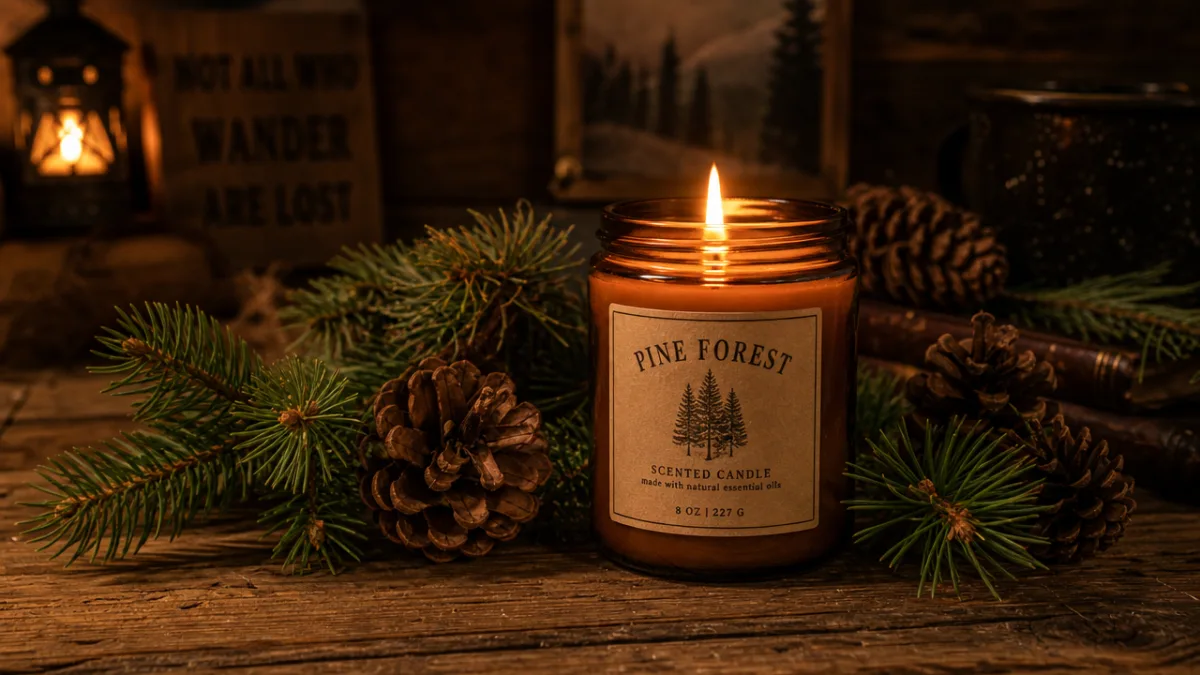
Choosing the Right Wax: Soy, Beeswax, and Paraffin Explained
The wax in your candle matters more than most people realize. It affects how the scent is released, how cleanly the candle burns, and how long it lasts. Paraffin wax — the petroleum-derived kind — was the industry standard for decades, and it’s still widely used in mass-produced candles for good reason: it holds fragrance really well and throws scent powerfully into a room. The downside is that it burns dirtier than plant-based waxes, releasing small amounts of soot and potentially irritating particles into the air.
Soy wax is now the go-to for most artisan candle makers, and it’s a solid choice for environmentally conscious shoppers too. It comes from hydrogenated soybean oil, burns slower and cleaner than paraffin, and typically gives you a longer-lasting candle with less airborne residue. The catch is that soy doesn’t hold as much fragrance as paraffin, so the scent throw tends to be a bit softer and more subtle. To get around this, a lot of makers use a soy-coconut wax blend, which keeps the clean burn of soy while borrowing the better fragrance-binding properties of coconut wax.
Beeswax is in its own category entirely. It’s naturally produced by honeybees, burns longer and hotter than any other natural wax, and when it burns it actually releases negative ions that can help clean the air by neutralizing dust, mold spores, and other particles floating around your home. A beeswax pine candle also has this subtle warm, honey-like undertone that works beautifully with forest fragrances, adding a golden richness to the pine and cedar notes. Yes, beeswax candles cost more — but the burn quality and overall experience are genuinely hard to beat.
The Art of Candle Making: Crafting Your Own Pine Forest Scent at Home
Making your own pine candle at home is one of those projects that’s much more approachable than it sounds, and it’s incredibly satisfying once you get it right. You don’t need a lot of equipment — the main things are a pre-blended soy container wax (great for beginners), a double boiler setup or a heat-safe pitcher over a pot of simmering water, and a reliable kitchen thermometer. The thermometer is non-negotiable: fragrance oils need to go in at a specific temperature to bind properly to the wax, so guessing won’t cut it.
For the scent itself, the best results usually come from layering a few different oils rather than relying on just one. A good starting point is Siberian fir needle essential oil, Virginia cedarwood essential oil, and a commercially blended “forest walk” or “winter woods” fragrance oil that adds complexity and helps the scent last longer. The general rule is to work with about six to ten percent fragrance by weight of your wax, though this varies depending on which wax you’re using. Adding your fragrance oils when the wax has cooled down to around 185°F gives you the best chance of a solid, well-integrated scent.
Wick choice is something a lot of first-timers underestimate, and it really does make or break the candle. Too thin and the wick will just tunnel down through the center, leaving a ring of unmelted wax around the edges and barely releasing any scent. Too thick and you’ll get a big sooty flame that burns through the wax way too fast and can actually overheat the jar. For a medium-sized soy or soy-blend container candle, a medium-weight cotton core wick is a reliable starting point. Do a few test burns in small batches, and let the candle cure for at least 48 hours before you judge the scent — it needs time to fully meld with the wax.
- Melt wax in a double boiler to approximately 185°F (85°C)
- Add fragrance oils at the correct temperature and stir gently for two minutes
- Secure your wick in the center of the container using a wick centering tool or clothespins
- Pour the wax slowly to avoid air bubbles, filling to about half an inch below the rim
- Allow the candle to cool undisturbed at room temperature for a minimum of 24 hours
- Trim the wick to one quarter inch before the first burn
- Let the candle cure for 48 hours before burning to allow fragrance to fully integrate with the wax

Using Pine Forest Candles to Transform Your Living Space
Where you place a scented candle matters just as much as what it smells like, and pine candles in particular have a way of really coming alive in certain settings. In a living room, a pine candle creates this warm, grounded feeling that puts people at ease almost immediately. The woody, resinous notes work especially well alongside natural textures — wool throws, leather furniture, wooden shelving — reinforcing that sense of organic warmth that feels so welcome once the weather turns cooler.
Bedrooms are another great spot for pine, particularly if you deal with sleep issues or anxiety. Certain terpenes found naturally in pine resin — alpha-pinene and beta-pinene in particular — have been studied for their mild calming and sedative effects. Burning a pine candle in the hour before bed can become part of a winding-down ritual, something your nervous system starts to recognize as a cue to relax. Just make sure you blow it out before you actually fall asleep, and consider switching to a pine-scented room spray or diffuser for overnight use.
Home offices are somewhere people don’t always think to use candles, but they’re actually a wonderful place for pine. Research into forest bathing — the Japanese practice known as Shinrin-yoku — has shown that the aromatic compounds trees release, called phytoncides, can lower stress hormones, reduce blood pressure, and sharpen focus. A candle can’t fully replicate standing in an old-growth forest, but a high-quality pine candle may offer some of the same benefits in a more modest way. A lot of people who work from home swear by burning a forest-scented candle during work hours, saying it helps them feel calmer and more focused than they do in a completely scentless space.
Seasonal Rituals and the Pine Candle Throughout the Year
Most people associate pine candles with winter and the holidays, and it’s true that they feel especially at home in that season. There’s something about a pine candle glowing on a cold December evening — paired with candlelight and soft textures — that just feels right. It calls to mind frosted forests, woodsmoke, and the particular stillness of a snow-covered landscape. It’s cozy in the most elemental sense of the word.
In autumn, pine candles make a great complement to the season’s more familiar scents. Apple, cinnamon, and pumpkin get most of the attention, but a pine or fir-forward candle adds a bracing, foresty edge that captures the cool crispness of October air under a canopy of turning leaves. Some candle makers blend pine and cedarwood with dried apple, fallen leaves, and Smoked Wood to create something that smells exactly like a woodland walk on a crisp autumn afternoon — and it’s genuinely lovely.
Spring and summer might feel like unlikely seasons for pine, but with the right pairing they can work really well. A spring pine candle softened with lavender, mint, or light florals captures that fresh, rain-washed feeling of a forest coming back to life. In summer, a pine and sea salt blend or a pine-citrus combination can transport your mind to a sun-warmed mountain forest or a coastal pine grove overlooking the water — a welcome escape on a sweltering city afternoon. Pine really isn’t just a winter thing; like the trees themselves, it works in every season if you know how to use it.
- Winter: Pair with clove, cinnamon, smoked wood, and amber for a deep holiday atmosphere
- Autumn: Combine with dried apple, fallen leaves, and birch for woodland walk vibes
- Spring: Blend with lavender, mint, and rain accords for a fresh forest-after-rain feel
- Summer: Layer with sea salt, citrus, or wild herbs for a bright mountain or coastal pine mood

Caring for Your Pine Candle: Maximizing Burn Time and Fragrance
Even a really excellent pine candle will disappoint you if you don’t look after it properly. The good news is that a few simple habits make a big difference. The most important one is the very first burn: let it go long enough that the entire top surface of the wax melts out to the edges of the container. This is sometimes called “training” the candle, and it prevents tunneling — that frustrating situation where the candle burns straight down the middle and leaves a thick ring of wax on the sides that never melts. For most container candles, that first burn should run somewhere between two and four hours.
Trimming your wick before every burn is probably the single most impactful habit you can build as a candle owner. Aim for about a quarter of an inch — you can use dedicated wick trimmers or just a small pair of scissors. A wick that’s too long creates a tall, flickering flame that eats through the wax too quickly, throws off excess soot, and can cause the jar to get uncomfortably hot. A properly trimmed wick gives you a steady, moderate flame, a cleaner burn, and a more consistent, pleasant scent throw. Wick trimmers are cheap and genuinely worth having if you burn candles regularly.
How you store your candles is something most people never think about, but it actually matters quite a bit. Fragrance oils are sensitive to heat, light, and air — all three can cause the scent to fade or change over time. Keep unused candles somewhere cool and dark, away from sunny windows and drafts. If your candle has a lid, put it back on once the wax has fully hardened after a burn. It keeps dust off and helps preserve the fragrance in that top layer of wax. Take good care of your pine candle and it’ll reward you with dozens of hours of that rich, forest-fresh atmosphere — which, honestly, makes it one of the better investments you can make in the way your home feels and smells.








What do you think?
It is nice to know your opinion. Leave a comment.