










Somerset and Dorset: A Journey Through England’s Most Enchanting Southwest Counties
The Timeless Landscape That Defines the Southwest
Few corners of England possess the quiet, unhurried magic that Somerset and Dorset share between them. Separated by a county boundary that feels almost arbitrary given how seamlessly their character flows from one to the other, these two counties together form one of the most photographed, most walked, and most deeply loved stretches of the English countryside. Whether you arrive by winding lane or coastal path, the landscape has a way of drawing you in slowly, like a long exhale after a noisy life elsewhere.
Somerset stretches from the lowland wetlands of the Somerset Levels, where ancient peat bogs hold thousands of years of preserved history, up through the rolling grandeur of the Quantock Hills and the wild, bracken-covered expanse of Exmoor. There is an elemental quality to this terrain that rewards patience. Stand on the Quantocks at dusk when the mist begins to gather in the combes below, and you will understand why Coleridge and Wordsworth chose to live and write here, drawing inspiration from a landscape that feels like it exists just slightly outside of ordinary time.
Dorset, meanwhile, holds within its boundaries one of the most dramatic coastlines in the world. The Jurassic Coast, a UNESCO World Heritage Site, stretches for 96 miles and represents 185 million years of Earth’s geological history laid out in stone, cliff, and wave-sculpted arch. From the famous natural amphitheatre of Lulworth Cove to the towering chalk stack of Old Harry Rocks, Dorset’s coast is a living textbook of the planet’s ancient story, rendered in breathtaking physical form that no photograph can fully capture.
Villages, Market Towns, and the Art of Slow Living
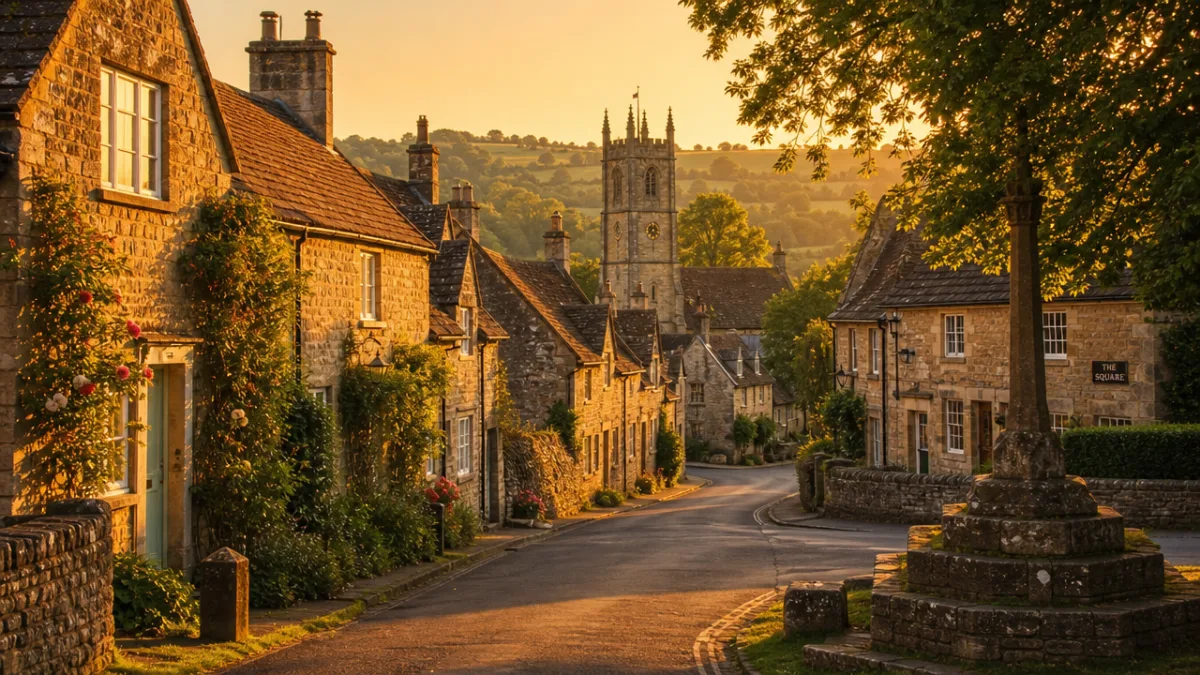
What truly sets these counties apart from other rural destinations in England is not just their scenery but the human settlements that have grown organically from it over centuries. The villages of Somerset and Dorset seem to have arrived at their current form through a process of natural selection, each building material drawn from the earth immediately underfoot. In Somerset, the golden hamstone of villages like Montacute and Martock glows warmly in afternoon sun, while in Dorset, the creamy Portland limestone of Corfe Castle village creates a visual harmony so complete it seems painted rather than built.
The market towns deserve their own meditation. Wells, technically England’s smallest city, presents a medieval streetscape anchored by a cathedral so perfect in its proportions that architects still travel from around the world to study it. The cathedral’s west facade, covered in carved stone figures, stands as one of the finest examples of Gothic sculpture in northern Europe. Meanwhile, Sherborne in Dorset offers a rival to this ecclesiastical splendour with its ancient abbey, its two castles, and an atmosphere of learned, unhurried gentility that feels unique even among English market towns of comparable character.
Dorchester, the county town of Dorset, carries the dual distinction of being both a thoroughly pleasant, working market town and the backdrop for much of Thomas Hardy’s fictional universe. Walking its streets means moving simultaneously through the present and through the world of Hardy’s imagination, where the same town appears as Casterbridge and the surrounding countryside becomes the stage for tragedy, comedy, and everything in between. The Thomas Hardy connection runs so deep in Dorset that it colours the entire visitor experience in a way that few literary associations manage to do in any corner of the British Isles.
- Montacute, Somerset — A National Trust village of honey-coloured hamstone surrounding one of England’s finest Elizabethan mansions, set among formal gardens that bloom magnificently from spring through autumn.
- Cerne Abbas, Dorset — A beautiful village perhaps best known for the ancient chalk figure carved into the hillside above it, thought by many to date to the Iron Age or Roman period.
- Dunster, Somerset — A perfectly preserved medieval village dominated by its restored castle, complete with a working octagonal yarn market at its centre that has stood since 1609.
- Abbotsbury, Dorset — Home to an ancient swannery founded by Benedictine monks, a sub-tropical garden, and the ruins of a great tithe barn, all within walking distance of a beautiful shingle beach.
Coastal Drama: Cliffs, Coves, and the Pull of the Sea
The coastline that runs from the Somerset shore of the Bristol Channel southward and then eastward along Dorset’s Jurassic edge is among the most varied in England. In Somerset, the coast is different in character from its southern neighbour — wilder, more industrial in its history, with the old Bristol Channel trade routes leaving their mark on port towns like Watchet and Minehead. The Somerset coast is dramatic in a quieter way, defined by long views across the channel toward Wales, by the strange flat-topped profile of Flat Holm and Steep Holm islands, and by sunsets that turn the Bristol Channel into something resembling molten copper.
Cross into Dorset and the geological drama intensifies immediately. The cliffs at Golden Cap, the highest point on England’s entire south coast at 191 metres, provide views on a clear day that sweep from Start Point in Devon to the Isle of Portland. The walk along the South West Coast Path through this section passes through landscapes of such austere beauty that first-time visitors often simply stop walking and stand in silence. The path dips into wooded valleys running down to the sea, crosses heathland fragrant with gorse and heather, and emerges suddenly onto cliff edges where the wind is always doing something interesting with the light.
Chesil Beach presents a different kind of coastal wonder entirely. Stretching for 18 miles from West Bay to the Isle of Portland, this extraordinary pebble barrier beach is one of the most studied landforms in England, a place of scientific fascination and also of considerable danger, where the waves come ashore with an energy that has claimed ships and swimmers across the centuries. Behind it, the Fleet Lagoon shelters one of England’s most important wildlife habitats, home to vast colonies of little egrets, waders, and wildfowl that shift and wheel above the still water in formations that turn the lagoon into something like living calligraphy.
The seaside towns along Dorset’s coast each have a character as distinct as the coastline itself. Lyme Regis, where Jane Austen walked the Cobb and where Mary Anning first revealed to the world the existence of Jurassic sea creatures embedded in its crumbling cliffs, remains one of the most charming resort towns in England. Swanage offers a Victorian seaside experience so intact it almost functions as a time capsule. And West Bay, made famous internationally by the television crime series Broadchurch, still manages to be a real, working fishing harbour first and a tourist attraction second, which gives it an authenticity that many similarly picturesque places have long since lost.
Food, Drink, and the Deep Pleasures of Provenance
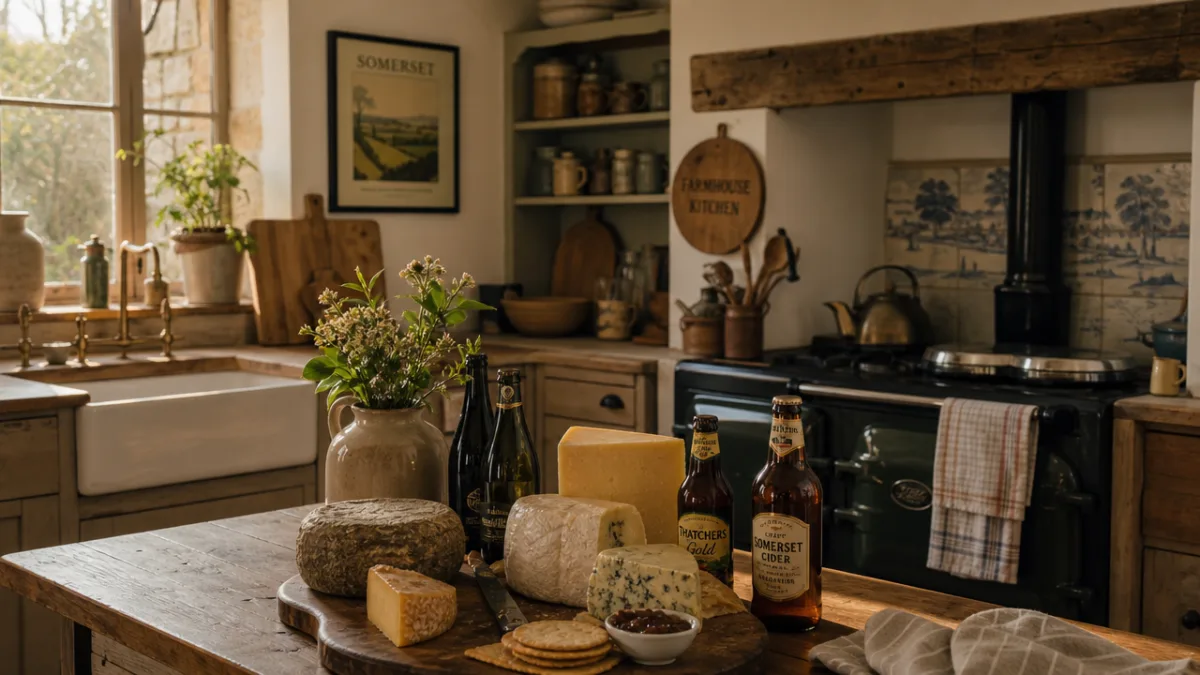
Any serious account of Somerset and Dorset must dedicate proper attention to the food and drink these counties produce, because the relationship between the landscape and what it yields for the table is in both places exceptionally intimate. Somerset is, of course, internationally famous for its cider, and rightly so. The county’s apple orchards, many of them ancient groves planted centuries ago with varieties that exist nowhere else on earth, produce a range of fermented apple drinks that runs from rough and rustic farmhouse scrumpy to complex, champagne-method sparkling ciders of genuine sophistication that would not be out of place at a fine dining table.
The cheese tradition runs equally deep. Somerset Cheddar is perhaps the most imitated cheese in the world, its name borrowed and debased across every continent, but the real article, made by a handful of producers in and around the village of Cheddar itself and aged in the caves there, is something of an entirely different order. Seek out a truly mature example, aged for eighteen months or more, and you will encounter a cheese with a crystalline texture, a sharpness that builds across the palate, and a depth of flavour that reminds you how much great food depends on great place. Dorset Blue Vinny, meanwhile, offers a regional alternative with its own considerable distinction, a crumbly, assertive blue cheese with a history dating back centuries.
The restaurant scene across both counties has developed considerably in recent decades without losing its essential character of regionalism and honest ingredient-led cooking. Chefs working in Somerset increasingly look to the Levels for their watercress and their eels, to the uplands for their lamb and venison, and to the Bristol Channel for their seafood. In Dorset, the proximity of the coast means that crab, lobster, and freshly caught flat fish define the best menus, often appearing on the table within hours of leaving the water. The farm shops and market stalls that punctuate the landscape of both counties represent, for many visitors, a revelation in what food can taste like when it has not travelled far.
- Somerset Cheddar — Aged in the natural caves of Cheddar Gorge, the original remains incomparably better than any imitation. Look for Montgomery’s or Westcombe for the finest traditional examples.
- Dorset Crab — Landed at Swanage and West Bay daily during the season, best eaten simply, with good bread and butter and a view of the sea from which it came.
- Elderflower Cordial — Made by numerous small producers across both counties from June flowers gathered from the abundant hedgerows; the Somerset variety often carries a particularly delicate floral note.
- Scrumpy Cider — Served by the pint in farmhouses and village pubs across the Somerset cider-making heartland around Taunton and the Levels, often unfiltered and assertively alcoholic.
- Dorset Knobs — A uniquely local biscuit, hard, dry, and moreish, traditionally eaten with Dorset Blue Vinny cheese or dunked into cider. Made by only one producer, Moores in Morcombelake.
History Written in Stone, Hill, and Water
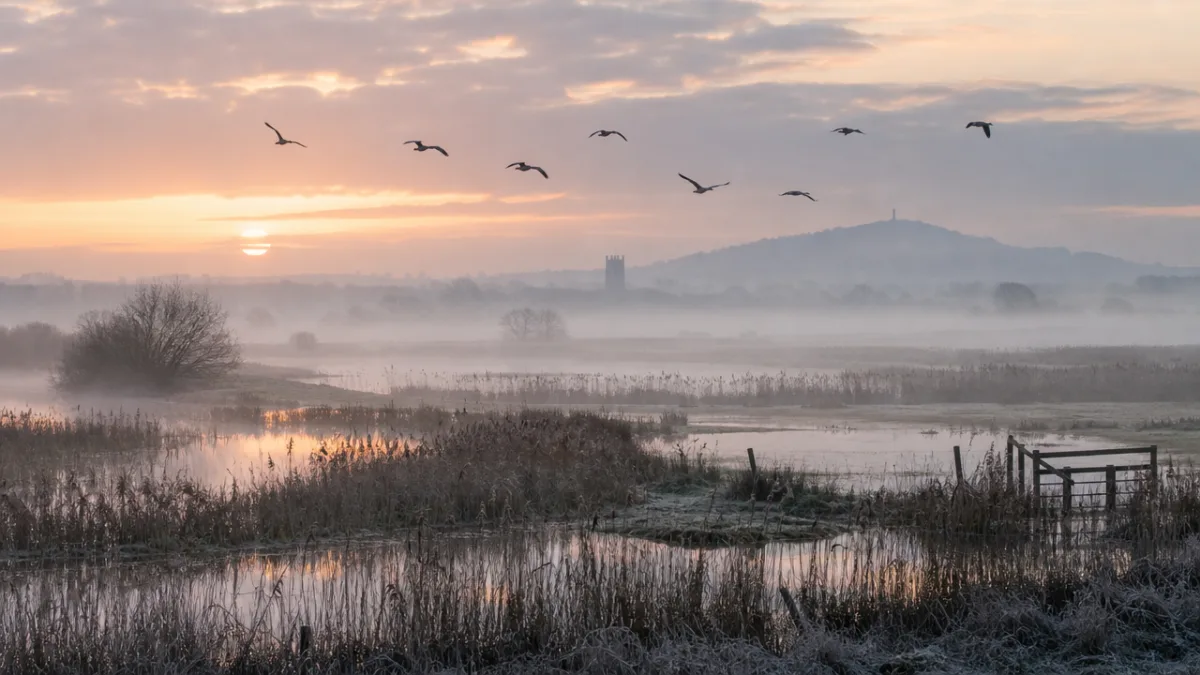
The layered history of Somerset and Dorset stretches back to before written records, embedded in the landscape in ways that are still being uncovered and interpreted. The Somerset Levels contain some of the best-preserved evidence of prehistoric human settlement in the British Isles. The Sweet Track, a raised wooden walkway built across the marshes around 3800 BCE, is one of the oldest engineered roads ever discovered anywhere in the world, and fragments of it along with thousands of other organic artefacts have survived in extraordinary condition preserved within the anaerobic peat. The lake villages of Glastonbury and Meare, occupied by Iron Age communities who built circular dwellings on platforms above the marsh, reveal through their excavated remains a sophisticated and comfortable way of life that challenges assumptions about prehistoric existence.
Glastonbury itself deserves extended attention, a town so encrusted with myth, legend, and spiritual significance that it functions as a kind of English Jerusalem, drawing pilgrims of remarkably varied kinds throughout the year. The Tor, rising 158 metres above the flat Levels, is visible from miles in every direction and crowned by the ruined tower of St Michael’s Church, has been a sacred site across multiple religions and cultures spanning thousands of years. The abbey ruins below, where legend holds that Joseph of Arimathea brought the Holy Grail and where the grave markers of King Arthur and Queen Guinevere were discovered by monks in 1191, represent one of the most atmospheric monastic sites in England even in their considerable state of ruin.
Dorset’s prehistoric credentials are no less impressive. Maiden Castle, the vast Iron Age hillfort on the edge of Dorchester, is the largest such fortification in Europe, its multiple defensive ramparts spreading across 47 acres of high ground in a feat of communal engineering that still produces a sense of awe in those who walk its perimeter. The Dorset Cursus, a Neolithic ritual monument stretching for nearly six miles across the chalk downland near Cranborne, represents one of the largest such structures in the country, though its purpose remains debated by archaeologists who continue to study it. Every hilltop in Dorset seems to carry a barrow or an earthwork; the dead have been marking this landscape for longer than the imagination can comfortably accommodate.
The Roman period has left its marks throughout both counties, most spectacularly in the form of Dorchester’s extraordinarily well-preserved Roman town house with its remarkable mosaic floors, and in the remains of numerous villas, temples, and roads that grid-reference the landscape with the characteristic Roman preference for straight lines. But it is perhaps the medieval period that has left the most visible architectural legacy: the great abbey at Glastonbury, the cathedral at Wells, the castle at Sherborne, the priory at Christchurch, the magnificent parish churches scattered through every village, each one a record of local pride and local prosperity expressed in stone over six or seven centuries of building, repair, and embellishment.
Walking, Wildlife, and the Rewards of Slow Travel
Both Somerset and Dorset reward the visitor who chooses to move slowly, who sets aside the car and takes instead to the network of footpaths, bridleways, and long-distance walking routes that make this part of England among the most accessible on foot of any rural region in the country. The South West Coast Path enters both counties, and the sections through Dorset in particular are widely regarded as the finest walking anywhere in Britain, combining extraordinary coastal scenery with manageable distances and a succession of rewarding villages and pubs at intervals that allow for thoroughly civilised progress. The Two Moors Way connects Dartmoor to Exmoor, passing through a landscape of remote farmland and ancient lanes that reveals a Somerset most visitors never encounter.
The wildlife across both counties reflects the extraordinary variety of habitats packed into a relatively small geographical area. The Somerset Levels in winter host some of the largest concentrations of wintering wildfowl and waders in Britain, with tens of thousands of starlings gathering each evening in the famous murmurations above the reed beds at Ham Wall and Shapwick Heath, a spectacle so theatrical in its choreography that it regularly attracts visitors who have no particular interest in birds but simply want to witness something that reminds them that the natural world is capable of producing beauty on a scale that human artifice cannot approach. Otters, which had disappeared from many English waterways, have returned to the rhynes and rivers of the Levels in numbers that now make them a realistic prospect for the patient observer.
Dorset’s heathlands, the remnant of what was once a vast lowland heath covering much of the county, support six of Britain’s seven native reptile species and provide the principal English stronghold of the rare Dartford Warbler, a small, long-tailed bird of extraordinary charm that clings to the gorse and heather through even the harshest winters. Brownsea Island in Poole Harbour, reached by ferry and managed by the National Trust, harbours one of England’s healthiest populations of red squirrels, those auburn, tufted-eared native rodents that have been displaced from most of England by the introduced grey squirrel. Standing beneath a pine tree on Brownsea while a red squirrel investigates a pine cone directly overhead is one of those experiences that travels well in the memory for years afterward.
The chalk downlands that run across both counties — the Dorset Downs, the Blackmore Vale’s surrounding hills, the limestone ridges of south Somerset — carry a flora of almost incomparable richness in high summer. The ancient grasslands, never ploughed because the thin chalk soils made them unsuitable for cultivation, have accumulated over centuries an extraordinary diversity of flowering plants, with a single square metre of unimproved chalk grassland sometimes containing more plant species than an entire hectare of improved agricultural land. Pyramidal orchids, bee orchids, clustered bellflowers, and round-headed rampion colour these slopes in succession from May through August, attracting populations of butterflies including the rare Adonis blue and chalkhill blue that turn the downland paths in high summer into something approaching an enchantment.
Choosing Between Them, or Better Still, Choosing Both
The title’s gentle dilemma — Somerset or Dorset, whichever you may choose — points to a real decision that visitors to the southwest of England must at some point make, though the honest answer is that the decision should almost always be resolved in favour of both. They are different enough in character to offer genuinely contrasting experiences within a single journey, and close enough in geography that moving between them requires very little effort. A base in Sherborne puts you simultaneously within easy reach of the Somerset countryside to the north and the Dorset coast to the south, offering the kind of flexibility that makes a week’s holiday feel considerably more expansive than its actual length.
If forced to characterise the distinction, one might say that Somerset speaks more to the imagination, to the mystical and the ancient and the quietly otherworldly, while Dorset speaks more directly to the senses — to the eye confronted with coastal drama, to the palate pleased by exceptional local food, to the legs challenged by the South West Coast Path’s demanding and magnificent terrain. But these are generalisations that the counties themselves regularly subvert. Dorset has its share of mysterious earthworks and spiritual significance, and Somerset possesses a coastline and a food culture that need apologise to no one. The honest truth is that England has nowhere better to offer for those who want to be reminded why the countryside of this island remains, in certain moods and at certain times of year, without parallel anywhere in the world.
Plan carefully but not too carefully. Allow room for the unscheduled afternoon that turns into the best memory of the trip, the lane you turned down by accident that led to an orchard in full blossom, the pub you stopped at for shelter from a sudden shower that turned out to serve the finest pasty you have ever eaten, the conversation with a stranger in a village churchyard that reoriented your entire understanding of the place you were standing in. Somerset and Dorset reward attention, patience, and the kind of openness to the unexpected that the best travel always requires. They are not destinations that surrender their best qualities to the hurried visitor, but for those willing to slow down and look properly, they offer something close to irreplaceable.








What do you think?
It is nice to know your opinion. Leave a comment.