










Marasmius Haematocephalus: The Tiny Pink Mushroom That Captivates the Natural World
Introduction to Marasmius Haematocephalus
The fungal kingdom is full of surprises, but few species stop you in your tracks quite like Marasmius haematocephalus. Sometimes called the pink-capped Marasmius or the bleeding-head mushroom, this little gem has won over mycologists, macro photographers, and casual forest wanderers in equal measure. Its cap blazes in shades of crimson and rose pink against the dark, soggy leaf litter it calls home — and somehow, despite being only a few millimeters to a couple of centimeters across, it manages to look absolutely enormous in photographs.
This species belongs to the family Marasmiaceae, a group of fungi known for their toughness and ecological usefulness. The genus Marasmius alone spans hundreds of species found across the world, but haematocephalus is something of a celebrity within it, thanks to that show-stopping color. Scientists formally described it in the nineteenth century, giving it a name drawn from Greek and Latin roots that together mean “blood-red head” — which, honestly, couldn’t be more accurate. It’s mainly found in tropical and subtropical forests across Asia, Africa, Central and South America, and parts of Oceania.
What makes it so interesting isn’t just the looks, though. Marasmius haematocephalus quietly does important work as a saprotrophic decomposer, feeding on dead plant material and helping break down cellulose so that nutrients can cycle back into the soil. Finding it in a patch of forest is actually a good sign — it suggests the forest floor is healthy and relatively undisturbed. For such a tiny thing, it carries a lot of ecological weight.
Physical Characteristics and Identification
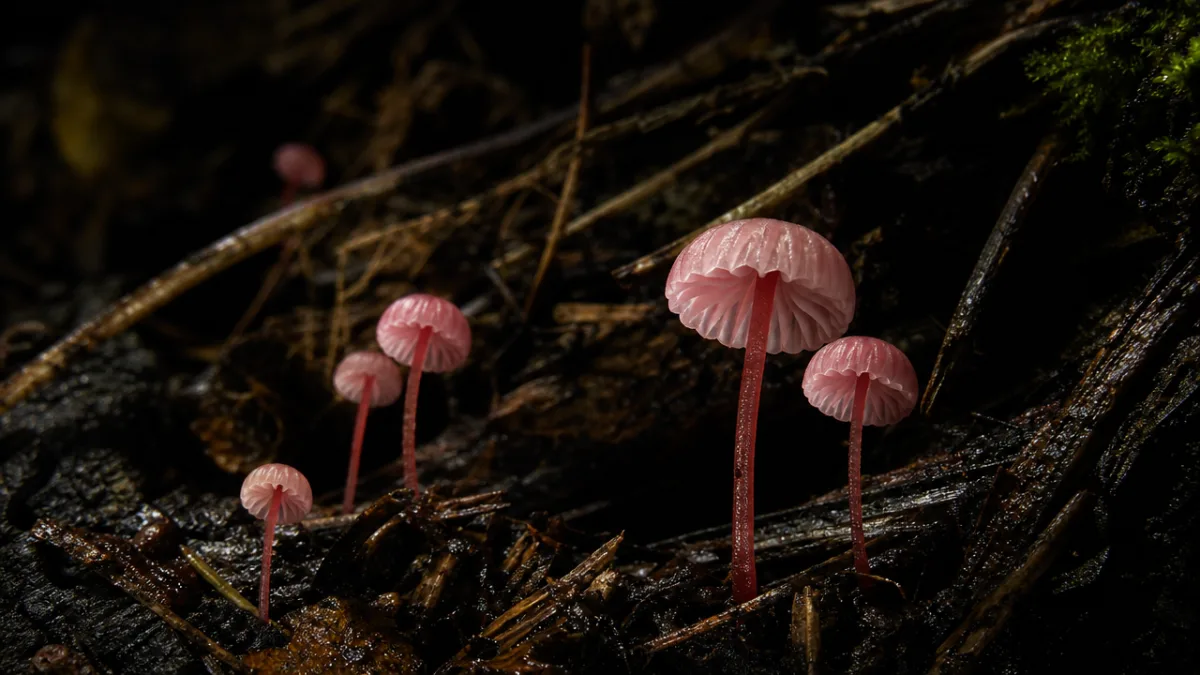
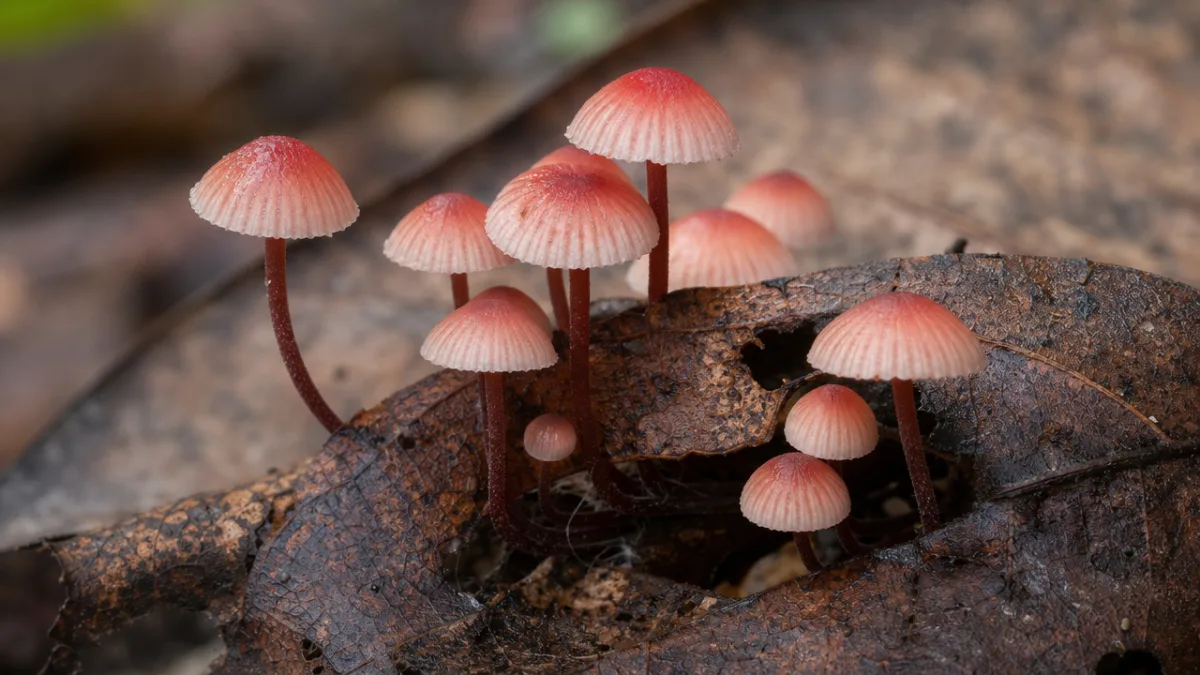
The cap is what everyone notices first, and for good reason. Ranging from deep blood red to vivid rose pink or magenta, it starts out convex when young and gradually flattens out, sometimes developing a shallow dip in the center as it matures. The surface is dry and smooth, and in the right light it almost seems to glow — which is probably why macro photographers can’t get enough of it. Cap diameter typically falls somewhere between five and twenty millimeters, so you really do need to look closely to appreciate it properly.
The stem is just as distinctive as the cap, in its own understated way. It’s remarkably long for such a small mushroom — sometimes three to seven centimeters tall — and it’s very thin and wiry, dark brown to black in color. The overall effect is like a tiny jeweled parasol balanced on a thread above the leaf litter. That contrast between the bright cap and the dark, slender stem is one of the easiest ways to identify this species in the field. The stem itself is tough and fibrous rather than brittle, which is a hallmark of the Marasmius genus generally.
The gills are white to pale pink, fairly widely spaced, and they attach to a collar-like ring around the upper stem rather than directly to it — a structure called a collarium, which is characteristic of several Marasmius species. The spore print comes out white, and under a microscope the spores are smooth and elliptical. There’s no notable smell. Put all of these features together and an experienced mycologist can identify it with confidence, though if you’re newer to fungi, it’s always worth getting an expert second opinion before handling or tasting anything from the forest floor.
Habitat, Distribution, and Ecological Role
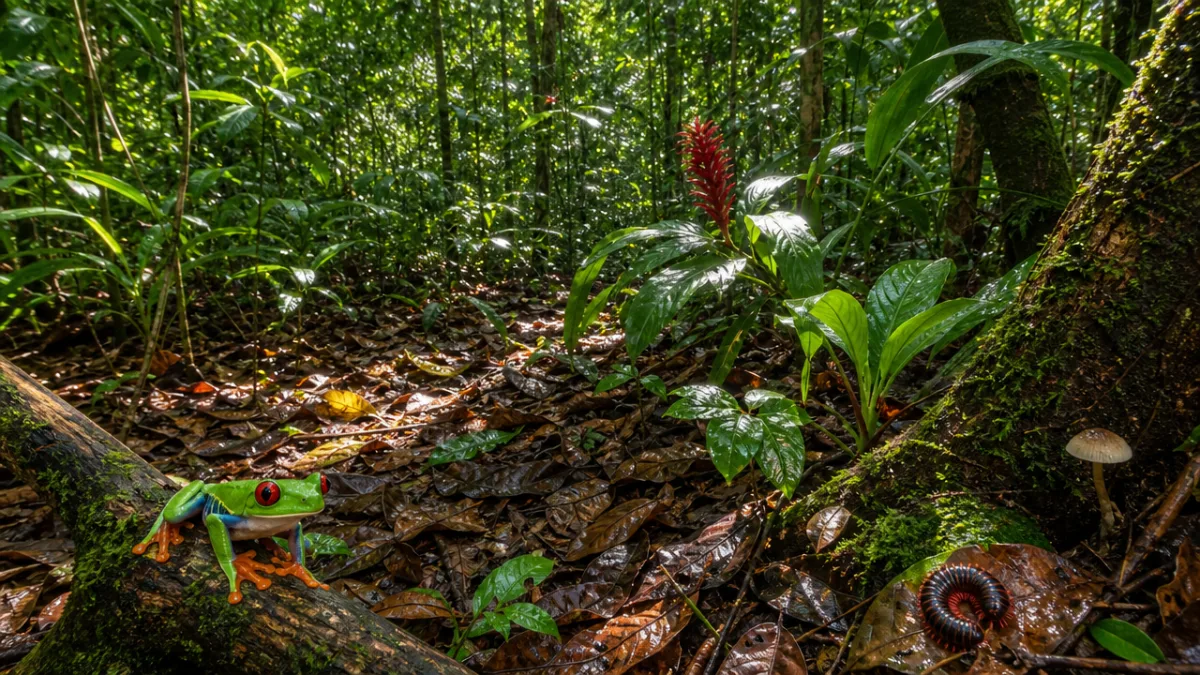
This mushroom likes it warm, humid, and shady. You’ll most often find it growing on decaying leaves, dead twigs, grass stems, and other plant debris on the forest floor, particularly in dense tropical rainforests where moisture hangs in the air and organic matter piles up. The fruiting bodies dry out easily, so they tend to prefer spots where humidity stays consistently high. That said, Marasmius haematocephalus has a neat trick — like other members of its genus, it can actually revive after drying out and get back to dispersing spores once moisture returns. The genus name Marasmius even comes from the Greek word for “withering,” a nod to this unusual resilience.
Geographically, it turns up across a wide tropical belt. Records exist from India, Sri Lanka, Thailand, Malaysia, Indonesia, the Philippines, parts of sub-Saharan Africa, Brazil, Costa Rica, Panama, Trinidad, and elsewhere. This broad range makes sense given how widespread lowland tropical forest conditions are around the equator. The species can show up in both old-growth primary forests and in secondary growth that’s been disturbed, as long as there’s enough leaf litter and moisture to support it. Fruiting tends to peak during rainy seasons, when conditions are most favorable.
Its role in the ecosystem is genuinely important. By breaking down lignin and cellulose in dead plant matter, it releases carbon, nitrogen, phosphorus, and other nutrients back into the soil, where plants and other organisms can use them. It’s a fundamental part of how forests stay fertile and productive. Without decomposers like this one doing their quiet work, dead organic matter would just pile up, nutrients would stay locked away in complex molecules, and the whole system would start to struggle.
Cultural Significance and Aesthetic Appeal
Marasmius haematocephalus isn’t a culinary star like shiitake or lion’s mane, but it’s carved out a well-deserved place in a different kind of fame — natural aesthetics. It’s become a go-to subject for macro photographers and naturalists who love uncovering the hidden beauty of the forest floor. Photos of this species circulate widely across nature photography sites, fungi-focused social media accounts, and scientific illustration archives. The vivid color, the elegant proportions, the way it pops against all that drab brown leaf litter — it’s genuinely hard to take a bad picture of it.
Within the growing mycology enthusiast community, this mushroom has come to represent something that resonates with a lot of people: the idea that extraordinary beauty exists at scales most of us walk straight past without ever noticing. Fungal forays — guided outings in natural settings where people learn to find and document fungi — have been growing in popularity, and stumbling across a cluster of pink Marasmius is frequently one of the highlights for participants. The mushroom has helped shift how many people think about fungi more broadly, moving past the old “food or poison” framework toward a genuine appreciation of their diversity and ecological value.
It’s also found a role in education. Schools, natural history museums, and science communicators have leaned on striking images of Marasmius haematocephalus to pull students and general audiences into conversations about mycology, ecology, and conservation. Because fungi tend to be overshadowed by plants and animals when it comes to public attention and research funding, having a genuinely gorgeous ambassador species helps make the case for paying more attention to this entire kingdom. For a mushroom you could cover with a fingernail, it’s doing a remarkable amount of work.
Scientific Research and Mycological Study
Scientists have been paying steady attention to Marasmius haematocephalus as part of the broader effort to understand the phylogenetics, biochemistry, and ecology of the Marasmiaceae family. DNA sequencing has led to some interesting revelations — what was once treated as a single species may actually be a cluster of morphologically similar but genetically distinct organisms hiding under the same name. This kind of cryptic diversity is surprisingly common in the fungal world, and it’s a good reminder of why relying on appearance alone can only get you so far. Modern mycology really does need both traditional field identification and molecular analysis working together.
On the biochemistry side, researchers have found a range of bioactive compounds in Marasmius species, including pigments, enzymes, and secondary metabolites. The vivid red and pink coloration in caps like those of Marasmius haematocephalus comes from compounds in the haematopodin family — molecules that have attracted some interest for their potential antifungal, antibacterial, or other biological properties. Pharmacological research into this particular species is still in its early stages, but the broader picture of Marasmius biochemistry suggests there may be undiscovered chemical stories worth telling here.
Its ecological role has also drawn scientific attention, particularly in studies of litter decomposition in tropical systems. Researchers looking at which fungi break down leaf litter and woody debris most effectively have found Marasmius species showing up consistently as significant contributors. This is becoming more than just academic interest — as climate change reshapes rainfall patterns, temperature ranges, and forest cover, understanding how fungal communities respond to those shifts matters for predicting how well nutrient cycling will continue to function in affected ecosystems.
Conservation Considerations and Threats
Marasmius haematocephalus hasn’t been formally assessed by the IUCN, and it’s not currently flagged as globally threatened. But that doesn’t mean there’s nothing to worry about. The tropical and subtropical forests it depends on are among the most endangered ecosystems on the planet, and as they go, so do the specific microhabitat conditions this mushroom needs — the right humidity, the right depth of leaf litter, the right amount of shade. Deforestation for agriculture, logging, urban expansion, and infrastructure keeps chipping away at these habitats at a pace that should concern anyone paying attention.
Conservation of this species is therefore inseparable from the broader effort to protect tropical forest ecosystems. The following factors are among the most significant threats to Marasmius haematocephalus and its habitat:
- Deforestation and habitat conversion for palm oil, soy, cattle ranching, and other agricultural uses across Southeast Asia, Africa, and South America.
- Selective logging that removes large trees and opens the forest canopy, dramatically changing the microclimate of the forest floor and reducing humidity.
- Climate change, which is altering rainfall patterns, increasing drought frequency, and raising temperatures in many tropical regions — conditions that are hostile to moisture-dependent microfungi.
- Invasive species, including introduced plants that alter leaf litter composition and soil chemistry, potentially displacing native saprotrophic fungi.
- General underrepresentation of fungi in biodiversity surveys and conservation planning, meaning that fungal species are often not considered when protected areas are designed or management plans are developed.
One practical upside of having such a visually striking species is that it can actually help make the case for conservation. When people encounter images of this tiny pink mushroom and realize it exists in forests that are being cleared, it tends to land differently than abstract statistics about biodiversity loss. Citizen science platforms that invite people to photograph and submit fungal records are also quietly expanding what we know about where species like this actually live, helping to identify hotspots of mycological diversity that might deserve protection — or at least a closer look.
How to Observe Marasmius Haematocephalus in the Wild
If you’re lucky enough to be in or visit a tropical region where this species occurs, seeing it in person is genuinely worth the effort. The trick is slowing way down. These fruiting bodies are small — sometimes no bigger than a fingernail — and anyone moving at a normal walking pace is almost certainly going to miss them entirely. The best approach is to get low, crouch or kneel close to the forest floor, and scan slowly and methodically through the leaf litter in shaded areas beneath broad-leaved trees. You’re looking for a tiny flash of pink or red against the browns and grays of decomposing leaves.
Timing helps a lot. Fruiting is most reliable during and just after heavy rainfall, when humidity is high and the soil is well saturated. Early mornings tend to be particularly productive — the air is cooler and more humid, and the mushrooms haven’t yet been exposed to the drying heat of midday. A hand lens or jeweler’s loupe is really worth bringing along. With the naked eye you can spot the cap color, but up close the texture, gill structure, and stem details become visible, and that’s where a lot of the visual magic actually lives.
When you do find them, please observe responsibly. Photograph rather than collect wherever possible, especially in areas where the species might be rare or where collection isn’t permitted. If you’re collecting for legitimate scientific purposes, do so sparingly and follow local rules. Avoid moving leaves aside for a better shot — it can disturb the mycelium underneath and damage the very microhabitat keeping the mushroom alive. And if you post your photos to a platform like iNaturalist, you’re contributing to citizen science databases that help track fungal distributions globally, which in the long run is far more valuable than any single photograph in isolation.








What do you think?
It is nice to know your opinion. Leave a comment.