










Low-Maintenance Container Gardening Flowers for Full Sun: A Complete Guide
Container gardening has become one of the most popular ways to bring color, life, and beauty to patios, balconies, decks, and entryways. For gardeners who want stunning results without spending hours on upkeep, choosing the right flowers for full sun containers is the single most important decision you can make. The good news is that nature has gifted us with a remarkable range of blooms that thrive in direct sunlight and ask very little in return. With the right selections and a few smart strategies, you can enjoy vibrant, long-lasting displays all season long without feeling chained to your watering can or fertilizer schedule.
The challenge that most beginning container gardeners face is the assumption that more exotic or elaborate flowers will produce a more impressive display. In reality, the plants that deliver the most consistent, season-long color in sun-drenched containers tend to be the workhorses — the varieties that have been cultivated and refined over generations specifically for heat tolerance, drought resistance, and continuous flowering. These plants have evolved or been bred to handle the intense conditions of a container environment, where roots heat up faster, soil dries out more quickly, and the margin for neglect is narrower than in the ground.
This guide will walk you through the best low-maintenance flowering plants for full sun containers, explain how to set up your containers for maximum success, and give you the practical tips you need to keep your displays looking their best with minimal effort. Whether you’re a seasoned gardener looking to simplify your routine or a complete beginner stepping into container gardening for the first time, these recommendations and strategies will help you create a thriving, colorful outdoor space that practically takes care of itself.
Understanding Full Sun Container Conditions
Before selecting plants, it’s essential to understand what “full sun” actually means in the context of container gardening, because it’s a more demanding environment than most people initially realize. Full sun is generally defined as six or more hours of direct sunlight per day, but containers placed in full sun locations can experience conditions far more intense than the ground nearby. The walls of a pot absorb heat from the sun and radiate it inward toward the roots, raising soil temperatures dramatically — sometimes 10 to 20 degrees Fahrenheit higher than air temperature on a hot summer afternoon.
This elevated root temperature, combined with the limited soil volume in a container, means that moisture evaporates at a significantly faster rate than in a traditional garden bed. A terra cotta pot in direct sun on a hot day may need watering twice daily during peak summer heat, while a similarly situated in-ground planting might go days between waterings. This is why plant selection is so critical — the flowers you choose must be genuinely adapted to heat and periodic moisture fluctuation, not just tolerant of bright light. There’s a meaningful difference between a plant that can survive full sun and one that genuinely thrives in it.
Container size, material, and color also play significant roles in managing full sun conditions. Larger containers retain moisture longer and buffer root temperatures more effectively, making them better choices for demanding sunny spots. Light-colored containers reflect heat rather than absorbing it, which can make a noticeable difference in root zone temperature on the hottest days. Dark-colored pots and metal containers can become extremely hot and may stress or damage plant roots even when the foliage looks perfectly healthy above the soil line. Understanding these dynamics helps you make smarter choices before you ever buy a single plant.
The Best Low-Maintenance Flowers for Sun Containers
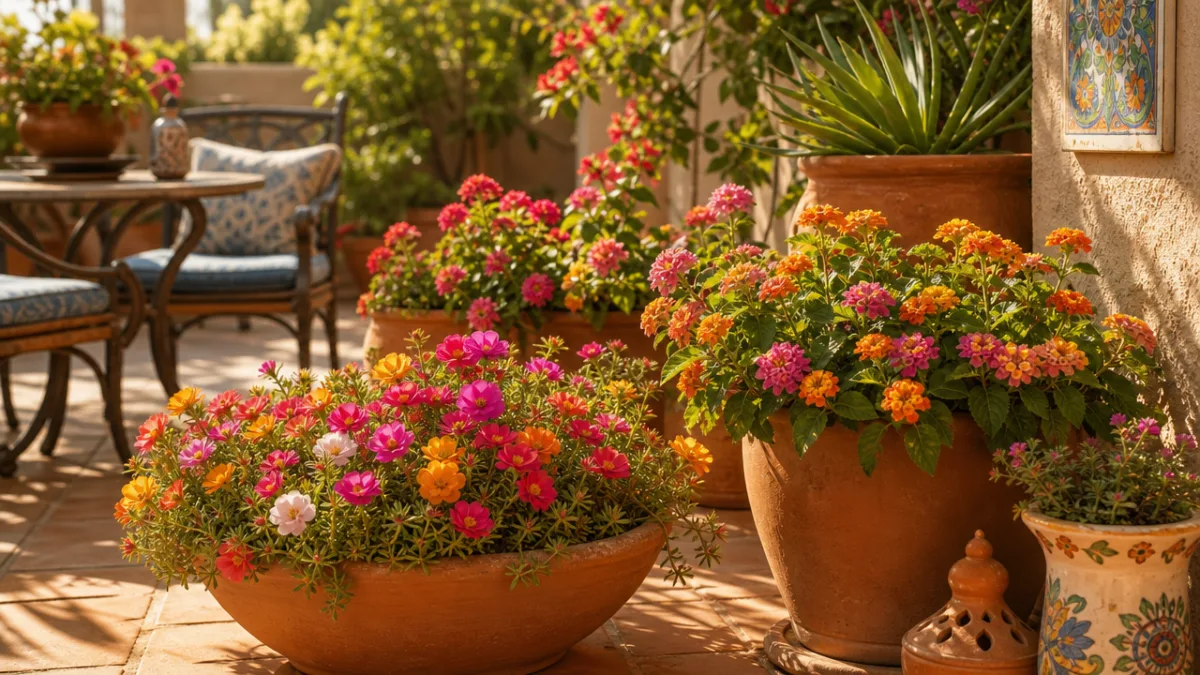
Portulaca, also known as moss rose, is perhaps the single most foolproof full sun container flower available to home gardeners. This succulent-like annual produces jewel-bright flowers in shades of magenta, orange, yellow, pink, and white, often with a silky, almost iridescent quality to the petals. What makes portulaca exceptional for low-maintenance situations is its remarkable drought tolerance — it stores water in its fleshy leaves and stems, meaning it can handle missed waterings that would devastate most other flowering plants. It actually tends to bloom more prolifically when grown slightly on the dry side, making it almost uniquely forgiving for gardeners with irregular schedules.
Lantana is another powerhouse performer for hot, sunny containers. A tropical perennial grown as an annual in cooler climates, lantana produces dense clusters of tiny florets in bicolor combinations — orange and yellow, pink and orange, red and gold — that shift and deepen as they age on the plant. Few flowering plants can match lantana’s combination of heat tolerance, continuous blooming, and butterfly-attracting power. It’s genuinely difficult to overdo it with sun and heat when it comes to lantana; the hotter and sunnier the spot, the more vigorously it tends to perform. Once established, it requires minimal watering and almost no deadheading, as spent flower clusters drop away cleanly on their own.
Additional excellent choices for low-maintenance full sun containers include a wide range of proven performers that experienced container gardeners rely on season after season. Marigolds offer cheerful orange and yellow hues along with natural pest-deterring properties, while zinnias provide a kaleidoscope of colors and exceptional heat tolerance. Vinca, also called Madagascar periwinkle, is almost indestructible in hot sun and blooms continuously without any deadheading required. Calibrachoa, sometimes called million bells, produces a cascade of small petunia-like flowers in dozens of color combinations and keeps blooming all season with only basic fertilization. Geraniums, particularly the zonal varieties, remain classic container performers that tolerate heat, bounced back from occasional dryness, and bloom for months on end with minimal fuss.
Setting Up Your Containers for Success
The foundation of a successful low-maintenance container garden lies in getting the setup right from the very beginning. Cutting corners on container preparation means more work, more problems, and less satisfying results throughout the season. Start with the largest containers your space and budget allow, because bigger containers mean more soil volume, which translates directly into more moisture retention, more nutritional reserves, and greater stability in temperature extremes. A pot that seems too large when you plant it in spring will likely feel perfectly proportioned by midsummer when your plants have filled in and are at their peak of performance.
Soil selection is arguably the most important single factor in container gardening success. Never use garden soil in containers — it compacts quickly, drains poorly, and can harbor pathogens that thrive in the warm, moist conditions of a pot. Instead, choose a high-quality potting mix specifically formulated for containers. Look for mixes that contain perlite or coarse sand for drainage, along with some moisture-retaining components like coconut coir or aged bark. For full sun containers, consider mixing in water-retaining granules or crystals, which can dramatically extend the time between waterings by absorbing and slowly releasing moisture as the soil dries.
Drainage is a non-negotiable requirement for container gardening. Every container you use for flowers must have drainage holes in the bottom, and those holes must be large enough to allow water to flow freely. Without adequate drainage, excess water accumulates around roots and creates anaerobic conditions that lead to root rot — a common and often fatal condition for container plants. If you fall in love with a decorative pot that lacks drainage holes, use it as a cachepot by placing a plain nursery container with drainage holes inside it, allowing you to remove the inner pot for watering and then replace it after draining. This approach gives you both aesthetic appeal and proper plant health management.
Watering and Fertilizing Strategies for Busy Gardeners
Even the most drought-tolerant full sun flowers need consistent watering during the heat of summer, but that doesn’t mean you need to water every single day. The key is learning to water deeply and less frequently rather than shallowly and constantly. When you water, apply enough to thoroughly saturate the entire root zone and allow water to drain freely from the bottom of the container. This encourages roots to grow deeper into the pot, where they’re somewhat insulated from surface heat and have access to moisture that evaporates more slowly from deeper soil layers. Shallow, frequent watering keeps roots near the surface where they’re vulnerable to heat and drying.
For gardeners who travel frequently or simply struggle to maintain consistent watering schedules, self-watering containers are a genuine game changer. These clever planters feature a reservoir built into the base that holds water, which is drawn up into the soil through capillary action as needed by the plants. A well-sized self-watering container can supply moisture to your flowers for several days to a week between refills, dramatically reducing the frequency of attention required. Many gardeners find that switching to self-watering containers essentially eliminates the single biggest challenge of full sun container gardening — the constant demand for moisture in hot weather.
Fertilizing container plants is more critical than fertilizing ground-planted flowers because nutrients in containers are depleted through a combination of plant uptake and the frequent leaching that occurs during watering. A slow-release granular fertilizer mixed into the potting soil at planting time provides a baseline of nutrition that feeds plants steadily over the course of several months. Supplementing this with a liquid fertilizer every two to three weeks during the active growing season — particularly one with a higher phosphorus and potassium content to promote flowering rather than excessive leaf growth — keeps plants performing at their peak. For the truly low-maintenance approach, choose a high-quality slow-release fertilizer with a longer duration formula and let it do the work for you.
Designing Stunning Container Combinations
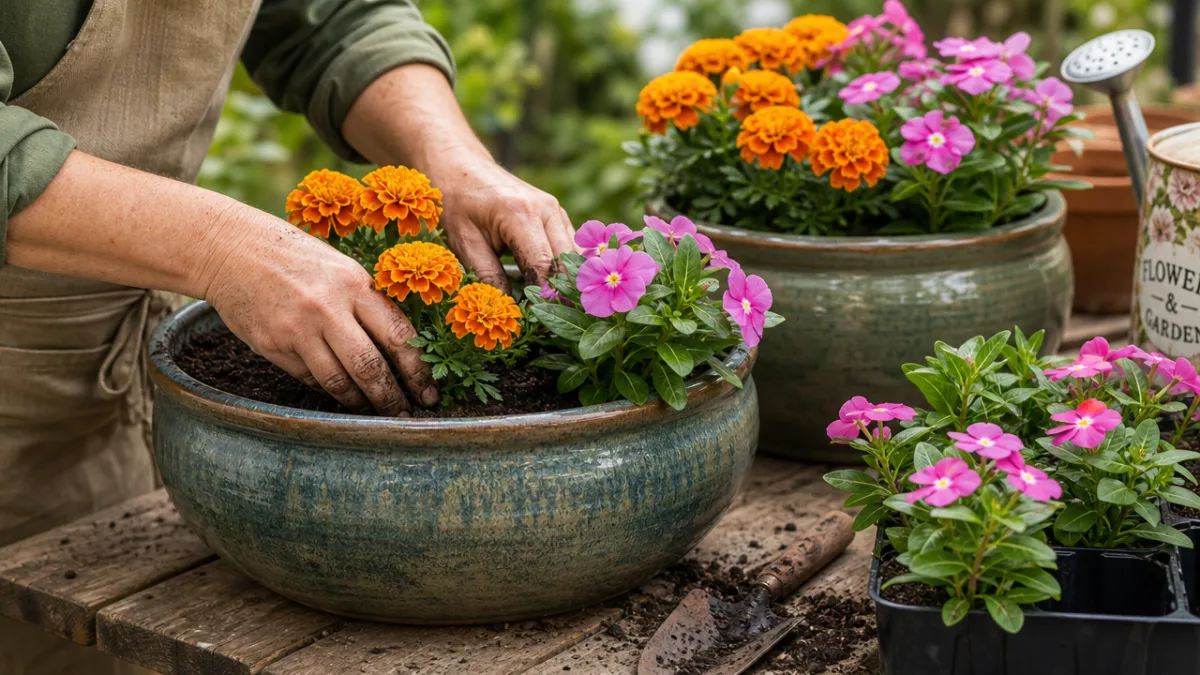
The “thriller, filler, spiller” design formula is one of the most useful frameworks for creating beautiful, balanced container combinations that look professionally designed even for beginners. The thriller is the tall, eye-catching centerpiece plant that gives the arrangement height and drama — think a bold ornamental grass, a tall salvia, or a dramatic spike plant. The fillers are the mounding plants that bulk out the middle layer of the arrangement with dense foliage and flowers — marigolds, geraniums, and vinca all excel in this role. The spillers are trailing plants that cascade over the edges of the container, softening the transition between pot and plant — calibrachoa, verbena, and sweet potato vine are classics in this role.
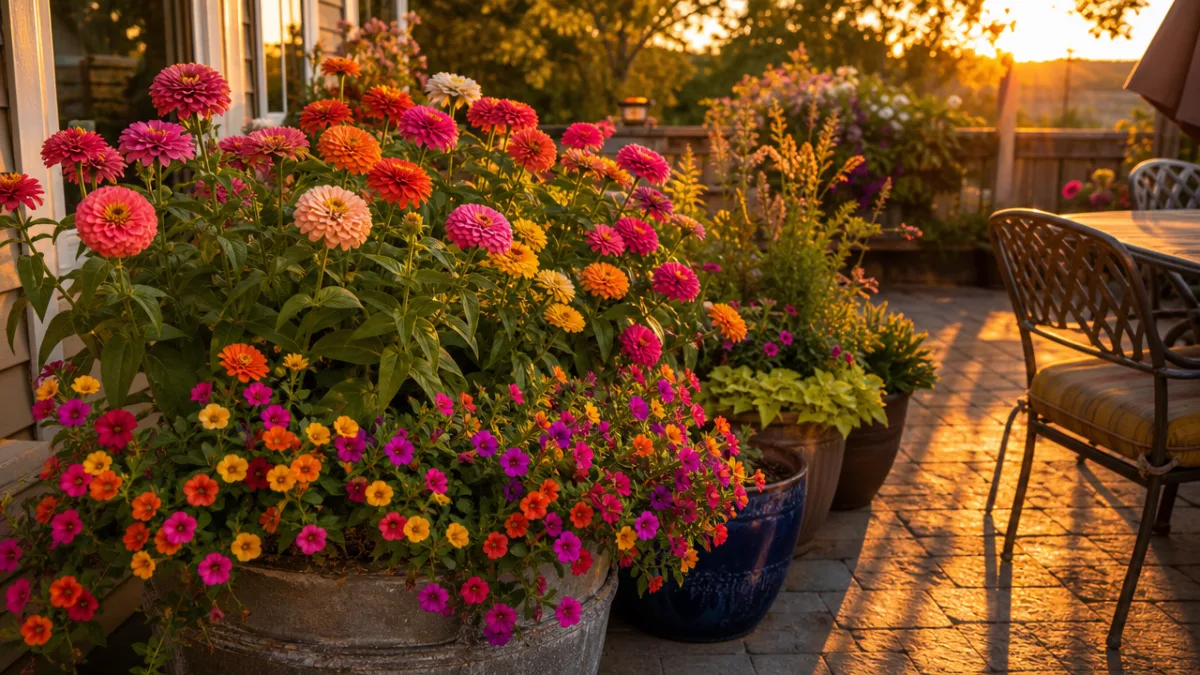
Color selection can feel overwhelming when you’re standing in a garden center surrounded by hundreds of beautiful options, but a few simple principles make the process manageable. Monochromatic combinations — different flowers in the same color family — create an elegant, sophisticated look that’s hard to get wrong. Complementary color schemes, pairing colors opposite each other on the color wheel such as orange and purple or yellow and violet, create high-energy, vibrant combinations that command attention from a distance. Analogous combinations using colors that sit adjacent to each other on the wheel — like pink, coral, and orange — feel harmonious and inviting. When in doubt, sticking with two or three colors rather than trying to include everything creates more visually cohesive results.
Don’t overlook the power of foliage in full sun container designs. While the flowers are naturally the stars of the show, interesting foliage plants used as thrillers or fillers add texture, depth, and visual interest even when flowering plants are between bloom cycles. Coleus varieties bred for sun tolerance offer spectacular patterns in combinations of red, green, purple, gold, and chartreuse. Dusty miller provides a soft, silvery contrast that makes surrounding flower colors appear more vivid by comparison. Persian shield, with its iridescent purple and silver foliage, adds an almost jewel-like quality to any combination. These foliage plants ask for nothing more than sun, water, and basic fertilization while contributing enormously to the overall impact of your display.
Seasonal Care and End-of-Season Tips
Successful low-maintenance container gardening requires a slightly different approach at different points in the growing season. In spring, when nights are still cool and the risk of frost lingers in many regions, resist the temptation to plant tender sun-lovers like portulaca, lantana, and vinca too early. These plants sulk in cold temperatures and may actually perform worse for the entire season if they experience cold stress during establishment. Wait until nighttime temperatures are consistently above 50 to 55 degrees Fahrenheit before placing heat-loving tropicals and annuals outdoors, and your patience will be rewarded with plants that establish quickly and hit their stride much sooner.
Midsummer sometimes brings a period called the “summer slump,” during which some container flowers temporarily slow their blooming during the most intense heat of the season. This is a natural physiological response — many plants redirect energy away from flower production when temperatures consistently exceed certain thresholds. The best response is patience combined with consistent watering and fertilizing. Many plants that slow during peak heat will resume prolific blooming when temperatures moderate slightly in late summer and early fall. A light trimming of tired, overgrown plants in midsummer — cutting them back by about one-third — can also revitalize their energy and trigger a fresh flush of late-season growth and blooming.
As the growing season winds down in fall, there are several strategies that maximize your enjoyment of container plants and set you up for success in the following year. In regions where winters are mild, some of the “annuals” grown in containers — including lantana, geraniums, and coleus — can actually be overwintered indoors as houseplants and returned outdoors the following spring. This can represent significant savings on plants you particularly love. Take cuttings from your favorite performers in early fall, root them in water or a light potting mix, and overwinter them on a sunny windowsill. At the end of the season, empty and clean your containers thoroughly, allow them to dry completely before storing to prevent cracking, and your investment in quality pots will pay dividends for years to come.
Troubleshooting Common Full Sun Container Problems
Even the most carefully designed and tended container garden will occasionally encounter challenges, and knowing how to diagnose and address common problems quickly is what separates experienced container gardeners from frustrated beginners. Wilting is the most common issue gardeners encounter in full sun containers, but it’s important to remember that wilting can be caused by both too little and too much water. The diagnosis is simple: check the soil moisture. If the soil is bone dry, the plant needs water immediately and thorough watering should revive it within a few hours. If the soil is wet and the plant is still wilting, root rot from overwatering or poor drainage is the likely culprit, and the prognosis is more serious.
Yellowing leaves in full sun containers can indicate several different underlying issues, and identifying the correct cause requires a bit of detective work. Yellow leaves at the base of the plant that progress upward often signal nitrogen deficiency, which is addressed with balanced fertilization. Yellow leaves accompanied by green veins — a pattern called interveinal chlorosis — typically indicate iron or magnesium deficiency, often caused by a soil pH that’s too high, which locks these minerals into forms the plant can’t absorb. Sudden yellowing of many leaves simultaneously, particularly when accompanied by wilting, often points to root damage from heat, salt buildup, or root rot. Each of these causes has a different solution, so accurate diagnosis is essential before treating.
Pests are a reality of any garden, but healthy, well-maintained container plants in full sun tend to be more resistant to pest pressure than stressed or weakened plants. Aphids, spider mites, and whiteflies are the most common visitors to full sun containers, all of which can be managed effectively with targeted interventions that don’t require harsh chemicals. A strong spray of water from the garden hose dislodges aphids and spider mites effectively and can be repeated every few days until the population is controlled. Insecticidal soap spray, which is available at any garden center and can also be made at home from dish soap diluted in water, provides effective control of soft-bodied insects on contact without leaving persistent residues that would harm beneficial insects visiting your flowers. Consistent monitoring — simply looking closely at your plants during your regular watering visits — allows you to catch pest problems early when they’re easiest to address.








What do you think?
It is nice to know your opinion. Leave a comment.