










Identifying 20 Plants That Thrive in the Desert: A Comprehensive Guide
Understanding Desert Environments and Plant Adaptation
Desert ecosystems are among the most demanding environments on Earth, characterized by extreme temperature fluctuations, scarce rainfall, intense solar radiation, and nutrient-poor soils. Yet despite these harsh conditions, an astonishing variety of plant life has evolved to not merely survive but genuinely flourish in arid landscapes. Understanding the fundamental challenges these plants face is the first step toward appreciating the remarkable biological engineering that allows them to thrive where most vegetation would perish within days.
The primary challenge desert plants must overcome is water scarcity. Most desert regions receive fewer than ten inches of rainfall annually, and that precipitation often arrives unpredictably in brief, intense bursts. Plants adapted to these conditions have developed an extraordinary range of strategies: some store water in thick, fleshy tissues; others send roots dozens of feet deep to reach underground aquifers; still others complete their entire life cycles during the brief wet seasons, spending most of the year as dormant seeds waiting for the right moment to germinate, bloom, and reproduce.
Temperature extremes add another layer of difficulty. Desert surfaces can reach temperatures exceeding 150 degrees Fahrenheit during summer days, then plummet to near freezing on winter nights. Desert plants have evolved physical and chemical adaptations to manage these swings, including reflective surfaces that deflect solar energy, waxy coatings that prevent moisture loss, and metabolic processes that operate efficiently across a wide thermal range. Recognizing these adaptations helps us identify desert plants in the field and understand why they look the way they do.
Iconic Cacti: The Quintessential Desert Survivors
No group of plants is more synonymous with desert life than cacti, and for good reason. The cactus family, Cactaceae, contains over 1,700 species, virtually all of them native to the Americas, and their success in arid environments represents one of evolution’s most elegant solutions to water stress. The defining feature of cacti is their succulent stems, which function as water storage organs, swelling during rainfall and slowly shrinking as the plant draws on reserves during dry periods. Their spines, which are modified leaves, reduce surface area for moisture loss while providing shade and defense against herbivores.
The Saguaro cactus (Carnegiea gigantea) is perhaps the most recognizable desert plant in the world, its towering columnar form dominating the Sonoran Desert of Arizona and northwestern Mexico. A mature Saguaro can reach forty feet in height, weigh several tons when fully hydrated, and live for two hundred years or more. Its accordion-like pleated skin expands dramatically after rainfall to accommodate the enormous volumes of water it absorbs through a shallow but wide-spreading root system. The Saguaro supports an entire ecosystem, providing nesting cavities for Gila woodpeckers and elf owls, and offering nectar, pollen, and fruit to dozens of animal species.
Other notable cacti include the Barrel cactus (Ferocactus species), which stores water in a ribbed cylindrical body and was historically used by desert travelers as an emergency water source; the Prickly Pear (Opuntia species), whose flat pads and sweet red fruits are edible and widely used in cuisine; the Organ Pipe cactus (Stenocereus thurberi), which produces multiple stems from a single base; and the diminutive Hedgehog cactus (Echinocereus species), beloved for its spectacular magenta blooms. Each of these species represents a slightly different evolutionary approach to the same fundamental problem of surviving without reliable water.
Succulents Beyond Cacti: Agaves, Aloes, and More
While cacti dominate the popular imagination, the broader category of succulents encompasses hundreds of plant families that have independently evolved water-storing tissues. Succulence is not a single evolutionary event but rather a convergent strategy that has arisen dozens of times across the plant kingdom in response to similar environmental pressures. This means that plants as distantly related as euphorbias, ice plants, and jade plants can all display strikingly similar physical characteristics because they have solved the same biological problem in the same general way.
Agaves are among the most dramatic and ecologically important succulents of North American deserts. The Century Plant (Agave americana) grows slowly for decades, accumulating energy in its rosette of thick, spine-tipped leaves, then sends up a towering flower stalk that can reach thirty feet before the plant dies, having devoted its entire life’s resources to a single spectacular reproductive effort. Other agave species, including Blue Agave (Agave tequilana), are economically critical, forming the basis of the tequila industry. The fibrous leaves of many agaves were historically used by Indigenous peoples to make rope, sandals, and baskets.
Aloes, though native to Africa and the Arabian Peninsula rather than the Americas, have become iconic desert plants worldwide and are widely cultivated in arid gardens everywhere. Aloe vera is the most commercially significant, prized for the soothing gel contained within its fleshy leaves and used in cosmetics, pharmaceuticals, and food products. The Joshua Tree (Yucca brevifolia), a yucca rather than a true tree, creates the otherworldly silhouette of California’s Mojave Desert. Other notable succulents include Elephant Bush (Portulacaria afra), Echeveria species with their perfect geometric rosettes, and the various stonecrops (Sedum species) that colonize rocky desert slopes.
Desert Shrubs and Trees: Woody Plants of Arid Landscapes
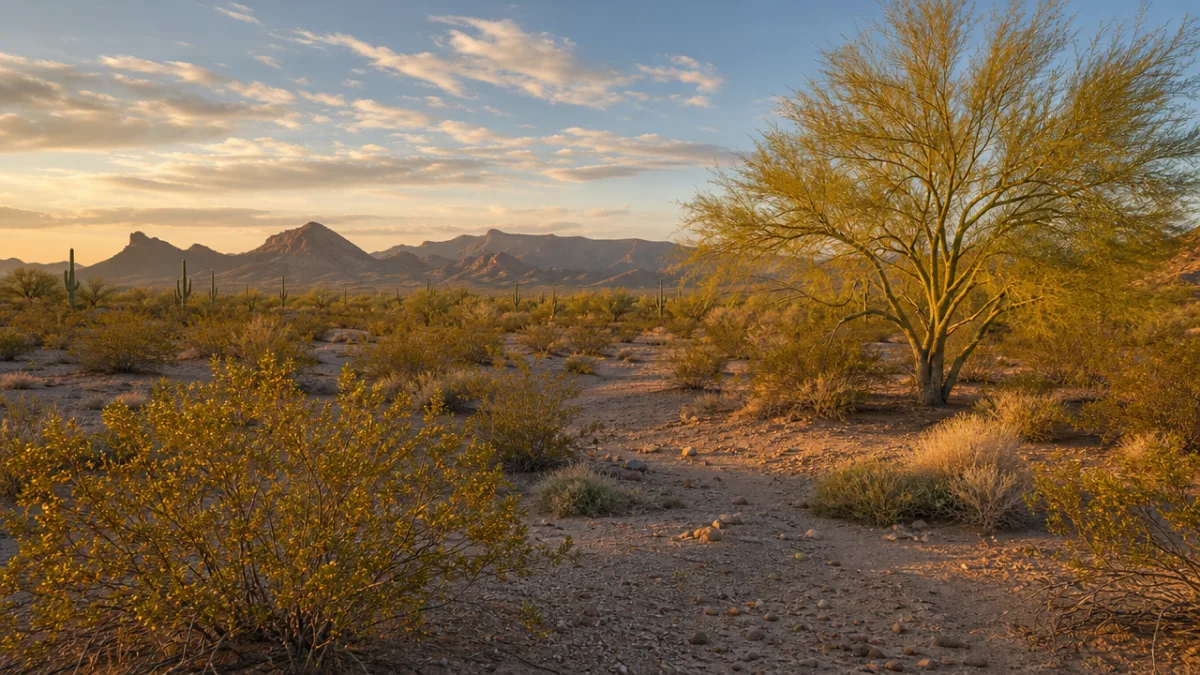
Beyond succulents, many desert plants have adapted to aridity through the woody shrub or tree growth form, which allows them to raise their leaves and reproductive structures above the scorching ground surface while investing in permanent structural tissue. These plants often have small, drought-deciduous leaves that they shed during the driest periods, deep and extensive root systems that far outweigh their above-ground biomass, and various biochemical strategies for managing the physiological stress of water deficit. Desert shrubs and trees are often the structural foundation of their ecosystems, providing shade, shelter, and food for countless other organisms.
The Creosote Bush (Larrea tridentata) is arguably the most ecologically dominant shrub in North American hot deserts, covering vast expanses of the Chihuahuan, Sonoran, and Mojave Deserts with its resinous, yellow-green foliage. Its characteristic sharp, medicinal scent intensifies dramatically after rainfall, creating the beloved smell many people associate with desert rain. Remarkably, some creosote bushes are among the oldest living organisms on Earth: a ring clone in the Mojave Desert, known as King Clone, is estimated to be over eleven thousand years old, having spread outward from a single original plant since the end of the last Ice Age.
The Palo Verde (Parkinsonia species) solves the transpiration problem elegantly by performing photosynthesis in its green bark rather than relying on leaves, allowing it to shed foliage during drought while still producing energy. The Mesquite tree (Prosopis species) is famous for sending taproots down sixty feet or more to reach deep water tables, earning it the nickname “the world’s deepest-rooted plant.” Desert Willow (Chilopsis linearis), not a true willow despite its name, produces orchid-like flowers that attract hummingbirds and bees. The African Acacia trees, now widespread in arid regions globally, form the iconic silhouette of savanna and desert edge environments worldwide.
Wildflowers and Annuals: The Desert’s Brief Burst of Color
Among the most spectacular natural events in any desert region is the emergence of annual wildflowers following adequate winter rainfall. These plants have evolved perhaps the most extreme form of drought avoidance: they simply do not exist as growing plants during the dry season at all. Instead, they persist as seeds, often protected by chemical germination inhibitors that prevent them from sprouting until rainfall has been sufficient to promise a reasonable chance of completing their life cycle. When conditions align perfectly, the results can be breathtaking, carpeting previously bare desert floors with millions of blooms in what ecologists and photographers call a superbloom.
The Desert Poppy (Eschscholzia species) and the Arizona Poppy (Kallstroemia grandiflora) are among the most beloved desert wildflowers, their vivid orange and gold petals creating rivers of color across desert washes and hillsides in good years. Desert Lupine (Lupinus sparsiflorus) adds purples and blues to the palette, while the Owl’s Clover (Castilleja exserta) contributes deep rose and magenta. The Desert Marigold (Baileya multiradiata) is exceptional among annuals in that it can also persist as a short-lived perennial in favorable locations, providing almost year-round color in warmer desert gardens.
Perennial wildflowers and herbaceous plants also play important roles in desert ecosystems. The Desert Globemallow (Sphaeralcea ambigua) produces brilliant orange flowers on upright stems and blooms repeatedly across multiple seasons. Brittlebush (Encelia farinosa), with its silvery-gray foliage and cheerful yellow daisy flowers, is a common and attractive component of Sonoran Desert plant communities. The Sacred Datura (Datura wrightii) opens its enormous white trumpet flowers only at night, pollinated by hawk moths whose long tongues can reach the nectar at the base of the flower. These wildflowers collectively support pollinators, seed eaters, and herbivores throughout the year.
Desert Plants in Landscaping: Cultivating Arid Beauty
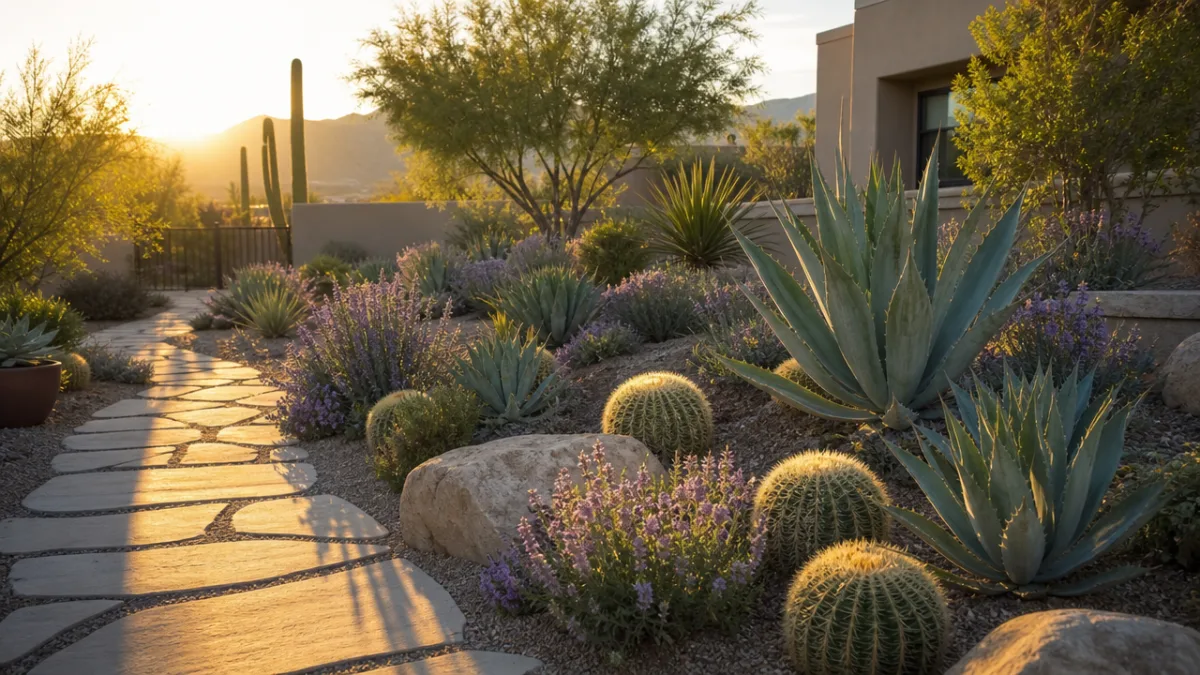
The growing recognition of water scarcity as a critical resource issue has driven enormous interest in xeriscaping, the practice of designing landscapes that require little or no supplemental irrigation beyond natural rainfall. Desert plants are the cornerstone of this approach, offering not just water efficiency but extraordinary diversity of form, texture, and seasonal interest. A well-designed xeriscape can be far more visually dynamic than a conventional lawn-dominated landscape, moving through cycles of bloom, seed production, and dormancy that connect the garden to natural ecological rhythms.
When selecting desert plants for landscaping, it is important to match species to local conditions rather than simply choosing whatever looks appealing in a nursery. Plants native to the Sonoran Desert may not tolerate the colder winters of high-elevation deserts, while Mojave species might struggle with the summer humidity of coastal California. Soil drainage is equally critical: most desert plants are exquisitely sensitive to root rot caused by standing water, and even drought-tolerant species will quickly decline in poorly drained clay soils. The following plants are particularly well-suited to low-water landscaping in warm, arid climates:
- Agave parryi (Parry’s Agave): A compact, symmetrical agave that tolerates cold better than most, making it suitable for high-desert gardens.
- Hesperaloe parviflora (Red Yucca): Produces tall, arching stems of coral-red flowers beloved by hummingbirds, with almost no care required once established.
- Leucophyllum frutescens (Texas Sage): A native shrub that bursts into lavender bloom following monsoon rains, sometimes called the “barometer bush” for this response.
- Salvia greggii (Autumn Sage): A long-blooming perennial available in red, pink, white, and coral, highly attractive to butterflies and hummingbirds.
- Echinocactus grusonii (Golden Barrel Cactus): An architectural cactus whose golden spines glow dramatically in low-angle sunlight, excellent as a focal point plant.
- Opuntia santa-rita (Santa Rita Prickly Pear): Stunning purple-tinted pads that intensify in color during cold weather, producing yellow flowers and red fruit.
Maintenance of desert landscapes, once plants are established, is far less demanding than traditional gardening but does require some knowledge and attention. Pruning should be done thoughtfully and sparingly, as many desert plants have evolved their natural forms over millennia and do not respond well to aggressive cutting. Fertilization is generally unnecessary and can actually harm plants adapted to nutrient-poor soils by promoting lush, soft growth vulnerable to pests and temperature extremes. Perhaps the most common mistake in desert landscaping is overwatering established plants, which are physiologically programmed for drought and can be killed by kindness. Learning to read the plants themselves, observing when they show signs of genuine stress versus simply appearing dormant, is the foundation of successful desert gardening.
Conservation and the Future of Desert Plants
Desert plant communities worldwide face escalating threats from climate change, urban expansion, off-road vehicle use, illegal collection, and invasive species. The accelerating pace of climate change is particularly concerning because it alters the delicate balance of temperature and precipitation cues that govern desert plant life cycles, potentially disrupting the relationships between plants and their pollinators that have coevolved over millions of years. Range shifts are already being documented, with some desert plant species moving to higher elevations or latitudes as their historical habitats become too extreme even for them, while invasive grasses like Red Brome and Buffelgrass are transforming fire regimes in ways that kill cacti and other native plants that have no evolutionary experience with frequent burning.
Conservation efforts for desert plants take many forms. Botanical gardens and seed banks around the world are working to preserve genetic diversity of rare and threatened desert species. Organizations like the Tucson-based Desert Botanical Garden and the Huntington Botanical Gardens in California conduct research, maintain living collections, and educate the public about desert plant conservation. Legislation protecting native plant collection on public lands has helped reduce the illegal cactus poaching that decimated some wild populations in the twentieth century, though enforcement remains challenging across vast, remote desert territories.
Individual gardeners and homeowners can contribute meaningfully to desert plant conservation by choosing locally native species for their landscapes, avoiding plants propagated from wild-collected specimens, supporting water-wise landscaping policies in their communities, and participating in citizen science programs that track the health and distribution of native plant populations. The twenty plants explored throughout this guide represent just a fraction of the extraordinary botanical diversity found in the world’s desert regions, each one the product of millions of years of evolutionary refinement. By learning to identify, appreciate, and protect them, we help ensure that these remarkable organisms continue to shape and sustain some of our planet’s most distinctive and irreplaceable ecosystems for generations to come.








What do you think?
It is nice to know your opinion. Leave a comment.