










Secret Garden Ideas: How To Create A Magical Backyard Hidden Garden
What Is a Secret Garden and Why Every Backyard Needs One
A secret garden is so much more than just a neglected corner of your yard — it’s a deliberate escape, a place where the noise of everyday life fades out and something quieter and more enchanting takes over. The idea has deep roots in literary tradition and landscape history, drawing on this romantic notion of a space you discover rather than one that’s simply there. Think walled courtyards in crumbling European estates, moss-covered archways leading nowhere in particular, or a wooden gate half-swallowed by climbing roses. What makes it magical is that feeling of arrival — like you’ve stepped somewhere genuinely apart from the rest of the world.
Here’s the thing — you don’t need a sprawling estate or a landscape architect on speed dial to pull this off. Backyards of almost any size can fit a hidden garden if you go about it with some intention. Even a small urban lot can be broken into zones using tall hedges, trellises, or a well-placed structure, so that one area feels completely separate from another. The trick is designing for discovery — creating a journey through your garden rather than revealing everything the moment you step outside.
And beyond just looking beautiful, secret gardens actually do something for you mentally. Research consistently shows that time spent in enclosed green spaces lowers cortisol, reduces blood pressure, and helps you feel more grounded. When a garden is hidden from view, it adds another layer to that effect — a sense of being sheltered and held by the landscape around you. Whether you use it for reading, meditation, or just sitting quietly with a cup of tea, having a proper refuge in your own backyard can make a surprisingly real difference to your day-to-day wellbeing.
Choosing the Perfect Spot: Location and Layout Fundamentals
The single most important decision you’ll make is where to put your secret garden. Before you do anything else, walk your backyard at different times of day and watch how the light moves. A south-facing corner gets the most sun and works beautifully if you want to grow flowers, herbs, or vegetables. A shadier, north-facing spot can become something else entirely — a cool, moody, fern-filled retreat that feels atmospheric even on the hottest summer days. Neither is better than the other; it all depends on the mood and function you’re going for.
Don’t think of existing structures and features as obstacles — treat them as starting points. A garden shed, a boundary fence, a mature tree, or even a change in ground level can all become the anchor your hidden garden is built around. Rather than starting completely from scratch, look for places that already feel slightly separate — a corner that’s not easily visible from the house, a low spot screened by existing shrubs, or a stretch of fence just waiting for a trellis. Working with what’s already there almost always saves money, saves time, and produces something that feels more genuinely settled than an entirely imposed layout.
Pathways are one of those things that rarely get enough credit in garden design, but they matter enormously here. The route into your secret garden should feel considered — gently curved rather than arrow-straight, narrow enough to feel intimate, and surfaced with something that fits the mood you’re creating. Stepping stones set into moss, a gravel path edged with lavender, a simple worn dirt track — each of these tells a different story. The path is the beginning of the experience, and it should build just enough anticipation that arriving in the hidden space feels like a genuine reward.

Enclosure and Structure: Creating the Feeling of Hiddenness
What really defines a secret garden — more than any single plant or decorative detail — is enclosure. That sense of being surrounded, sheltered, and set apart. The good news is you don’t need to build actual walls to achieve it. Some of the most beautiful hidden gardens rely almost entirely on planting to create their boundaries. Tall ornamental grasses, dense shrubs like boxwood or yew, climbers trained onto a simple post-and-wire system, or columnar trees like hornbeam can all establish the feeling of walls without a single brick. Living boundaries also get better with age, which is a pretty nice bonus.
If you prefer something more defined, there are classic architectural elements that feel right at home in a secret garden. A wooden pergola draped in wisteria or climbing hydrangea creates an overhead canopy that signals enclosure from above. A picket fence or split-rail fence smothered in roses sets a clear boundary while keeping things soft and romantic. Stone walls, if the budget stretches, are probably the most atmospheric option going — they hold warmth, develop beautiful moss and lichen over time, and carry a sense of permanence that nothing else quite replicates. You can mix and match all of these depending on what suits your style and your wallet.
Entrances deserve special thought, because that’s the moment of transition — the threshold between the ordinary garden and whatever lies beyond. A moon gate, which is a circular opening cut into a wall or hedge, is one of the most dramatic options and has its roots in traditional Chinese garden design. A simple wooden arch smothered in roses or clematis works just as well in a more classic Western setting. Even a gap in a hedge, marked by a shift in underfoot material or a pair of flanking pots, can be enough to signal that you’re crossing into somewhere different. The entrance doesn’t need to be grand — it just needs to feel like a beginning.
Planting Schemes: The Plants That Make a Garden Feel Magical
This is where your secret garden really finds its personality. The most enchanting hidden gardens tend to share a few planting qualities: they feel lush rather than sparse, they build height and texture from ground level all the way up, and they include plants that engage more than just your eyes — scent, touch, and sound all matter here. Fragrance is especially powerful in an enclosed space, because perfume concentrates within sheltered walls or hedges in a way it simply can’t in an open garden. Roses, jasmine, lavender, sweet peas, and night-scented stock are all brilliant choices that greet you with an invisible, atmospheric welcome.
When you’re building your planting scheme, think in layers. The ground layer might be low-growing plants like thyme, chamomile, or mind-your-own-business (Soleirolia soleirolii) that soften hard edges and spill between stepping stones. Above that, your mid-layer is made up of herbaceous perennials and smaller shrubs — foxgloves, ferns, astrantia, salvia, alliums — whatever suits your site. Then the upper layer comes from taller structural plants and climbers: roses trained up obelisks, verbascum reaching for the sky, climbing hydrangea scaling a wall, or the arching canes of a tree peony. Together these layers create the lush, layered density that’s absolutely central to the secret garden look.
Don’t underestimate the plants that move and make sound. Ornamental grasses stir in even the faintest breeze, adding an almost musical quality to the space. Bamboo, used carefully in contained beds so it doesn’t take over, creates a distinctive whispering that’s genuinely calming. Add a water feature surrounded by water-loving plants — iris, gunnera, rodgersia — and you’ve got yet another sensory layer. The goal is a space that feels alive and responsive, one that changes with the light, the season, and the wind, so that every visit feels a little different from the last.
It’s also worth setting aside some space for plants chosen purely for their strange or theatrical qualities. Tree ferns create a prehistoric, otherworldly atmosphere that’s hard to replicate any other way. Dark-leaved plants like black elderberry (Sambucus nigra ‘Black Lace’) or sombre-flowered hellebores add mystery and depth. An unusual topiary shape — a spiral, a ball, something abstract — introduces a note of craft and whimsy. And white-flowered plants are particularly effective in a secret garden because they glow in low light, making the space feel luminous at dusk and dawn and stretching the hours you can actually enjoy it.

Furniture, Lighting, and Decorative Details That Complete the Mood
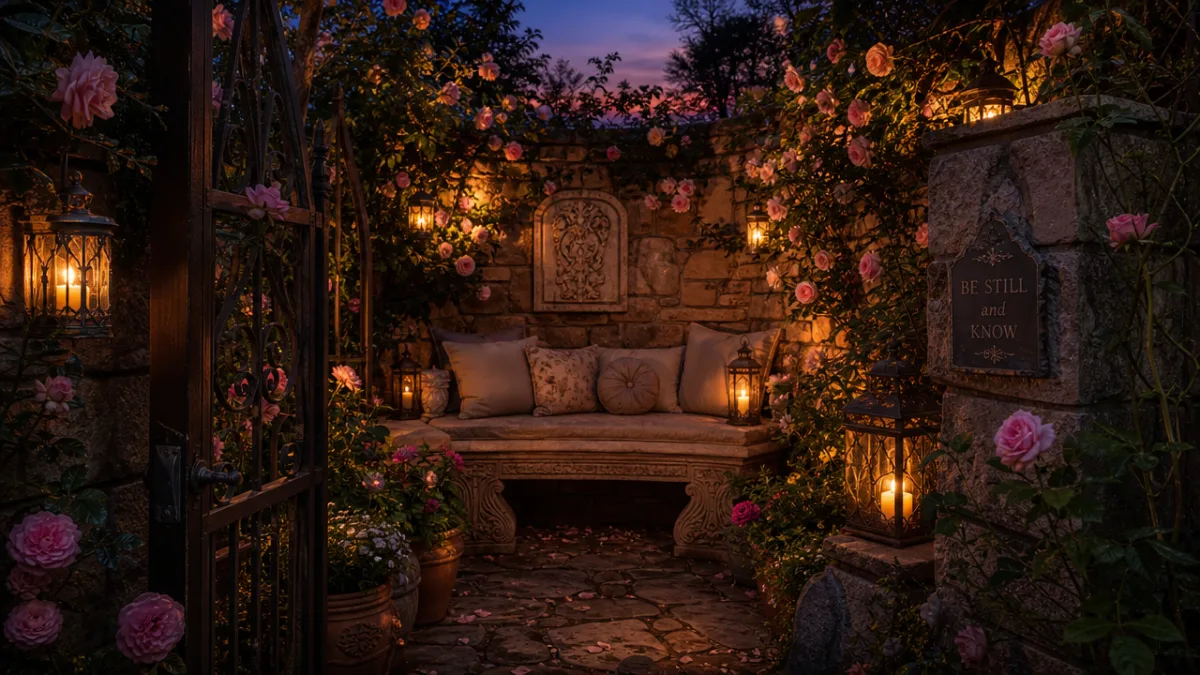
Once your structure and planting are taking shape, the finishing touches become surprisingly important. Furniture sets the tone for how the space gets used, and it contributes a lot to the overall atmosphere. A weathered stone bench half-hidden by overhanging roses is the quintessential secret garden seat — it looks like it’s always been there, and it has that particular beauty of something shaped by time and weather. Cast-iron furniture in deep green or matte black disappears into the planting beautifully. Wooden pieces in teak or oak gradually develop a silver-grey patina that sits perfectly with a naturalistic planting scheme.
Lighting completely transforms a secret garden after dark, and it means you can actually use the space through the longer evenings of spring and summer. Solar-powered fairy lights woven through climbing plants create a romantic, twinkling canopy that’s genuinely lovely. Lanterns — hanging from branches or sitting on a low table — add warmth and intimacy. Path lighting at ground level is both practical and atmospheric, guiding your way while casting interesting shadows through the foliage. For something more dramatic, uplighting a sculptural tree or an architectural plant like an agave or large phormium creates a striking silhouette against the evening sky.
Decorative details are often what separates a well-planted garden from a truly magical one. Think carefully about what you place in the space and why. A weathered terracotta pot with a single bold plant. A vintage watering can repurposed as a planter. A small stone statue half-swallowed by groundcover. A worn wooden sign with a line you love. A birdbath positioned where it catches the afternoon light. Each object tells a small story and adds to the sense that this space has its own history and character. Don’t overcrowd it though — a few well-chosen things will always have more impact than a crowded collection of unrelated bits and pieces.
Maintaining the Magic: Seasonal Care and Long-Term Management
Like any garden, a secret garden needs some ongoing care to stay beautiful — but the approach here can be far more relaxed and naturalistic than you’d apply to a formal garden. Lean into a degree of controlled wildness. Let self-seeding plants naturalize over time; the foxgloves, aquilegias, and forget-me-nots that pop up in unexpected spots actually add to the sense that the garden has its own will, its own desire to grow and evolve. Fallen leaves left to break down quietly in corners become habitat for insects and add to the feeling of living richness. Some of the most magical-looking gardens are also the most forgiving to maintain.
Seasonal tasks are much easier to manage when you think of them as a rhythm rather than a chore. In early spring, cut back last year’s dead stems and lay down a generous mulch of garden compost or well-rotted manure around your plants. That single task suppresses weeds, holds moisture in the soil, and feeds everything underneath — it’s probably the best return on effort of anything you’ll do all year. Summer is about deadheading flowering plants to keep them going, watering new plants during dry spells, and tying in climbers before they get unruly. Come autumn, it’s time to plant bulbs — one of the highest-reward gardening tasks there is — and to cut back or divide any perennials that have become congested.
The structural elements of your garden — hedges, fences, walls, climbers — will all need periodic attention to keep doing their job. Hedges generally want clipping once or twice a year depending on the species. Climbers need an annual prune to keep them flowering well and to stop them becoming a tangled mass that pulls away from their supports. Wooden structures benefit from a coat of natural wood preservative every year or so, which makes a real difference to their lifespan. None of this is particularly time-consuming, but staying on top of it season by season means you never face that overwhelming catch-up moment where the whole thing starts to feel like a burden.
Finally, let your secret garden change and grow along with you. The plants you started with might get replaced as your taste evolves or as certain things prove wrong for your conditions. A visit to a good nursery or a friend’s garden might inspire something new. The space itself might gradually expand as you reclaim more of the yard from lawn. The gardens people love most are rarely the result of a single brilliant design moment — they accumulate character slowly, through seasons of growth, small experiments, and the patient observation of what thrives and what quietly gives up. That gradual unfolding, that ongoing sense of discovery, might just be the most secret and magical thing about gardening of any kind.








What do you think?
It is nice to know your opinion. Leave a comment.