










31+ Beautiful Bushes for the Front of Your House: The Complete Guide to Stunning Curb Appeal
Why Foundation Plantings Transform Your Home’s Appearance
The front of your home makes a powerful first impression on every visitor, neighbor, and passerby who encounters it. Foundation plantings, particularly well-chosen bushes and shrubs, are one of the most cost-effective ways to elevate that impression dramatically. A bare foundation looks unfinished and harsh, while thoughtfully selected shrubs soften architectural lines, frame your entryway, and create a sense of welcome that no coat of paint or new door can achieve on its own. The right bushes literally make your house look more expensive and more intentional without requiring a full renovation.
Beyond pure aesthetics, front yard shrubs serve a range of practical purposes that homeowners often overlook. Dense, well-placed bushes can act as a natural noise barrier from street traffic, provide privacy without the formality of a fence, and even improve energy efficiency by sheltering the home from wind. Many flowering shrubs attract pollinators like bees and butterflies, contributing to local ecosystems. Some varieties offer year-round interest through seasonal blooms, colorful berries in fall and winter, or striking foliage that changes with the seasons, ensuring your curb appeal never completely disappears.
Choosing the wrong shrub, however, can lead to years of frustration. A bush that grows far too large for its space will swallow windows, block walkways, and require constant pruning that quickly becomes a chore rather than a pleasure. That is why understanding your home’s specific conditions — sunlight levels, soil type, climate zone, and the scale of your architecture — is absolutely essential before you purchase a single plant. This guide is designed to walk you through everything you need to know to make confident, beautiful choices that will reward you for decades to come.
Understanding Your Yard’s Conditions Before You Plant
Before falling in love with any particular shrub at the garden center, you need to do a honest assessment of what your front yard actually offers. Start with sunlight. Walk around your front yard at different times of day and note which areas receive full sun (six or more hours of direct sunlight daily), partial shade (three to six hours), or deep shade (fewer than three hours). This single factor will eliminate many shrubs from consideration and highlight others as ideal candidates. Many of the most popular flowering shrubs, such as roses and hydrangeas, have very specific light requirements that simply cannot be negotiated.
Soil quality and drainage are equally important factors that many enthusiastic gardeners overlook in their excitement. Compacted clay soil drains poorly and can suffocate roots, while overly sandy soil drains so quickly that plants struggle to absorb sufficient moisture and nutrients. Test your soil pH, which most shrubs prefer in the slightly acidic range of 6.0 to 7.0, though acid-loving plants like azaleas thrive at lower pH levels around 4.5 to 6.0. Amending your soil before planting is always easier than trying to correct problems after a shrub is established and struggling. A simple soil test kit from a garden center or your local agricultural extension office will provide invaluable data.
Your USDA hardiness zone determines which plants can survive your winters without protection, and this is non-negotiable. A gorgeous camellia that thrives in Zone 8 will die in a Zone 5 winter, no matter how lovingly it is tended. Equally important is understanding your local summer conditions — heat, humidity, and drought — because some plants that survive cold winters struggle with hot, humid summers. Look up your specific hardiness zone online using the USDA Plant Hardiness Zone Map, and always check that any shrub you are considering is rated for both your coldest winter temperatures and your summer conditions before purchasing.
Evergreen Shrubs for Year-Round Structure and Beauty
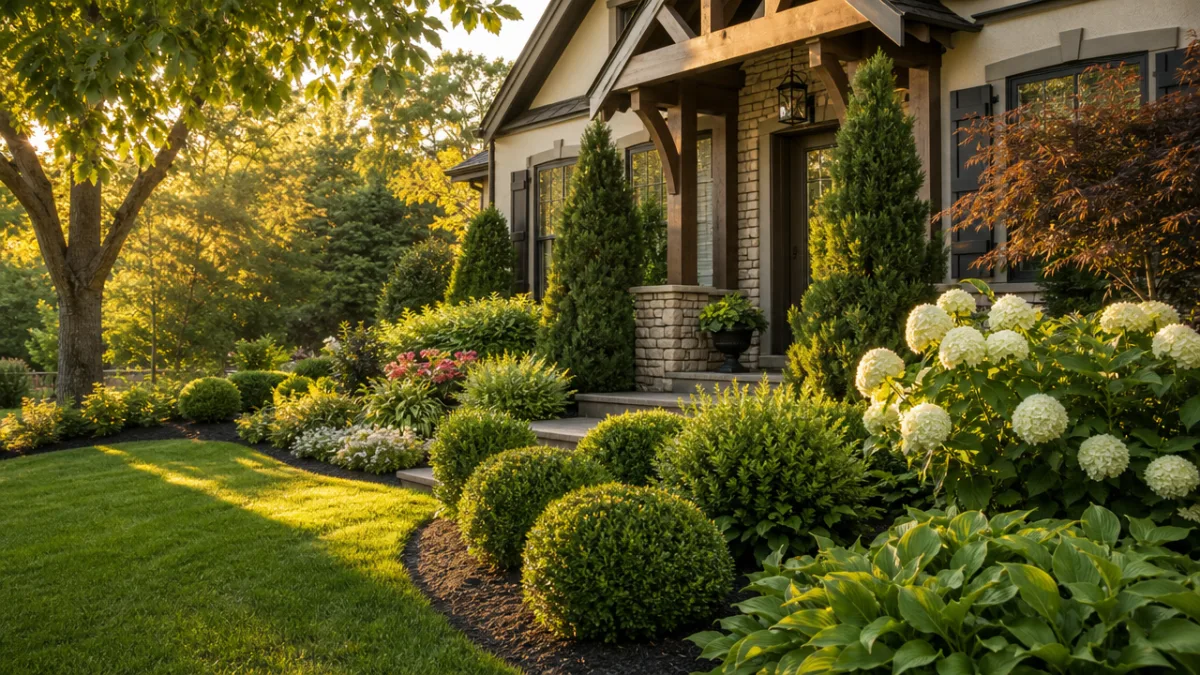
Evergreen shrubs form the backbone of any great foundation planting scheme because they provide consistent color, texture, and structure throughout every season of the year. When deciduous plants drop their leaves and flowering perennials go dormant, evergreens ensure your front yard never looks completely bare or abandoned. They are the anchors of the landscape, the elements that tie everything together visually and give the planting a sense of permanence and maturity. Some of the most reliable and beautiful evergreen shrubs for front yards include boxwood, holly, inkberry, pittosporum, and various junipers.
Boxwood (Buxus) has been a cornerstone of formal landscape design for centuries, and its enduring popularity is entirely justified. It tolerates heavy pruning exceptionally well, which allows homeowners to maintain precise shapes — spheres, cubes, cones, or organic mounds — with relative ease. Dwarf varieties like ‘Green Velvet’ and ‘Winter Gem’ grow slowly to manageable sizes of two to three feet, making them perfect for planting along walkways or flanking an entryway. However, boxwood does require attention to pest and disease issues, particularly boxwood blight and boxwood leafminer, so select resistant cultivars and maintain good air circulation around plants to minimize problems.
Hollies (Ilex) offer an extraordinary range of sizes, shapes, and seasonal interest that makes them among the most versatile evergreen shrubs available to homeowners across a wide range of climate zones. Compact varieties like ‘Sky Pencil,’ which grows narrow and columnar to about six feet, or ‘Dwarf Burford,’ a rounded form that stays under four feet with regular pruning, provide excellent options for tight foundation spaces. Female holly plants produce the iconic red berries that persist through winter and attract birds, adding a dynamic, wildlife-friendly element to your landscape. Always plant at least one male holly nearby to ensure berry production on your female plants.
- Boxwood (Buxus) — Excellent for formal hedges and shaped specimens; prefers partial to full sun and well-drained soil; slow growing and very long-lived.
- Holly (Ilex) — Produces striking red or black berries; wide range of sizes available; excellent wildlife value; tolerates partial shade.
- Skip Laurel (Prunus laurocerasus) — Fast-growing evergreen with large, glossy leaves; ideal for creating privacy screens; extremely adaptable to varying light conditions.
- Japanese Pieris (Pieris japonica) — Beautiful cascading flower clusters in early spring; colorful new growth in red or pink; excellent for shaded spots beneath trees.
- Inkberry (Ilex glabra) — Native shrub with excellent cold hardiness; produces small black berries loved by birds; tolerates wet soils unusually well.
Flowering Shrubs That Deliver Stunning Seasonal Color
Flowering shrubs bring a level of drama and joy to the front yard that no evergreen can quite replicate. Whether it is the extravagant blooms of a hydrangea in midsummer, the delicate papery flowers of a mock orange drifting fragrance across the front porch, or the electric azalea display of early spring, flowering shrubs create those wow moments that make neighbors slow their cars and pedestrians stop to admire. The key to making them work beautifully is selecting varieties that bloom at different times so that the display is staggered across the entire growing season rather than concentrated in one brief burst.
Hydrangeas have become wildly popular in recent years, and for very good reason — their large, dramatic flower heads in shades of white, pink, blue, and purple provide months of color from mid-summer through fall, and the dried flower heads add interest even into winter. The ‘Incrediball’ smooth hydrangea produces enormous white blooms on strong stems that do not flop, while the ‘Endless Summer’ series of bigleaf hydrangeas blooms repeatedly from early summer through frost on both old and new wood, solving the classic problem of losing blooms to winter dieback. Panicle hydrangeas, like ‘Limelight’ and ‘Quick Fire,’ are among the most adaptable, tolerating full sun and a wider range of soil conditions than other types.
Azaleas and rhododendrons create some of the most spectacular spring displays in the landscape world, with flowers that can literally cover every inch of the plant in shades ranging from pure white through every shade of pink, red, orange, and purple. Evergreen azalea varieties retain their foliage year-round, adding to the plant’s value as a foundation shrub. The Encore series of azaleas is particularly worth seeking out because it blooms in spring, takes a brief summer rest, and then blooms again heavily in fall — essentially doubling your flowering season. For larger spaces, rhododendrons can grow quite large, so always check the mature size of any cultivar you are considering and give them the acidic, well-drained soil they require to truly thrive.
Native Shrubs That Support Local Wildlife and Ecosystems
The movement toward native plant gardening has gained enormous momentum over the past decade, and for compelling reasons that go far beyond trend-following. Native shrubs evolved alongside local insects, birds, and other wildlife over thousands of years, developing relationships of mutual benefit that exotic species simply cannot replicate. A native shrub like American beautyberry or buttonbush supports dozens or even hundreds of native insect species compared to a handful that can use an exotic ornamental, and those insects in turn support the songbirds, bats, and other wildlife that depend on them for food. Choosing native shrubs is one of the most meaningful things a homeowner can do for local biodiversity.
Ninebark (Physocarpus opulifolius) is a particularly outstanding native shrub for front yard use because it combines excellent adaptability with remarkable visual interest across multiple seasons. In spring, it produces clusters of small white or pink flowers that attract pollinators enthusiastically. Its foliage — available in varieties ranging from deep burgundy to chartreuse gold — provides color interest throughout the entire growing season. The peeling, exfoliating bark adds winter texture, and small clusters of reddish seed capsules attract birds in fall. Varieties like ‘Coppertina’ and ‘Little Devil’ offer more compact sizes suitable for smaller front yards without sacrificing any of the plant’s inherent toughness and adaptability.
Viburnum is a vast genus of native and near-native shrubs that deserves far more attention than it typically receives from homeowners. Arrowwood viburnum (Viburnum dentatum) is a particularly valuable native species that produces flat-topped clusters of white flowers in late spring, followed by blue-black berries that birds devour eagerly through fall and early winter. It tolerates a wide range of soil conditions including clay and occasional wet feet, and it colors beautifully in shades of red to purple in autumn. American cranberrybush viburnum (Viburnum opulus var. americanum) offers similar qualities with the added bonus of translucent red berries that persist through winter and are absolutely stunning against snow.
- Buttonbush (Cephalanthus occidentalis) — Unique spherical white flowers; exceptional value for pollinators; tolerates wet areas where other shrubs struggle to survive.
- American Beautyberry (Callicarpa americana) — Produces extraordinary clusters of vivid purple berries in fall that are virtually unmatched in landscape drama and are irresistible to birds.
- Spicebush (Lindera benzoin) — Host plant for spicebush swallowtail butterfly; fragrant yellow spring flowers; brilliant yellow fall foliage; red berries for wildlife.
- Sweetshrub (Calycanthus floridus) — Unusual burgundy-red flowers with a fruity, spicy fragrance; tolerates partial shade well; excellent wildlife value for native bees.
- Mountain Laurel (Kalmia latifolia) — Pennsylvania’s state flower; stunning late spring blooms; excellent evergreen foliage; thrives in dappled shade under taller trees.
Design Principles for Arranging Shrubs in Front of Your House
Selecting beautiful individual shrubs is only half the challenge — arranging them in a way that looks intentional, balanced, and proportionate to your home’s architecture is where the real artistry of landscaping comes into play. One of the most fundamental principles is to vary the heights of your plantings so that the eye moves naturally across the landscape rather than encountering a monotonous flat line. Place taller shrubs at the corners of the house and progressively shorter shrubs toward the center of the facade, or use taller plants as vertical accents behind lower mounding varieties to create layers of depth and visual interest that look lush and intentional.
The concept of repetition is equally important and often counterintuitive to homeowners who want variety. Using the same shrub species or at least the same color palette repeatedly throughout the planting creates a sense of unity and cohesion that random variety cannot achieve. Rather than planting one of every shrub that catches your eye, consider buying three or five of the same variety and grouping them together for visual impact, then repeating that grouping in another area of the front yard. This approach, sometimes called “plant in drifts,” is used by professional landscape designers to create plantings that look rich and designed rather than collected and random.
Leave adequate space between shrubs at planting time, which is genuinely difficult because young shrubs look lonely and lost when planted at their mature spacing. Resist the urge to crowd plants together for immediate fullness; overcrowded shrubs compete for water and nutrients, develop disease problems from poor air circulation, and will eventually require removal anyway as they mature. Research the mature width of every shrub you plant and space them accordingly, perhaps planting inexpensive annual flowers between them for the first several years to fill the visual gaps while the shrubs grow into their intended space. Your patience will be handsomely rewarded with a landscape that looks precisely as planned once the shrubs reach maturity.
Seasonal Maintenance Tips for Keeping Your Shrubs Healthy and Beautiful
Even the most well-chosen and well-placed shrubs require consistent care to look their best year after year. Pruning is the maintenance task that most directly affects both the appearance and health of your foundation shrubs. The most important rule of pruning timing is to understand whether your shrub blooms on old wood or new wood. Shrubs that bloom on old wood — including most spring-flowering varieties like forsythia, lilac, and azalea — should be pruned immediately after flowering, never in fall or early spring when you would be removing the buds that carry next year’s flowers. New-wood bloomers like panicle hydrangeas and butterfly bushes can be pruned in late winter before growth begins.
Mulching is perhaps the single most beneficial thing you can do for your foundation shrubs, yet it is frequently done incorrectly in ways that actually harm the plants. A two to three inch layer of organic mulch applied over the root zone — not piled against the trunk or stems in the infamous “mulch volcano” pattern — conserves soil moisture, moderates soil temperature, suppresses weed growth, and gradually improves soil structure as it breaks down. Use shredded bark, wood chips, or composted leaf material, and refresh the mulch layer annually each spring. Always keep mulch pulled back at least two inches from the base of each shrub to prevent rot and discourage rodent nesting, which can devastate shrub roots over winter.
Fertilizing requirements for established shrubs are typically modest, and overfeeding is actually a more common problem than underfeeding in most home landscapes. Excess nitrogen encourages lush, soft growth that is highly attractive to pests and diseases and may compromise the shrub’s ability to harden off properly before winter. For most foundation shrubs, an annual application of a slow-release balanced fertilizer in early spring, just as new growth begins, is entirely sufficient. Acid-loving shrubs like azaleas, rhododendrons, and mountain laurel benefit from a fertilizer formulated specifically for them. Always follow soil test recommendations when available, as they provide far more accurate guidance than any general rule of thumb can offer.








What do you think?
It is nice to know your opinion. Leave a comment.