










Crochet Tarot Cloth: A Complete Guide to Creating Your Sacred Reading Space
The Magic Behind a Handcrafted Tarot Cloth
Of all the tools a tarot reader can have, a cloth feels like one of the most personal — and when you’ve made it yourself through crochet, it becomes something really special. There’s a big difference between pulling a mass-produced velvet square out of a drawer and laying down a cloth you spent hours making with your own hands. A lot of readers feel that crocheting your own reading surface imbues it with your energy, your intentions, and something uniquely you that no store-bought alternative could ever replicate.
There’s also something about the rhythm of crochet itself that feels fitting for this kind of project. That repetitive loop-through-loop motion has a way of quieting the mind and drawing you inward — which isn’t so different from the focused, receptive state you aim for during a reading. If you stitch with intention — whispering affirmations, setting a clear purpose for your practice, or just breathing slowly and staying present — you’re essentially dedicating the cloth before it ever meets a single card. The yarn and hook become more than materials; they become part of the ritual.
On a purely practical level, a crocheted cloth has some real advantages over fabric alternatives too. The natural texture of lacework gives cards something to grip, so they stay put during a spread instead of sliding around. You can make it whatever size you need — a small personal cloth for daily draws or a generous one with plenty of room for a full Celtic Cross — and it rolls or folds for travel without picking up the creases that woven fabric tends to hold. Once you’ve used a cloth you made yourself, it’s honestly hard to go back.
Choosing Your Materials: Yarn, Hook, and Color Magic
Choosing your yarn is part practical decision, part intuitive one — and honestly, both sides matter. If your cloth is going to see regular use, natural fibers are worth reaching for. Cotton is the most popular choice for good reason: it lays flat, holds its shape well, skips the drama of blocking, and comes in just about every color you can imagine. Linen and bamboo blends are another lovely option if you want something with a bit more drape and a subtle sheen that catches candlelight in a really beautiful way.
Color is worth thinking about carefully, because it carries weight in both crochet and tarot. Deep purples and violets are classics for a reason — they’ve long been connected to psychic intuition and spiritual wisdom. Midnight blue brings in that feeling of the starlit sky and the vast unconscious. Forest green anchors the practice in earth energy and connects to the suit of Pentacles. Black is practical and powerful, making card imagery really pop while grounding the reading space. And rich burgundy or crimson speaks to passion, fire, and the energy of Wands. Whatever draws you in is probably the right choice.
Your hook size will follow your yarn weight naturally, but most tarot cloth makers tend to gravitate toward fingering or sport weight yarn with a fine hook — somewhere in the 2mm to 3.5mm range. That combination lets you work delicate lacework with lovely open spaces while still giving the cloth enough structure to hold its shape. If you’d rather have something chunkier and more tactile, a DK or worsted weight with a 4mm to 5.5mm hook gives you a sturdier, more grounded cloth. There’s no single right answer here — let your hands guide you toward what feels good.
Essential Crochet Stitches and Patterns for Tarot Cloths
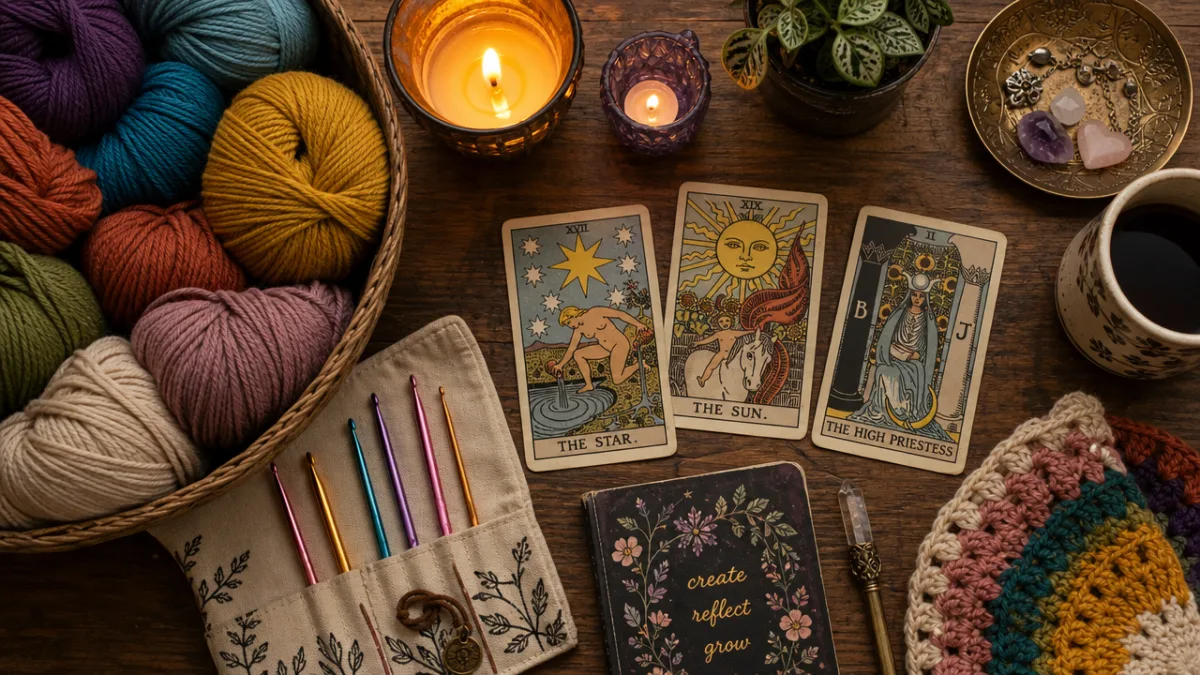
You don’t need to be an advanced crocheter to make something genuinely beautiful here, but knowing a few core stitches opens up a lot of possibilities. A solid base stitch is where everything starts. Single crochet gives you a tight, dense fabric that sits very stably — great if you want something substantial underhand. Half double crochet is a little more open with a nice height to it. And double crochet is the foundation of most lace patterns, creating those tall, airy stitches that look so elegant as a reading surface.
A few stitch patterns have developed a real following among tarot cloth makers, and it’s easy to see why. Granny squares assembled into a larger cloth create a patchwork geometry that echoes the structured layouts of tarot spreads in a satisfying way. Shell stitch produces those wave-like scalloped rows that feel fluid and flowing — very Cups energy. The star stitch, with its interlocking little stars, is an obvious favorite for its celestial symbolism and its connection to the astrological underpinnings of tarot. And mandala-style circular motifs worked outward from the center create a cloth that mirrors the centered, radiating focus of a reading itself.
If you’re ready to go further, surface crochet and tapestry crochet let you work actual motifs and symbols into the cloth — and that’s where things get really personal. Crescent moons, five-pointed stars, the infinity symbol, elemental symbols, the Eye of Providence — all of these show up regularly in handmade tarot cloths. Some makers even work the four suits into the corners using tapestry crochet, so the cloth itself maps the energetic landscape of the full deck. Whatever symbols carry meaning in your own practice are the right ones to reach for.
Step-by-Step Pattern Guide for a Basic Tarot Cloth
Your first tarot cloth is a very approachable weekend project — beginner to intermediate skill level is plenty. The guide below walks you through a rectangular cloth roughly 18 by 24 inches, which is a comfortable size for most spreads including a three-card draw, a Celtic Cross, or a horseshoe layout. Before you sit down to start, pull together your yarn (around 200 to 300 yards of sport weight cotton), your hook, a yarn needle for weaving in ends, and a space that feels calm enough to set a real intention for the work.
Start with your foundation chain. For an 18-inch-wide cloth using sport weight cotton and a 3mm hook, chain 100 stitches plus 3 turning chains for a double crochet base. Work your first row across, turn, and keep going in your chosen stitch until the cloth reaches the length you want. For a simple lace border, finish the main body and then work three rounds of shell stitch around all four edges, joining corners with slip stitches and adjusting your stitch count so everything stays flat. When you’re done, block the cloth by soaking it in cool water, gently pressing out the excess moisture between towels, and pinning it flat to dry.
Here is a simple materials checklist and recommended steps for your first tarot cloth project:
- 200–300 yards sport weight cotton yarn in your chosen color
- 3mm crochet hook (adjust for your gauge and tension)
- Yarn needle and scissors
- Blocking mat and pins for finishing
- Optional: embellishment yarn in a contrasting color for border details
- Optional: fabric stiffener spray for added structure and stability
Once the cloth is dry and off the pins, take a moment to cleanse or consecrate it in whatever way fits your practice. Passing it through incense smoke — frankincense and sandalwood are traditional favorites — works well, as does leaving it under the moonlight overnight to charge. Some makers speak a blessing or intention aloud over the finished cloth, formally dedicating it to clear and honest readings. However you approach it, this last step is what completes the shift from crochet project to something you’ll actually reach for every time you sit down to read.
Caring for Your Crochet Tarot Cloth
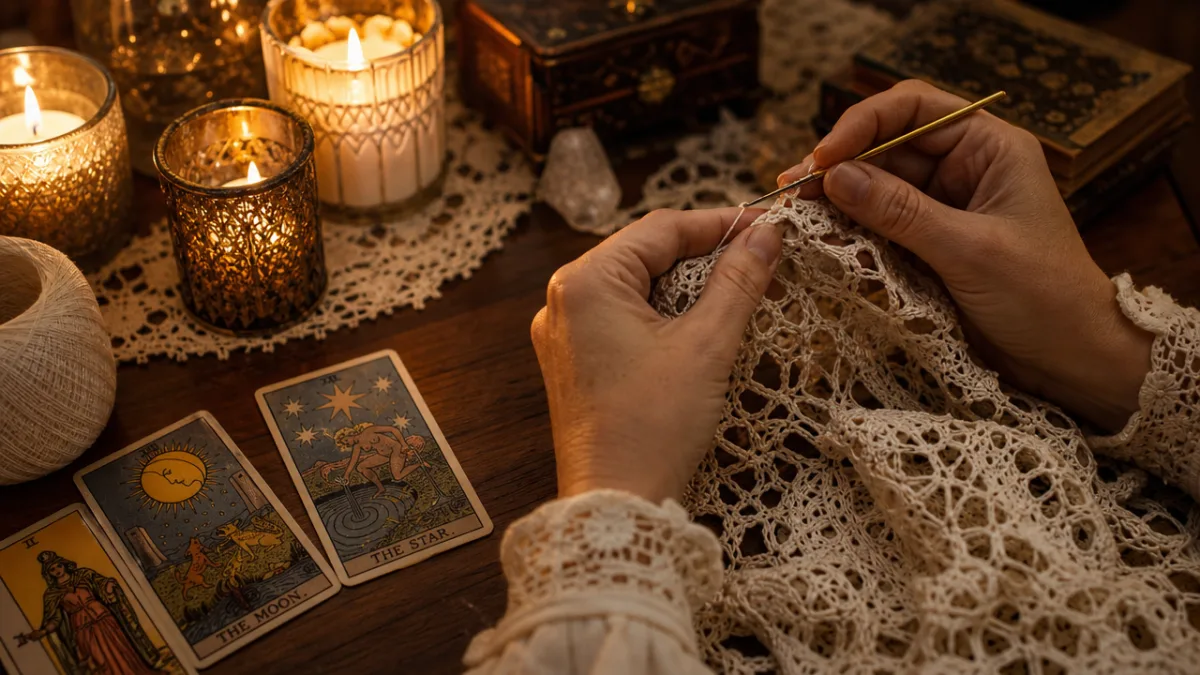
A cloth you’ve made with care deserves to be taken care of in return — both physically and energetically. On the practical side, natural fiber cloths (cotton, linen) do best with a gentle hand wash in cool water and a mild, fragrance-free soap. Skip the wringing and twisting; just press the cloth gently between clean towels to get the excess water out, then re-pin it flat to dry the same way you did when you first blocked it. This keeps the shape intact and the fiber happy for years of regular use.
Energetically, many readers cleanse their cloth alongside their cards on a regular basis to keep the reading space feeling clear and fresh. Smoke cleansing with rosemary, lavender, or cedar is a popular method. Laying the folded cloth under a piece of selenite or clear quartz overnight is another. Some readers sync their cleansing routine to the lunar cycle — refreshing both cloth and cards at each new moon as a kind of monthly reset. Whatever approach resonates with you, the intention behind it is what matters most.
Storage is worth thinking about too. A lot of crocheters make a simple drawstring bag — crocheted, of course — to keep the cloth and deck together, which has the practical benefit of protecting them from dust and moisture and the added bonus of keeping them energetically connected. Try not to store your cloth tightly compressed under other things; prolonged pressure can flatten and distort the lace texture that makes it such a pleasure to use. With a little consistent care, a well-made crocheted tarot cloth can genuinely become an heirloom — something that accumulates meaning and resonance the longer it’s part of your practice.
Personalizing and Gifting Crochet Tarot Cloths
One of the best things about making your own tarot cloth is how much room there is to make it truly yours. Beyond color and stitch choices, you can pull in your birth chart — earthy tones for earth signs, soft pastels for air, warm crimsons for fire, oceanic blues and teals for water. Or choose colors tied to your sun, moon, and rising sign specifically, so your cloth is literally woven from your astrological identity. It’s one of those details that sounds small but feels deeply meaningful every time you lay it out.
Embellishments after finishing open up even more possibilities. Small crocheted motifs stitched to the corners or center can carry a lot of personal symbolism — a tiny pentacle, a crescent moon, a flower for your birth month, or a symbol connected to a deity or spiritual tradition that’s important to you. Some makers take it further with hand-embroidered sigils, runes, or astrological glyphs worked in coordinating embroidery floss. And if you want something with a bit of sparkle, threading glass or crystal seed beads onto the yarn before you crochet lets you work them directly into the fabric so they catch light in the most lovely way.
A handmade tarot cloth also makes one of the most genuinely thoughtful gifts you can give to a fellow reader or someone just starting out with the cards. When you’re making one for someone else, take the time to learn a little about their practice — their favorite colors, any symbols that matter to them, whether they lean toward structured or more open reading styles. Writing a small note to go with it, sharing what intentions you held while you were making it, turns the gift into something even richer. In a world full of mass-produced spiritual goods, a cloth made stitch by stitch with someone specific in mind is pretty hard to top.
Building a Broader Crochet Practice Around Tarot
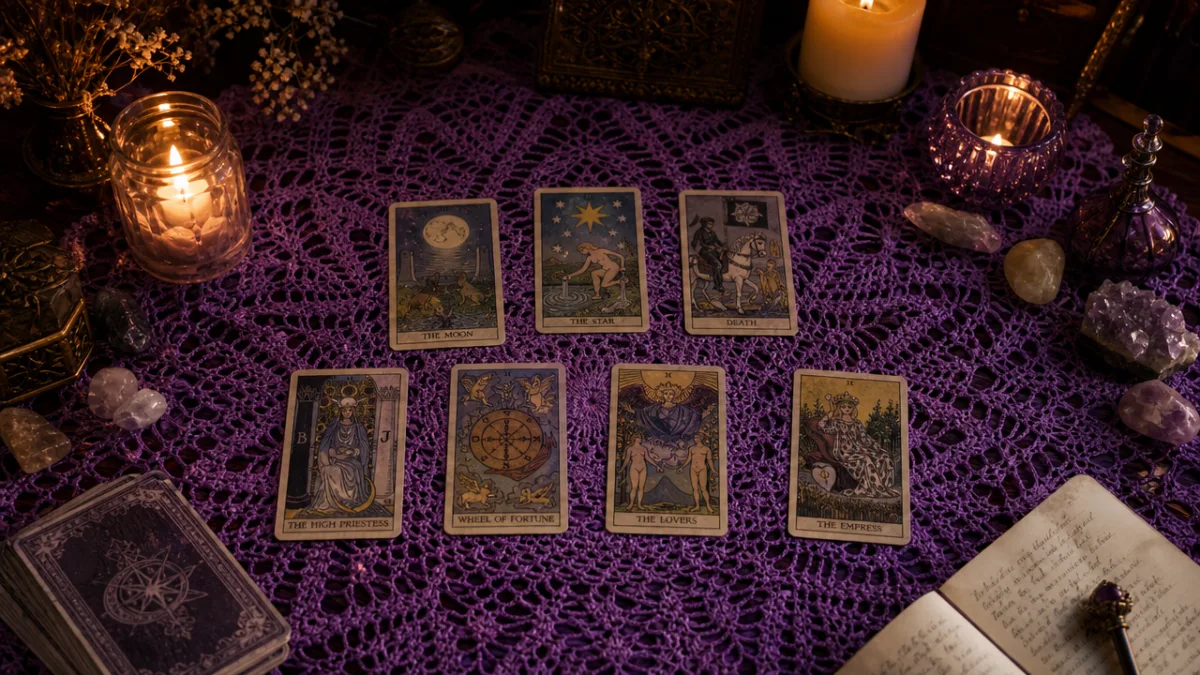
Once the tarot cloth is done, a lot of people find they don’t want to stop there. It’s a natural next step to start thinking about a full set of coordinated accessories — a drawstring bag for the deck, a small pouch for crystals or a pendulum, a padded coaster for a candle, maybe even a wall hanging featuring a favorite Major Arcana card worked in tapestry crochet. Keep everything in the same color palette and stitch family and you end up with a reading space that feels genuinely cohesive and intentional, like it was designed rather than accumulated.
Some practitioners take the integration even deeper by using individual cards as creative prompts during crochet sessions. Pull a card before you sit down to work and let its energy shape your choices for that session. The High Priestess might call for slow, silent single crochet worked in a deep, quiet color. The Star might inspire metallic yarn and delicate lace. The Empress might want lush texture and an abundance of color. Used this way, crochet becomes a form of active tarot study — embodied, tactile, and surprisingly insightful.
There’s also a wonderful community side to all of this. Pinterest boards, Instagram hashtags, Ravelry groups, and Reddit communities are full of people who live right at this intersection of fiber arts and divination. Sharing your finished cloth, your pattern notes, your intention-setting process — all of it can spark something for someone else while also connecting you with makers who genuinely understand why the craft goes deeper than just a hobby. When we share these handmade objects and the meaning behind them, we build something that goes beyond any individual project: a community made not of yarn but of shared curiosity, creative generosity, and mutual support, stitch by meaningful stitch.








What do you think?
It is nice to know your opinion. Leave a comment.