










Fruit Cereal Soy Wax Candles: The Complete Guide to Making, Using, and Loving This Playful Home Fragrance Trend
What Are Fruit Cereal Soy Wax Candles?
If you’ve ever wished you could bottle the smell of Saturday morning cartoons and a big bowl of Froot Loops, well — someone did. Fruit cereal soy wax candles are exactly what they sound like: artisan candles that capture that sweet, fruity, faintly milky scent of your favorite childhood breakfast cereals. We’re talking Froot Loops, Trix, Fruity Pebbles — that whole colorful, sugary universe. They’re made with a soy wax base, and the combination of clean, slow-burning wax and an unexpectedly fun fragrance has turned these into a genuine phenomenon in the handmade and home décor world.
But here’s the thing — the appeal goes way beyond nostalgia. These candles have found a sweet spot between playful pop culture vibes and the cleaner, more intentional world of soy candle-making. They attract everyone from millennials chasing a specific childhood feeling to younger buyers who are just drawn to their bright, candy-like look. A lot of makers lean all the way into the visual theme too, pouring multicolored wax layers or adding little decorative cereal-inspired shapes so the candle becomes a statement piece before you even light it.
Soy wax is the right choice here for a reason. It burns slower and cleaner than paraffin, which lets those berry, citrus, and tropical fruit notes open up gradually instead of all rushing at you at once. It also holds fragrance oil really well, so the scent throw — both when the candle is cold and when it’s burning — tends to be genuinely impressive. Light one of these in a room and the effect is immediate: cheerful, warm, and somehow more sophisticated than you’d expect from something inspired by a cereal box.
The Benefits of Choosing Soy Wax as Your Candle Base
Soy wax has become the go-to for artisan candle makers, and it’s not hard to see why. It comes from hydrogenated soybean oil, making it a renewable, biodegradable resource that produces noticeably less soot than paraffin. If you burn candles regularly at home — and especially if you’re lighting them in smaller spaces — that difference in air quality actually adds up. You’re introducing fewer toxins into your living space over time, which makes the whole ritual feel a lot better.
On a more practical level, soy wax is really well-suited for a layered, complex fragrance like fruit cereal. Its lower melting point means it releases scent gradually and consistently rather than in one big rush, which matters when you’re working with something that has distinct top, middle, and base notes. You want the citrus to hit first, then give way to the fruity heart, then settle into that warm, creamy base — soy wax lets that story unfold the way it’s supposed to.
It’s also genuinely forgiving to work with, which is great news if you’re new to candle-making. It blends easily, re-melts cleanly when you make mistakes, and sticks well to glass containers. Cleanup is just soap and warm water — no stubborn waxy residue like you’d get with paraffin. Whether you’re a seasoned maker or someone giving this a shot for the first time, soy wax is the kind of material that meets you where you are and makes the finished product better for it.

The Fragrance Profile: Understanding the Fruit Cereal Scent
The fruit cereal scent is actually more interesting than you might expect. It’s built from a blend of synthetic and natural fragrance compounds that recreate the smell of those brightly colored, sugar-coated loops and puffs — but when you break it down by notes, it reads almost like a proper perfume. The top notes open with a bright burst of citrus: lemon, orange, sometimes a little lime. That’s the first thing you smell when you bring the candle close, and it’s what fills the room within the first few minutes of lighting.
Once the candle warms up and that initial citrus burst settles a bit, the heart notes come through — and this is honestly where the fun is. A mix of tropical and berry notes, things like raspberry, strawberry, watermelon, and tropical punch, all layered together in a way that’s sweet but not overwhelming. Good fragrance formulators balance this middle section carefully to land on that specific sweetness that comes from fruit flavoring combined with the grain-and-sugar base of the cereal itself. It’s surprisingly specific and surprisingly hard to get right.
The base notes are what give the whole thing its warmth and staying power. Most fruit cereal fragrance oils settle into a soft, creamy musk with a touch of vanilla — a nod to the milk in the bowl, essentially. It’s what lingers in the room after the candle has been blown out and what gives the scent that comforting, homey quality underneath all the playfulness. The full effect is a scent that manages to be nostalgic and complex at the same time, which is probably why it appeals to both casual candle buyers and people who genuinely geek out about fragrance.
How to Make Your Own Fruit Cereal Soy Wax Candle at Home
Making one of these at home is a lot more doable than it sounds, and it’s a genuinely satisfying project whether you’re a seasoned crafter or a complete beginner. The process has a nice meditative quality to it, and at the end you have something totally customizable — you control the scent strength, the color, the container, all of it. Before you start though, get everything together first. Hunting for a thermometer while your wax is melting is a recipe for an uneven pour.
Here’s everything you’ll need to get started:
- Soy wax flakes (approximately 8 oz for a standard 8 oz jar candle)
- Fruit cereal fragrance oil (high-quality, skin-safe candle fragrance oil)
- Pre-tabbed cotton or wood wick sized appropriately for your container diameter
- Glass jar or container of your choice (mason jars, apothecary jars, and tumblers all work beautifully)
- Double boiler or a heat-safe pitcher and a pot of water
- Candle thermometer
- Wick centering tool or two pencils and tape
- Colorful candle dye or cosmetic-grade mica powder in vibrant fruit shades (optional but fun)
- Stirring utensil (a dedicated silicone spatula or stainless steel spoon)
- Digital kitchen scale for accurate measurements
Start by melting your soy wax flakes in a double boiler until they hit around 170–180°F (77–82°C). Once it’s fully melted, take it off the heat and let it cool down to about 140–145°F before you add the fragrance oil. The standard fragrance load for soy wax is 6–10% of the total wax weight — for an 8 oz candle, that’s roughly 0.5 to 0.8 oz of fragrance oil. Stir slowly and thoroughly for at least two full minutes so everything is properly incorporated and won’t separate as it cools. If you’re adding color, do that now and mix it in completely. Then pour into your prepared, wick-secured container when the wax is around 130–135°F for the smoothest possible surface.

Creative Variations and Aesthetic Ideas for Your Fruit Cereal Candle
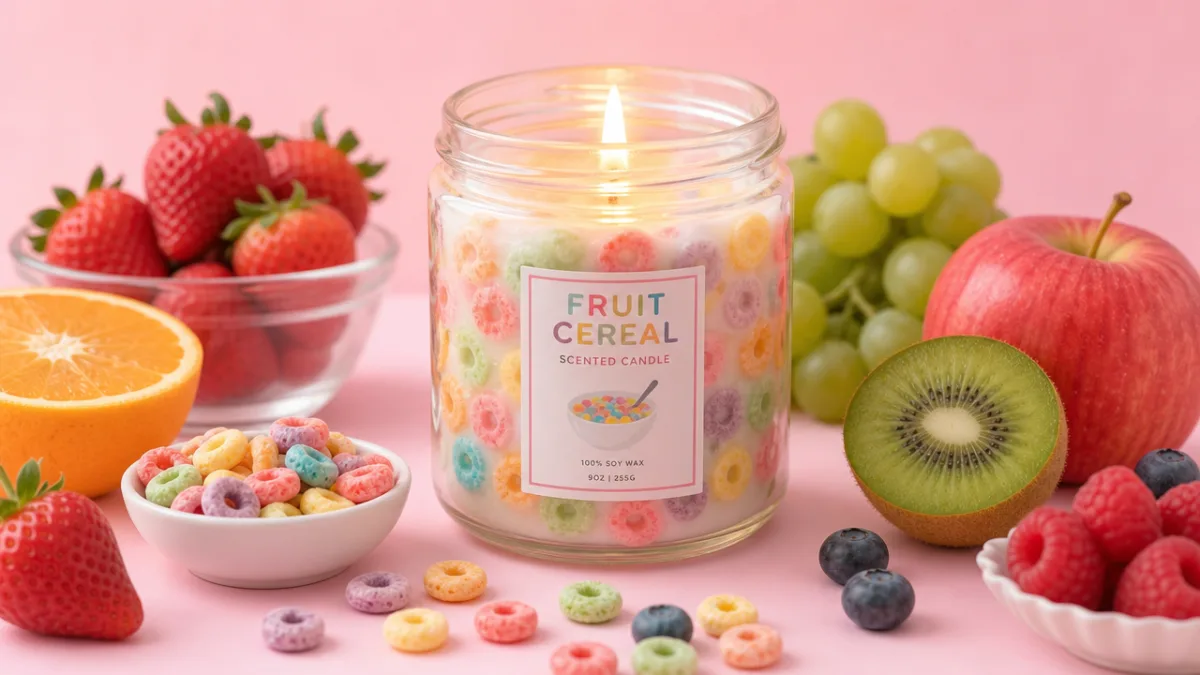
This is honestly one of the best parts. Because the whole concept is already colorful and a little wild, the candle’s appearance can fully run with that energy. The most popular approach is a multicolored layered pour — letting each color set completely before adding the next, using pinks, oranges, yellows, greens, and purples to mirror the actual colors of fruit cereal. The result is genuinely stunning, and more than a little irresistible. It’s the kind of candle people pick up just to look at it.
Beyond layered pours, there are several other creative techniques worth exploring:
- Swirl pours: Run a skewer through two or more colors just before the wax sets and you get a marbled, dreamy effect that’s completely unique every single time.
- Embedded decorations: Small candle-safe or food-safe decorative elements — tiny resin fruit shapes, dried citrus slices, or even actual cereal pieces used as pure decoration in an unscented top layer — make the candle feel extra thematic and gift-ready.
- Ombre effects: Transitioning from a deep, saturated color at the bottom to a soft pastel at the top gives the candle a polished gradient look that photographs incredibly well.
- Contrasting vessel choices: A vibrantly colored pour in a clear glass jar lets the color do all the talking, while the same wax in a matte ceramic vessel feels more subtle and elevated — totally different vibes, both great.
The packaging side of things is just as fun. Because the scent story is so specific and playful, labels that lean into the cereal box aesthetic — retro fonts, cartoon fruit illustrations, bright primary colors — really land with buyers and gift recipients. Some small business owners go all the way and package their candles in custom boxes that reference vintage cereal branding, so the whole experience starts before anyone even opens the lid. That kind of cohesive, committed presentation is a big part of why fruit cereal candles stand out so well in the handmade marketplace.
Caring for Your Fruit Cereal Soy Wax Candle to Maximize Burn Life
Even a beautifully made candle won’t perform well if you don’t take care of it, and fruit cereal soy wax candles are no different. The single most important habit to build: trim your wick before every burn, without exception. It should be about 1/4 inch (6mm) long before you light it. A wick that’s too long creates an oversized flame, throws off excess soot, eats through the wax too fast, and often leads to uneven burning — that frustrating tunneling effect where the center burns straight down and wax builds up around the edges untouched.
The very first burn matters more than most people realize, because soy wax has memory. Whatever melt pool you establish on that first lighting is essentially what the candle will follow for the rest of its life. That means your first burn should last long enough for the entire surface to reach a full, even melt pool — the general rule is one hour per inch of the candle’s diameter. A standard 3-inch candle needs at least three hours that first time. Cut it short even once and you’ll likely deal with tunneling from that point on, no matter what you do.
And know when to call it. Stop burning when there’s about 1/2 inch of wax left in the container. Burning all the way to the bottom risks overheating the glass, which can crack or shatter — a real safety issue, not just a cosmetic one. Once you’ve hit that point, clean the jar out with warm soapy water and give it a second life: a small planter, a storage jar, a drinking glass. Repurposing the container fits perfectly with the sustainable spirit behind soy candle-making in the first place, and it means nothing about the whole experience goes to waste.
Why Fruit Cereal Candles Make Perfect Gifts and How to Present Them
Handmade gifts that manage to be surprising, genuinely delightful, and actually useful are pretty rare — but fruit cereal soy wax candles pull it off. The scent concept is unexpected enough to feel original and memorable, but it’s also the kind of thing almost anyone can appreciate. Whether you’re giving it to a teenager who still pours herself a bowl of sugary cereal on weekends or a friend in their forties who just loves a good dose of childhood nostalgia, the reaction when they take the lid off is almost always the same: a big smile and an immediate second sniff.
Presentation takes it from a nice gesture to a genuinely memorable one. Wrap the jar in tissue paper in coordinating fruit colors before nestling it in a gift box, and consider adding a small card that walks the recipient through the fragrance notes — the citrus opening, the berry heart, the creamy vanilla base. That little storytelling touch transforms the unboxing into its own experience. Some people tuck in a small bag of actual fruit cereal as a playful nod to the scent, and it never fails to land exactly right — a laugh and a genuine “oh, I love this.”
For anyone selling these as a small business, fruit cereal candles are a strong performer. At craft fairs and pop-up markets, the brightly colored layered candles catch eyes immediately in a crowded display, and once someone gets close enough to smell one, the sale pretty much makes itself. Offering a range of sizes keeps price points accessible for impulse buyers while giving more committed customers the option to go big. With consistent quality, vibrant presentation, and thoughtful pricing, these are honestly one of the most commercially promising products in the artisan candle world right now.








What do you think?
It is nice to know your opinion. Leave a comment.