










Crochet Chakra Wall Hanging: A Complete Guide to Creating Your Mindful Fiber Art Masterpiece
There is something deeply meditative about the act of crocheting, and when you combine that ancient craft with the spiritual symbolism of the chakra system, you create something truly extraordinary. A crochet chakra wall hanging is more than just a decorative piece for your home — it is a handmade expression of energy, intention, and artistry that transforms any space into a sanctuary of color and meaning. Whether you are a seasoned crocheter or someone picking up a hook for the first time, this project offers a rewarding journey from the first stitch to the final display on your wall.
The chakra system originates from ancient Indian spiritual traditions and describes seven energy centers located along the spine, each associated with specific colors, emotions, and aspects of human experience. When translated into fiber art, these seven centers become a vibrant palette of red, orange, yellow, green, blue, indigo, and violet — a rainbow that carries both aesthetic beauty and personal significance. A crochet wall hanging built around this color system becomes a daily visual reminder of balance, healing, and the interconnectedness of mind, body, and spirit.
This guide will walk you through everything you need to know to create your own crochet chakra wall hanging from scratch. From understanding the materials and tools you will need, to mastering the stitches, to hanging and displaying your finished piece with intention, every step of this process has been designed to be accessible, enjoyable, and deeply meaningful. By the time you finish reading, you will feel confident and inspired to begin your own creation.
Understanding the Seven Chakras and Their Colors
Before you pick up your crochet hook, it is worth spending time understanding the symbolic language you are about to work with. The seven chakras each carry a distinct color vibration that corresponds to their energetic function within the body. The root chakra at the base of the spine is associated with the color red and governs feelings of safety, grounding, and physical security. When this energy center is balanced, we feel stable, present, and deeply connected to the earth beneath our feet.
Moving upward, the sacral chakra glows in warm orange and is linked to creativity, sensuality, and emotional flow. The solar plexus chakra radiates yellow and represents personal power, confidence, and willpower. The heart chakra, found at the center of the chest, pulses with green energy and embodies love, compassion, and connection to others. Each of these lower and middle chakras forms a foundation for the higher centers above them, which is why many healers and practitioners emphasize the importance of working through each level in sequence.
The upper three chakras ascend into increasingly refined frequencies of experience. The throat chakra appears in a clear, luminous blue and governs communication, truth, and self-expression. The third eye chakra, located between the eyebrows, is associated with indigo and the realm of intuition, wisdom, and inner vision. Finally, the crown chakra at the very top of the head shimmers in violet or pure white light, representing spiritual connection, enlightenment, and unity with all that exists. Understanding these associations will help you choose your yarn colors with intention and create a piece that carries genuine energetic resonance.
Gathering Your Materials and Tools
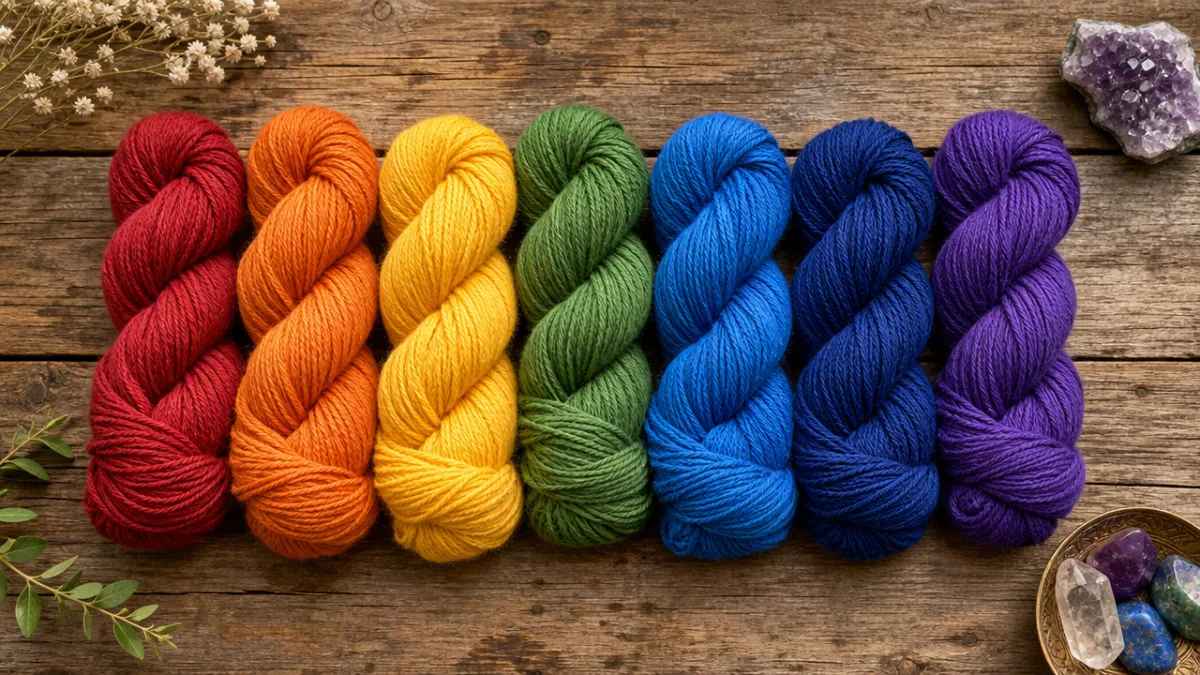
Creating a crochet chakra wall hanging begins with assembling the right collection of materials, and the choices you make here will significantly influence the final look and feel of your piece. Yarn selection is perhaps the most important decision you will make throughout this entire project. Look for yarn in the seven chakra colors — deep red, vibrant orange, sunny yellow, lush green, sky blue, deep indigo, and soft violet or purple. You may also want to include natural or off-white yarn for neutral sections, fringe, or background elements that allow the chakra colors to stand out beautifully against a calm base.
The weight of your yarn matters considerably. Many fiber artists prefer a medium weight, or worsted weight yarn, for wall hangings because it creates a satisfying visual presence without becoming too heavy or unwieldy. However, combining weights can add wonderful texture and dimension — using a bulky yarn for the main mandala rounds and a thinner yarn for delicate accent rows creates visual interest that keeps the eye moving across the piece. Natural fibers such as cotton and wool tend to hold their shape beautifully when used for wall art, and they photograph exceptionally well if you plan to share your creation on social media or sell your work.
Beyond yarn, you will need a selection of crochet hooks sized appropriately for your chosen yarn, a wooden dowel or branch for hanging, scissors, a tapestry needle for weaving in ends, and a measuring tape. Many crochet chakra wall hangings incorporate additional embellishments such as wooden beads, gemstone chips, feathers, dried flowers, or macramé-style fringe. These additions are entirely optional but can elevate the piece from a craft project to a genuine work of art. Gather your supplies thoughtfully, treating the process of preparation itself as a form of mindful intention-setting.
- Worsted or bulky weight yarn in all seven chakra colors: red, orange, yellow, green, blue, indigo, and violet
- Neutral base yarn in cream, white, or natural cotton
- Crochet hooks sized 5mm to 6.5mm depending on your yarn weight
- Wooden dowel, driftwood branch, or decorative rod for hanging
- Tapestry needle and sharp scissors
- Optional embellishments: wooden beads, crystal chips, feathers, or dried botanicals
- Twine or macramé cord for hanging loops
Mastering the Key Crochet Stitches for This Project
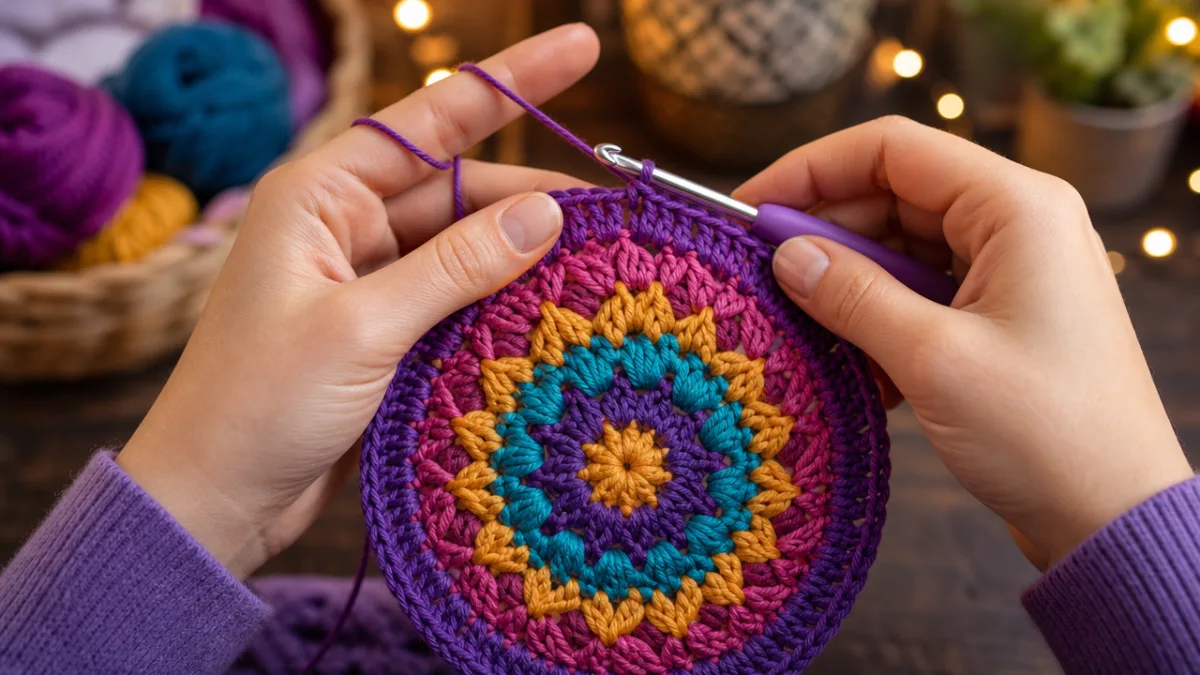
The beauty of a crochet chakra wall hanging lies in its visual layering — circles, mandalas, geometric shapes, and flowing fringe all working together in harmonious composition. Before diving into the full project, it is worth practicing the core stitches you will encounter most frequently. The magic ring, also known as the adjustable ring, is the foundational technique for beginning any circular crochet element. It allows you to start your mandala rounds with a tight, invisible center that keeps everything looking clean and professional from the very first stitch.
From the magic ring, you will work your way outward using combinations of chain stitches, single crochet, half double crochet, double crochet, and treble crochet. Each of these stitches has a different height, and alternating between them within a round creates the kind of organic, petal-like texture that gives crochet mandalas their distinctive appearance. Shell stitches — where multiple double crochets are worked into the same stitch — create beautiful fan shapes that echo the lotus flower, one of the most beloved symbols in chakra iconography. Picot stitches along the edges of individual mandala rounds add a delicate, lacy quality that photographs beautifully.
Color changes in crochet can feel intimidating at first, but they are essential for a chakra-themed piece that requires smooth transitions between seven distinct hues. The key is to change your yarn color in the last yarn over of the stitch before the color change, rather than at the beginning of the new stitch. This creates a seamless visual transition that looks intentional and polished. Practice this technique on a small swatch before beginning your wall hanging, and you will quickly develop the muscle memory needed to work through all seven colors with confidence and ease.
Recommended Stitch Patterns for Each Chakra Section
Different chakras lend themselves to different visual expressions, and you can use stitch choice to deepen the symbolic meaning of each section. For the root chakra, consider using dense, grounded stitches like single crochet worked in tight rows to evoke stability and the solid earth element. For the sacral chakra, flowing shell stitches in warm orange bring to mind the fluid movement of water, which is the element associated with this energy center. The solar plexus chakra, ruled by fire, looks magnificent in a starburst or sunburst mandala pattern worked in various shades of yellow and gold.
The heart chakra invites the most open and expansive stitch work — open lacework patterns in green allow light to literally pass through the yarn, evoking the boundless quality of love and compassion. For the throat chakra, consider incorporating chain loops and picot edging that suggest the ripple of sound waves, honoring this center’s connection to voice and expression. The third eye and crown chakras at the top of your hanging can be worked in increasingly refined, geometric mandala patterns that suggest expanding awareness and the dissolution of boundaries between self and universe.
Designing and Assembling Your Wall Hanging
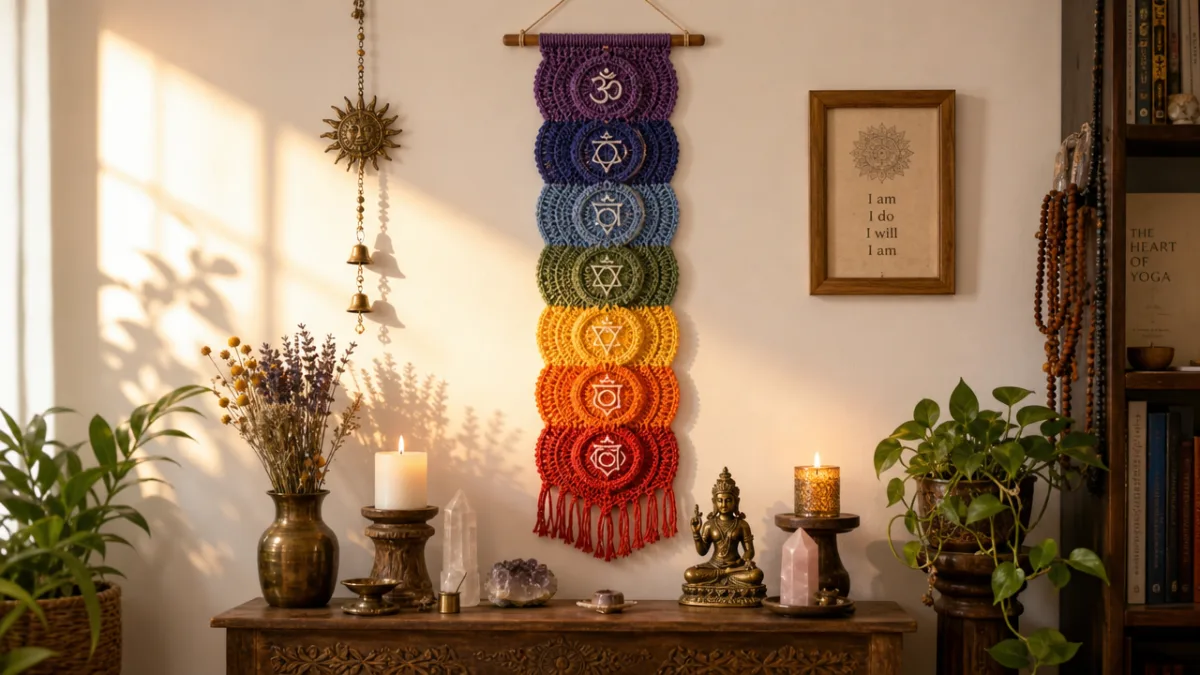
Designing your crochet chakra wall hanging is one of the most creatively satisfying parts of the entire process, and there is no single right way to approach the composition. The most common format involves crocheting seven individual mandala circles, one for each chakra, and then connecting them vertically along a central spine of yarn or cord. This creates a classic totem-style wall hanging where the colors flow downward from violet at the top through to red at the bottom, mirroring the descending sequence of the chakras in the body. Alternatively, you might choose to ascend from red to violet, representing the upward movement of kundalini energy.
Each mandala typically measures between four and eight inches in diameter, though you can vary the sizes intentionally — making the heart chakra mandala slightly larger than the others, for instance, to emphasize love as the central organizing force of the system. Once all seven mandalas are crocheted, lay them out on a flat surface before assembling to get a sense of how the composition flows. This is also the moment to add any embellishments — stitching a wooden bead to the center of each mandala, or attaching a small crystal chip that corresponds to each chakra’s healing stone.
Connecting the mandalas can be done in several ways. You can sew them directly to a long vertical strand of thick yarn or macramé cord, spacing them evenly with a few inches between each. Alternatively, you can join them with short crocheted chains that create both connection and separation, allowing each mandala to breathe visually. Once your mandalas are assembled, add fringe to the bottom of the piece for a bohemian finishing touch — cut long strands of yarn in graduating chakra colors and loop them through the bottom edge of your final mandala, then trim to your desired length for a waterfall effect.
Adding Finishing Details and Fringe
The finishing details of your crochet chakra wall hanging are what transform a collection of crocheted circles into a truly cohesive and polished piece of fiber art. After assembling your mandalas along the central spine, weave in all remaining yarn tails using your tapestry needle, burying each end securely within the stitches so that nothing unravels over time. This step requires patience and attention, but it is worth taking your time here — visible tails can distract from the beauty of the finished piece and create an unfinished impression that undermines all your careful work.
For the fringe, cut your yarn strands at least twice the desired finished length to account for the fold and the knot. Working across the bottom edge of your final mandala, use a crochet hook to pull folded bundles of yarn through the edge stitches and secure them with a simple lark’s head knot. You might choose to use all seven chakra colors in your fringe, creating a rainbow cascade, or you might stick to a single neutral color that allows the mandalas above to take center stage. Some fiber artists add beads to individual fringe strands by threading them on before knotting, which adds beautiful movement and sound to the piece.
Infusing Intention and Spiritual Meaning Into Your Work
One of the most distinctive aspects of creating a chakra-themed craft project is the opportunity to bring genuine spiritual intention to your creative practice. Many fiber artists who work with sacred symbolism choose to begin each crafting session with a brief meditation, setting a clear intention for the energy they wish to weave into their work. Before picking up your hook, you might take a few deep breaths, visualize the specific chakra you are working on, and reflect on the qualities you wish to cultivate or honor. This practice transforms crochet from a hobby into a form of moving meditation.
You might also choose to work on each chakra section during a different day or session, giving yourself time to sit with the energy of each center before moving on to the next. Lighting a candle in the corresponding chakra color while you work, or playing sound frequencies associated with each energy center, can deepen the sense of intentionality and create a truly immersive creative ritual. Some practitioners choose to charge their completed mandalas under moonlight before assembling them, or hold them during a brief prayer or affirmation that speaks to the quality each chakra embodies.
The finished wall hanging carries the accumulated energy of all the hours of mindful attention you poured into its creation. When it is displayed in your home, it serves as both a beautiful piece of fiber art and a visual anchor for your spiritual practice. Many people choose to hang their chakra wall hangings in meditation spaces, yoga rooms, or above an altar, where it can serve as a daily reminder of the balance and wholeness available to us when all of our energy centers are open and flowing freely. The piece becomes a conversation between maker and observer, craft and spirit, color and meaning.
Affirmations for Each Chakra While You Crochet
Working affirmations into your creative process is a beautiful way to deepen the spiritual dimension of this project. As you crochet each chakra mandala, you might silently or aloud repeat a short affirmation that resonates with that energy center’s qualities. For the root chakra, try “I am grounded, I am safe, I belong here.” For the sacral chakra, “I flow with creativity and embrace the joy of being alive.” These simple phrases, repeated rhythmically in time with your stitching, create a mantra-like quality to your work that many fiber artists find deeply calming and centering.
- Root chakra (red): “I am safe, grounded, and connected to the earth.”
- Sacral chakra (orange): “I embrace creativity, pleasure, and emotional flow.”
- Solar plexus chakra (yellow): “I stand in my power with confidence and clarity.”
- Heart chakra (green): “I give and receive love freely and without condition.”
- Throat chakra (blue): “I speak my truth with clarity, kindness, and courage.”
- Third eye chakra (indigo): “I trust my intuition and honor my inner wisdom.”
- Crown chakra (violet): “I am connected to the divine light within and around me.”
Displaying, Caring For, and Gifting Your Finished Creation
Once your crochet chakra wall hanging is fully assembled and all ends are neatly woven in, it is time to choose the perfect display location and method. The most popular approach involves tying a length of twine, leather cord, or yarn to both ends of your dowel or branch and creating a hanging loop centered at the top. When selecting where to hang your piece, consider both practical and energetic factors — a spot that receives gentle natural light will show off the colors beautifully, while a location in your meditation corner or near a window that faces east, toward the rising sun, adds additional symbolic resonance.
Caring for your crochet wall hanging is relatively simple, but it does require some attention to keep the piece looking its best over time. Dust can accumulate in the fibers, particularly in the fringe, so a gentle shake outdoors every few weeks or a light pass with a soft brush or lint roller will keep it fresh. If your yarn is washable, you can carefully hand wash the piece flat in cool water with a gentle soap, then reshape and dry it completely flat before rehanging. Avoid hanging your wall art in direct sunlight for extended periods, as UV exposure can fade even the most vibrant yarn colors over time.
A crochet chakra wall hanging makes one of the most thoughtful and meaningful handmade gifts you could offer to someone special in your life. The combination of handcrafted effort, spiritual symbolism, and personalized color choices communicates a depth of care that no store-bought gift can replicate. Consider gifting one to a friend who is beginning a yoga or meditation practice, to someone recovering from illness who could benefit from the healing symbolism of the chakras, or to a loved one moving into a new home and setting intentions for their next chapter. Wrap it in tissue paper, tuck in a handwritten card explaining the meaning of each color, and you have created something truly unforgettable.
Sharing Your Work and Finding Community
The fiber arts community is one of the most welcoming and generous creative communities in the world, and sharing your crochet chakra wall hanging with others — whether in person or online — can be an incredibly rewarding experience. Platforms like Pinterest, Instagram, and Ravelry are filled with fiber artists who specialize in mandala-style crochet and chakra-themed projects, and posting your finished work invites connection, encouragement, and an exchange of creative ideas that can inspire your next project. Tagging your posts with relevant hashtags helps your work reach others who share your interests and values.
If you find yourself making multiple wall hangings and developing a distinctive personal style, you might consider selling your work through an online marketplace like Etsy or at local artisan markets and wellness fairs. Handmade chakra art appeals strongly to yoga studios, holistic wellness centers, massage therapists, energy healers, and anyone who values the intersection of creativity and spirituality. Pricing handmade fiber art appropriately — accounting for materials, time, and the genuine skill involved — honors both your work and the broader tradition of valuing handmade craftsmanship in a world saturated with mass-produced goods.
Ultimately, the crochet chakra wall hanging is a project that gives back in ways that extend far beyond the finished object. The hours spent in quiet, focused creation are themselves a form of self-care and spiritual practice. The knowledge that your hands have shaped something beautiful and meaningful from simple yarn and a hook is a powerful affirmation of human creativity and intentionality. Whether it hangs on your own wall, is gifted to someone you love, or inspires a beginner crocheter to try something ambitious and meaningful, your chakra wall hanging carries the energy of its making — and that energy is always, without exception, worth celebrating.








What do you think?
It is nice to know your opinion. Leave a comment.