










From Canvas to Finger: The Art of Turning Painted Flowers into Wearable Rings
The Magic Behind Miniature Wearable Art
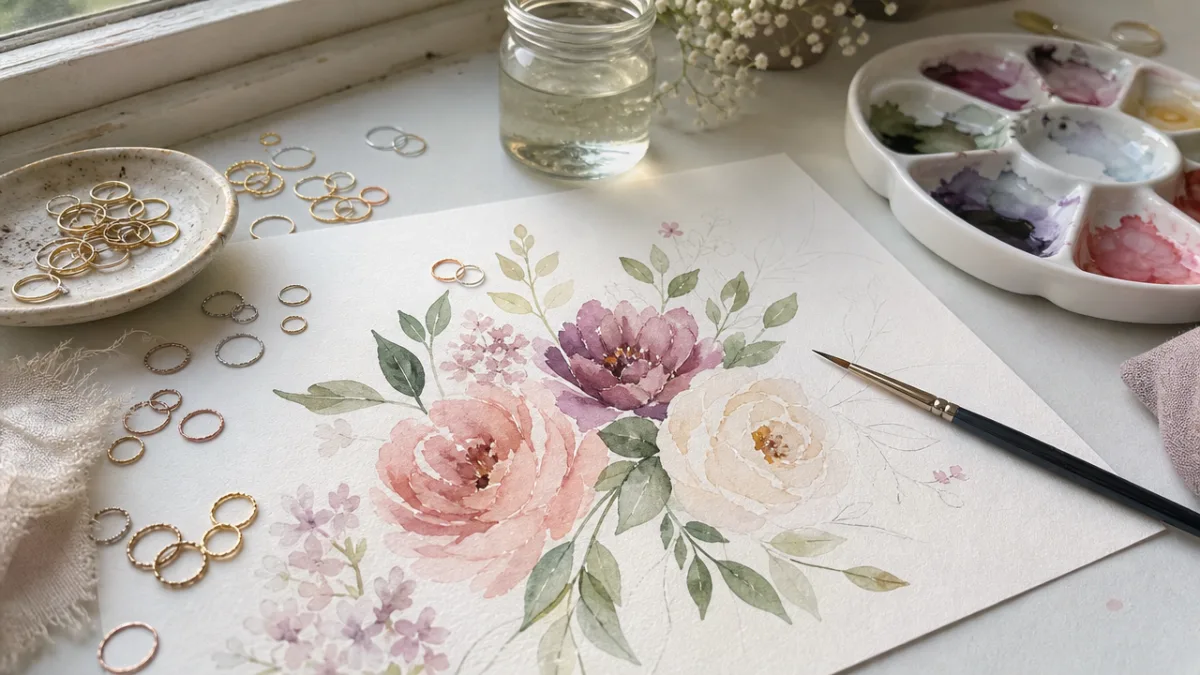
There’s something almost unbelievable about holding a piece of jewelry that started out as a full-sized painting. Taking a hand-painted flower and turning it into a delicate little ring sounds like something from a storybook — but it’s a very real craft, and it’s been catching on fast. It lives right at the intersection of fine art and jewelry making, and artists who’ve spent years working on canvas are finding that those same skills translate surprisingly well into tiny wearable pieces. The result is jewelry that feels warm, intentional, and completely unlike anything you’d find in a store.
The magic really is in the transformation. A painter might start with a big, expressive floral piece — sweeping brushstrokes, colors blooming across the paper with total freedom. Then, through a careful reduction process, that same painting ends up small enough to sit on a fingertip. The scale shift alone is kind of breathtaking. But what really gets people is how much of the original painting’s personality survives the journey. The brushstrokes, the color gradients, even the little imperfections — all of it makes it down into miniature form.
And this goes way beyond novelty. Wearing a painted flower ring is a genuinely personal experience. Unlike mass-produced jewelry stamped out by a machine, each piece is unique all the way down to the microscopic level — how the paint was applied, how the resin catches light, how the colors shift depending on where you’re standing. Two rings made from the same original painting will still look different from each other. Collectors and art lovers have absolutely noticed, and more people are actively seeking out jewelry that actually has something to say.
Choosing the Right Floral Painting to Begin
Not every floral painting is a great candidate for miniaturization, and learning to spot what works is honestly one of the first real skills you’ll develop. Paintings with strong contrast between the flower and background tend to translate best at small scales — detail that reads clearly at six inches can turn into muddy confusion at half an inch. Artists who’ve been doing this for a while usually recommend starting with bold, graphic compositions rather than highly realistic botanical illustrations, at least until you get a feel for how your particular painting style holds up when scaled way down.
Color saturation matters more than you might expect. When a painting gets photographically reproduced and shrunk down for printing or UV transfer onto resin or metal, colors can shift in surprising ways. Reds tend to deepen toward burgundy, yellows can go a little orange, and soft lavenders sometimes disappear almost entirely. Experienced makers account for this by deliberately painting their florals with the saturation cranked up a bit, knowing the process will dial things back. Testing small printed versions of a painting before committing to full production is pretty much considered non-negotiable.
The medium of the original painting matters too. Watercolor florals have this beautiful translucency that looks stunning under a domed resin coating — it’s like looking at pressed flowers trapped in amber. Gouache and acrylic paintings, with their opaque, vivid quality, tend to hold detail more reliably through the reduction process. Oil paintings are trickier to preserve but can produce extraordinary depth when properly scanned and reproduced. A lot of artists eventually land on a preferred medium specifically for their jewelry work and treat it almost as a separate discipline from their larger canvas paintings.
The Technical Process of Miniaturization
Actually shrinking a painting down to ring size involves several distinct stages, and each one has its own tools and learning curve. It starts with high-resolution digital capture — which is a lot more demanding than snapping a photo with your phone. Most artists working at a professional level invest in either a flatbed scanner that resolves at least 1200 DPI, or a mirrorless camera with a macro lens that can pick up fine brushstroke textures. This digital file becomes the master for all your reproductions, so its quality sets the ceiling for everything else you’ll make from it.
Once you have a solid digital file, the real creative decisions start. A single floral painting might offer dozens of possible ring-sized crops, each one highlighting something different about the original. Some artists zero in on a single bloom for an intimate portrait effect. Others go more abstract, pulling out crops that are really about color fields and brushstroke patterns rather than recognizable petals. These cropping decisions are genuinely artistic — they require the same compositional eye you used to make the original painting — and a lot of artists spend real time exploring options before committing.
The reproduction method itself varies quite a bit from maker to maker. Some artists print their miniaturized designs onto specialty papers and seal them under glass or resin bezels. Others use UV printing to apply the image directly onto metal or acrylic ring blanks. More adventurous makers have played around with photographic emulsion processes, cyanotype transfers, and even laser engraving for a graphic, line-based look. Each approach produces a noticeably different result, and many jewelry artists eventually develop a signature technique that makes their work instantly recognizable to anyone familiar with the field.
Materials and Tools You Will Need
Building a practice around painted flower rings means assembling a thoughtful kit of materials and tools, and the investment can range from pretty modest to fairly substantial depending on the quality level you’re going for. At the foundation, you’ll need painting supplies suited to your preferred medium — watercolor pans and cold-press paper, tubes of gouache on hot-press illustration board, or acrylic paints on primed canvas panels. Quality matters more here than in conventional painting, because any grain, texture irregularity, or color inconsistency in the original gets scrutinized up close by whoever is wearing the finished piece.
Once you move into the reproduction and jewelry construction phase, the materials list expands quite a bit. Most artists working in this space rely on some combination of the following:
- A high-resolution flatbed scanner or dedicated macro photography setup with consistent, calibrated lighting — you need to capture the original painting without color distortion or perspective issues, and that takes more setup than most people expect.
- Image editing software like Adobe Photoshop or Affinity Photo for color corrections, cropping, and preparing files at the right resolution and dimensions for printing.
- UV resin in both doming and casting formulations, along with UV curing lamps at appropriate wattage — undercured resin stays tacky and yellows over time, so this part isn’t something to cut corners on.
- Ring blanks in various sizes and base metals, including brass, copper, sterling silver, and surgical-grade stainless steel, so you can accommodate different preferences and price points.
- Adhesives specifically made for bonding resin to metal, since general craft glues often fail under the thermal and mechanical stress of everyday jewelry wear.
- Fine-grit wet-dry sandpaper from 400 through 3000 grit for smoothing resin surfaces, followed by polishing compounds to get that professional, glass-like clarity.
Beyond the physical materials, there are a few tools that beginners often overlook. Good daylight-balanced task lighting is essential both for painting and for checking finished pieces, since colors under warm incandescent light can hide defects that are immediately obvious in natural light. A jeweler’s loupe or magnifying lamp lets you inspect your work at the same scale someone might hold it up to examine it. And precision digital calipers are genuinely useful for confirming that your printed or transferred image is sized correctly before sealing it permanently under resin — discovering a misalignment after the piece has cured is a frustrating lesson that most makers only need to learn once.
Sealing and Finishing for Lasting Beauty
Finishing is where technical skill and artistic instinct collide most visibly. A beautifully painted image reduced to a perfect crop can still result in a disappointing ring if the sealing and finishing are careless or rushed. On the flip side, even a painting with moderate detail can become a stunning piece when the finishing is done with real patience and care. Most professionals will tell you that finishing is what separates hobbyist results from professional-quality work — and it’s usually where beginners need the most practice before things start coming out consistently.
Doming resin over the image surface is both a protective measure and an aesthetic one. A well-applied dome of UV resin creates a subtle magnifying lens effect that makes the miniature painting appear to recede into depth — it feels like you’re looking into the flower rather than at a flat image on a surface. Getting that dome right means working in a dust-free environment, warming the resin slightly to reduce viscosity before you apply it, and briefly passing a heat gun or butane torch over the surface to pop any bubbles before it cures. Dust is genuinely the enemy here, and plenty of serious makers have a workspace set aside exclusively for resin work.
The edges and the back of the ring setting deserve just as much attention as the face, especially for pieces at higher price points. Raw metal edges around a resin bezel should be smoothed and polished so there’s nothing sharp catching on skin or fabric. The inner band needs to feel comfortable against the finger, which can mean additional sanding or burnishing of the metal. Many artists sign their work on the back of the ring shank using a fine engraving tool or a permanent marker sealed under lacquer — a small touch that lifts the piece from craft item to signed artwork.
Building a Creative Practice and Sharing Your Work
What often starts as one experiment with a favorite painting and a ring blank has a way of turning into a full creative practice with its own rhythms and aesthetic direction. A lot of artists who’ve gone deep into painted flower jewelry say the process changed how they approach their larger work too — making them more deliberate about composition, more aware of how colors will read at scale, more attentive to how brushwork texture survives reproduction. The jewelry and the painting end up feeding each other in genuinely productive ways, creating a cycle of creative development that neither one would produce on its own.
Social media — and Pinterest especially — has played a big role in how this art form has spread. Images of tiny painted flower rings do really well on visual platforms because they hit several sources of delight at once: botanical beauty, the intimacy of jewelry, and the satisfying mystery of a process that seems almost impossible. Artists who share both finished pieces and behind-the-scenes process content tend to build engaged audiences quickly, because people are genuinely fascinated by the journey from full-sized painting to wearable miniature. The comment sections on these posts are reliably full of some version of the same question: how is this even possible?
For anyone who wants to turn this into a business or a sustained creative pursuit, there are a few directions worth thinking about:
- Starting with a small collection of rings based on a single cohesive floral series — it creates a visually unified body of work that reads well in both portfolio presentations and online shop listings, and gives potential buyers a clear sense of your aesthetic.
- Offering both ready-to-ship pieces and custom commissions, where customers can request rings made from their own favorite flowers or color palettes. Custom work commands higher prices and tends to build much deeper customer relationships.
- Documenting the process thoroughly from the beginning — process videos and time-lapses of both the painting and construction phases are among the most widely shared content types in the craft and jewelry communities online.
- Connecting with makers in adjacent disciplines like pressed flower jewelry, botanical illustration, and resin art. These communities share audiences and technical knowledge freely, and there’s a genuine collaborative spirit in that space.
- Exploring retail partnerships with botanical gardens, art museum gift shops, and florist studios — places where customers are already in exactly the right headspace to appreciate the combination of floral art and wearable craft.
But beyond all the technical ingenuity and artistic skill involved, what makes painted flower rings so enduringly appealing is something simpler: the intimacy they create between maker, material, and wearer. When someone puts on a ring that contains a fragment of a real painting — made by real hands, with a real brush — they’re carrying a piece of human expression through their day. In an era when so much of what we own has been engineered to erase the evidence of its making, these little painted rings do the opposite. They’re unmistakably, beautifully, stubbornly handmade. And honestly, that might be the most magical thing about them.








What do you think?
It is nice to know your opinion. Leave a comment.