










Step Inside: Leah Faye Gaeddert’s Family Home is Full of Magical Design Moments
An Introduction to a Home That Feels Like a Story
There are homes that function, and then there are homes that speak. Leah Faye Gaeddert’s family residence belongs firmly in the second category — a space that communicates warmth, creativity, and an unmistakable sense of lived-in beauty from the moment you cross the threshold. This is not a showroom dressed up to impress photographers; it is a real family home shaped by real choices, each one revealing something true about the people who inhabit it. The result is a residence that manages the rare trick of feeling both aspirational and deeply personal at the same time.
What makes Gaeddert’s home particularly compelling is the way it resists the tyranny of any single aesthetic. There are nods to traditional craftsmanship sitting comfortably alongside more contemporary choices, vintage finds mingling effortlessly with modern pieces, and rich color punctuating spaces that also know how to breathe. This is the hallmark of a confident designer — or rather, a confident homeowner — who understands that a truly beautiful space is not about following trends but about curating a life. Every corner of this home carries that philosophy forward with conviction.
For those who follow interior design with genuine passion, a home like this offers more than visual pleasure. It offers a kind of education in the art of making decisions that accumulate into something greater than the sum of their parts. From the way natural light is coaxed through the windows to the thoughtful layering of textiles that gives each room its particular texture and temperature, Gaeddert’s home is a masterclass in the kind of design that looks effortless precisely because so much thought has gone into it. Walking through these rooms, you begin to understand what people mean when they describe a home as magical.
The Philosophy Behind the Aesthetic
Every home with a coherent identity has a philosophy driving it, whether the homeowner has articulated it consciously or not. In Gaeddert’s case, the guiding principle seems to be one of emotional authenticity — the idea that a home should reflect not who you aspire to be in some abstract sense, but who you actually are in the fullest, most specific sense. This means making room for imperfection, for the beloved object that doesn’t technically match, for the drawing your child made that deserves a place on the wall alongside more formal art. It is a generous and humanizing approach to design.
This philosophy also shows up in the way the home handles scale and proportion. Rather than defaulting to safe, medium-scale everything, Gaeddert embraces contrast — a dramatically oversized mirror here, a delicately small lamp there, a ceiling treatment that draws the eye upward when least expected. These decisions demonstrate a willingness to take risks that most homeowners shy away from, and it is precisely these risks that make the space so rewarding to spend time in. The unexpected becomes, over time, the beloved.
Understanding this philosophy is key to understanding why the home feels so cohesive despite its eclecticism. It is not the cohesion of a matched set — not the coherence you get when everything comes from the same catalog — but the deeper coherence of a unified point of view applied consistently across diverse materials. Each room, however different its mood, shares the same underlying commitment to honesty and care. That shared commitment is what ties everything together and elevates the whole above any individual piece or room.
The Heart of the Home: Living Spaces That Invite You to Stay
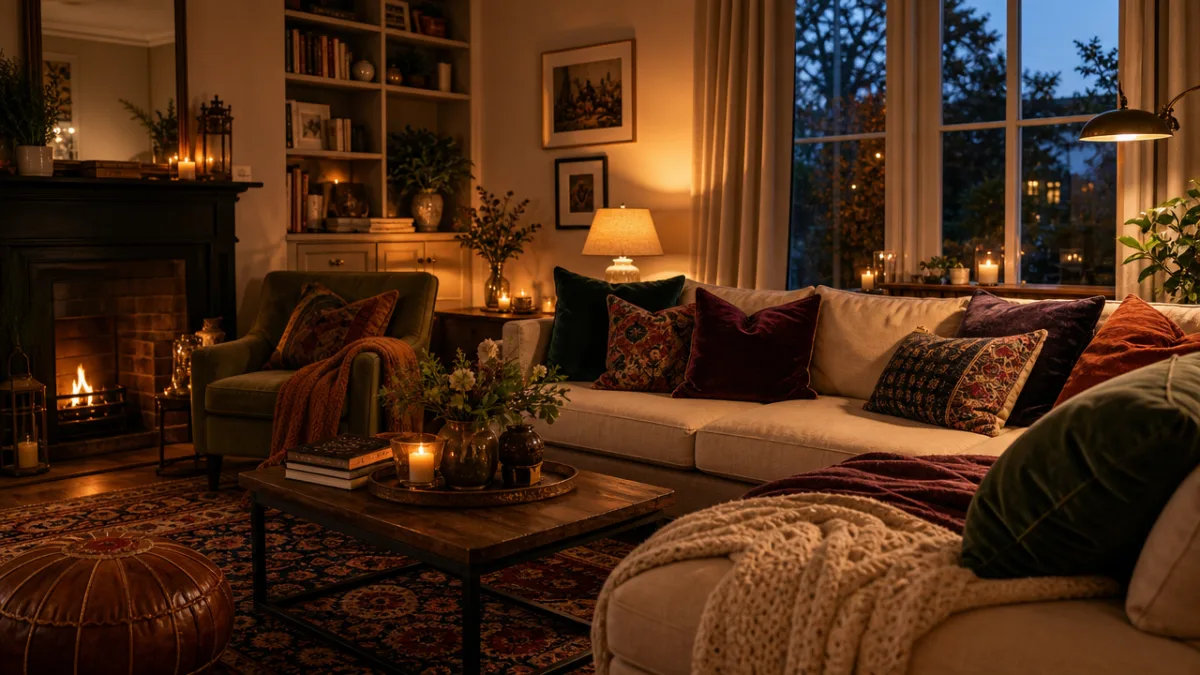
The main living areas of Gaeddert’s home carry out the promise made by the entryway in full. These are spaces designed not for occasional use but for daily life — for the kind of long, meandering evenings that drift from conversation to reading to the comfortable silence of people who know each other well. Sofas are positioned for genuine conversation rather than for the optics of a room tour. Coffee tables are at the right height. The lighting has been considered at every hour of the day, from the brightness of morning to the warm amber glow of late evening. These are decisions that add up to a room that actually works.
Color plays a particularly important role in the living spaces. Rather than committing to a single wall color and calling it done, Gaeddert layers color through textiles, art, and objects, allowing the palette to shift subtly as you move through the room. Deep, saturated tones appear in unexpected places — a velvet cushion in a rich jewel tone, a piece of art with earthy, complex pigments, a rug whose colors seem to change depending on the light hitting it at any given moment. The effect is one of depth and richness without heaviness, a balance that is genuinely difficult to achieve and speaks to a sophisticated understanding of how color behaves in three-dimensional space.
Furniture choices in the living areas reflect a similar sophistication. There is a mix of periods and provenances that would look random in lesser hands but reads here as considered and intentional. A mid-century silhouette sits beside something more rustic and handmade, and both are in conversation with a more contemporary piece that grounds the arrangement in the present moment. What holds it all together is an attention to materials — wood, linen, leather, ceramic — and a consistent preference for pieces that bear the marks of genuine craft. Nothing here looks cheap, but very little looks precious either, which is exactly the point.
Textiles and Layering: The Secret Weapon
If there is one technique that most distinguishes Gaeddert’s approach to her living spaces, it is the extraordinary care she gives to the layering of textiles. This is not simply about having a lot of throw pillows — it is about understanding how different weights, weaves, and textures interact with one another and with the harder surfaces around them. A chunky knit blanket draped over the arm of a sofa softens the room in a way that nothing else quite can. A flat-woven rug under a plushly upholstered chair creates a dialogue between surfaces that makes both more interesting. This is the kind of nuance that photographs well but that you really feel when you are in the room itself.
The palette of the textiles is worth noting separately from the broader color story of the room because it operates on its own terms. Gaeddert gravitates toward colors that have warmth in them even when they are ostensibly neutral — creams with a yellow undertone, whites with a whisper of blush, grays that lean toward taupe. These choices keep the rooms from ever feeling cold or clinical, ensuring that even at their most restrained, the spaces radiate a quality of welcome that is the ultimate goal of residential design. It is a warmth that cannot be manufactured; it must be chosen, deliberately and repeatedly, at every step of the design process.
The Kitchen and Dining Areas: Where Function Meets Soul
Any serious conversation about a family home must reckon with the kitchen, and Gaeddert’s is no exception. This is a space that has clearly been designed with the reality of family life at its center — the morning rush, the after-school snack, the long weekend cooking session, the dinner party that overflows from the dining table into the prep area. The kitchen accommodates all of these scenarios with grace, and it does so without sacrificing an ounce of its visual appeal. This is a remarkable achievement, because making a kitchen genuinely beautiful while making it genuinely functional requires an almost paradoxical set of decisions.
The material palette in the kitchen is one of the most confident in the house. Natural stone surfaces carry an inherent gravitas and beauty that manufactured materials simply cannot replicate, and Gaeddert has used them with a sensitivity to their variation and movement. Cabinetry finishes have been chosen to complement rather than compete with the stone, creating a background that is rich without being overwhelming. Hardware choices — the small decisions that many homeowners leave to the last minute — have been treated here with the same seriousness as the larger ones, and the cumulative effect of getting all those small decisions right is a kitchen that feels finished and intentional in every direction you look.
The dining area adjacent to the kitchen completes the picture of a space designed for real gathering. A table of generous proportions anchors the room without overwhelming it, and the chairs surrounding it represent yet another opportunity for the mixing of materials and periods that defines the home’s broader aesthetic. Lighting over the dining table is perhaps the most consequential single design decision in any dining room, and Gaeddert has made the right call — a fixture that provides genuine illumination while also serving as a piece of sculpture, beautiful even when unlit, transformative when it is. The overall effect is of a space where you would genuinely want to linger over a meal.
Storage and Organization as Design Elements
One of the quieter pleasures of Gaeddert’s kitchen and dining areas is the way storage and organization have been integrated into the design rather than treated as afterthoughts to be hidden away. Open shelving in the kitchen allows a curated collection of ceramics, glassware, and small objects to participate in the visual story of the room. This is a design choice that requires both confidence and discipline — confidence to put your everyday objects on display, and discipline to ensure that what is displayed actually merits the attention. Gaeddert navigates both requirements with apparent ease, resulting in shelving that looks as intentional as any gallery wall.
The organizational approach extends to the dining area, where a thoughtful sideboard or buffet serves double duty as storage and display surface. These pieces — often overlooked in contemporary interiors that have moved toward purely minimal approaches — provide an invaluable combination of practical function and decorative opportunity. Gaeddert uses such surfaces to rotate seasonal objects, to display meaningful items that tell small stories about the family’s life and travels, and to introduce cut flowers or living plants that bring organic life and movement into what might otherwise be a static composition.

The Private Spaces: Bedrooms and Retreats Designed for Rest
The private spaces of a home — the bedrooms, the reading nooks, the small corners carved out for solitude — reveal something different about a designer’s instincts than the public-facing rooms do. In the public rooms, there is always some awareness of the impression being made on visitors. In the private spaces, that pressure relaxes, and what emerges is often more personal and more revealing. Gaeddert’s private spaces are quieter than the rest of the house, appropriately so, but they are no less carefully considered. The restraint on display here feels deliberate — a pulling back that allows for rest and recovery in a home that is otherwise generously stimulating.
The primary bedroom is perhaps the most instructive room in the house for understanding Gaeddert’s design sensibility in its most distilled form. Here, the layering of textiles reaches its fullest expression: linen bedding with a natural, slightly wrinkled quality that communicates ease, a quilt or coverlet that adds visual weight without physical heaviness, pillows arranged with the appearance of casualness that actually results from careful thought. The color palette is more muted here than in the rest of the house, with natural linens and soft whites providing a ground against which warmer accents — wood tones, a terracotta vessel, the color of a single flower — read with particular clarity.
Lighting in the bedrooms deserves special mention. Gaeddert understands something that many homeowners miss entirely: that bedroom lighting must work at multiple levels, from the bright clarity needed for getting dressed in the morning to the low, warm glow that eases the transition into sleep. This means multiple light sources at different heights — a bedside lamp that can be switched independently, perhaps a wall sconce that casts light upward, maybe a floor lamp in a reading corner. The result is a room that can shift its mood and function throughout the day, accommodating the full range of activities that modern bedrooms are asked to host.
Children’s Spaces: Imagination Given Room to Breathe
A family home is incomplete without considering how it serves its youngest inhabitants, and Gaeddert’s approach to children’s spaces reflects the same thoughtfulness that characterizes the rest of the house. Rather than defaulting to the primary-colored, character-branded aesthetic that dominates so much children’s design, these rooms are spaces where imagination is given room to breathe — where the design provides a backdrop rich enough to inspire play without being so literal that it crowds out the child’s own creative contribution. The walls might carry a color with genuine depth and character; the furniture might be small-scale versions of forms that would look at home anywhere in the house.
Storage in the children’s rooms is handled with particular ingenuity, because few design challenges are more demanding than making a child’s room function well enough for daily use while looking beautiful enough to bring genuine pleasure. Low shelving that a child can reach independently encourages autonomy and teaches, by example, the habit of putting things away. Bins and baskets in natural materials provide flexible storage that can adapt as the child grows and their needs change. The result is a space that respects the child’s intelligence and capacity while providing enough structure to make daily routines manageable for everyone.
Perhaps the most touching aspect of the children’s spaces in Gaeddert’s home is the way they honor the child’s own creative output. Drawings, paintings, and small made objects are displayed with the same care and thoughtfulness that the rest of the house brings to its art collection. A simple clip frame on a low section of wall, a small ledge dedicated to rotating works in progress, a corner of a bulletin board given over to the week’s favorite finds — these are small gestures with large implications. They communicate to the child that what they make and care about matters, which is perhaps the most important design message a home can send.
Outdoor Spaces and the Art of Extending the Home Beyond Its Walls
A truly successful family home does not stop at the front door or the back door — it extends its sense of welcome into whatever outdoor space is available, however modest that space might be. Gaeddert’s approach to the outdoor areas of her home reflects the same design sensibility that governs the interior: a commitment to layering, to material quality, to the creation of spaces that invite genuine use rather than merely looking good in photographs. The outdoor areas feel like rooms in their own right, with clear zones for different activities and transitions between them that feel considered rather than accidental.
Planting choices play a role in the outdoor design that is analogous to the role textiles play inside — they provide softness, movement, and a quality of organic life that harder materials cannot supply on their own. Gaeddert appears to favor plants with interesting textures and forms over purely colorful ones, choosing specimens whose structural qualities remain interesting through multiple seasons rather than relying on a single annual flush of color. This is a sophisticated horticultural approach that requires patience and foresight but rewards both with outdoor spaces that feel genuinely beautiful year-round rather than only in the brief window of peak flowering.
Outdoor furniture and objects are chosen with the same material consciousness that governs the interior selections. Natural materials — teak, rattan, stone, terracotta — weather in ways that are beautiful rather than merely showing their age, developing a patina over time that adds character rather than signaling neglect. A terracotta pot left outdoors through a winter becomes more itself, not less. A wooden table that has been rained on and dried in the sun acquires a silver warmth that no new finish can replicate. By choosing materials that improve with age and exposure, Gaeddert ensures that her outdoor spaces become more beautiful over time, earning their place in the home’s story rather than merely being rented from a catalog.
Bringing the Outside In: The Role of Nature Throughout the Home
The boundary between inside and outside in Gaeddert’s home is deliberately permeable, and not only in the literal sense of windows and doors. Throughout the interior, there is a consistent effort to bring the natural world inside in ways that are both practical and aesthetic. Cut flowers appear throughout the home, not as a formal decorative gesture but as a natural and renewable source of color, scent, and life. Potted plants in forms that complement the rooms they inhabit provide a similar function with greater permanence. Even the materials chosen for furniture and objects — stone, wood, linen, ceramic — carry within them the memory of the natural world from which they came.
This connection to nature is not incidental; it reflects a genuine understanding of what makes spaces feel restorative. Research in environmental psychology has long supported what great designers have always known intuitively: that exposure to natural materials, natural light, and living plants has measurable positive effects on mood, stress levels, and cognitive function. By incorporating these elements throughout her home, Gaeddert has created spaces that are not only beautiful to look at but genuinely good for the people who live in them — a distinction that is often lost in discussions of interior design but that represents the highest aspiration of the field.
The result of all these choices — the carefully selected materials, the layered textiles, the respectful attention to children’s spaces, the permeable boundary between indoors and out — is a home that earns its description as magical without resorting to anything supernatural. The magic here is the magic of genuine care applied consistently over time, of decisions made with both head and heart, of a family home that truly serves the family that lives in it. Gaeddert’s home reminds us that great design is not about showing off but about creating the conditions under which a good life can be lived. That is a more ambitious goal than it might first appear, and this home achieves it with apparent ease and evident joy.

- Layered textiles: The deliberate combination of different weights, weaves, and textures creates warmth and visual depth throughout every room in the home.
- Material authenticity: A consistent preference for natural materials — stone, wood, linen, ceramic — ensures that every surface has character and ages gracefully over time.
- Eclectic curation: Mixing periods, provenances, and styles with a unified point of view produces a home that feels collected and personal rather than catalog-assembled.
- Lighting at every level: Multiple light sources at varying heights allow each room to shift its mood and function across different times of day and different types of use.
- Nature throughout: Cut flowers, living plants, and natural materials maintain a consistent connection to the organic world that makes the home feel restorative as well as beautiful.
- Children honored: Treating children’s spaces and creative output with the same seriousness given to adult areas of the home communicates deep respect and produces genuinely livable family rooms.








What do you think?
It is nice to know your opinion. Leave a comment.