










Atölye: The Art of the Creative Studio and Its Transformative Power
What Is an Atölye? Understanding the Creative Workshop
The word atölye comes from the French atelier — a workshop or studio where artists, craftspeople, and designers bring ideas to life. In Turkish culture, the term took on a life of its own, growing into something bigger than just a place. It became a whole way of thinking about making, learning, and creating. An atölye is where raw materials meet imagination, where skills get built through repetition and happy accidents, and where the line between enthusiastic beginner and seasoned pro gets beautifully fuzzy. For anyone who creates with their hands, their mind, or both, it’s something close to a sanctuary.
Workshops and studios have always been at the heart of artistic civilizations. Think of the Renaissance ateliers of Florence, where apprentices ground pigments alongside masters like Leonardo and Raphael, or the Ottoman craft guilds of Istanbul, where tile-makers spent generations perfecting İznik patterns. The idea of a dedicated creative space has been central to culture and craft for as long as we can remember. The atölye carries all of that history within its walls — the memory of countless hands that worked before us, and the promise of countless more to come. It connects us to something ancient and deeply, unmistakably human.
These days, the atölye has stretched well beyond its traditional roots. You’ll find them dedicated to ceramics, painting, textile arts, jewelry making, woodworking, illustration, photography, and digital design. Community art centers, boutique creative studios, university workshops, and cozy home-based creative corners all fit comfortably under this umbrella. What ties them together isn’t the medium or the discipline — it’s the spirit. A genuine commitment to the process of making, a respect for materials, and an openness to discovery that turns every session into its own little adventure.
Designing Your Atölye: Space, Light, and Atmosphere
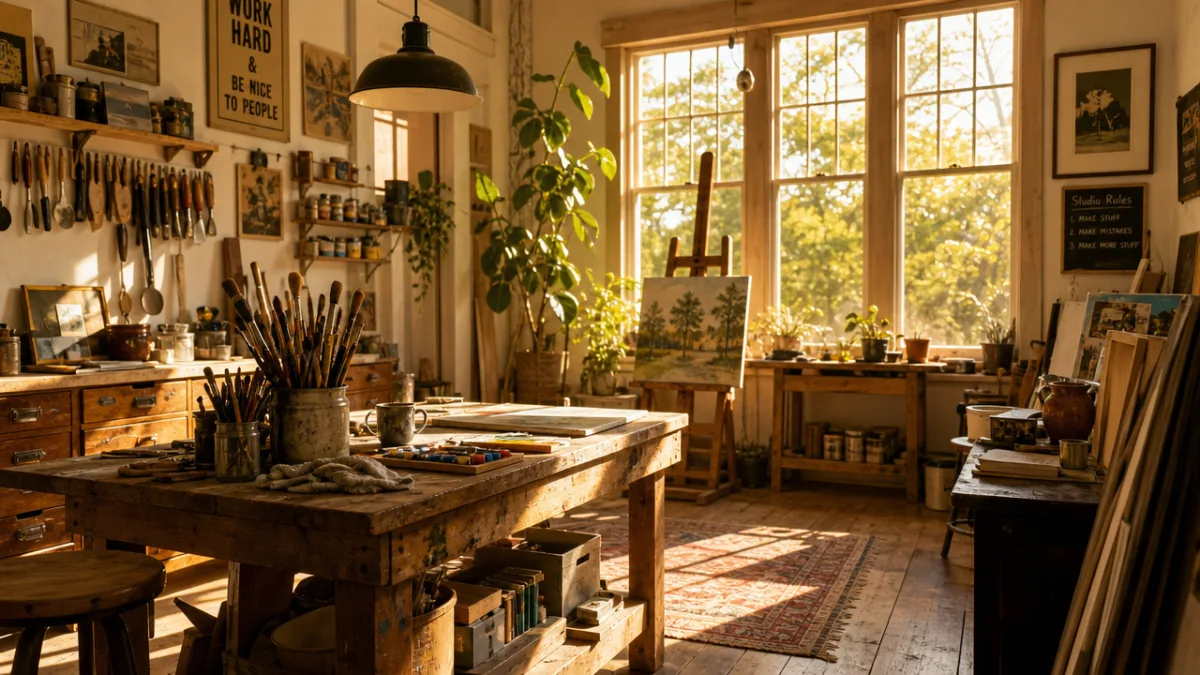
The physical setup of an atölye matters more than you might think. A well-designed studio doesn’t just store your tools — it actively inspires you, cuts down on friction, and creates the kind of mental environment where creative flow actually happens. Natural light is probably the single most important factor. North-facing windows have been a favorite of painters for centuries because they offer consistent, diffused light that doesn’t shift dramatically as the day goes on. East-facing light brings a warm, energizing morning glow that works beautifully if you’re an early riser who likes to create before the world gets loud. Whatever direction your space faces, getting the light right should be your first priority.
Storage and organization come in a close second. Creative work generates a surprising amount of stuff — materials, tools, half-finished projects, reference images, finished pieces — and all of it needs somewhere logical to live. Open shelving is great because you can see everything at once, which often sparks ideas you wouldn’t have had otherwise. Pegboards, magnetic strips for metal tools, labeled drawers, and rolling carts you can move around as projects change are all staples of a well-organized studio. The goal isn’t a spotless, magazine-ready workspace — it’s purposeful accessibility. Everything within reach, nothing in the way.
Beyond the practical stuff, an atölye’s atmosphere says a lot about the person who works in it. Plants bring life into the room. Pinboards layered with inspiration — torn magazine pages, fabric swatches, postcards, rough sketches — build up into a visual language that’s entirely your own. The smell of linseed oil or fresh clay, a worn worktable, whatever music you play while you work: these sensory details accumulate over time into something you really can’t manufacture on purpose. A studio that’s actually been worked in feels completely different from one that’s just been furnished, and that lived-in quality is exactly what turns a room into a real atölye.
The Disciplines of the Atölye: A World of Creative Practices
Ceramics is one of the oldest and most beloved things you can do in an atölye. Working with clay is deeply tactile and almost meditative in a way that’s hard to find in other mediums. The wheel demands patience, balance, and a sensitivity to the material that takes real time to develop. Hand-building — coiling, pinching, slab construction — offers a different kind of satisfaction: slower, more deliberate, and closely tied to the long human history of making things from earth. Then there’s glazing, which introduces a whole world of color chemistry where the final result stays beautifully uncertain until the kiln opens and shows you what the fire decided to do.
Textile arts cover an enormous range of practices that feel right at home in an atölye — weaving, embroidery, macramé, natural dyeing, quilting, knitting. Each has its own technical language, its own community, its own aesthetic traditions. Natural dyeing, for instance, involves sourcing plant materials like indigo, madder, weld, or walnut husks and using them to transform raw fabric into richly colored cloth in ways that synthetic dyes just can’t replicate. The results are subtle and complex, and there’s something deeply satisfying about working with materials pulled from the natural world — especially now, when so many people are thinking more seriously about sustainability and craft.
Illustration, printmaking, and paper arts form another rich cluster of studio practices. Linocut and woodblock printing let you make bold, graphic work with surprisingly simple equipment. Bookbinding turns functional craft into something that feels like art. Watercolor, gouache, and ink drawing reward careful observation and confident mark-making. What these disciplines share is an intimacy of scale and directness of medium that makes them perfectly suited to smaller studio spaces. You don’t need a giant room or expensive machinery — a good worktable, decent light, and quality materials are often all it takes to build a deeply satisfying practice.
Community and Connection in the Atölye
One of the most genuinely powerful things about the atölye model is how naturally it builds community. Shared studios, cooperative workshops, and community art centers bring together people from wildly different backgrounds, ages, and skill levels around one simple thing: making. And those encounters turn out to be surprisingly fertile ground for friendship, collaboration, and learning from each other. A retired teacher picking up watercolor beside a young graphic designer. A textile artist watching a jeweler work with metal and suddenly seeing unexpected connections to her own practice. A beginner ceramicist getting a word of encouragement from a master potter. These are the quiet, everyday miracles of shared creative space.
Workshops and classes offered through atölyes do something genuinely important: they keep traditional crafts alive and accessible. Skills that were once passed down almost exclusively within families or guilds — natural dyeing, hand-weaving, traditional embroidery, decorative painting — are being preserved and shared through community studio programs. That matters culturally. When skills are taught in open, welcoming spaces rather than guarded as trade secrets, they become part of a shared cultural commons that everyone can draw from and add to, which is how they survive across generations rather than quietly disappearing.
The social life of atölye culture extends well beyond the studio itself — through exhibitions, open studio events, craft markets, and online communities. Contemporary makers share their processes on social media with remarkable generosity, posting work-in-progress shots, explaining techniques, and building audiences that stretch across continents. It’s an interesting contrast to older traditions of craft secrecy, and it reflects a very modern understanding that sharing knowledge doesn’t diminish it — it multiplies it. The global community of atölye practitioners, connected through both digital platforms and local studio networks, is one of the most vibrant creative ecosystems around right now.
The Philosophy of Making: Why the Atölye Matters
In a world of mass production, algorithmic content, and near-constant digital noise, the atölye offers something increasingly rare: the experience of actually making something with your own hands. And that experience matters far more than whatever objects come out of it. Learning a craft — struggling with a technique, failing, adjusting, trying again, eventually getting it — builds resilience and patience in a way that passive consumption simply cannot. When you make something with your hands, you understand it differently, more deeply, in a way that feels written into your body rather than just stored somewhere in your memory.
There’s also compelling evidence that creative practice does genuinely good things for mental health and wellbeing. The state of focused, absorbed engagement that craft produces — what psychologist Mihaly Csikszentmihalyi famously called “flow” — is associated with reduced anxiety, better mood, and a sense of meaning that doesn’t evaporate the moment you leave the studio. A lot of people who come to atölye classes looking for a hobby or a bit of social connection discover that their creative practice becomes something much more central to who they are: a reliable source of calm when things get hard, a way of processing feelings that words can’t quite reach, and a way of anchoring themselves to the present moment that works surprisingly well.
The philosophy of the atölye also involves a very particular relationship with time — one that feels genuinely countercultural right now. In a world obsessed with speed, efficiency, and scale, the atölye insists on slowness, repetition, and the irreplaceable value of time spent in deliberate practice. A pot thrown on the wheel can’t be rushed. An embroidery pattern stitched by hand takes as long as it takes. A painting reveals itself on its own schedule. This refusal to be accelerated isn’t just nostalgic — it reflects a real wisdom about the conditions under which genuine skill and meaningful work actually develop. Some of the most important things can’t be optimized, only practiced, and the atölye knows this in its bones.
Starting Your Own Atölye: A Practical Guide
Starting a creative studio practice requires far less space, equipment, and money than most people assume. The most important step is simply picking a discipline that genuinely excites you and then showing up for it consistently over time. Curiosity and consistency beat talent and resources every time, especially at the beginning. Plenty of celebrated makers started with borrowed tools on a kitchen table, building their skills over years before investing in a dedicated space or professional-grade equipment. Start with what you have, where you are, with the time you can spare — and let the practice grow from there.
That said, equipping your atölye thoughtfully makes a real difference. This doesn’t mean buying the most expensive things — it means investing wisely in a small number of quality essentials. A ceramicist needs reliable wheel and kiln access far more than a drawer full of decorating tools. A weaver benefits more from a well-made loom than from a huge yarn collection. A printmaker gets more mileage from sharp carving tools and good paper than from every color of ink available. Do your research before you buy, ask experienced practitioners what they’d actually recommend, and prioritize the tools that most directly support the core of what you’re doing.
It’s also worth connecting with existing atölye communities before or alongside setting up your own practice. Taking a class or workshop gives you technique and community at the same time. Many experienced makers offer one-on-one sessions, mentorships, or open studio access that can speed up your learning considerably while also giving you a bit of encouragement during the inevitable frustrations of early practice. The atölye tradition has always been built on knowledge shared generously between generations of makers, and stepping into that living tradition is honestly one of the best parts of beginning a creative practice in a world as richly connected as ours.
The Future of the Atölye: Craft in the Digital Age
The relationship between traditional craft and digital technology is more interesting and generative than it might first appear. Rather than pushing handmade practice aside, digital tools have in many ways given it a boost. Laser cutters let woodworkers achieve precision details that would take days by hand, freeing them to put their manual effort where it counts most. 3D printing lets ceramicists and jewelers prototype forms quickly before committing to time-intensive manual production. Digital design software gives textile artists the ability to plan complex patterns with a precision that wasn’t possible before. The most creative makers today tend to be fluent in both analog and digital languages, moving between them naturally as each project calls for it.
Online platforms have also shifted the economics of craft in ways that have opened up real opportunities for studio practitioners. Marketplaces like Etsy, Instagram shops, and independent maker websites allow skilled craftspeople to reach audiences around the world without needing traditional retail gatekeepers. A new generation of full-time makers — ceramicists, weavers, jewelers, printmakers — are now sustaining themselves entirely through their atölye practice, something that would have been incredibly hard to pull off even twenty years ago. The combination of craft skill, digital literacy, and community building has become the new foundation of a viable creative career.
Looking further ahead, the atölye seems not just relevant but genuinely necessary as a counterweight to the homogenizing pull of digital culture. As more of our lives shift into virtual spaces, the hunger for physical, tactile, embodied creative practice is only going to grow. The atölye — in all its forms, from a professional ceramics studio to a community weaving circle to a child’s drawing corner in the living room — represents a fundamentally human insistence on making things, touching things, and leaving a bit of ourselves in the material world. That insistence is timeless. And the spaces that honor it will always have something vital to offer in how we understand ourselves and each other.








What do you think?
It is nice to know your opinion. Leave a comment.