










Cozy Home Theater with Floor Seating & Starry Projection: The Ultimate Guide to Creating Your Dream Cinema Space
The Magic of Floor Seating in a Home Theater
There’s something genuinely special about sinking into a pile of plush cushions and oversized floor pillows to watch a movie you love. Floor seating in a home theater takes what could be a perfectly ordinary viewing experience and turns it into something that feels immersive, personal, and a little bit magical. Unlike a traditional sofa or recliner setup, floor seating invites you to fully let go — sprawl out, get comfortable, and lose yourself in whatever’s on screen. It strips away the formality of movie-watching and replaces it with something warmer, more intimate, and honestly a lot more fun.
One of the best things about floor seating is how flexible it is. You can rearrange cushions, poufs, bean bags, and low-profile sofas on a whim — whether it’s a quiet night for two or a full movie marathon with a crowd. Layering textures makes a huge difference here: velvet floor cushions, faux fur throws, knitted blankets, memory foam poufs — all of it adds up to a sensory experience that regular theater seating just can’t match. The floor becomes a space where comfort is something you actually build rather than something that’s handed to you, and every person gets to make their little corner exactly right for them.
From a design standpoint, floor seating naturally pulls the visual center of a room downward, which creates that snug, enclosed feeling that’s perfect for a home theater. Pair it with dim lighting, dark walls, and a thoughtfully chosen projection setup, and the low seating arrangement draws everyone’s attention toward the screen in a completely natural way. It also frees up the upper part of the room for something really special — dramatic ceiling treatments, lighting installations, and the crowning touch of any cozy home cinema: a stunning starry night projection that turns a plain ceiling into the night sky.
Designing Your Starry Night Projection System
A starry ceiling projection is the thing that takes a cozy home theater from simply comfortable to genuinely magical. Modern star projectors have come a long way over the past decade — we’re well past the spinning disc planetarium toys of years ago. Today’s devices cast thousands of individual stars across your walls and ceiling with impressive realism. Higher-end models even add Milky Way nebula effects, shooting stars, and color-adjustable aurora borealis displays, letting you completely shift the mood of the room with a voice command or a quick tap on your phone.
When you’re shopping for a star projector, a few things are worth thinking through carefully. Laser-based projectors tend to produce sharper, more defined stars that look genuinely realistic even in rooms with high ceilings. LED-based projectors go the other direction — softer, dreamier constellations that feel more romantic and atmospheric. Before you buy anything, measure your ceiling height and room dimensions, because the projector’s throw distance determines how large the projection field will be. A lot of people mount their projector on a central ceiling fixture or tuck it on a low shelf behind the main seating area to get the most even spread of stars across the ceiling.
It’s also worth thinking about how your star projector fits into the overall theater experience. The best setups let you program it to sync with your movie watching — dimming slowly as the film starts, brightening gently during the end credits, or shifting to a deep blue tone when things get tense on screen. Smart home integration through Google Home, Amazon Alexa, or Apple HomeKit makes this kind of ambient syncing surprisingly easy. When your ceiling fills with softly twinkling stars right as an epic film score swells, the whole effect is something close to cinematic perfection — and it’s happening in your own home.
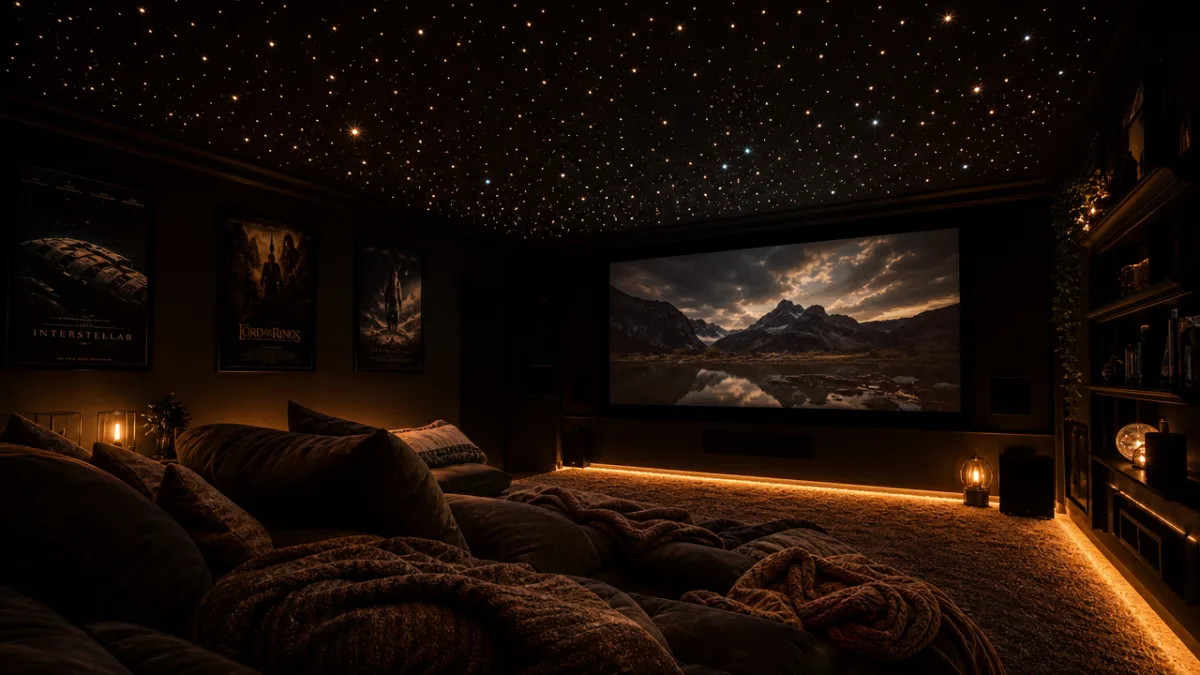
Choosing the Right Projector and Screen Setup
The image is at the heart of any home theater, and picking the right projector for a floor-seating setup involves a few considerations you wouldn’t encounter in a more traditional room. Because your viewers are closer to the ground, the screen or projection surface usually needs to sit lower than it would in a conventional setup. A wall-mounted pull-down screen with its lower edge sitting roughly 18 to 24 inches off the floor tends to work well for most floor-seating arrangements — that way, even someone lying fully reclined has a comfortable, clear view of the screen.
If you’re working with a dedicated home theater room, a short-throw or ultra-short-throw projector can be a real game changer. These can sit just a few inches or a couple of feet from the screen and still throw a large, sharp image, so you don’t need a long unobstructed path running the length of your room. 4K resolution projectors have gotten genuinely affordable lately and are absolutely worth the investment if you’re serious about your home cinema. Pair a good 4K projector with a high-gain ambient light rejecting screen and you’re looking at image quality that gives commercial cinemas a run for their money — all from the comfort of your floor cushions.
Aspect ratio and screen size should be matched to your room and how far back your seating sits. A 16:9 widescreen ratio is the most flexible choice for a modern home theater, handling everything from streaming to Blu-ray without much in the way of black bars. If you watch a lot of cinemascope films, a 2.35:1 scope screen takes the widescreen experience up another notch. A good rule of thumb for screen size is to aim for a viewing distance of about 1.5 times the screen’s diagonal — which, for most floor-seating rooms, puts you somewhere in the 100 to 130 inch range for a sweet spot between immersion and comfort.
Layering Lighting for Atmosphere and Function
Lighting might be the single most transformative design element in a cozy home theater, and it deserves just as much thought as your projection setup. You’re really trying to accomplish several things at once: enough ambient light so people can move around safely, the right atmosphere during a film, and a look that feels intentional and inviting even when you’re not watching anything. A well-designed lighting scheme makes a home theater feel like it was truly planned, rather than just a dark room with a big screen in it.
LED strip lighting is one of the most useful tools you have here. Running warm-toned LED strips along the base of the walls at floor level creates a soft, glowing perimeter that defines the room without throwing any glare onto the screen. This is often called bias lighting, and it has a practical benefit beyond aesthetics — it reduces eye strain during long viewing sessions by keeping a gentle level of ambient light around the screen so your eyes aren’t constantly adjusting between a bright image and complete darkness. Cool-toned bias lighting placed directly behind the screen can actually enhance perceived contrast, making colors pop and blacks look deeper.
If your home theater doubles as a lounge or gathering space, dimmable overhead lights on a smart system are worth their weight in gold. You can move between full brightness, a warm social setting, and near-total blackout for serious film watching without getting up or fumbling for switches. Salt lamps, Edison bulb string lights draped over low bookshelves, and flickering LED candles around the perimeter of the seating area all add to the enchanted, starlit atmosphere without competing with your projection. When you layer all of this with a ceiling full of stars, the room stops feeling like a media room and starts feeling like a genuine retreat.
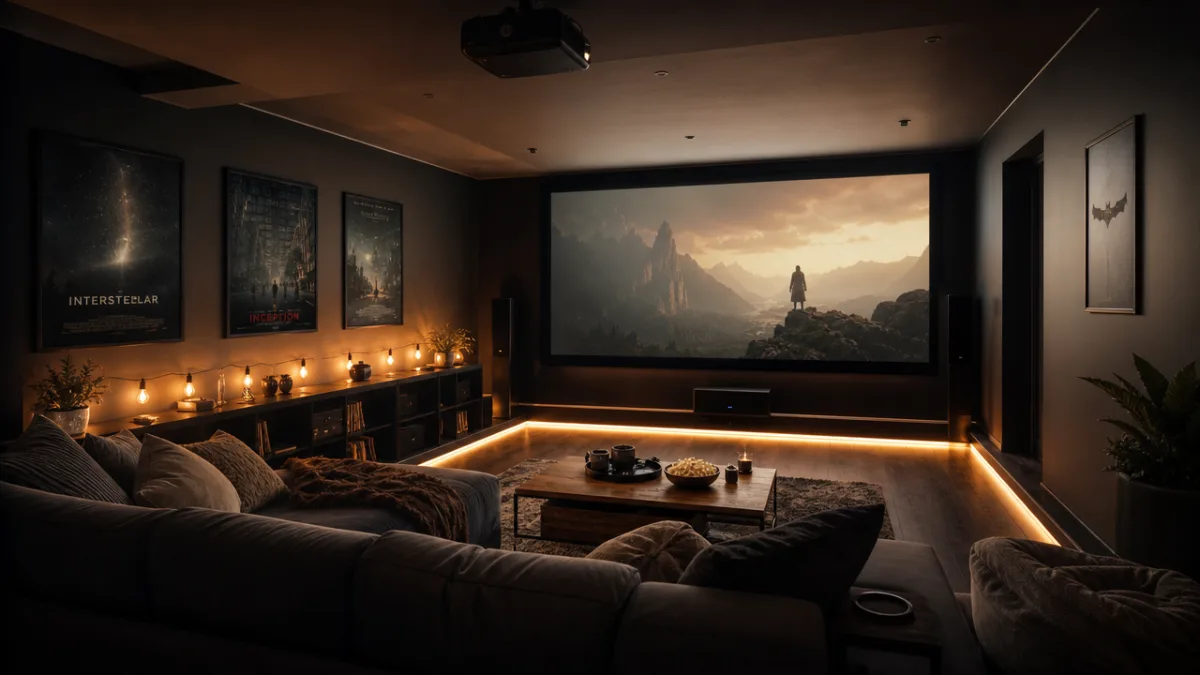
Acoustics, Sound Systems, and the Art of Immersive Audio
Great visuals deserve great audio, and in a floor-seating room, speaker placement takes a bit of extra thought compared to a conventional setup. Standard surround sound guidelines are built around the ear height of someone sitting in a chair, so in a floor-seating theater, your main left, right, and center channel speakers should come down to meet your listeners — think low credenzas, floor placement on short stands, or low wall mounts. Your surround and overhead Atmos speakers, though, should stay up high where they belong to do their spatial magic properly.
Dolby Atmos or DTS:X object-based surround sound is the gold standard for home cinema, and it’s a natural match for a starry ceiling theater. The overhead height channels in an Atmos system put discrete sounds above you — rain, aircraft, the echo of a vast space — which, combined with a ceiling full of projected stars, creates a sensory environment where the line between the room and the film genuinely starts to blur. Even a modest 5.1.2 Atmos setup (five main channels, one subwoofer, two height channels) is a massive step up from conventional stereo or standard surround sound, and well worth pursuing.
Acoustic treatment is one of those things a lot of home theater enthusiasts skip in favor of buying better gear, but it makes an enormous difference in how everything actually sounds. Hard surfaces bounce sound around and create echo and flutter that muddies dialogue and smears musical detail. The good news is that the things that make a floor-seating theater cozy are also genuinely excellent acoustic treatment: thick floor cushions, heavy curtains, upholstered walls, plush rugs, and piles of throws and blankets all absorb sound energy and cut down on reflections. A large, thick area rug under the entire seating area is probably the most effective single acoustic upgrade you can make, and it happens to look great too.
- 5.1 Surround Sound: The classic home theater setup — five speakers and a subwoofer — that delivers excellent immersion for most films and streaming content.
- 7.1 Surround Sound: Adds two rear surround channels for a wider, more enveloping soundfield that works especially well in larger floor-seating rooms.
- 5.1.2 Dolby Atmos: Brings two overhead height channels into a standard 5.1 system, unlocking the three-dimensional object-based audio that pairs so beautifully with a starry ceiling.
- 7.1.4 Dolby Atmos: The enthusiast’s benchmark — seven main channels, one subwoofer, and four overhead speakers for a completely enveloping cinematic audio experience.
Décor, Textiles, and the Final Cozy Touches
Once your projection, seating, lighting, and audio are sorted, the décor and textiles are what turn a functional home theater into a space that actually feels like your own private retreat. Cozy home theaters tend to live in a palette of deep, rich colors — midnight navy, forest green, charcoal grey, warm burgundy — that absorb ambient light, minimize screen reflections, and create a sense of being in a contained, intimate world that exists apart from the rest of the house. Dark walls aren’t just practical; they read as intentional, luxurious, and serious about the cinematic experience in a way that lighter, neutral walls simply can’t pull off.
Layer your textiles generously and choose them for both how they look and how they feel. A large, thick area rug in a deep, patterned design anchors the seating area and brings an enormous amount of warmth while doing double duty as acoustic treatment. Oversized floor cushions in velvet, boucle, or faux suede form the base of your seating, supplemented by big throw pillows, bolsters, and rolled cushions for back support. Weighted blankets, chunky knit throws, and faux fur layers finish the nest-like quality of the space, the kind of setup that makes it genuinely hard to want to get up when the credits roll.
A few well-chosen décor pieces can reinforce the magical, cinematic atmosphere without making the room feel cluttered or distracting. A small gallery wall of framed vintage film posters or hand-illustrated constellation maps looks beautiful during pre-film gathering time and adds real personality to the space. Low wooden shelving with a curated stack of Blu-ray cases, a turntable, or a decorative bowl for remotes gives the room practical purpose alongside its aesthetic. And don’t underestimate plants — trailing varieties like pothos or heartleaf philodendron thrive in low light and do a wonderful job of softening the edges of a dark, dramatic room, adding just enough organic life to keep the space feeling cozy rather than cave-like.
- Choose a dark, rich wall color — deep navy, charcoal, or forest green — to cut down on screen glare and set a genuinely cinematic mood.
- Layer your floor seating with a mix of large floor cushions, poufs, low sofas, and plenty of throws and blankets for comfort and flexibility.
- Install a quality star projector on the ceiling or a low shelf and program it to build a seamless starry night atmosphere above your seating area.
- Add layered accent lighting — LED strip floor lighting, warm string lights, and dimmable overhead fixtures — to support every mood from social gathering to serious film watching.
- Invest in good audio that fits your room’s size and layout, and position your main speakers low to match the ear height of your floor-seated viewers.
- Finish with rich textiles and personal décor — rugs, vintage posters, plants, warm accessories — that make the space feel curated, intentional, and deeply inviting.
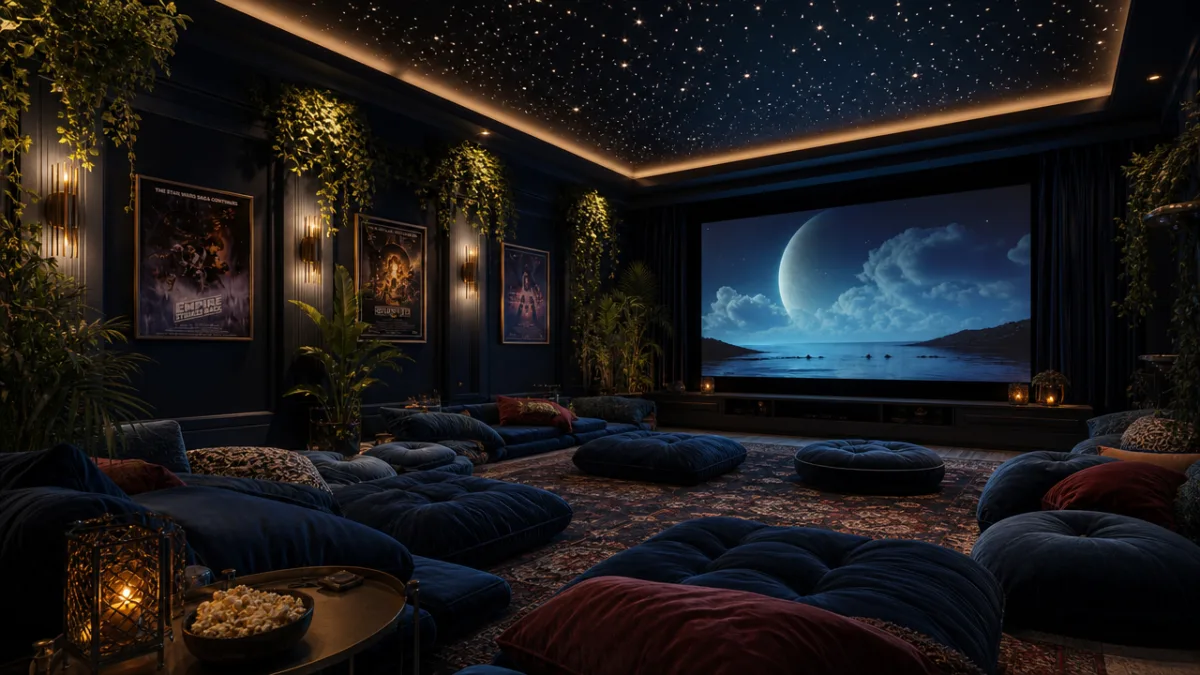
A cozy home theater with floor seating and a starry ceiling projection is really the best version of what home cinema can be — not just a functional room for watching things, but a complete environment designed to spark your imagination, deepen your experience of film, and give you a genuine escape from the noise of everyday life. Every decision, from which projector you choose to how deep your cushions are to where you hang your posters, adds to an atmosphere that takes cinema seriously while never losing sight of the irreplaceable comfort of being at home. When the lights go down, the stars come out above you, and the movie begins — there really is nowhere else you’d rather be.








What do you think?
It is nice to know your opinion. Leave a comment.