










The Healing Power of Mind Relaxing Art
Life moves fast these days — sometimes uncomfortably so. Stress and mental exhaustion have become almost universal experiences, and the usual advice about wellness often feels like it’s missing something. That’s part of why so many people have started turning to art. Not because they want to hang something on a wall, but because making things with your hands can genuinely shift something inside you. Mind relaxing art isn’t really about the finished product. It’s about what happens to you while you’re making it.
Humans have always seemed to understand this on some level. Cave paintings, mandalas, ritualistic pottery — people have been making things with intention for as long as we’ve existed. And now neuroscience is starting to catch up to what artists and healers have known intuitively for centuries: engaging with art actually lowers cortisol, slows your heart rate, and lights up the parts of your brain tied to reward and emotional balance. Therapists, educators, and wellness professionals are paying close attention to this research, and for good reason.
What’s especially great about art as a relaxation tool is that it doesn’t require any special talent or training. A cheap sketchpad, a set of colored pencils, or even a free drawing app on your phone is enough to get started. The door is open to anyone willing to walk through it — the only real requirement is being willing to begin and to set aside the urge to judge what you create. You might be surprised what shows up when you give yourself that kind of permission.
Why Creativity Is a Natural Stress Reliever
When you get into a creative flow, your brain shifts into a state that researchers compare to meditation. The part of your brain responsible for self-criticism and analytical thinking quiets down, while the network associated with imagination and self-reflection becomes more active. The result is a kind of mental spaciousness — tension loosens, thoughts slow down, and you land in the present moment almost without trying. For people who find traditional meditation frustrating or difficult to sustain, this can feel like a revelation.
A lot of art forms amplify this effect through repetition and rhythm. Sketching patterns, blending colors, weaving, tracing flowing lines — these activities gently anchor your attention to what your hands are doing right now, which is essentially what mindfulness is. The difference is that it doesn’t feel like a discipline. It feels more like play, which makes it a lot easier to actually want to do it every day rather than treating it like another item on a wellness checklist.
There’s also a physiological piece to this. Creating art triggers dopamine release — the brain’s feel-good chemical, linked to pleasure, motivation, and a sense of accomplishment. Even small wins count here: finishing a sketch, finding a color combination you love, completing a zentangle design. Each of these delivers a little reward signal, and over time your brain starts associating the creative process with feeling good and feeling safe. This feedback loop is actually one of the foundations of art therapy as a clinical practice.
Exploring Different Art Forms for Inner Peace
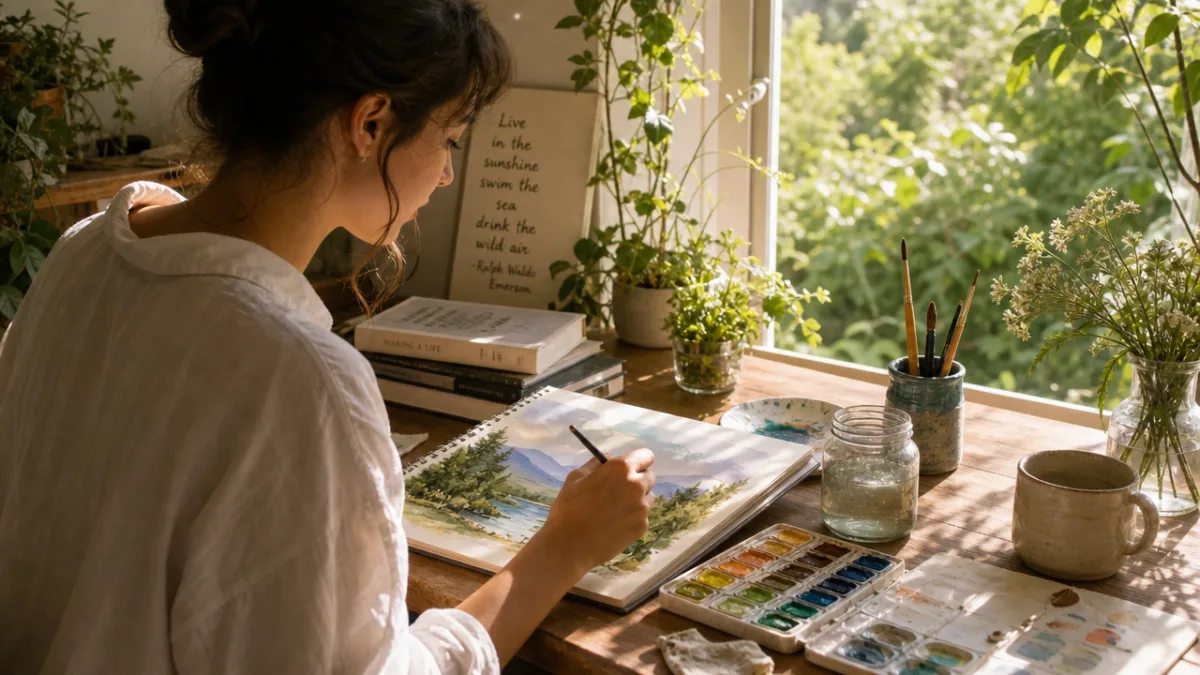
The range of options within mind relaxing art is genuinely wide, which means there’s likely something that fits your personality and your life. Watercolor painting has a particular following among people who are working on loosening their grip on control. The medium is beautifully unpredictable — water and pigment do their own thing, and fighting that tends to make things worse. Learning to work with it rather than against it becomes a kind of practice in itself, and the slow build of translucent layers has a hypnotic, almost meditative quality that a lot of people find deeply calming.
Mandala drawing and zentangle art are probably the most beginner-friendly options out there, and they work quickly. Both involve drawing repetitive patterns — geometric or organic, always varied, often built outward from a center point — and the mark-making itself seems to shift your mental state in the same way meditation does. Many people describe it as entering a kind of trance. It’s not unusual for someone to sit down feeling tightly wound and stand up twenty minutes later feeling genuinely clear-headed and calm.
If you’re someone who holds tension in your body, working with clay or other tactile materials might resonate more than anything flat. There’s something about the physical sensation of your hands in cool, pliable clay that engages your nervous system in a full-body way that drawing on paper simply can’t replicate. Collage, fabric art, and mixed media are also worth exploring — they’re rich, sensory, and surprisingly expressive. The best approach is just to try things without too much pressure and notice what feels like it fits. The right medium tends to feel a bit like coming home.
Popular Art Forms for Relaxation
- Watercolor painting — Encourages flow, surrender, and acceptance of the unexpected through its fluid, luminous qualities.
- Zentangle and mandala art — Uses repetitive pattern-making to induce a meditative, focused mental state accessible to all skill levels.
- Adult coloring books — Provides structured creative engagement that reduces anxiety and improves present-moment awareness.
- Sketching and doodling — Offers a low-pressure, spontaneous outlet for emotional expression and mental decompression.
- Clay and sculpting — Delivers tactile, grounding physical engagement that releases tension stored in the body.
- Collage and mixed media — Combines intuitive selection and arrangement to process complex emotions through visual storytelling.
Setting Up Your Creative Space for Maximum Calm
Where you create matters more than most people realize. Your space doesn’t need to be a dedicated studio — a corner of a room, a particular chair by a window, or a small folding table tucked into a quiet spot can work beautifully. What matters is that it feels like yours: intentionally set up, reasonably free from interruption, and mentally associated with slowing down. After a while, just walking into that space starts to cue your nervous system to relax, almost like a signal that it’s safe to exhale.
Lighting is worth taking seriously. Natural daylight is ideal — it renders colors accurately and has a quality of openness that supports creative thinking. When that’s not an option, warm-spectrum LED lighting that mimics afternoon sunlight is a solid substitute. Harsh fluorescent lighting, on the other hand, has actually been shown to raise cortisol levels, which is the opposite of what you’re going for. Soft, diffused light can make even a modest space feel genuinely welcoming rather than functional.
Think about the other senses too. Soft instrumental music or nature sounds in the background can deepen the meditative quality of your sessions considerably. A scented candle, a diffuser running lavender or cedarwood, or even a vase of fresh flowers can anchor the relaxation response through smell in a way that’s subtle but surprisingly effective. And keep your supplies organized and within reach — having to hunt for a brush or dig through a messy drawer mid-session pulls you right back out of the flow and into your head. A thoughtfully set up creative space is its own act of self-care, and it tells your mind and body that their peace is worth protecting.
Essential Elements of a Calming Creative Space
- Comfortable seating — Choose a chair or cushion that supports good posture without causing physical discomfort during extended creative sessions.
- Warm, natural lighting — Prioritize natural daylight or warm-spectrum artificial lighting to support both mood and accurate color perception.
- Organized supplies — Keep materials tidy, labeled, and easily accessible to minimize friction and maintain creative flow.
- Minimal digital distractions — Silence notifications and keep screens out of the creative space whenever possible.
- Sensory anchors — Incorporate scent, sound, and texture through candles, music, plants, or soft textiles to deepen the relaxation experience.
Building a Sustainable Daily Art Practice
A lot of people talk themselves out of a creative practice before they even start, because they assume they need big chunks of uninterrupted time to make it worthwhile. That’s not how it works. Research on habit formation and creative psychology pretty consistently shows that short, regular sessions beat infrequent marathon ones — both for building skill and for the stress-relief benefits you’re after. Even ten or fifteen minutes a day, kept up consistently over weeks and months, produces real, measurable improvements in mood, resilience, and overall well-being.
The practices that actually last are the ones small enough to feel doable even on a hard day, but nourishing enough that you actually want to come back. A daily sketch diary where you spend ten minutes drawing whatever’s in front of you — or whatever’s on your mind — requires almost no setup and builds into a genuinely meaningful record of your inner life over time. A weekly watercolor experiment where you try one technique without any particular goal keeps things playful and skill-building at the same time. The specific form is less important than showing up regularly and being present when you do.
It also helps a lot to attach your creative practice to something you already do every day. Some people create first thing in the morning, before the demands of the day have fully arrived, and find it sets a calmer tone that carries forward for hours. Others use art as an evening wind-down, a deliberate transition between the busyness of the day and rest. Some find a lunchtime creative break resets their focus and makes the afternoon easier. There’s no single right time — what matters is treating your practice with the same consistency you’d give a workout or a medication, because the benefits are just as real and just as cumulative.
Tips for Maintaining Creative Momentum
- Start each session with a brief two-minute breathing exercise to transition your nervous system from a reactive to a receptive state before picking up any creative tools.
- Keep a simple sketchbook and a single pen or pencil in your bag or on your desk at all times, so that creative moments can be captured spontaneously wherever they arise.
- Follow artists and creative communities on social media selectively, choosing accounts that inspire rather than intimidate, and that celebrate process over polished results.
- Join a local or online art group to experience the additional benefits of creative community, shared encouragement, and the gentle accountability of showing up regularly for others as well as yourself.
The Deeper Journey: Art as a Path to Self-Discovery
Stress relief is a real and worthwhile reason to make art — but it’s not the whole story. When you create regularly without worrying about the outcome, something else tends to start happening: you begin to notice patterns. Recurring colors, shapes, themes, images. A person who keeps returning to dark, turbulent imagery might be finding a safe container for grief or anger that has no other outlet. Someone who keeps painting wide open skies and empty horizons might be discovering a longing for freedom they hadn’t quite put into words. The work starts to tell you things about yourself.
Art therapists who work with people experiencing trauma, depression, anxiety, and grief understand this dimension of creative work very well. They know that what appears on the canvas is rarely random — it’s more like a visualization of the inner world, made legible through image and color. But you don’t need a clinical setting to experience this. People who maintain a regular personal creative practice often report the same kinds of insights on their own: a growing awareness of their emotional states, a greater capacity to sit with difficult feelings without being swept away by them, and a deepening sense of who they actually are beneath the noise of daily life.
That’s really the deeper gift of mind relaxing art — not just the pleasant calm it creates in the moment, though that calm is real and worth having. It’s what that calm makes possible: a quieting of the inner chatter that normally obscures what you actually think and feel, and a gentle, unhurried invitation to know yourself more honestly. In the creative space, you’re not performing or meeting anyone’s standards. You’re just present with yourself, making marks, following curiosity, and finding out — with patience and an open mind — who’s actually there.
Reflective Practices to Deepen Your Creative Journey
- After each creative session, spend five minutes journaling about what you noticed — emotionally, physically, and creatively — during the process, without analyzing or judging what arose.
- Photograph your artwork regularly and review it monthly, looking for recurring themes, color preferences, or compositional choices that might reveal something meaningful about your inner life.
- Occasionally create with your non-dominant hand, as this simple technique bypasses habitual patterns and can surface more spontaneous, unconscious material with surprising power.
- Experiment with creating art in response to music, a poem, a memory, or a specific emotion, using the artwork as a translation of inner experience rather than a depiction of external reality.
- Share your work with someone you trust, not for evaluation but for conversation — sometimes another person’s reflection reveals dimensions of your own creative language that you cannot yet see yourself.

Embracing Imperfection as Creative Liberation
If there’s one thing that keeps most people from ever starting a creative practice, it’s the fear of making something that doesn’t look the way they imagined it would. And honestly, that fear makes sense — we’re surrounded by highly curated, digitally polished images of creative work, and comparing your first wobbly attempts to that standard can feel pretty discouraging. But that comparison fundamentally misses the point of what mind relaxing art is actually for. The wonky line, the muddy color mix, the composition that didn’t quite come together — those aren’t failures. They’re proof that a real human being was in the process of making something, and learning, and trying.
Learning to be okay with imperfection in your art practice turns out to have ripple effects well beyond the sketchbook. Research in positive psychology and resilience consistently finds that the willingness to engage with something despite the risk of getting it wrong is one of the strongest predictors of both creative growth and psychological well-being. When you practice releasing perfectionism within the relatively low-stakes context of a canvas or a journal page, you’re quietly building the same capacity for the rest of your life — becoming a little more willing to try unfamiliar things, take meaningful risks, and tolerate the uncertainty that comes with actually living fully.
The most experienced and celebrated artists in the world will tell you the same thing: their best work almost never came from certainty and control. It came from following a hunch, embracing a surprise, and trusting the process even when the destination wasn’t clear. That spirit of curious exploration — not the perfectionist who needs to get it right, but the person genuinely excited to see what happens next — is exactly what mind relaxing art is inviting you into.








What do you think?
It is nice to know your opinion. Leave a comment.