










Clay Mirrors: The Art of Handcrafted Elegance for Your Home
What Is a Clay Mirror and Why Is Everyone Talking About It?
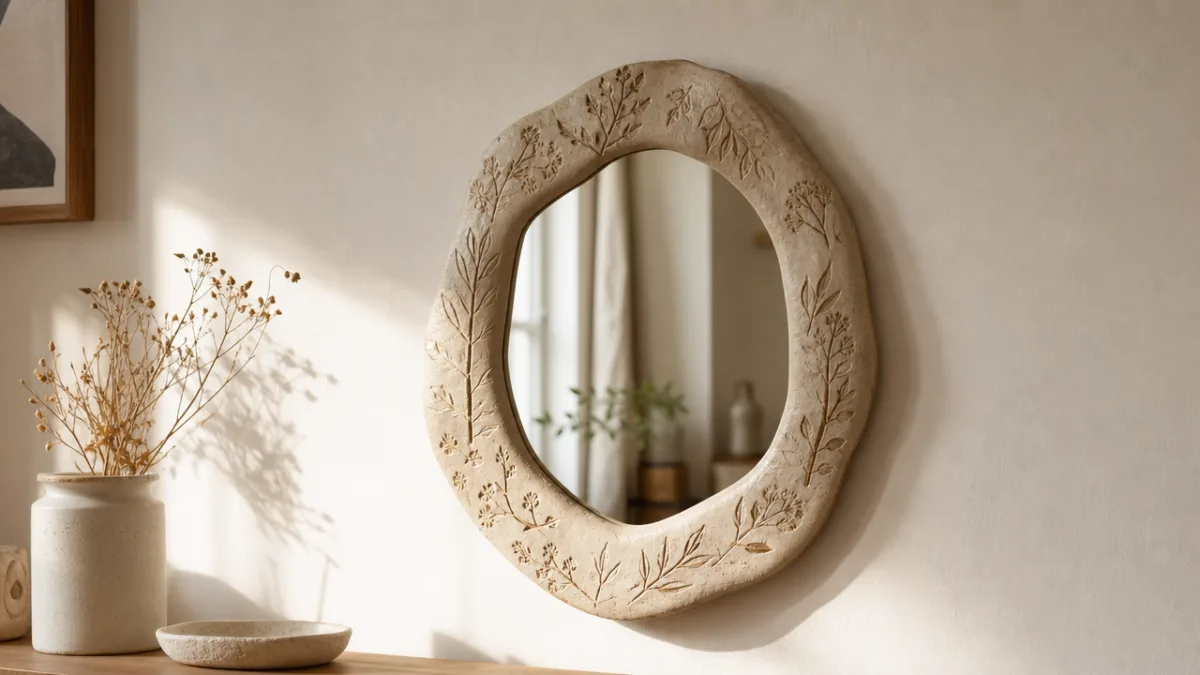
A clay mirror is pretty much exactly what it sounds like — a mirror framed or decorated with clay, hand-shaped into organic, sculptural forms that turn an everyday functional object into something genuinely beautiful. Unlike the mass-produced mirrors you find at big box stores with their uniform plastic or metal surrounds, clay mirrors have an unmistakable warmth to them. Every ridge, every pressed texture, every carefully rolled coil tells you something about the person who made it, which means each one is truly its own thing.
The appeal of clay mirrors has really taken off in recent years, and it makes sense when you look at where interior design has been heading — away from cold, industrial perfection and toward something more tactile, personal, and alive. Designers and homeowners have figured out that a clay-framed mirror does something no other decorative object quite pulls off: it grounds a space and elevates it at the same time, adding visual weight and warmth without ever feeling heavy or suffocating. The matte, earthy finish of fired or air-dried clay looks great against virtually any wall color or material palette.
Social media — especially Pinterest and Instagram — has had a huge hand in the clay mirror revival. Makers started sharing their studio processes online: rolling slabs, pressing botanicals into wet clay, glazing bisqueware in earthy ochres and sage greens. Audiences loved it. What was once a pretty niche craft became a full-blown design movement, with clay mirrors popping up in luxury hotels, boutique shops, and beautifully designed living rooms all over the world. The demand hasn’t slowed down, and honestly, it’s not hard to see why — these pieces are beautiful, they last, and they carry real meaning.
Materials and Tools You Need to Get Started
You don’t need a fully equipped pottery studio to start making clay mirrors, though having access to a kiln does open up a lot more options. For anyone working at home, air-dry clay is the easiest place to begin. Brands like Crayola Air-Dry, Amaco, and Das all offer workable clays that dry to a surprisingly solid finish without any firing at all. They’re great for beginner projects and for experimenting with form and texture before you commit to kiln work. Air-dry clay has its limitations — it’s more brittle and less water-resistant than fired stoneware — but for a wall-mounted decorative mirror, it holds up really well.
If you do have access to a kiln, whether through a local ceramics studio or a community arts center, stoneware and earthenware clays open up a much richer world of possibilities. Stoneware fired to cone 6 or higher becomes dense, strong, and gorgeous, and it can take a wide range of glazes from high-gloss and reflective to deeply matte and velvety. Earthenware, fired at lower temperatures, has a warmer, more rustic character and looks especially lovely left unglazed or finished with a simple terracotta slip. Either way, you end up with a frame that has real permanence to it — something you could genuinely pass down.
Beyond the clay itself, the tools you need are refreshingly simple. A rolling pin or slab roller, a sharp craft knife or fettling tool for cutting, texture tools like stamps, lace, leaves, or interesting found objects, a bowl of water for smoothing seams — that’s the core of it. A lot of makers also keep wooden skewers or toothpicks nearby for adding fine detail, and a soft paintbrush is invaluable for blending seams and applying slip. The mirror itself can come from a craft store, be cut to size by a glass supplier, or even be salvaged from an old mirror you already have lying around.
- Air-dry clay: best for beginners, no kiln required, widely available and affordable
- Stoneware clay: durable and glaze-compatible, requires kiln firing to cone 6 or higher
- Earthenware clay: warm, rustic character, fires at lower temperatures, beautiful unglazed
- Rolling pin or slab roller: essential for creating even, consistent clay slabs
- Texture tools: stamps, lace, leaves, shells, carved rollers — anything with surface interest
- Craft knife or fettling tool: for precise cutting and trimming of clay pieces
- Strong epoxy or silicone adhesive: for attaching the mirror to the finished clay frame
Step-by-Step: How to Make a Clay Mirror Frame
The most common way to approach a clay mirror frame is to start by rolling out a slab of clay to a consistent thickness — usually somewhere between half an inch and three-quarters of an inch. Lay your mirror face-down on the clay and use a craft knife to cut around it, leaving whatever border width feels right to you. Anywhere from one inch gives you a delicate, minimal look, while four or five inches makes a bold sculptural statement. This base slab becomes the back plate of your frame, giving the mirror something solid to adhere to once everything is finished and dried or fired.
Once your base slab is cut, the fun really starts. You can build the frame up using coils of clay rolled between your palms, layering them around the mirror’s perimeter and blending the inner edge smoothly while letting the outer edge stay expressive and organic. Or you can cut decorative elements from additional slabs — leaves, petals, abstract shapes, textured tiles — and attach them using slip, which is just clay mixed with water until it reaches the consistency of heavy cream. Press each piece on firmly and smooth the joint from behind with a damp finger to make sure you’ve got a strong bond that won’t crack as everything dries.
Texture is really where clay mirrors come alive, and this is your chance to let creativity take over completely. Press a piece of lace into the wet clay for a delicate all-over pattern. Use a fork, a shell, or a carved stamp to create repeating motifs. Sculpt small three-dimensional elements — abstract shapes, botanical forms, tiny faces — and attach them with slip. Carve into the surface with a loop tool or knife for incised lines and patterns. The possibilities really are endless, and because every hand moves differently, your mirror will naturally reflect your own aesthetic in a way that nothing store-bought ever could.
After building and decorating, the frame needs to dry slowly and evenly to avoid cracking. Drape it loosely with plastic sheeting and let it dry over several days, gradually uncovering it as it stiffens up. Once it’s fully dry and leather-hard, you can sand any rough spots with fine-grit sandpaper, then fire the piece in a kiln or — if you’re working with air-dry clay — go straight to finishing. After firing, you can leave the clay in its natural bisque state, apply glazes and fire again, or use acrylic paint, chalk paint, or metallic wax to get whatever look you’re going for. Then attach the mirror with a strong silicone or construction adhesive, let it cure fully, and add hanging hardware to the back.
Design Styles and Aesthetic Directions for Clay Mirrors
One of the things that makes clay mirrors so compelling as a design object is how wildly versatile they are. The exact same basic construction technique can produce completely different results depending on the choices you make along the way. A smooth, minimal frame in a pale chalky white glaze reads as quietly sophisticated and works beautifully in a Scandinavian-influenced interior or a modern bathroom with clean lines and neutral tones. In that context, the mirror becomes a subtle accent rather than a focal point — adding texture and handmade warmth without shouting about it.
On the completely opposite end of the spectrum, a heavily sculptural frame layered with botanical elements — ferns pressed into the surface, coiled vines climbing the edges, sculpted flowers spilling across one corner — is practically wall sculpture more than it is a mirror. This kind of maximalist, nature-forward aesthetic has been enormously popular in boho and cottagecore design communities, where natural materials, organic imperfection, and handmade craft are central to the whole visual philosophy. Earthy glazes in terracotta, moss green, and dusty rose feel right at home in this direction.
There’s also a strong tradition of using clay mirrors to explore more graphic, architectural forms. Geometric frames with sharp angles and repeating pressed patterns can feel Art Deco or Brutalist depending on the scale and finish. A large hexagonal frame in a dark, nearly-black glaze with a hammered texture makes a dramatic and sophisticated statement in a contemporary interior. On the flip side, a small round mirror with a simple rope-textured border in warm sand tones feels effortlessly casual — the kind of thing that looks great in an entryway without trying too hard.
- Minimal and modern: smooth surfaces, neutral glazes, simple geometric shapes for understated elegance
- Botanical and organic: pressed leaves, sculpted flowers, vine-like coils for a nature-inspired look
- Maximalist sculptural: layered three-dimensional elements, bold color, complex composition for a statement piece
- Rustic and earthy: unglazed or slip-finished terracotta with rough textures for a raw, artisanal feel
- Graphic and geometric: crisp angles, repeating stamped patterns, strong silhouettes for a contemporary edge
Caring for and Displaying Your Clay Mirror
Clay mirrors — whether fired stoneware or air-dry clay — are tougher than most people expect, but they do appreciate a bit of thoughtful placement and basic care. Fired and glazed pieces are genuinely durable and will last for decades if you treat them reasonably well. Air-dry clay frames are more vulnerable to moisture, but they perform excellently in dry interior spaces — just keep them away from bathrooms or kitchens where humidity goes up and down. Both types should be mounted securely with hardware rated for the weight of the piece, because a large clay mirror can get surprisingly heavy.
Honestly, dusting is about all the regular maintenance a clay mirror needs. A soft, dry cloth or a natural-bristle brush to clear dust from textured surfaces, working gently into crevices without pressing too hard on raised elements. For glazed pieces, a very lightly damp cloth works fine if the frame actually needs cleaning, but avoid anything abrasive that could scratch the glaze. The mirror glass itself can be cleaned with any standard glass cleaner — just apply it to the cloth first rather than spraying it directly onto the mirror, which keeps liquid away from the clay frame entirely.
As for where to hang them, clay mirrors look stunning in basically every room, but some spots let them really shine. A large clay mirror above a fireplace or console table becomes an instant focal point, anchoring the whole room around its warm, handmade presence. A grouping of several smaller mirrors in complementary finishes arranged as a gallery wall creates a layered, dynamic effect that rewards closer looking. In a bedroom, a clay mirror propped against the wall on a dresser or leaned casually in a corner has a relaxed, artistic quality that suits spaces meant for rest and personal expression.
Lighting makes a bigger difference than you might think in how a clay mirror reads in a room. Warm-toned bulbs — Edison-style filament lights or warm white LEDs — bring out the golden and earthy tones in terracotta and unglazed clay beautifully. Natural daylight is universally flattering for clay objects, which is exactly why so many studio photos of clay mirrors are taken in bright, window-lit spaces. If your mirror is going in a darker corner of the house, a small picture light mounted above it or a nearby floor lamp with a warm shade can make a real difference, washing the frame in light that highlights every texture and detail.
The Broader Cultural Significance of Clay Craft Today
The enthusiasm for clay mirrors isn’t a random isolated trend — it’s part of a much larger cultural shift toward slowness, intentionality, and reconnecting with how things are actually made. In a world that runs on digital experience and algorithmically optimized production, there’s a real hunger for objects that bear the mark of human hands and human time. Ceramics, textiles, woodworking, and other traditional crafts have all seen significant revivals recently for exactly this reason — people want things in their homes that feel real, that have weight, that couldn’t have been spit out by a machine.
Clay in particular carries enormous historical and cultural resonance across virtually every human civilization. From the terracotta vessels of ancient Greece to the celadon porcelains of Song Dynasty China to the earthenware of pre-Columbian Mesoamerica, humans have been shaping clay for tens of thousands of years. Working with clay connects you, even gently, to that vast and deeply human lineage. When you press your thumb into wet clay to shape a mirror frame that will hang in your home for decades, you’re participating in one of the oldest practices our species has ever known — and that’s not a small thing.
The democratization of clay craft through social media, community studios, and accessible air-dry products has also meant that ceramics is no longer the exclusive territory of trained artists or people lucky enough to own a kiln. Anyone with a kitchen table, twenty dollars worth of air-dry clay, and a willingness to experiment can make something genuinely beautiful and meaningful. That accessibility has been transformative — it’s brought the meditative, tactile pleasure of clay work to people who never would have found it otherwise, and it’s built a global community of makers who share their work, their techniques, and their enthusiasm with remarkable generosity.
Looking ahead, the clay mirror shows every sign of sticking around as a beloved craft form rather than fading like a passing trend. Its combination of real functional utility, limitless aesthetic possibility, and genuine connection to handmade tradition gives it a depth and staying power that more surface-level design moments simply don’t have. As more people discover the pleasure of making with their hands — and as more skilled makers push the work in increasingly sophisticated and ambitious directions — the clay mirror will keep evolving, surprising, and delighting. Whether you make one yourself or seek out the work of a skilled ceramicist, bringing a clay mirror into your home is an investment in beauty, craft, and the enduring human love of making things.








What do you think?
It is nice to know your opinion. Leave a comment.