










Lycoris Radiata & Hardy Nerines: The Complete Guide to Red Spider Lily Bulbs
Introduction to Lycoris Radiata and the Nerine Family
Few plants command attention in the autumn garden quite like Lycoris radiata, the legendary Red Spider Lily. With its explosive, spidery blooms erupting from bare soil in late summer and early autumn, this bulb has captivated gardeners for centuries across Asia, Europe, and now the wider world. Often sold alongside its close relative Nerine bowdenii — commonly known as the Bowden Lily or Cornish Lily — these red and pink flowering bulbs represent some of the most dramatic and rewarding additions any gardener can make to their outdoor space or container collection.
Lycoris radiata is native to China, Korea, and Japan, where it holds deep cultural and spiritual significance. In Japan it is called Higanbana, the flower of the autumn equinox, and it blooms with uncanny precision around that time each year. Its vivid scarlet flowers, with long curling stamens that give it the common name Red Spider Lily, rise on naked stems before any foliage appears — a botanical phenomenon called hysteranthous flowering that makes the plant appear almost magical. Nerine bowdenii, by contrast, hails from South Africa and produces its rosy-pink to deep red blooms slightly later in the season, offering gardeners an extended flowering window.
When these bulbs are sold together as mixed collections, the effect in the garden is spectacular. The deep blood-red of Lycoris radiata contrasts beautifully with the softer pink-red shades of Nerine bowdenii, and because their bloom times overlap slightly, a well-planted bed can remain in colour for six weeks or more. Understanding the differences and similarities between these two genera is the first step toward getting the most out of your bulb investment, and this guide will walk you through everything you need to know from planting through to long-term care.
Understanding Your Bulbs: Characteristics and Identification
When you receive Lycoris radiata bulbs of approximately 10 cm diameter, you are holding a mature, flowering-sized specimen that has taken several years to reach this size. These bulbs are tunicate, meaning they are covered in a papery brown skin similar to an onion. The basal plate at the bottom is where roots will emerge, and you should handle this area with particular care to avoid damage. At 10 cm, these bulbs are large enough to flower reliably in their first season after planting, provided conditions are suitable and the bulb has not been subjected to prolonged stress during shipping or storage.
Nerine bowdenii bulbs are similarly structured but tend to be slightly more elongated in shape, with a distinct neck that should be planted at or just above soil level. This distinction is important: while Lycoris bulbs prefer to be buried a little deeper, Nerine bowdenii actually performs better when its nose is near the surface, mimicking its natural rocky South African habitat. Both bulbs will feel firm and solid when healthy. Any softness, mould, or significant blemishes should be treated with a fungicide dust before planting to prevent rot spreading in the soil.
One of the most fascinating aspects of these bulbs is their growth cycle, which runs contrary to most spring-flowering bulbs that gardeners are familiar with. Both Lycoris and Nerine produce their foliage in autumn and winter, drawing energy from sunlight during the cooler months, then dying back in spring and summer. This means that during the summer months, your planting area will appear empty and bare — a fact that confuses many first-time growers who assume the bulbs have died. Patience is absolutely essential, and marking your planting spots clearly will prevent accidental disturbance during their dormant phase.

Ideal Growing Conditions and Climate Suitability
Lycoris radiata is often described as hardy, but this designation requires some nuance. In the United Kingdom, USDA hardiness zone 7 and above, and across much of Europe, established Lycoris bulbs can tolerate mild frosts and will survive outdoors year-round in well-draining soil. However, in regions where hard freezes are common and the ground freezes solid for extended periods, some winter protection in the form of a thick mulch of straw or bark is advisable. The term “hardy nerines” typically refers to Nerine bowdenii, which is considerably more cold-tolerant than other members of the Nerine genus, surviving reliably in sheltered spots in the UK and comparable climates.
Both plants share a strong preference for full sun. A south- or west-facing border that receives at least six hours of direct sunlight daily will produce the most vigorous growth and the most prolific flowering. In shadier positions, the plants will still grow but flowering will be reduced and stems may become etiolated and weak. Soil drainage is perhaps even more critical than sunlight. These bulbs evolved in environments where summer rainfall is minimal and soils drain quickly. In heavy clay soils, waterlogging during the summer dormancy period is the single most common cause of bulb failure, leading to rot that destroys the bulb before autumn flowering can occur.
If your garden has heavy or poorly draining soil, there are two practical solutions worth considering. First, you can raise the beds by incorporating large quantities of horticultural grit, coarse sand, and organic matter to open up the soil structure. Second, and perhaps more reliably, you can grow these bulbs in containers filled with a free-draining loam-based compost mixed with grit in a ratio of roughly two parts compost to one part grit. Container growing also has the advantage of allowing you to move the pots to a sheltered position during particularly cold winters, providing protection that would be impossible for in-ground plantings.
Planting Techniques: Step-by-Step for Success
The optimal planting time for both Lycoris radiata and Nerine bowdenii is late summer to early autumn, ideally August or September in the Northern Hemisphere. Planting at this time gives the bulbs the best possible chance of establishing before their autumn flowering display. However, many suppliers ship these bulbs in spring or early summer, and planting them at that time is also perfectly acceptable — you simply may not see flowers in the first year, with a full display arriving in year two once the bulbs have had a full growing cycle in their new home. Never be discouraged by a slow first season; these plants are long-lived and reward patience generously.
For Lycoris radiata specifically, planting depth should be approximately two to three times the diameter of the bulb, which for a 10 cm bulb means placing it roughly 20 to 30 cm below the soil surface. This deeper planting provides insulation against temperature extremes and anchors the bulb firmly enough to support its tall, naked flowering stems. Space bulbs at least 15 to 20 cm apart to allow for the natural multiplication that will occur over subsequent years. Nerine bowdenii, as mentioned earlier, is an exception to the deep-planting rule — plant these with the tip of the bulb barely covered or even slightly exposed above the soil line.
Follow these steps for the best results when planting your bulbs:
- Prepare your planting area thoroughly, removing weeds and improving drainage with added grit if necessary.
- Inspect each bulb carefully, discarding any that are soft, mouldy, or heavily damaged, and treating minor blemishes with sulphur powder or fungicide dust.
- Dig individual holes or a wider trench to the appropriate depth for each species, placing Lycoris deeper and Nerine shallower.
- Position each bulb with the basal plate facing downward and the nose pointing upward, which should be obvious from the bulb’s natural shape.
- Backfill with soil or a grit-enriched compost mix, firming gently to remove large air pockets without compacting the soil.
- Water in lightly after planting, then largely leave the bulbs alone until signs of growth appear — overwatering at this stage is a common mistake.
- Mark the planting area clearly with labels or stakes so you do not accidentally dig into the bulbs during their long dormant period.
After planting, resist the urge to water frequently. These bulbs have evolved to cope with dry summers and do not need constant moisture. A single thorough watering after planting is usually sufficient to settle the soil and initiate root growth. Once foliage appears in autumn, you can begin watering more regularly, and a light liquid feed with a potassium-rich fertiliser such as tomato feed will support strong leaf development and energy storage for the following year’s flowers.

Ongoing Care, Feeding, and Seasonal Maintenance
Once your Lycoris and Nerine bulbs are established, they are remarkably low-maintenance plants. Their primary requirements are a dry summer dormancy, good drainage, and access to sunlight during their active growing season in autumn and winter. One of the most important rules to follow — and one that catches many gardeners out — is to never cut back or remove the foliage until it has died back naturally and turned yellow. The strap-like leaves that appear after flowering are the bulb’s only opportunity to photosynthesise and replenish the energy reserves it depleted during flowering. Removing leaves prematurely leads to progressively smaller bulbs and eventually no flowers at all.
Feeding should be done with care and appropriate products. A high-potassium liquid fertiliser applied every two to three weeks during the growing season — from the emergence of foliage through to its natural die-back — will encourage strong bulb development. Avoid high-nitrogen feeds, which promote lush leafy growth at the expense of flowers. A top-dressing of well-rotted garden compost or leaf mould applied in late autumn, after flowering, will also provide slow-release nutrients and help protect the bulb zone from the worst of winter temperatures. In containers, repotting should be done sparingly, as both plants actually flower more prolifically when their roots are somewhat congested.
Pest and disease problems are mercifully rare with these bulbs, but there are a few issues worth being aware of:
- Narcissus bulb fly: The larvae of this fly can bore into bulbs and destroy them from within. Covering the soil with a fine-mesh insect barrier during the summer dormancy, when the adult flies are most active, is an effective preventive measure.
- Slugs and snails: Emerging flower stems and young foliage can be targeted by molluscs, particularly in damp weather. Organic slug pellets or copper tape around container rims will provide protection.
- Basal rot: Caused by Fusarium fungus, this condition turns the basal plate of the bulb soft and brown. It is almost always a consequence of waterlogged soil. Prevention through good drainage is the only reliable remedy.
- Red lily beetle: Although primarily associated with true lilies (Lilium species), this bright red beetle will occasionally attack related bulbs. Hand-picking adults and checking the undersides of leaves for clusters of orange eggs is the recommended organic approach.
Dividing established clumps every four to five years, once you notice a significant reduction in flowering, will rejuvenate the planting and provide you with additional bulbs to spread around the garden or share with fellow enthusiasts. The best time to divide is during the summer dormancy, working carefully with a hand fork to separate individual bulbs without damaging their basal plates. Replant divisions immediately or store them in a cool, dry, well-ventilated location for no more than a few weeks before planting.
Aesthetic Uses and Companion Planting Ideas
The architectural drama of Lycoris radiata and Nerine bowdenii makes them invaluable for specific design roles within the garden. Their blooms appear on bare stems without any accompanying foliage, which creates a striking effect but also means the planting area can look rather bare for much of the year. Thoughtful companion planting solves this problem elegantly. Ground-covering perennials that die back by late summer — such as hardy geraniums, Alchemilla mollis, or ornamental grasses — make ideal companions, filling the space with interest during the months when the bulbs are dormant and then conveniently retreating just as the lily stems emerge.
From a colour perspective, the intense scarlet of Lycoris radiata pairs magnificently with the burgundy foliage of plants like Heuchera ‘Palace Purple’ or Berberis thunbergii f. atropurpurea. This combination creates a rich, jewel-toned autumn display that photographs beautifully and makes an immediate impression in any garden. For a more contrasting effect, planting against a backdrop of silver-leaved plants such as Stachys byzantina or Artemisia ‘Powis Castle’ makes the red flowers sing with almost luminous intensity. The softer pink-red tones of Nerine bowdenii, meanwhile, work wonderfully with late-flowering blue salvias, pale lavender asters, or the airy purple haze of Verbena bonariensis.
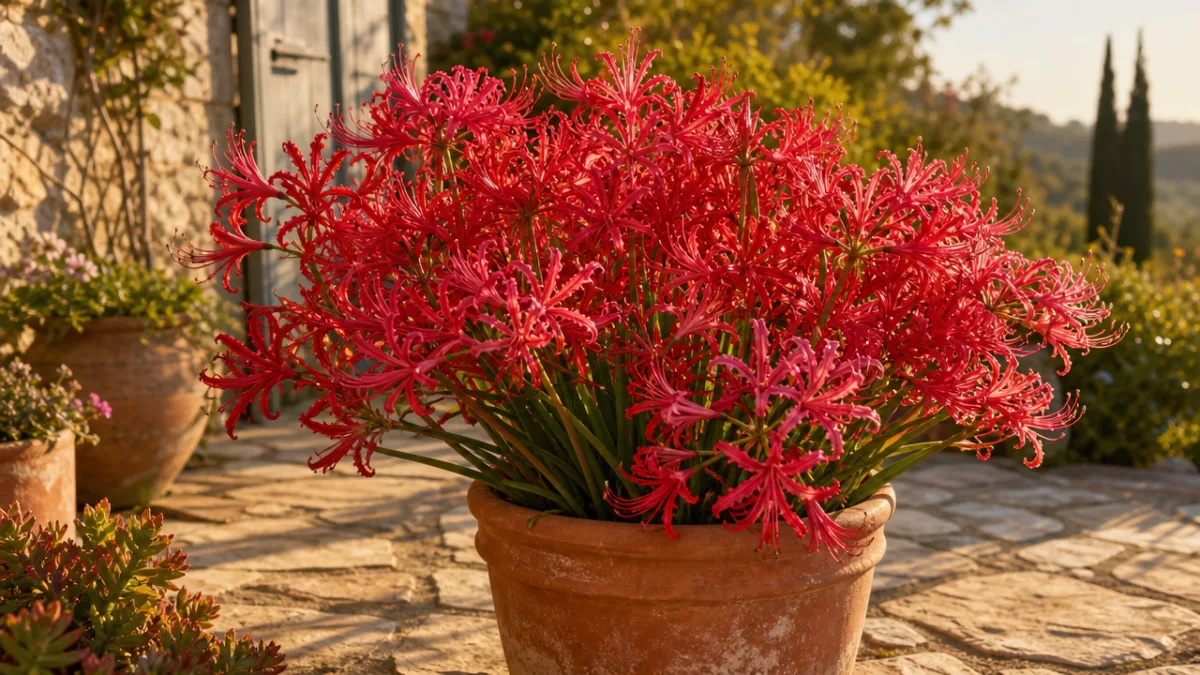
In containers, a large terracotta pot planted exclusively with Nerine bowdenii bulbs packed closely together — far more densely than you would plant in the ground — will produce a breathtaking display each autumn. Position the pot prominently during flowering and move it to a less visible spot during dormancy. Lycoris radiata also performs well in containers but requires a deeper pot to accommodate its preferred planting depth. Both species are excellent cut flowers, with long vase life that makes them a wonderful option for home decorating in autumn, when other cut flowers become scarcer and more expensive. Cut the stems when the first two or three florets on the umbel have opened for the longest possible vase life.
Naturalising, Propagation, and Long-Term Garden Investment
One of the most compelling arguments for investing in high-quality, large-diameter bulbs of Lycoris radiata and Nerine bowdenii is their capacity to naturalise and multiply over time. Unlike many garden plants that need frequent replacement, these bulbs, once established in a suitable position, will slowly but steadily increase in number year after year. A single bulb planted today can become a dense, impressive clump of a dozen or more flowering bulbs within a decade, providing an ever-expanding display for absolutely no additional cost. This makes them not just a purchase but a long-term garden investment of genuine value.
Propagation can be achieved in several ways. Natural offset production, where small daughter bulbs form alongside the mother bulb, is the most common method and requires no intervention from the gardener beyond periodic division as described earlier. Seed propagation is also possible but is a slow process, typically taking five to seven years from germination to flowering size, and the resulting plants from Lycoris radiata are frequently sterile in cultivation. For gardeners wanting to expand their collection more quickly, purchasing additional bulbs of a known flowering size, such as the 10 cm diameter specimens, is far more practical than attempting seed propagation.
From a financial perspective, these bulbs represent exceptional value when their longevity is taken into account. A good-quality, large bulb may seem more expensive at point of purchase than a smaller specimen, but it will flower reliably from the first or second year and continue to do so for decades with minimal care. Smaller, cheaper bulbs often require several years before reaching flowering size and may fail entirely if conditions are not perfect. When calculating the true cost per flower over the lifetime of the planting, large-diameter bulbs consistently prove to be the more economical choice, rewarding the initial investment many times over across the years and seasons to come.








What do you think?
It is nice to know your opinion. Leave a comment.