










The Cheap & Easy-To-Find Thrift Store Item That Makes The Ultimate Statement Piece
Why Thrift Stores Are the Secret Weapon of Savvy Decorators
Something quietly exciting is happening in the world of home decorating, and it’s got nothing to do with high-end showrooms or those glossy furniture boutiques you walk past at the mall. The most design-savvy decorators out there have known for years what everyone else is finally starting to figure out: the pieces that actually make a room interesting almost never come with a hefty price tag. In fact, the things that make guests stop mid-conversation and ask “wait, where did you get that?” are usually the ones you dug out from between a chipped casserole dish and a stack of old Reader’s Digest issues — for about four dollars.
And thrifting for your home isn’t just about saving money, though that’s obviously a nice perk. When you pull something out of a secondhand shop, you’re bringing home an object with real history, real patina, real character — the kind of thing you genuinely cannot manufacture at scale. A lamp that spent decades on someone’s grandmother’s writing desk has a warmth that no brand-new replica can fake. That authenticity is exactly what people are craving right now, especially as more of us grow tired of rooms that look like they were assembled directly from a single catalog page.
There’s also the thrill of the hunt, which is honestly half the fun. Shopping a retailer’s website is predictable — everything is photographed perfectly, priced accordingly, and available in three colorways. A thrift store is the opposite of that. You might walk in looking for a bookshelf and walk out with a hand-carved wooden mirror that becomes the most talked-about thing in your living room. That kind of happy accident doesn’t happen by luck alone — it rewards the patient, open-minded shopper who walks in without rigid expectations and keeps their eyes open.
The Item Itself: Large-Scale Framed Art and Mirrors
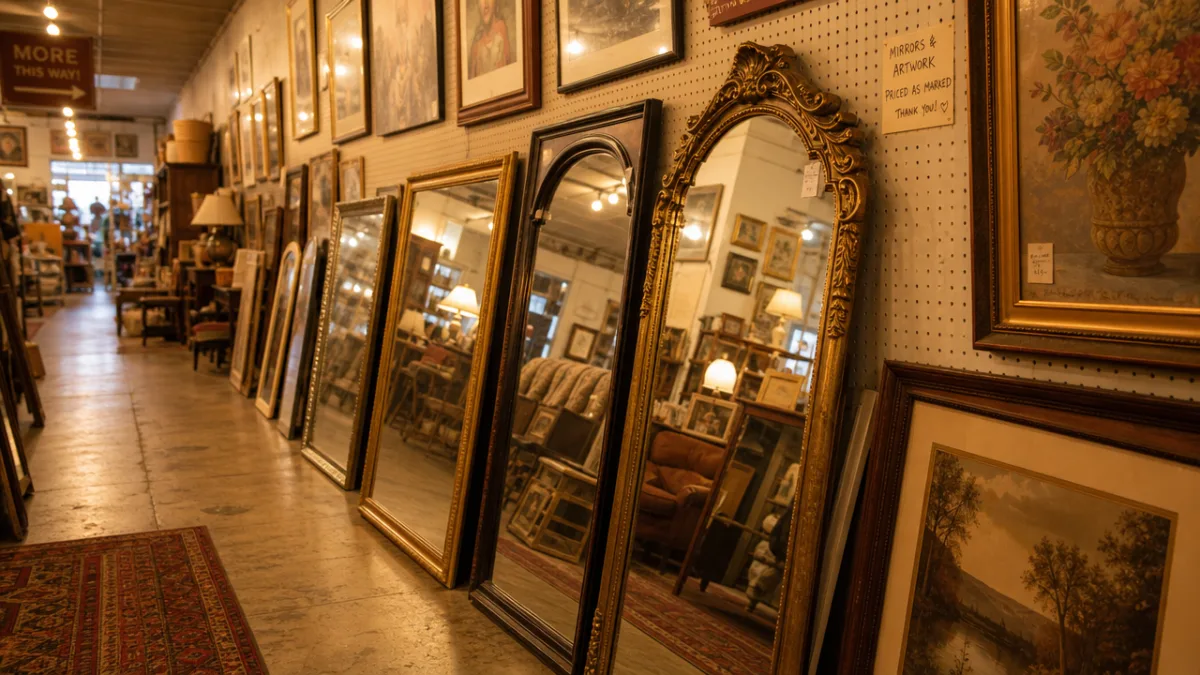
Of all the things you can find in a thrift store, one category consistently delivers the biggest decorating payoff for the smallest amount of money: large-scale framed art and oversized mirrors. These show up in secondhand shops constantly — usually because they’re awkward to move or because whoever donated them simply changed their look. That means they’re often dramatically underpriced, sitting there with tags between two and thirty dollars for pieces that would easily run hundreds, sometimes thousands, at a home décor store or gallery.
The reason these pieces make such a strong statement comes down to something pretty fundamental in design: scale. A large piece commands attention in a way that a cluster of smaller accessories simply can’t, no matter how many you arrange together. It anchors a room, creates a focal point, and gives the whole space a sense of intention. Interior designers will tell you over and over to go bigger than feels comfortable when it comes to wall art, because our instinct to play it safe and pick something small almost always results in a piece that looks lost and a little sad on a generous wall.
Mirrors are especially worth hunting for because they pull double duty. A well-placed oversized mirror doesn’t just look good — it makes a small room feel dramatically larger, bounces light into a dark corner, and adds a sense of depth that can genuinely transform a space. When you find a big, ornately framed mirror at a thrift store — one with gilded edges, carved wood detailing, or an interesting aged frame — you’re holding something with almost unlimited potential. The frame itself becomes sculpture. The mirror does its quiet, powerful thing in the background. It’s a win on every level.
How to Spot the Best Pieces When You Are Shopping
Going into a thrift store with a little bit of knowledge changes everything about what you walk out with. When you’re looking at a large framed piece, the first thing to check is the frame’s structure. Run your fingers along the corners — if it wobbles or the joints are pulling apart, it’s not going to hold up without some repair work. Look for frames made of solid wood, heavy resin, or metal. These materials are durable, easy to refinish, and tend to look far more expensive than their plastic counterparts once they’re cleaned up and on your wall.
Here’s the mistake almost every new thrift shopper makes: letting unappealing artwork talk them out of buying a great frame. Don’t do it. The art inside a found frame is almost beside the point. A spectacular gilded frame with a forgettable landscape painting inside it is, in reality, just a spectacular gilded frame waiting for a new purpose. You can swap out the original art for a print you love, a piece of fabric or wallpaper, a mirror cut to size, or even just a piece of backing board painted a single bold color. The frame is what you’re buying.
When you’re evaluating mirrors specifically, take a close look at the reflective surface in decent light. Minor foxing — those dark spots you see on antique mirror glass — can actually add really beautiful character and is considered desirable in a lot of design circles. Large areas of deterioration or deep scratches are a different story, since that could mean the mirror needs professional resilvering, which adds cost. Also flip it over and check the hanging hardware. Heavy mirrors with flimsy hardware are a safety issue, but that’s an easy fix — a quick trip to the hardware store and a few D-ring hangers and wall anchors takes care of it completely.
Styling Your Statement Piece for Maximum Impact
Finding the right piece is only half of it — where and how you hang it determines whether it actually does what you want it to do. The most effective spot for an oversized piece of art or a large mirror is almost always the wall your eye naturally goes to when you walk into the room. That’s usually the wall directly opposite the entry point, or the one anchoring your main seating area. Putting your statement piece there means it’s the first thing a visitor sees and the visual anchor that sets the tone for the whole space.
Height is one of those things that gets quietly wrong in so many homes. The rule that galleries and professional installers use is to center a piece at roughly 57 to 60 inches from the floor, which lands around average eye level when you’re standing. This applies whether you’re hanging a single large piece or building out a gallery wall. Pieces hung too high lose their connection to the furniture and the people below them, and the room ends up feeling disjointed in a way that’s hard to put your finger on but very easy to sense.
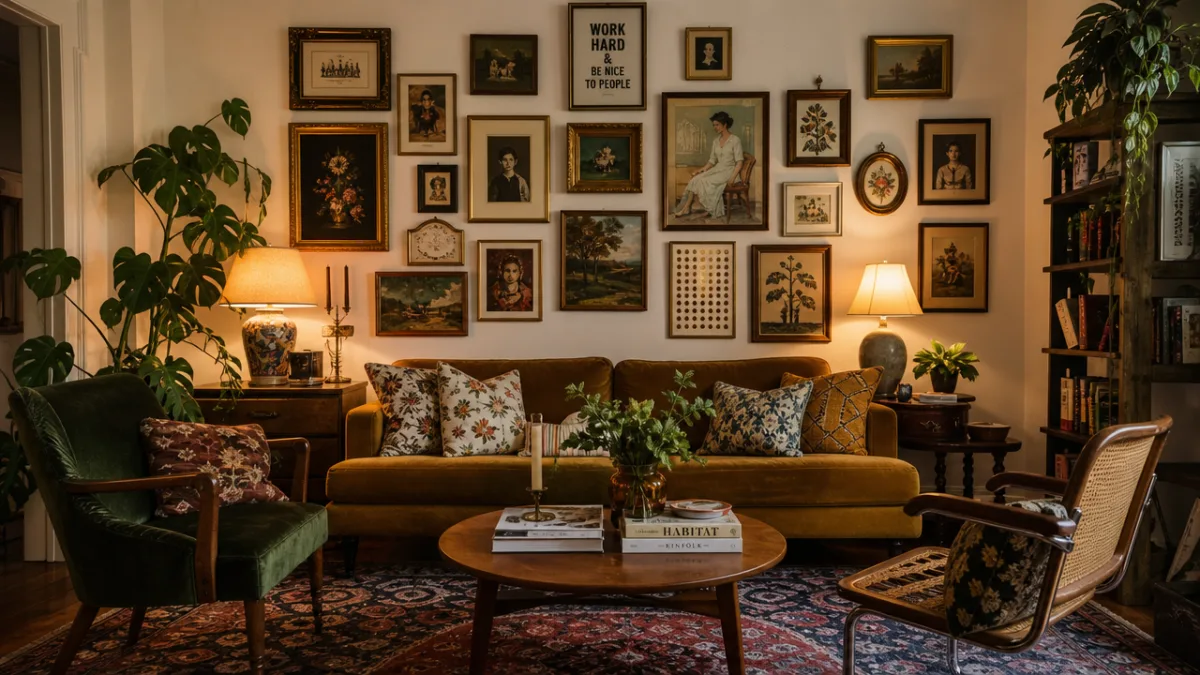
Once you’ve got your piece placed, the surrounding décor should support it rather than compete with it — and that usually means pulling back a little. If you’ve hung a large ornate gilded mirror, keep nearby surfaces relatively calm: maybe a simple console table underneath with one or two carefully chosen objects. If your statement piece is bold abstract art with strong colors, pull those colors through the room in textiles, throw pillows, or a single vase. That visual thread is what makes a room feel curated rather than coincidental.
Simple Transformations That Elevate a Thrifted Find
One of the best parts of thrift store decorating is the transformation — those small, satisfying interventions that turn a raw find into something that looks completely intentional. For frames, the single most impactful thing you can do is paint. A can of spray paint in matte black, warm brass, antique white, or deep forest green can completely reinvent a frame that looked tired or dated in the store. The process is simple: a light sanding, a coat of spray primer on glossy surfaces, and two thin coats of your chosen color will give you a finish that looks deliberate and polished.
If you want to go a step further, gilding wax is one of those products that genuinely deserves more attention than it gets. You can find it at most craft stores for under ten dollars, and it comes in gold, bronze, copper, and silver. Apply it with a fingertip or small cloth directly to raised surfaces, carved details, or frame edges and you get a luxurious metallic effect that looks like it cost real money. On a frame with textured or ornamental surfaces, the results are kind of remarkable — a plain brown thrift store frame with some gilding wax worked into its details can easily pass for a designer piece worth fifty times what you paid.
Beyond the frame itself, what you put inside it is a whole creative opportunity. Some of the most striking wall pieces in thoughtfully designed homes are nothing more than thrift store frames filled with unexpected content. Consider these ideas for filling a beautiful found frame:
- A large-scale printed photograph or digital art file printed at a copy shop to fit your exact frame dimensions
- A piece of decorative fabric, linen, or velvet stretched across a backing board and inserted like a canvas
- Vintage botanical or anatomical prints sourced from old books or downloaded from public domain archives
- A piece of mirror glass cut to size by a local glass shop, turning any frame into a custom mirror
- Hand-lettered text, a favorite quote rendered in a simple font and printed large scale
- A collection of pressed and dried botanicals arranged on a neutral background
None of these take much money or much skill, but the results feel genuinely custom and deeply personal. The difference between a room that looks like it came together by accident and one that feels considered often comes down to exactly this kind of hands-on engagement with the things in it.
Building a Cohesive Look Without Spending a Fortune
Once you’ve experienced what one great thrift store find can do for a room, the natural next question is how to build a whole space — or a whole home — around this approach without things starting to feel mismatched or random. The key is to have a framework in place before you shop, so you’re evaluating each find against a clear vision rather than grabbing things impulsively because they seemed exciting in the moment. Start by identifying two or three core colors that run through your space, a general material palette (warm wood tones, metals, natural fibers, whatever fits your style), and a sense of the overall mood you’re going for.
With that in mind, thrift store shopping becomes much more focused. You’re no longer vulnerable to impulse buys that look great in the store but have no real home in your space. Instead, you can ask the right questions about every potential find: does this frame color fit within my palette? Is the scale right for the wall I have in mind? Will this material feel at home with what I already own? That kind of discipline is, a little counterintuitively, what separates rooms that look effortlessly collected from rooms that just look like they were furnished entirely at Goodwill.
It’s also worth getting to know the thrift stores in your area, because inventory turns over fast and the best pieces go quickly. A lot of experienced thrift shoppers visit their favorite spots on the same days each week — often early in the week, when weekend donations have been processed and put on the floor. Some stores offer loyalty cards, email updates, or will even let you leave a wishlist with staff. A little investment in those relationships can pay off in a big way when a spectacular oversized mirror rolls in and you get first look before anyone else does.
The Bigger Picture: Sustainable Style on Your Own Terms
Leaning into thrift store statement pieces isn’t just a budget move — it’s also a way of aligning with values that more and more people genuinely care about. Every item you rescue from a secondhand shop is one less thing heading to a landfill. Every dollar spent at a thrift store, especially those run by nonprofits, often goes toward supporting community programs and services. And every room furnished with real found objects instead of mass-produced replicas carries a smaller environmental footprint than one filled top to bottom with brand-new stuff.
Beyond the environmental side of it, there’s a deeply personal satisfaction that comes with knowing your home reflects actual choices — not algorithm-driven recommendations or whatever trend cycle is currently being pushed. The large gilded mirror you found for twelve dollars, cleaned up with a damp cloth and a little gilding wax, and hung above your fireplace is yours in a way that something ordered online simply isn’t. You saw its potential when it was leaning dusty against a thrift store wall. You made something of it. That story is invisible to guests but completely real to you, and it’s exactly what transforms a house into a home.
The biggest shift anyone can make in how they approach decorating is to stop chasing rooms that match a catalog and start building rooms that match a life. Thrift store decorating, anchored by bold, character-rich statement pieces found for a fraction of their actual value, is one of the most direct routes to that kind of authentic, personal space. The item is cheap, it’s easy to find, and when you give it the attention it deserves, it becomes the piece that defines the whole room — and tells anyone who walks in exactly the kind of person who lives there.








What do you think?
It is nice to know your opinion. Leave a comment.