










Bespoke Upcycled Bicycle Wall Lamp: Crafting Light from Recycled Bike Parts and Pallet Wood
The Art of Upcycling: Where Sustainability Meets Craftsmanship
In a world increasingly conscious of waste and environmental impact, upcycling has emerged as one of the most creative and meaningful responses to our throwaway culture. Rather than discarding old materials, skilled artisans and hobbyist makers are reimagining their second life, transforming what was once destined for landfill into objects of genuine beauty and utility. The bespoke upcycled bicycle wall lamp stands as one of the finest examples of this philosophy in action, marrying industrial salvage with handmade artistry to produce something truly extraordinary.
The appeal of a lamp made from recycled bicycle components and reclaimed pallet wood goes far beyond mere novelty. Each piece carries its own history — the weathered patina of a chainring that once powered someone through city streets, the honest grain of timber that bore weight in some forgotten warehouse. When these materials are brought together thoughtfully, they create an object imbued with narrative depth that no factory-produced fitting could ever hope to replicate. This sense of story and provenance is increasingly valued by homeowners who want their interiors to reflect genuine character.
Bespoke craftsmanship of this kind also represents a meaningful rejection of mass production. Every bicycle wall lamp of this type is inherently one of a kind because the raw materials themselves are unique. No two salvaged derailleurs are worn in exactly the same way; no two pallet boards carry identical marks from their working lives. The maker who assembles these components must possess not only technical skill but also a sensitive eye for composition, deciding how each element relates to the others and to the space it will ultimately illuminate.
Anatomy of the Lamp: Understanding the Components
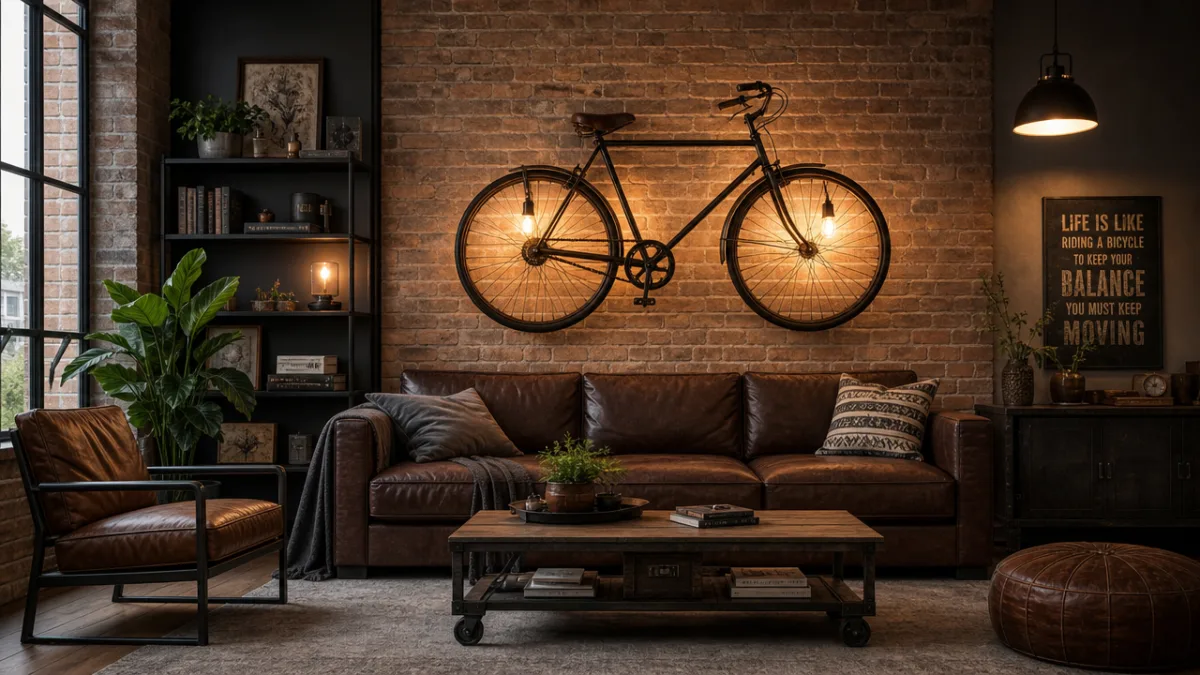
To appreciate what goes into a bespoke bicycle wall lamp, it helps to understand the individual components that typically find their way into these creations. The bicycle itself offers a remarkable wealth of raw material: chainrings and sprockets provide bold circular forms with wonderful mechanical detailing; gear derailleurs offer complex, articulated shapes that cast intricate shadows when lit; handlebars and stem assemblies give structural possibilities; brake levers, cables, and housings contribute fine linear elements; and even inner tubes can be repurposed as cord management or decorative wrapping. Each part is selected as much for its visual character as for its structural suitability.
Pallet wood brings an entirely different material vocabulary to the composition. Typically made from pine, spruce, or hardwoods depending on their origin, pallets bear the marks of their working life with admirable honesty: stamped heat-treatment codes, nail holes, staining from transported goods, and the gentle undulation that comes from years of bearing load. When cleaned, sanded selectively, and sealed, these boards become a warm, textured backdrop that grounds the metallic bicycle components and prevents the piece from feeling too cold or industrial. The contrast between rough wood grain and polished or raw metal is central to the lamp’s aesthetic success.
The electrical components, while less romantically storied, deserve equal attention from a safety and design perspective. Quality lamp holders, appropriately rated flex or cable, proper earthing where required, and suitable bulbs — typically vintage-style Edison filament bulbs that complement the industrial aesthetic — must all be chosen with care. Many makers choose to run the cable along the surface of the wall plate in a deliberate, visible way, using conduit clips or cable staples that themselves become part of the design language rather than something to be hidden. This honest expression of function is very much in keeping with the upcycling ethos.
The Making Process: From Salvage to Statement Piece
Creating a bespoke bicycle wall lamp begins long before any tools are picked up, with the critical process of sourcing suitable materials. Bicycle components can be found at a surprising variety of places: local bike shops often accumulate broken or worn parts that they are happy to sell cheaply or even give away; charity shops and car boot sales sometimes yield entire bicycles for very little outlay; online marketplaces list salvage by the boxful; and dedicated bicycle recycling organizations process large volumes of donated machines. The maker must develop a discerning eye, learning to identify components that have interesting visual character without being structurally compromised beyond safe use.
Once materials are gathered, the preparation stage demands patience and attention. Pallet wood must be carefully inspected for protruding nails, which are removed or punched below the surface; boards are then cleaned of dirt and debris, assessed for stability, and cut to the desired dimensions for the wall plate. Metal bicycle components are degreased thoroughly, inspected for any sharp edges that need filing smooth, and treated according to the maker’s finish intention — some prefer to preserve the original patina as found, applying only a clear lacquer to stabilize it; others lightly sand and re-coat with matt black or metallic spray; still others use rust-effect or verdigris treatments to create a more deliberately aged appearance.
The assembly process requires the maker to think simultaneously as an engineer and a visual artist. The wall plate must be structurally sound enough to bear the weight of the assembled components and safely house the electrical installation. Bicycle parts need to be fixed securely, whether by bolting through the board, welding to a backing plate, or using industrial adhesives rated for the materials in question. As the composition builds, the maker constantly steps back to assess the visual balance of the piece — considering how light will interact with different surfaces, how shadows will be cast, and how the finished lamp will read from different distances and angles within its intended room.
Design Styles and Aesthetic Variations
One of the most exciting aspects of bespoke bicycle wall lamps is the breadth of aesthetic directions a maker might choose to pursue. At one end of the spectrum sits a raw, uncompromising industrial approach: black-painted components, rough-sawn pallet wood with minimal finishing, exposed cabling, and a bare Edison bulb that casts a warm, slightly harsh light. This style sits comfortably in urban loft conversions, warehouse apartments, and any interior that embraces exposed brickwork, concrete floors, and a generally unpolished palette. The lamp becomes an extension of the architecture’s own honest materiality.
A softer interpretation might lean toward what could be called industrial-rustic or workshop-chic: pallet wood that has been lightly sanded and treated with a warm tung oil or beeswax finish, bicycle components in their original colours or given a brushed rather than painted treatment, and cabling neatly routed in cloth-braided flex that adds a tactile warmth. This approach broadens the lamp’s appeal significantly, making it at home in farmhouse kitchens, converted cottages, and Scandinavian-influenced interiors where warmth and texture are valued alongside simplicity. A well-chosen shade or diffuser might be incorporated to soften the light output.
Some makers push the concept in a more sculptural, almost gallery-worthy direction, treating the lamp primarily as a three-dimensional artwork that happens also to function as a light source. In these pieces, the bicycle components might be more elaborately arranged, perhaps incorporating a full wheel rim as a halo element, or using multiple gearing components in a layered composition. The wall plate might be shaped, carved, or combined with other salvaged materials such as reclaimed copper pipe, vintage glass insulators, or antique leather strapping. These pieces command significant prices and are genuinely collectible works of applied art.
Installing Your Bicycle Wall Lamp: Practical Considerations
Before any new light fitting can be installed, it is essential to approach the electrical aspects with appropriate seriousness. In many countries, including the United Kingdom, permanent electrical installations must either be carried out by a qualified electrician or, where permitted for minor works, by a competent DIYer who understands the applicable wiring regulations and, where required, notifies the relevant authority. A lamp that plugs into a standard socket via a length of flex obviously sidesteps most of these requirements, and many bespoke bicycle wall lamps are deliberately designed as plug-in fittings for exactly this reason, making them genuinely accessible to renters and those without electrical qualifications.
The physical mounting of the lamp requires equally careful thought. Pallet wood, while robust, varies considerably in density and structural integrity, and it is important to ensure that the wall fixings pass through the backing board and engage securely with the wall structure itself rather than merely with plaster or render. In masonry walls this typically means using appropriate rawl plugs and screws; in stud partition walls, fixings should ideally locate the timber studs for maximum security. The combined weight of the wooden backboard and all metal bicycle components can be considerable, and a lamp that pulls away from the wall is both a safety hazard and deeply disappointing after the creative effort invested in making it.
Bulb choice has a significant impact on the character of the finished installation. Vintage-style LED filament bulbs now offer the warm, visible-element aesthetic of traditional Edison bulbs with a fraction of the energy consumption and heat output, making them the sensible default choice for most installations. Globe-shaped bulbs tend to suit compositions where the bulb itself is intended to be a visual feature, while tubular or candle shapes may suit more compact arrangements. The colour temperature of the bulb — measured in Kelvin — should be chosen to complement the materials: lower values around 2200–2700K produce the warmest, most amber-tinted light that flatters wood and raw metal beautifully.
Living With Upcycled Lighting: Style, Sustainability, and Value
Bringing a bespoke upcycled bicycle wall lamp into a home is rarely just a lighting decision — it is a statement about values, priorities, and the kind of interior environment the occupant wishes to create and inhabit. These pieces tend to become conversation starters almost immediately, drawing the eye and prompting questions about their origins and construction. Guests who might otherwise never give a light fitting a second glance find themselves drawn to examine the mechanical complexity of a gear cluster or the texture of weathered timber in a way that no mass-produced fitting could provoke. This capacity to generate genuine engagement and connection is among the most undervalued qualities of handmade objects.
From a purely environmental perspective, each lamp represents a meaningful diversion of materials from the waste stream. The steel and aluminium in bicycle components require enormous amounts of energy to produce from raw ore; by extending the useful life of these materials in a new application, the maker and the buyer together offset some fraction of that original environmental cost. Pallet wood, similarly, is a material that is produced in vast quantities and frequently disposed of after only a single or small number of uses, despite being structurally sound timber that could serve many further years of life in the right application. Choosing an upcycled lamp is a small but tangible act of environmental responsibility.
The question of value — both financial and cultural — is worth addressing directly. Bespoke upcycled bicycle wall lamps made by skilled makers command prices that can surprise those accustomed to mass-market lighting, often ranging from several dozen to several hundred pounds or dollars depending on complexity, the maker’s reputation, and the quality of components used. This price reflects not cheap materials cheaply assembled, but hours of skilled labour, the cost of safe and appropriate electrical components, and the genuine uniqueness of each piece. Considered alongside a mass-produced fitting that might be discarded within a few years, a well-made upcycled lamp purchased from a skilled craftsperson represents excellent long-term value and a far more meaningful contribution to the economy of making.
- Each lamp is genuinely unique — no two pieces share the same combination of components, wear patterns, or wood grain, making your purchase a one-of-a-kind object.
- Quality electrical components, properly installed, mean these lamps can offer decades of reliable service rather than the short lifespan typical of budget retail fittings.
- The aesthetic versatility of the industrial-upcycled style means these pieces adapt well as interior tastes evolve, remaining relevant across multiple decorating generations.
- Supporting independent makers who work in this tradition contributes to a wider culture of skilled craft, repair, and material stewardship that benefits communities broadly.
- Many makers offer commission services, meaning you can work directly with an artisan to specify dimensions, finish, and component selection for a result perfectly suited to your space.
Finding, Commissioning, and Caring for Your Lamp
The market for bespoke upcycled bicycle wall lamps has grown considerably over the past decade, and there are now numerous avenues through which buyers can find skilled makers. Online handmade marketplaces such as Etsy host many independent craftspeople working in this area, with listings that typically include detailed photographs, dimensions, and information about the specific components used. Local craft fairs, design markets, and maker fairs are excellent venues for encountering these pieces in person — crucially allowing you to assess the quality of construction, the weight and finish of materials, and the electrical specification directly before purchasing. Social media platforms, particularly Instagram and Pinterest, are where many of the most talented makers build and maintain their audiences.
Commissioning a piece directly from a maker offers the most rewarding experience and the greatest opportunity for personalisation. A good commissioning conversation will cover the intended location of the lamp, the dimensions of the wall space available, the existing colour palette and material palette of the room, any preferences regarding specific bicycle components (some buyers have sentimental attachments to particular brands or component types), the desired light output and bulb type, and the intended installation method. Many makers will provide sketches or mood boards at this stage, and some charge a design fee that is credited against the final price. Lead times for bespoke pieces typically range from two to eight weeks depending on the maker’s schedule and material sourcing requirements.
Caring for a bicycle wall lamp is straightforward but benefits from a little understanding of the materials involved. The wooden elements should be kept away from excessive moisture and wiped with a lightly dampened cloth when dusty, followed immediately by a dry cloth; periodic re-application of the original finish — whether oil, wax, or lacquer — will keep the wood looking its best. Metal components that have been lacquered require nothing more than occasional dusting; those left raw or treated with oils may need periodic re-oiling to prevent surface rust in humid environments. Bulbs should be replaced like-for-like in terms of wattage and fitting type, and any changes to the electrical installation beyond bulb replacement should be handled by a qualified electrician. Treated with this modest degree of care, a well-made bicycle wall lamp will remain a treasured and functional piece for many years to come.








What do you think?
It is nice to know your opinion. Leave a comment.