










Red Railroad Stripe “Peek a Boo” Jean Patches: The Ultimate Guide to Iron-On Denim Repair and Style
The Art and Necessity of Jean Patching
Denim is one of those fabrics that feels practically indestructible — until it isn’t. Knees blow out from constant bending, repeated washing slowly eats away at the fibers, and don’t even get me started on inner-thigh wear. For a long time, your options when this happened were pretty bleak: shell out for a tailor, attempt some clunky visible stitching yourself, or just toss a pair of jeans that honestly had plenty of life left in them. Iron-on patches changed all of that. Suddenly, fixing a hole became something fast, affordable, and — here’s the part people weren’t expecting — actually stylish.
The Red Railroad Stripe “Peek a Boo” Jean Patches from HoleyPatches are a good example of how far this product category has come. These aren’t just functional — they’re a deliberate design choice. The whole “Peek a Boo” idea is that the patch is meant to be noticed, peeking through or framing the damaged area in a way that says “yes, I patched this, and I meant to.” That mindset turns a basic repair into something that feels more like personal expression, which is a pretty significant shift from slapping a plain khaki square over a hole and hoping nobody notices.
This fits right into a larger cultural moment around how we think about our clothes. Sustainability-minded shoppers, vintage lovers, and DIY enthusiasts have all landed in the same place: patching is meaningful. It keeps good fabric out of landfills, it preserves garments you actually love, and it gives mass-produced clothing a personal touch that’s entirely your own. A red railroad stripe patch is a small thing, but it sits squarely in that movement — making repair feel like something worth doing, not just something you settle for.
Understanding Railroad Stripe Denim: History and Aesthetic Appeal
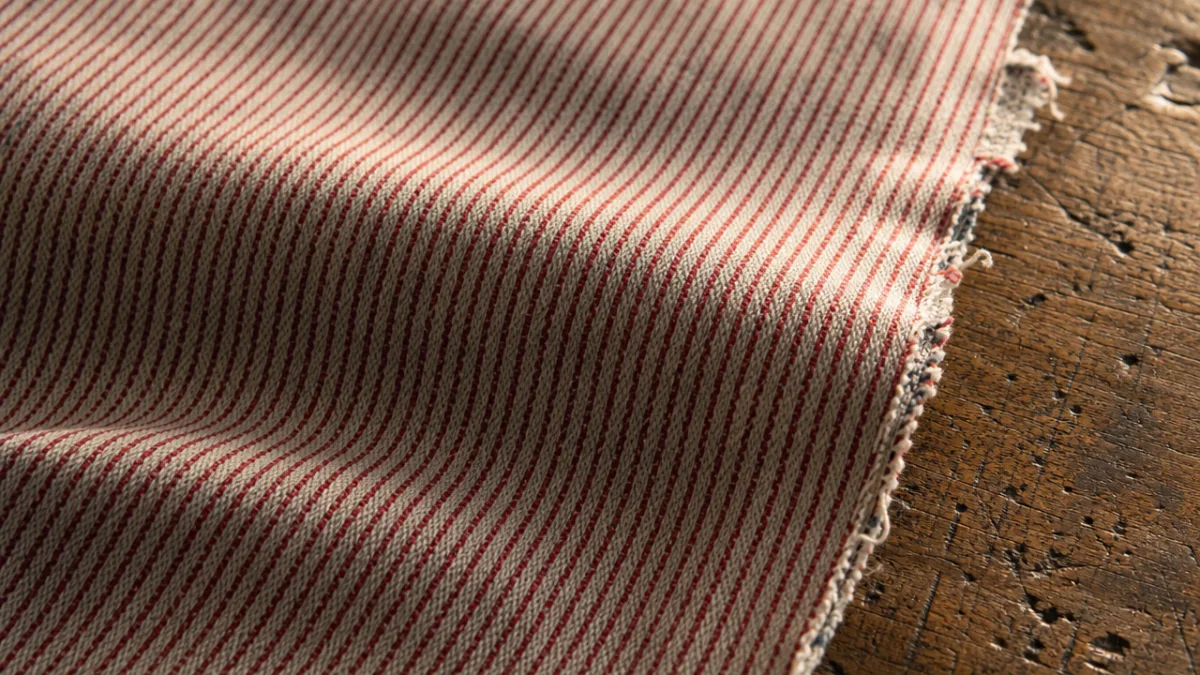
Railroad stripe fabric has been around since the mid-1800s, and its origins are about as no-nonsense as you’d expect. It was designed for the workers who actually built and ran the railroads — people who needed clothing that was visible, tough, and could hold up to brutal daily conditions. The stripes aren’t printed on; they’re woven directly into the fabric structure, which gives railroad stripe denim a texture and depth that printed versions just can’t match. Over time, that purely practical workwear took on a life of its own as a symbol of American craftsmanship and working-class culture.
By the twentieth century it had made its way out of the railyard and into everyday culture — overalls, conductor caps, the romantic imagery of train travel and small-town America. It had a big moment in the 70s and 80s with vintage and counterculture fashion, and it’s never really gone away. Today it shows up in heritage workwear brands and contemporary streetwear alike, which speaks to how versatile the aesthetic really is. The red version specifically has a boldness to it that the more traditional blue-and-white or black-and-white stripes don’t quite capture.
As a patch material, railroad stripe denim carries all of that visual and cultural history in a small square of fabric. A well-placed red railroad stripe patch doesn’t just cover a hole — it adds a layer of meaning. It suggests that you know something about where these textiles came from, that you appreciate durable, well-made materials, and that you’re comfortable mixing different eras and references in a way that feels intentional rather than random. For people who treat their jeans as an extension of their identity, that kind of patch is almost too perfect.
What Makes HoleyPatches Products Superior: Construction and Quality
Not all iron-on patches are created equal, and you find that out pretty quickly once the first wash cycle hits. Cheap patches start peeling at the corners almost immediately, leaving this sad half-attached flap that catches on everything and looks worse than the original damage. The fabric on those budget options is also usually too thin to provide any real structural support, so the hole keeps growing right underneath the patch. HoleyPatches specifically addresses both of those problems.
The “Super Strong” label isn’t just marketing — it reflects a real difference in how the adhesive is made. The heat-activated backing is formulated to create a permanent bond with denim at normal household iron temperatures, and that bond holds through repeated machine washing and drying without peeling or lifting. What makes it work is the weight and formulation of the adhesive film itself, which actually penetrates into the weave of both the patch and the garment to create something closer to a mechanical interlock between the two layers of fabric.
The patch fabric matters just as much as the adhesive, though. Using genuine denim or denim-weight material means the repaired area bends and stretches naturally with the rest of the garment, rather than creating a rigid stiff zone that puts stress on all the surrounding fabric. The railroad stripe weave adds an extra layer of structural integrity on top of that, because the woven stripe construction resists tearing in both directions — along the warp and the weft. Put a quality adhesive together with quality fabric and you actually get a repair that holds, which sounds like it should be the baseline but unfortunately isn’t always the case.
Step-by-Step Application Guide for Perfect Results
Getting an iron-on patch to stick properly is one of those things that takes maybe five minutes to learn and makes an enormous difference in how long the repair actually lasts. Before you do anything else, make sure both the patch and the jeans are ready. The denim needs to be completely clean and dry — moisture trapped under the patch will prevent the adhesive from bonding, and any detergent residue on the fabric surface can interfere with adhesion. If you just washed the jeans, give them time to dry fully before you start.
The actual application follows a pretty simple sequence, but doing each step carefully is what separates a patch that lasts years from one that starts peeling after a few washes:
- Preheat your iron to the cotton or high-heat setting, and turn off the steam. Steam adds moisture, which works directly against the heat-activated adhesive chemistry.
- Position the patch adhesive-side-down over the damaged area. Before you commit, take a moment to make sure the stripe direction is oriented the way you actually want it — once the adhesive bonds, repositioning isn’t really an option.
- Place a thin pressing cloth or a piece of parchment paper over the patch. This protects the fabric from direct iron contact, which can scorch or crush the texture of the railroad stripe weave.
- Press firmly and evenly for 30 to 45 seconds without sliding the iron around. A sliding motion can shift the patch out of position before the adhesive has a chance to set.
- Let the patch cool completely before you test the bond by trying to lift an edge. If a section lifts easily, go back over that area with the iron and a bit more pressure.
- Add stitching around the perimeter if the patch is going somewhere high-stress, like the inner thigh or knee. Those areas flex constantly, and a few stitches give the adhesive mechanical backup that helps it hold under ongoing strain.
The first few washes after application are really the proving ground for any patch. Turn the jeans inside out for the first several washes, and hold off on high-heat drying until the adhesive has had a chance to cure through a few thermal cycles. Once your patch has made it through those initial washes without issue, you can generally treat it like any other part of the garment. The little bit of extra attention you pay right after application goes a long way toward making the repair look clean and stay secure for the long haul.
Styling Red Railroad Stripe Patches: Fashion and Creative Applications
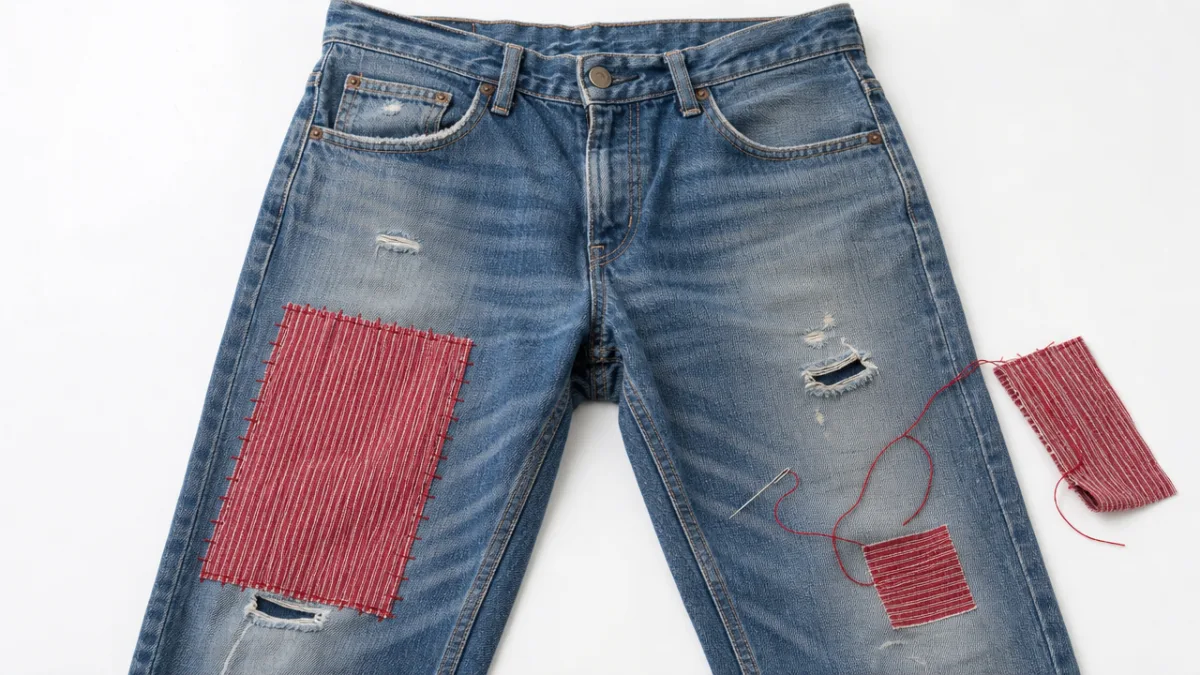
One of the genuinely fun parts of choosing a patch this visually distinctive is how much creative room it opens up in your wardrobe. The whole point of the “Peek a Boo” design philosophy is that you’re not trying to hide the repair — you’re leaning into it, using it as an intentional style element. That’s very much in step with the visible mending movement that’s been growing in sustainable and slow fashion circles, where the mark of repair is something to be shown off rather than concealed.
The red colorway is flexible in ways that might surprise you. If you’re into Americana or heritage workwear, a red railroad stripe patch on raw selvedge denim hits an authentically historical note that ties modern garments back to their working-class origins. If your style runs more contemporary and streetwear-adjacent, that bold red stripe against indigo or black denim reads as a sharp graphic element — the kind of thing that looks deliberate rather than accidental. And for more eclectic, maximalist dressers, the patch actually grounds a look with its clear textile reference, providing a visual anchor in the middle of heavier pattern mixing.
You don’t even need a hole to use these patches. Applying one to an undamaged knee, along a back pocket seam, or on the sleeve of a denim jacket turns the patch into pure embellishment. A lot of crafters use multiple patches — same design or complementary ones — to build out full patchwork looks on jackets, bags, and overalls. Railroad stripe works particularly well for this because its geometric quality creates a satisfying visual rhythm when it repeats across a garment. It’s one of those rare cases where the more you use it, the better it tends to look.
Sustainable Fashion and the Philosophy of Repair
Fashion is one of the most environmentally costly industries on earth. The water consumption, chemical runoff, and sheer volume of textile waste it generates every year are genuinely staggering numbers. Fast fashion has made things worse by normalizing a cycle where clothes are essentially disposable — worn a few times and then discarded — and the environmental toll of that cycle stacks up at every stage, from growing the cotton to dyeing it to shipping finished garments across the globe.
Repairing clothes instead of replacing them is one of the most direct things an individual can do to push back against that cycle. Every pair of jeans you patch and keep wearing is a pair that doesn’t need to be manufactured, which means less water, fewer chemicals, less fuel. Scale that logic up across millions of people making the same choice and the impact becomes genuinely meaningful. A product like the HoleyPatches Red Railroad Stripe Iron-On isn’t just a practical fix — it’s a small tool for opting into a different relationship with clothing.
There’s also something more personal at stake here, beyond the environmental math. A garment that’s been worn, damaged, repaired, and worn again carries a kind of meaning that new clothing can’t replicate. The patch becomes part of the jeans’ history — a visible mark of use and care that makes the object specific and irreplaceable in a way that anything fresh off a shelf simply isn’t. This idea has deep roots in textile traditions around the world. The Japanese concept of boro — heavily patched and mended indigo textiles that become objects of beauty in their own right — is probably the most well-known example. The “Peek a Boo” design taps directly into that sensibility: the patch is meant to be seen, not hidden, because it’s part of the story the garment is telling.
Caring for Patched Denim: Maintenance and Longevity
Once your patches are on and looking the way you want them, keeping them that way doesn’t take much effort — just a few small habits. The main thing that shortens patch life isn’t water or detergent; it’s the combination of aggressive mechanical agitation and high heat, which happens to be the same combination that fades and ages denim in general. A few simple adjustments to how you wash your jeans can go a long way toward preserving both the adhesive bond and that vivid red color.
The washing habits that make the biggest difference are pretty easy to adopt. Always flip your jeans inside out before they go in the machine — this cuts down on direct mechanical abrasion on both the patch surface and the adhesive edge where the patch meets the surrounding denim. Wash in cold water rather than hot, since repeated hot washes gradually break down heat-activated adhesives over time. Skip harsh biological detergents with enzymes designed to break down protein and cellulose fibers, since those can quietly degrade both the denim and the patch backing. And whenever you have the option, air drying beats the dryer for extending the life of your patches and the garment overall.
If a patch does start to lift at an edge after a lot of washes, that’s not a death sentence — it’s just a heads-up that it needs a quick re-press. Set the affected area on a hard, heat-resistant surface, cover it with a pressing cloth, and hold a hot iron over it with firm pressure for about 30 seconds. That’s usually enough to reactivate the residual adhesive and close things back up. For patches on high-stress areas that have been re-pressed a few times, a handful of stitches around the perimeter will give the adhesive some mechanical reinforcement and keep everything locked in place from that point on. With that level of maintenance, a well-applied HoleyPatches piece can realistically last as long as the jeans themselves.








What do you think?
It is nice to know your opinion. Leave a comment.