










DIY Crochet Round Motif Using T-Shirt Yarn: A Complete Creative Guide
Introduction to T-Shirt Yarn and Round Motifs
T-shirt yarn, often called “tarn,” has quietly become one of the most beloved materials in the modern crafting world, and for very good reason. Made by cutting old cotton t-shirts into continuous strips, this chunky, stretchy yarn gives new life to textiles that might otherwise end up in a landfill. Working with it feels wonderfully tactile — soft, forgiving, and satisfying in a way that traditional acrylic or wool yarns simply cannot replicate. Its thick weight means projects grow quickly, making it especially appealing to beginners who want to see results fast.
Round motifs are among the most elegant and versatile structures in all of crochet. Unlike rectangular or granny-square projects, a round motif radiates outward from a central point, creating a natural symmetry that is visually compelling and structurally strong. When you combine the organic beauty of round motif construction with the bold, chunky texture of t-shirt yarn, you get a finished piece that works as a decorative element, a functional textile, or even a statement art object suitable for hanging on a wall.
What makes this particular project so accessible is that it requires minimal tools, very little prior experience, and can be completed in a single afternoon. Whether you are a seasoned crocheter looking for a satisfying weekend project or a complete beginner taking your first steps into the craft, the DIY crochet round motif using t-shirt yarn is an ideal starting point. The generous size of each stitch makes it easy to see exactly what you are doing, and the forgiving elasticity of the yarn means that small mistakes can often be corrected simply by adjusting tension as you go.
Gathering Your Materials and Tools
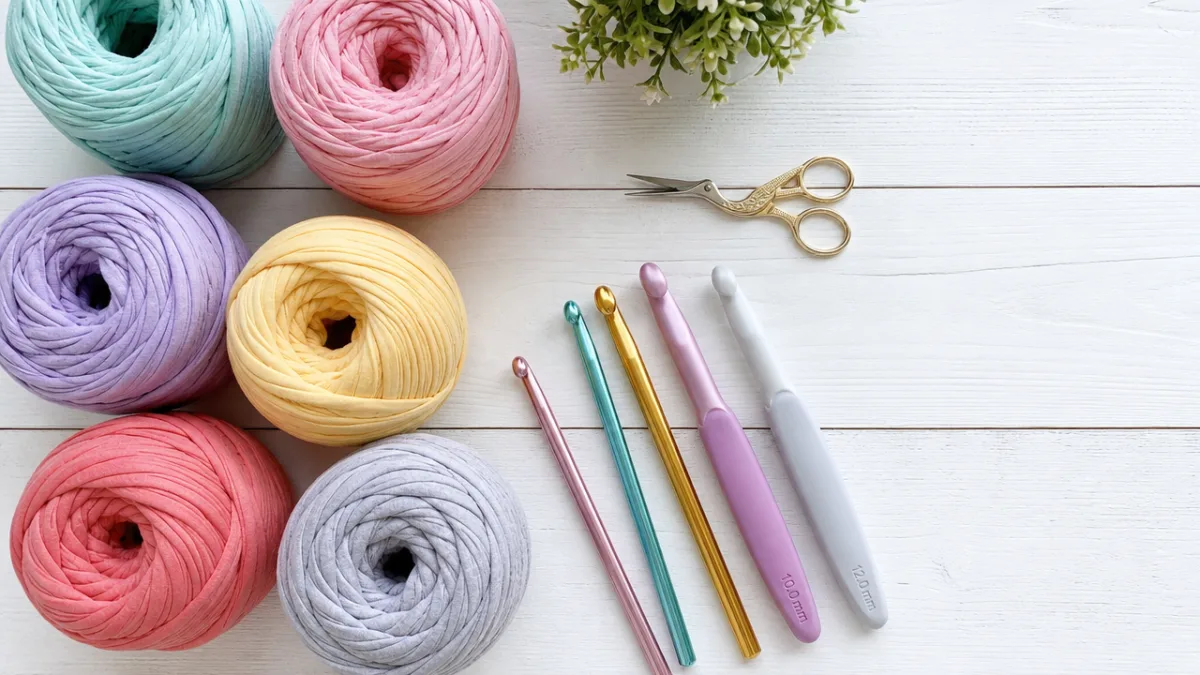
Before you begin crocheting, it pays to spend a few minutes assembling everything you need in one place. The primary material, of course, is your t-shirt yarn. You can purchase ready-made tarn from craft stores or online marketplaces, where it comes wound into neat balls in dozens of colors, from muted neutrals to vibrant jewel tones. Alternatively, making your own t-shirt yarn from secondhand shirts is a rewarding process in itself, and it gives you complete control over color and thickness while keeping costs extremely low. A single adult-sized cotton t-shirt typically yields enough yarn for a small to medium-sized motif.
In terms of tools, you will need a crochet hook sized appropriately for the weight of your tarn. Most t-shirt yarn works best with a hook in the range of 8mm to 12mm, though some particularly thick commercial tarns may require something even larger. Ergonomic hooks with cushioned handles are worth considering if you plan to crochet for extended periods, since the resistance of chunky yarn can tire your hands more quickly than finer materials. You will also want a pair of sharp scissors, a blunt tapestry needle for weaving in ends, and a flat surface where you can lay your motif out periodically to check its shape.
Optional but highly recommended materials include stitch markers, which help you keep track of the beginning of each round especially as the motif grows larger and counts become harder to manage visually. A measuring tape is also useful if you have a specific diameter in mind for your finished piece. Some crafters like to keep a notepad nearby to mark off completed rounds, particularly when working with complex stitch patterns that involve increases at precise intervals. Having everything within arm’s reach before you sit down to crochet creates a smoother, more enjoyable experience from start to finish.
- T-shirt yarn or tarn (commercial or handmade from recycled shirts), approximately 100–200 grams depending on desired size
- Crochet hook, 8mm to 12mm, ergonomic handle preferred
- Sharp scissors for cutting yarn and trimming ends
- Blunt tapestry or yarn needle for finishing
- Stitch markers to track round beginnings
- Measuring tape for checking diameter
- Optional: spray bottle with water and blocking board for finishing
Understanding the Basic Stitches and Round Structure
If you are new to crochet, a brief orientation to the stitches used in round motifs will make your experience considerably smoother. Most round motifs begin with either a magic ring or a foundation chain joined into a circle. The magic ring is widely preferred because it allows you to cinch the center hole completely closed, leaving no gap at the heart of your motif. To make one, simply wrap the yarn around your fingers, insert your hook through the loop, draw up a loop of working yarn, chain one to secure, and then work your first round of stitches into the ring before pulling the tail end to tighten it shut.
The stitches most commonly used in round motifs include the single crochet, the half double crochet, and the double crochet. Single crochet produces a dense, tight fabric that lies flat and sturdy — excellent for coasters, trivets, or pot holders. Double crochet creates a more open, lacy fabric that works up faster and drapes more softly. For a chunky t-shirt yarn project, many crafters prefer single or half double crochet because the thick yarn already adds significant visual weight, and tighter stitches help the motif hold its circular shape without curling or cupping at the edges.
The key structural principle behind any flat round motif is consistent, evenly spaced increasing. In every round, you must add a calculated number of stitches to compensate for the expanding circumference. For single crochet rounds, the standard formula is to add six stitches per round — so round one has six stitches, round two has twelve, round three has eighteen, and so on. If you add too few increases, the motif will begin to cup upward like a bowl. If you add too many, it will ruffle and ripple outward. Learning to recognize and correct these tendencies by feel is one of the most satisfying skills you will develop as a crocheter.
Step-by-Step Instructions for the Round Motif
Begin by creating your magic ring. Hold the tail end of your t-shirt yarn against your palm with your thumb, then wrap the working yarn twice around your index and middle fingers. Slide the hook under the first wrap, catch the second wrap, and pull it through to form a loop on your hook. Chain one to secure the loop, but do not count this chain as a stitch. You are now ready to work your first round into the center of the ring. Work six single crochet stitches into the ring, then pull the tail firmly to close the center hole. Join with a slip stitch to the first single crochet to complete round one.
For round two, chain one and work two single crochets into each stitch around, giving you twelve stitches total. Join with a slip stitch and move your stitch marker to the first stitch of the new round. For round three, alternate between one single crochet in the next stitch and two single crochets in the following stitch, repeating this pattern all the way around to achieve eighteen stitches total. Each subsequent round follows a similar logic: the number of single stitches between increase points grows by one with each round. By round six or seven, your motif will already have a satisfying, substantial diameter that clearly reads as a round medallion shape.
Continue working rounds until your motif reaches the desired size. A small coaster typically measures around 10–15 centimeters in diameter, while a larger decorative piece or rug-style motif might reach 40–50 centimeters or beyond. The generous thickness of t-shirt yarn means that each round adds significant width, so it rarely takes more than eight to twelve rounds to create a piece that feels complete and purposeful. When you are satisfied with the size, finish by cutting the yarn, leaving a tail of about 15 centimeters, and pulling it through the final loop to secure. Thread the tail onto your tapestry needle and weave it invisibly through several stitches on the back of the work to hide it completely.
- Create a magic ring and chain one to secure.
- Work six single crochets into the ring; join and tighten the center.
- Round 2: Two single crochets in each stitch (12 stitches total).
- Round 3: Alternate one single crochet, then two in one stitch (18 stitches).
- Continue increasing by six stitches per round until desired size is reached.
- Fasten off, weave in ends securely on the wrong side.
- Block the finished piece if needed for perfect flatness.
Finishing Techniques and Creative Variations
Once your basic round motif is complete, the finishing process transforms a simple circle of yarn into a polished, professional-looking piece. Blocking is the crocheter’s secret weapon: by lightly misting your finished motif with water and pinning it to a foam blocking board in a perfect circle, then allowing it to dry completely, you encourage the fibers to relax into their final positions. T-shirt yarn, being primarily cotton, responds very well to wet blocking and will hold its shape beautifully once dry. This step is particularly important if your motif will be used as a coaster, trivet, or displayed as a decorative element where a perfectly flat, even surface matters aesthetically.
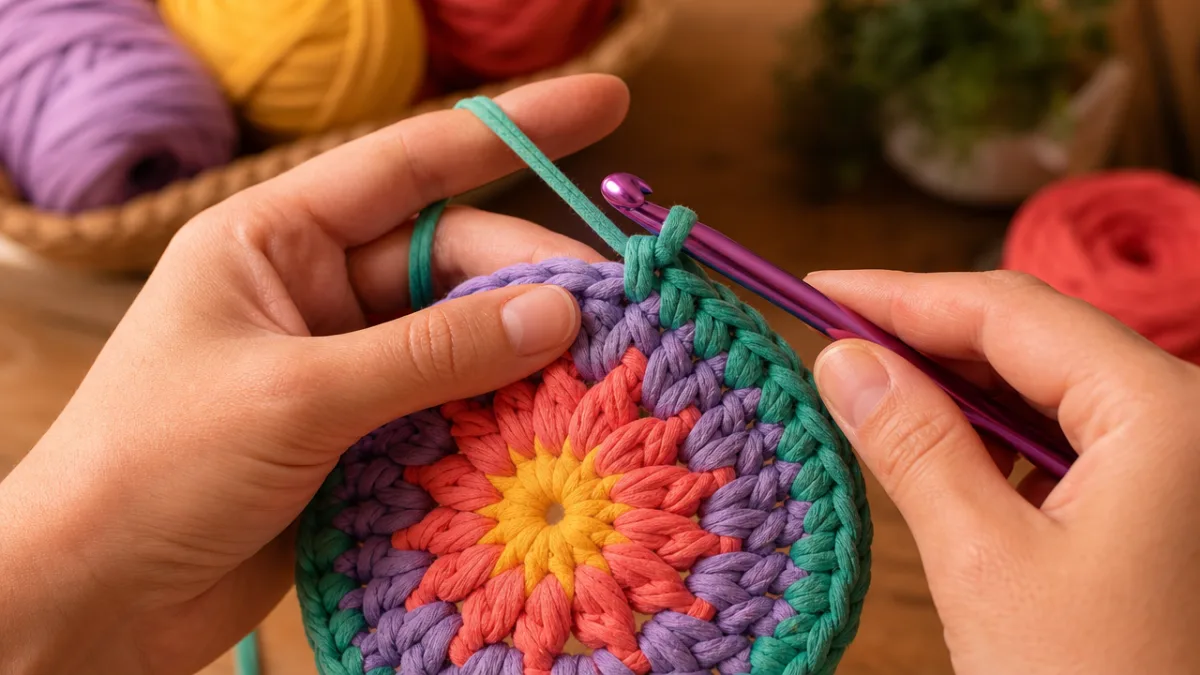
Beyond the classic solid-colored motif, there are countless creative variations worth exploring once you have mastered the basic technique. Color-changing is one of the most accessible and dramatic options: simply switch to a new color of tarn at the beginning of any round by joining the new yarn with a slip stitch after fastening off the old one. Striped motifs, ombré effects achieved by gradually transitioning between shades, and variegated tarns that shift color on their own are all stunning choices. You can also experiment with stitch variations — replacing single crochet with clusters of double crochets, adding picots along the outer edge for a lacy finish, or working raised stitches around posts to create tactile texture and dimensional interest.
The applications for a finished round motif are remarkably diverse, limited only by your imagination and the size of the piece you have made. Small motifs make excellent coasters, trivets, and pot holders — practical items that also double as colorful kitchen decor. Medium-sized pieces work beautifully as wall hangings when fitted with a wooden dowel or a simple ring of driftwood threaded through a few outer stitches. Larger motifs crocheted in durable tarn can function as bath mats, play mats for young children, or floor rugs that add warmth and personality to any room. You can also sew several motifs together to create patchwork-style blankets, tote bags, and cushion covers.
Sustainability and the Joy of Upcycling
One of the most meaningful dimensions of working with t-shirt yarn is its relationship to sustainability and conscious consumption. The fashion industry generates enormous amounts of textile waste every year, and old or worn-out cotton t-shirts represent one of the most common and easily diverted streams of that waste. By choosing to transform discarded shirts into creative material rather than sending them to landfill, you participate in a practice of upcycling that is both environmentally responsible and deeply satisfying on a personal level. Each skein of homemade tarn carries the history of a garment that was once worn and loved, giving your finished crochet project a layer of meaning and story that purchased materials simply cannot offer.
Making your own t-shirt yarn is simpler than it might initially appear. Begin by laying a clean, flat t-shirt on a cutting surface and removing the hem and any seams. Then, using a ruler and fabric chalk or a rotary cutter with a cutting mat, slice the body of the shirt into horizontal strips of consistent width, typically between one and two centimeters wide depending on how chunky you want your final yarn to be. Rather than cutting all the way through, leave a narrow spine along one edge uncut so that the strips remain connected. Then, at the spine, cut diagonally from one strip to the next to create a single continuous length of fabric. Stretch each strip gently as you wind it into a ball — this stretching is what causes the edges to curl inward, hiding raw edges and creating the smooth, rounded appearance characteristic of quality tarn.
Beyond individual environmental benefit, the growing community around t-shirt yarn crochet represents a broader cultural shift toward slower, more intentional making. Craft communities online and in person regularly organize t-shirt yarn swaps, where participants exchange homemade tarn in colors they have excess of for shades they need, creating circular networks of resource sharing that reduce waste and build genuine connection. Workshops teaching t-shirt yarn preparation and crochet basics have become popular in community centers, libraries, and schools, introducing the craft to new generations who might never have encountered traditional yarn crafting. The humble crochet round motif, then, is not merely a decorative object — it is a small but genuine act of participation in a more thoughtful, creative, and sustainable way of engaging with the material world around us.
Tips for Success and Troubleshooting Common Mistakes
Even experienced crocheters encounter challenges when working with t-shirt yarn for the first time, and understanding the most common pitfalls in advance will save you significant frustration. The most frequent issue beginners encounter is a motif that cups or domes upward rather than lying flat. This almost always indicates insufficient increases — too few extra stitches are being added as the circumference expands. The fix is straightforward: simply undo the most recent round or two and rework them with the proper increase count, paying careful attention to the pattern instructions. Counting your stitches at the end of every round, even when it feels tedious, is the single most effective habit you can develop to prevent this problem from occurring in the first place.
The opposite problem, a ruffled or wavy outer edge, indicates too many increases. This is a less common issue with t-shirt yarn specifically, since the weight of the material naturally encourages the fabric to lie flat, but it can occur if you are working very loosely or if your hook size is significantly larger than recommended for the yarn weight. If ruffling appears, try working the next round with no increases at all, or switching to a slightly smaller hook. Tension consistency is also worth monitoring throughout your work — a significant change in how tightly or loosely you crochet partway through a project will produce a visible ridge or shift in the fabric that can be difficult to correct after the fact.
For crafters who want to take their skills further, joining multiple round motifs is a technique that opens up a world of larger project possibilities. Motifs can be joined while the final round of the second motif is being worked, using a technique called join-as-you-go, which creates a seamless, flat connection without any sewing required. Alternatively, finished motifs can be arranged in a pattern and whip-stitched together with the tapestry needle using a length of matching or contrasting tarn. Experimenting with different arrangements — hexagonal clusters, linear strips, or random organic placements — is a creative and meditative process that can absorb many happy hours and yield truly spectacular results that showcase both your technical skill and your artistic sensibility.
- Always count stitches at the end of each round to catch errors early before they compound.
- If your motif cups, add more increases; if it ruffles, reduce increases or skip one round of increases entirely.
- Use stitch markers religiously, especially in rounds beyond the sixth, when stitch counts become harder to track visually.
- Maintain consistent tension throughout; taking breaks if your hands tire helps prevent gradual tightening.
- Block finished pieces for a polished, professional look that lies perfectly flat.
- Store your tarn loosely wound to prevent stretching and distortion between crafting sessions.
- Practice joining multiple motifs on small swatches before committing to a large combined project.
Above all, remember that crochet is a craft that rewards patience, curiosity, and a willingness to learn from imperfection. Every motif you complete, regardless of whether it turns out exactly as planned, teaches you something valuable about your own hands, your materials, and the endlessly fascinating logic of fabric construction. The DIY crochet round motif using t-shirt yarn is an ideal project precisely because it is simultaneously simple enough to be genuinely accessible and rich enough in variation and possibility to keep drawing you back, encouraging you to try new colors, new stitch combinations, and new applications with every fresh ball of tarn you pick up. There are few creative pleasures quite as quietly satisfying as watching a flat circle of soft, colorful material grow outward, round by round, under your own hands.








What do you think?
It is nice to know your opinion. Leave a comment.