










CD Reciclaje: Transforming Old Discs Into Creative Masterpieces
We’re all thinking more about sustainability these days, and one of the most surprisingly fun ways to get involved is by doing something creative with old CDs and DVDs. Chances are you’ve got a stack of them collecting dust somewhere — old music albums, burned copies, software discs nobody uses anymore. The thing is, these little rainbow-colored discs can take up to a million years to break down in a landfill, which is a pretty good reason to find something better to do with them. And as it turns out, “something better” can mean genuinely beautiful, useful, even impressive things.
Why CD Recycling Matters for the Environment
CDs are made from polycarbonate plastic, aluminum, and lacquer — a combination that nature really doesn’t know what to do with. Toss one in the trash and it’ll sit in a landfill for something like a million years without fully breaking down. That number sounds almost made up, but it’s not, and it makes a pretty compelling case for finding a better use for them.
When you think about just how many CDs were made during the peak of the optical disc era — we’re talking billions worldwide between the 1980s and early 2000s — the scale of the problem starts to feel real. Streaming killed the disc, but the discs themselves are still very much with us, sitting in drawers and garages across the globe. Getting creative with them is a genuinely low-barrier way to tackle that problem. You don’t need special equipment or a big budget — just a little curiosity and some free time.
There’s also a bigger picture here. Every CD that gets turned into a mosaic tile, a garden ornament, or a piece of jewelry is one fewer piece of plastic heading into an already overwhelmed waste system. And when schools start incorporating disc art into their programs, or communities organize CD collection drives, something shifts — people start seeing discarded objects differently, not just CDs but all kinds of things they’d normally throw away without a second thought.
Essential Tools and Materials for CD Craft Projects
Before you dive in, it helps to get a few things together. The good news is that most of what you’ll need is either already in your home or costs very little to pick up. A good pair of craft scissors or tin snips is handy for cutting CDs into smaller shapes — just go carefully, because the cut edges can be genuinely sharp. Grab a pair of safety gloves before you start handling cut pieces; it’s not dramatic to wear them, it’s just smart.
Glue is central to most CD projects, and the right type depends on what you’re making. For wall installations or mosaic work on hard surfaces, a strong epoxy or construction adhesive is the way to go. For lighter projects involving fabric, paper, or foam, a hot glue gun is fast and flexible enough to work with. If you want to paint your CDs, acrylic paints work well once the surface is primed, and glass or mirror paints can produce some really striking results that play nicely off the disc’s natural shimmer.
Depending on how ambitious you’re feeling, you might also reach for glass gems, mosaic grout, decorative beads, wire, or shells. A small drill bit lets you add hanging holes, sandpaper helps paint stick better, and a coat of sealant at the end protects your finished piece from moisture and sun damage. Set up a dedicated workspace with some newspaper or a silicone mat underneath, and you’re ready to make a mess in the best possible way.
- Craft scissors or tin snips for shaping and cutting discs
- Safety gloves to protect hands from sharp edges
- Epoxy adhesive or hot glue gun depending on the project scale
- Acrylic paints and glass paints for coloring and decorating surfaces
- Drill and small drill bit for creating hanging holes or threading wire
- Grout and tile adhesive for mosaic applications
- Sealant or varnish to protect completed projects from wear
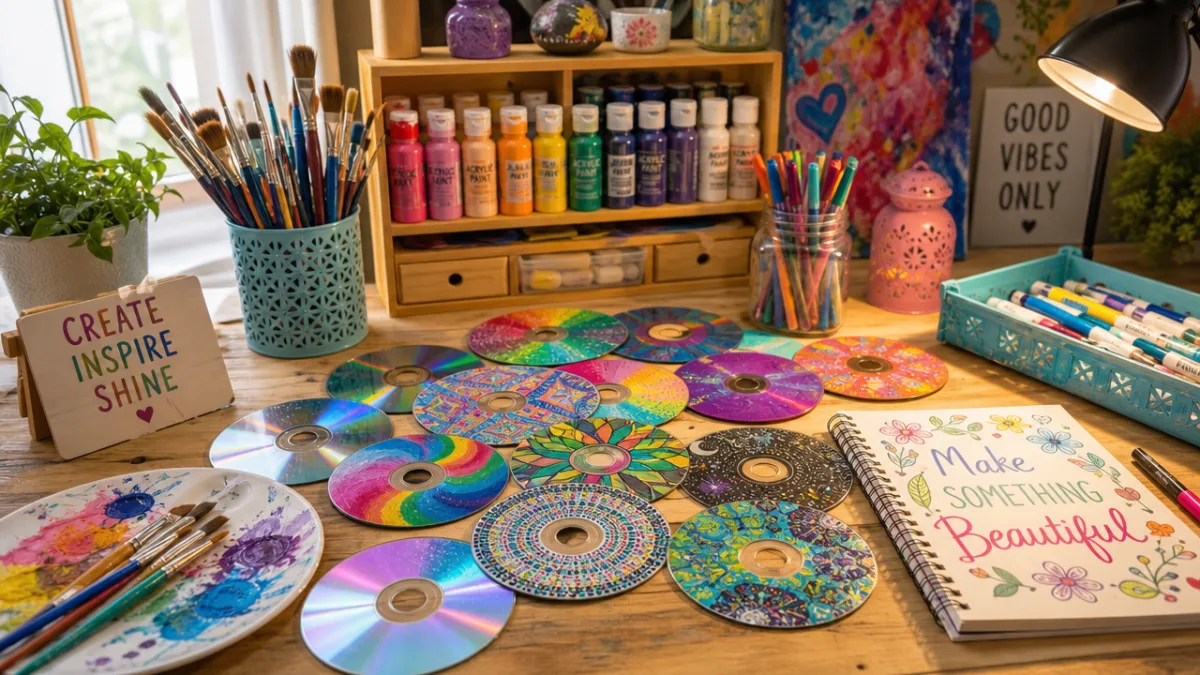
Stunning Home Décor Ideas Using Recycled CDs
One of the most popular things people do with recycled CDs is turn them into home décor — and the results can look far more expensive than they actually are. A simple but really effective idea is arranging whole CDs in a circular pattern on a wall to create a light-reflecting installation. Because CDs naturally throw off that rainbow iridescence when light hits them at different angles, even a straightforward arrangement becomes something dynamic and alive, shifting subtly as the light in the room changes throughout the day.
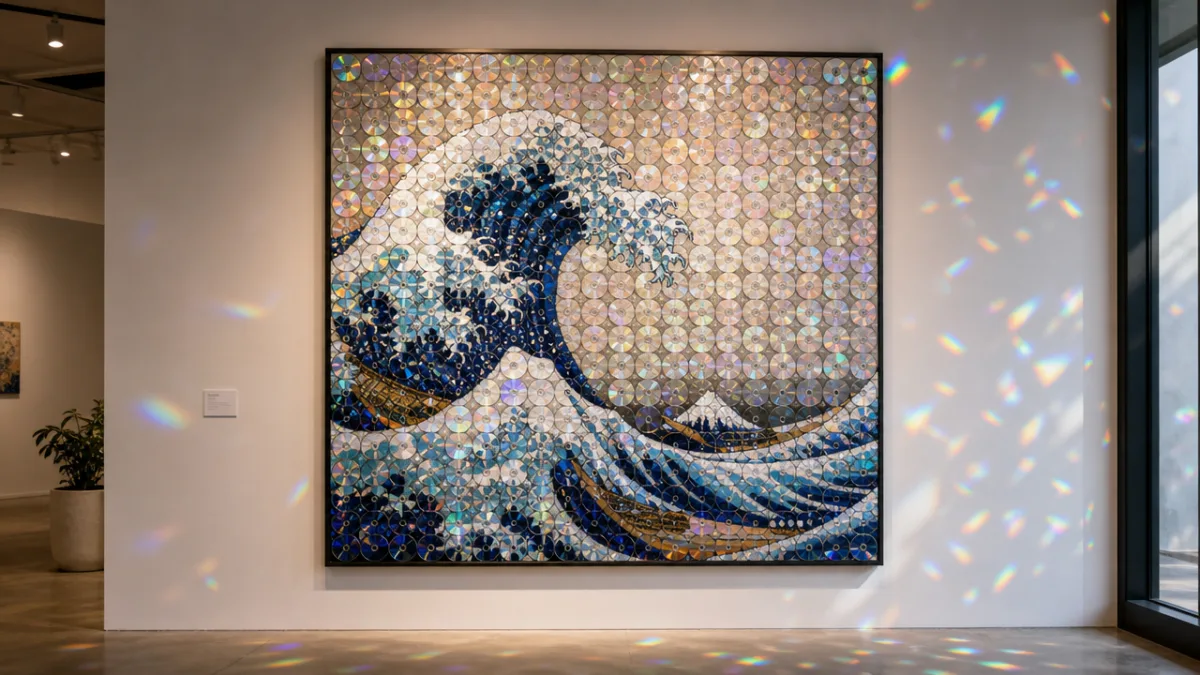
CD mosaics are another direction worth exploring. By cutting or breaking CDs into smaller pieces and arranging them with tile adhesive over a surface — a picture frame, a flower pot, a tabletop — then grouting in a complementary color, you end up with something that genuinely resembles traditional mosaic work, but with that distinctive prismatic sparkle that only a CD can give you. It’s especially beautiful in bathrooms or kitchens where light and water can play off the finished surface.
Wind chimes and hanging garden ornaments are another fan favorite. Drill a few holes near the edges of several discs, thread them onto fishing line or colored wire along with some beads, shells, or small bells, and you’ve got something that catches the breeze, spins in the sun, and casts little rainbow reflections across your garden for essentially no money. As a bonus, the movement and flashing light apparently does a decent job of keeping birds away from certain areas of the garden too.
For a more polished finish, resin casting with CD fragments is worth trying. Arrange pieces of CD in a frame or mold, pour clear resin over them, and once it cures you have a smooth, glossy, almost gem-like surface that looks genuinely professional. Depending on how you arrange the fragments and what else you include, the finished piece can fit a modern, industrial, or bohemian aesthetic — and it’s the kind of thing that people tend to assume you bought rather than made yourself.
Educational CD Recycling Projects for Children and Schools
If you’re looking for a way to get kids interested in both art and environmental thinking at the same time, CD projects are genuinely great for this. There’s something about a shiny, iridescent disc that children just find irresistible — hold one up to light and watch what happens to the room around you. That natural excitement gives teachers and parents a perfect opening to talk about waste, reuse, and why we don’t just throw things away without thinking about where they end up.
Spin art is probably the most joyful entry point for younger kids. Put a CD on something that rotates — a lazy Susan works perfectly — drop some acrylic paint onto it while it’s spinning, and the centrifugal force does the rest, flinging the paint outward in spiraling patterns that look far more complex than they are. Every single one turns out differently, which means even kids who feel nervous about “being good at art” get something genuinely unique and surprising at the end. Once dry, the painted discs can be displayed as they are or used as a starting point for more decoration.
Older students can take things in a more scientific direction. The reflective surface of a CD is a natural tool for exploring light refraction — you can literally show students how white light breaks into a visible spectrum just by angling a disc toward a light source. CDs can also play a role in simple solar energy demonstrations. Weaving these activities into a recycling and creative reuse context means you’re covering science, art, and environmental studies all at once, and doing it in a way that’s hands-on enough to hold attention across different kinds of learners.
- Spin art painting using acrylic colors and a rotating surface
- CD wind catchers strung with beads and nature objects
- Light refraction science experiments demonstrating the visible spectrum
- Mosaic art projects exploring geometric patterns and color theory
- CD clock-making projects combining craft skills with practical outcomes
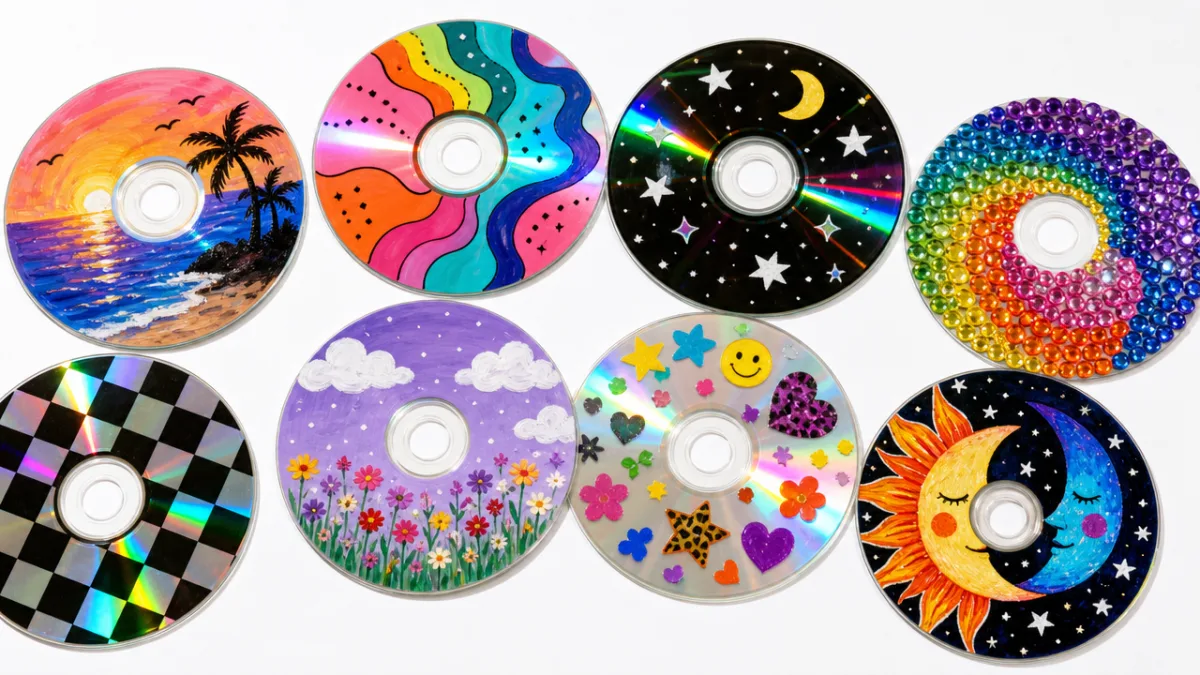
Upcycling CDs Into Functional Everyday Objects
Not everything has to be art. CDs can be turned into objects that actually do something. Take coasters, for example — stack two CDs back to back, bond them together with strong adhesive, and stick a felt or cork base on the bottom, and you’ve got a coaster that’s heat-resistant, waterproof, and a lot more interesting-looking than anything you’d buy in a shop. A set of them makes a great handmade gift and will absolutely prompt questions from anyone who notices them on your coffee table.
Handmade clocks are another surprisingly accessible project. The center hole of a CD happens to be just the right size for a standard clock mechanism spindle, which you can find in any craft supply store for next to nothing. Once you’ve threaded the mechanism through, you can paint on numbers, collage imagery around the face, or just leave the reflective surface as-is for a clean, minimalist look. The end result functions as well as any clock you’d hang on a wall, and it has a story behind it that a store-bought version never will.
In the garden, CDs have been used informally for decades as bird deterrents. Hang them in fruit trees, along trellises, or near seedbeds, and the flashing reflections and unpredictable movement are often enough to discourage birds from landing and helping themselves to your crops. It costs nothing, involves no chemicals, and makes use of something that would otherwise go straight in the bin. It’s about as straightforward as upcycling gets.
CD jewelry has also become a real thing, particularly among people interested in sustainable fashion. Cut a CD into small geometric shapes, sand the edges smooth, add a coat of resin or nail polish in whatever colors appeal to you, and you’ve got pendants, earrings, or brooches that are one-of-a-kind by definition — because the iridescence of each disc is slightly different, and the cutting and coloring process introduces even more variation. No two pieces will ever look exactly alike, and that’s a big part of what makes them appealing.
Getting Started With Your Own CD Recycling Journey
Getting started is easier than you might think, and you definitely don’t need any prior crafting experience. Begin with whatever CDs you already have at home — old music, burned copies, software discs, promotional freebies. Then ask around. Friends, family, and neighbors often have stacks they’d be happy to pass along, and thrift stores almost always have bins of CDs going for pennies. Building up a good supply before you start means you can experiment freely without feeling like you’re wasting anything precious.
Once you’ve got your materials, it’s worth spending some time just browsing what other people are making. Pinterest in particular is full of CD craft ideas at every skill level, from genuinely beginner-friendly to seriously impressive. Save the ones that catch your eye before you start your first project — having a visual reference makes a real difference when you’re trying to figure out where to begin. The communities built around this kind of upcycling tend to be welcoming and enthusiastic, and most people are happy to answer questions if you reach out.
The most important thing to bring to any CD project, though, is a willingness to experiment without needing everything to turn out perfectly. Working with a found material means surprises are part of the deal, and sometimes something won’t go the way you planned. The crafters who tend to produce the most interesting work are usually the ones who treat those moments as an opportunity to try something unexpected rather than a reason to start over. Some of the most creative techniques out there came about purely by accident.
And once you’ve made some things you’re proud of, share them — at a local craft fair, through a school fundraiser, on social media, or just as gifts to people you care about. Sharing the work spreads something beyond just the object itself. It opens up a conversation about why you made it, and that conversation has a way of making people look at their own forgotten discs a little differently. That’s how a small personal hobby starts to ripple outward into something with a bit more meaning behind it.








What do you think?
It is nice to know your opinion. Leave a comment.