










21 Creative Egg Carton Crafts Kids Will Love Making
Why Egg Carton Crafts Are Perfect for Kids
Most of us toss egg cartons straight into the recycling bin without a second thought — but if you’ve ever watched a kid get their hands on one, you know there’s real magic in those little cardboard cups. Crafty parents and teachers have long known that egg cartons are one of the most versatile materials you can work with, and the best part? They’re completely free. Whether you’re making a painted caterpillar or an elaborate three-dimensional scene, the humble egg carton can pull it off.
What makes egg carton crafts so great for kids isn’t just the price tag — it’s how naturally they build real skills. Cutting, painting, gluing, and assembling all work together to develop fine motor coordination, spatial reasoning, and a little patience, without it ever feeling like a lesson. The cardboard is soft enough for kids’ scissors but sturdy enough to hold paint, glue, sequins, and pipe cleaners without falling apart. That sweet spot makes these projects doable for kids as young as three, all the way up through the elementary years.
There’s also a quiet but powerful environmental message woven into every one of these projects. When a child turns what would have been trash into a bright, cheerful caterpillar or a bouquet of paper flowers, they’re experiencing upcycling firsthand — not just hearing about it. That kind of hands-on lesson tends to stick. Kids who grow up seeing potential in discarded materials often carry that resourcefulness with them long after the glue has dried.
Essential Supplies to Gather Before You Start
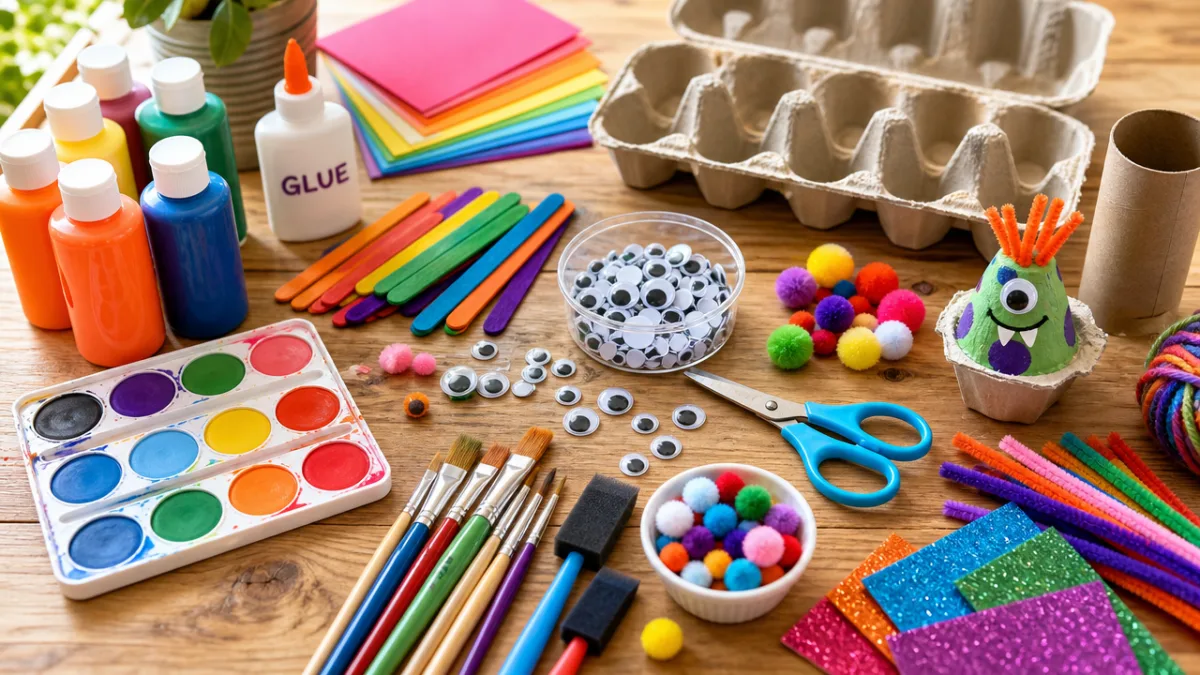
A little preparation goes a long way with egg carton crafts. Before you dive into any of these twenty-one projects, it’s worth getting your supplies organized and ready to go. For paint, tempera or acrylic are your best bets — both stick well to cardboard and dry quickly. A mix of foam and bristle brushes gives kids more options, and don’t forget a smock or old shirt to protect their clothes. When everything is within reach before you start, kids can focus on actually making things instead of hunting for scissors.
Glue is where things can get a little more nuanced. Regular white school glue is perfect for lightweight stuff like tissue paper and yarn, but it won’t do much for heavier embellishments. A low-temperature glue gun (adult-operated) handles googly eyes, wooden beads, and small stones without any drama. Double-sided tape is also handy for clean, invisible joins. Having all three on the table means you’re ready for whatever a project throws at you.
A good collection of embellishments is what really takes these crafts from “cute” to “wow.” It’s worth putting together a dedicated craft box so you’re never scrambling mid-project. Here’s what to keep stocked:
- Googly eyes in multiple sizes for animal and monster creations
- Pipe cleaners in assorted colors for legs, antennae, and tails
- Pom-poms in various sizes for noses, spots, and decorative accents
- Tissue paper, crepe paper, and cellophane for flowers and wings
- Feathers, sequins, and glitter for texture and sparkle
- Yarn and string for hair, tails, and hanging elements
- Wooden craft sticks and toothpicks for structural support
- Washable markers for adding fine details after painting
One thing worth paying attention to: scissors. Not all kids’ scissors are up to the job of cutting through the thicker ridged parts of an egg carton, and a pair that keeps slipping will frustrate even the most enthusiastic little crafter. Look for crafting scissors designed for kids — they tend to have sharper blades while still being safe. For younger children, a parent or older sibling can pre-cut the carton into individual cups or strips ahead of time, so the kids get straight to the fun part.
Animal-Themed Egg Carton Projects
Animal crafts are the most popular egg carton projects by a mile, and it’s not hard to see why. Those rounded little cups already look like the body of a ladybug, the face of an owl, or a segment of a caterpillar — you’re halfway there before you even pick up a paintbrush. The classic caterpillar, made from a strip of connected cups painted in alternating bright colors with pipe cleaner antennae and googly eyes up front, is usually the first egg carton craft kids ever try, and it never gets old.
Ladybugs are another great starting point, especially for younger kids who want to do most of it themselves. Paint a single cup red, let it dry, then add black dots with paint or a marker and glue on a small black circle for the head. Six pipe cleaner legs and a pair of googly eyes, and you’re done in under twenty minutes. Older kids love cutting the cup slightly to hint at wing separation — it’s a small touch that makes a big difference to how the finished bug looks. A handful of ladybugs arranged on green cardstock makes a display worth putting on the wall.
Once you’ve got the basics down, there’s plenty of room to get more ambitious. Butterflies come together when two cups are cut and shaped into wings and painted with bold, symmetrical patterns. Fish are surprisingly easy — just cut a cup so the pointed end becomes an open mouth. Owls work beautifully with two cups stacked together, the upper rim snipped into ear-tufts and a paper triangle beak tucked between the layers. If you’re throwing a birthday party or planning a classroom activity, a full egg carton zoo — where each child makes a different creature for a shared habitat — is a genuinely wonderful group project.
Flower and Garden-Themed Creations
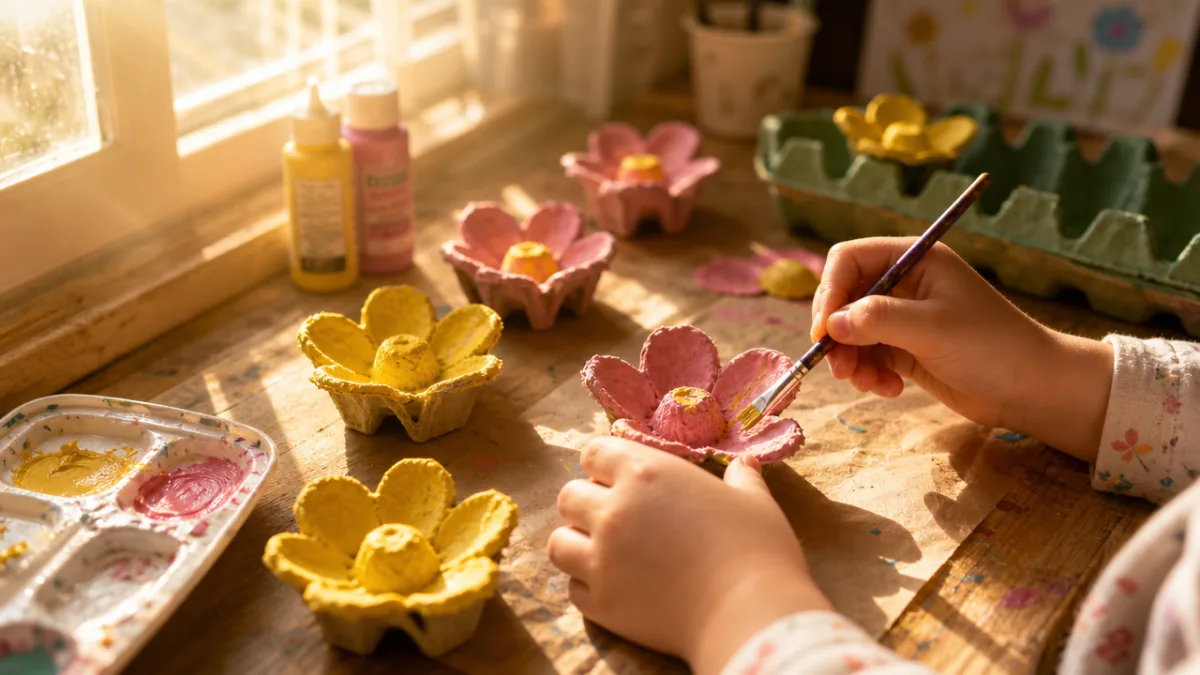
Here’s something most people don’t realize: egg cartons make incredible flowers. When you cut the rim of a single cup into petal shapes, it immediately starts to look like a bloom. Paint a batch in cheerful colors, stick them on green pipe cleaner or wooden dowel stems, and you’ve got a bouquet that will outlast any bunch from the grocery store. Plenty of parents have reported these little crafted flowers holding a spot on the kitchen windowsill for months — which says a lot about how much kids love making them.
Sunflowers are a step up in difficulty and a great challenge for older kids who want to push themselves a bit. Start with a cup painted brown or dark yellow for the center, then press small brown pom-poms or dried seeds into glue around the inside for texture. Cut long pointed petals from the golden sections between cups and glue them around the outside, and you’ve got something that genuinely looks like a sunflower. Pop it on a craft stick, anchor it in a small pot with dried beans or gravel, and it becomes a gift any grandparent would be thrilled to receive.
Garden scenes can grow well beyond flowers, too. Yellow-and-black striped bumblebees with tissue paper wings can hover over egg carton daffodils. A snail made from a single cup paired with a rolled cardstock shell looks surprisingly convincing inching across green felt. You can even add a garden pond — flat sections of carton painted blue, surrounded by cheerful frog characters perched on lily pad shapes. These little worlds naturally invite storytelling, which is one of the best things about them: kids don’t just make the scene, they start inventing the lives of the characters who live there.
Holiday and Seasonal Egg Carton Crafts
One of the nicest things about egg carton crafts is how naturally they follow the calendar. Every season and holiday has something that works, and because the materials cost next to nothing, you can make decorations without worrying about the budget. At Easter, painted egg cups can be strung on twine into a bunny banner or nestled in a basket with crinkled paper grass. A row of little yellow chicks with orange beak triangles and tiny cardboard wings marching across a mantelpiece is exactly the kind of homemade touch that makes a holiday feel warm and real.
Halloween is honestly where egg carton crafts really get to shine. Spiders made from a single black-painted cup with eight pipe cleaner legs threaded through holes in the sides can be hung at different lengths from a doorframe — spooky enough to be fun, but not the kind of thing that sends younger kids running. Orange cups with jack-o’-lantern faces cut into them, lit from behind with a battery-operated tea light, make a sweet and completely safe alternative to real carved pumpkins. And if you’re up for a multi-evening family project, turning an entire egg carton into a Halloween scene — one character per cup — is a genuinely fun way to build up to the big day.
Christmas brings its own wonderful possibilities. Homemade advent calendars made from two full cartons glued together, painted red and green and numbered one through twenty-four, have become a real favorite as a personal alternative to the expensive ones you find in stores. Wreaths assembled from cups cut into flower or star shapes, painted in mixed greens, and arranged in a ring on a cardboard base with a red bow look genuinely lovely on a front door. And angel ornaments — inverted cups with a toilet roll tube head, tissue paper wings, and a pipe cleaner halo — bring a handmade warmth to any tree that store-bought ornaments just can’t match.
Educational and STEM-Inspired Projects
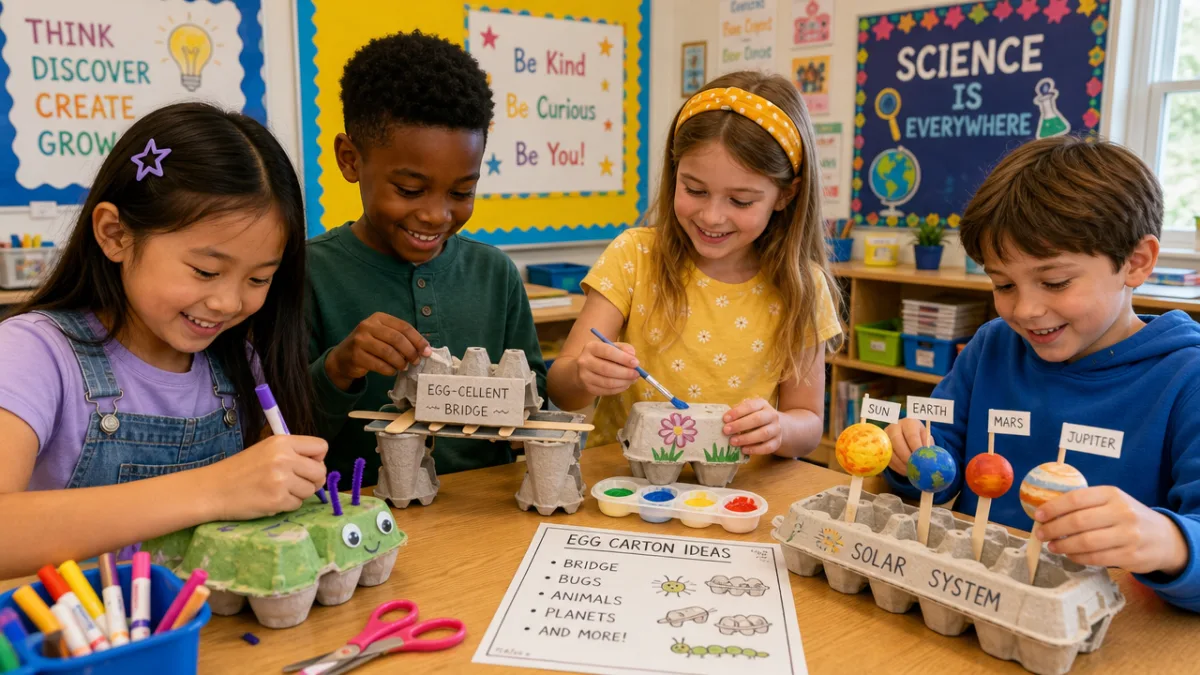
Egg cartons slide into educational settings surprisingly naturally. For homeschool families, after-school programs, or classroom teachers looking to make learning more hands-on, these projects offer a lot. Number recognition and basic counting, for instance, become genuinely engaging when kids are placing buttons or dried beans into numbered cups — the physical act of matching quantity to numeral helps concepts stick in a way a worksheet rarely manages. Color-sorting with pom-poms dropped into matching painted cups is another great one for younger kids building early math skills.
Older kids with a taste for science and engineering will find plenty to sink their teeth into as well. Building the tallest freestanding tower using only egg carton pieces and masking tape, or constructing a bridge strong enough to hold a set number of coins, puts engineering and physics concepts into immediate, tangible practice. These kinds of timed challenges work especially well at holiday clubs or birthday parties, where the friendly competitive element keeps energy high. And the post-build conversations — about why some structures held while others collapsed — open up vocabulary around stability, weight distribution, and how materials behave under pressure.
Egg cartons are also a natural fit for nature and environmental science topics. A butterfly lifecycle display, with different carton elements representing egg, caterpillar, chrysalis, and adult butterfly, makes for a memorable visual anchor to science curriculum content. Seed-starting experiments in individual cups filled with potting soil — watching germination happen over days and weeks — connect the craft table directly to plant biology. Best of all, when the seedlings are ready to go into the ground, the whole egg cup can go with them: the cardboard breaks down naturally in the soil, which brings the whole experience full circle in the most satisfying way.
Tips for a Successful Egg Carton Craft Session
Setup really does make or break a craft session. Laying down a washable tablecloth or a good layer of newspaper before any paint comes out saves the kind of grief that turns craft time into cleanup time. Water cups for rinsing brushes, paper towels for blotting, and a clear drying area where finished pieces can sit undisturbed — all of that small-scale organization makes the session run more smoothly than you’d expect. Kids with a tidy, well-organized workspace tend to stay focused longer and feel prouder of what they make.
Drying time is probably the most common frustration point, especially for younger kids who want to immediately stick googly eyes onto paint that’s still wet. The easiest fix is to split the session into two stages: paint first, then take a snack break or go outside, then come back for decorating. That waiting time stops feeling like an obstacle and becomes a natural pause in the process. Some families keep a stash of pre-painted cups ready to go — done during a previous session or while the kids are sleeping — so the decorating can start right away and the momentum never dips.
Finally, and maybe most importantly: make a genuine fuss over what they’ve made. Display it somewhere prominent, take a photo, or send it home to a grandparent. When kids see that their creative work is valued and appreciated, it reinforces that the process of making things matters — not just whether the result looks exactly like the picture. An egg carton caterpillar made by a four-year-old on a rainy Tuesday afternoon might not win any art prizes, but it represents something genuinely worth celebrating: a kid who’s discovered that making things with their own hands is one of the best feelings there is.








What do you think?
It is nice to know your opinion. Leave a comment.