










Aubrieta Flower: A Colorful Carpet for Your Garden
Introduction to Aubrieta: The Rock Garden Gem
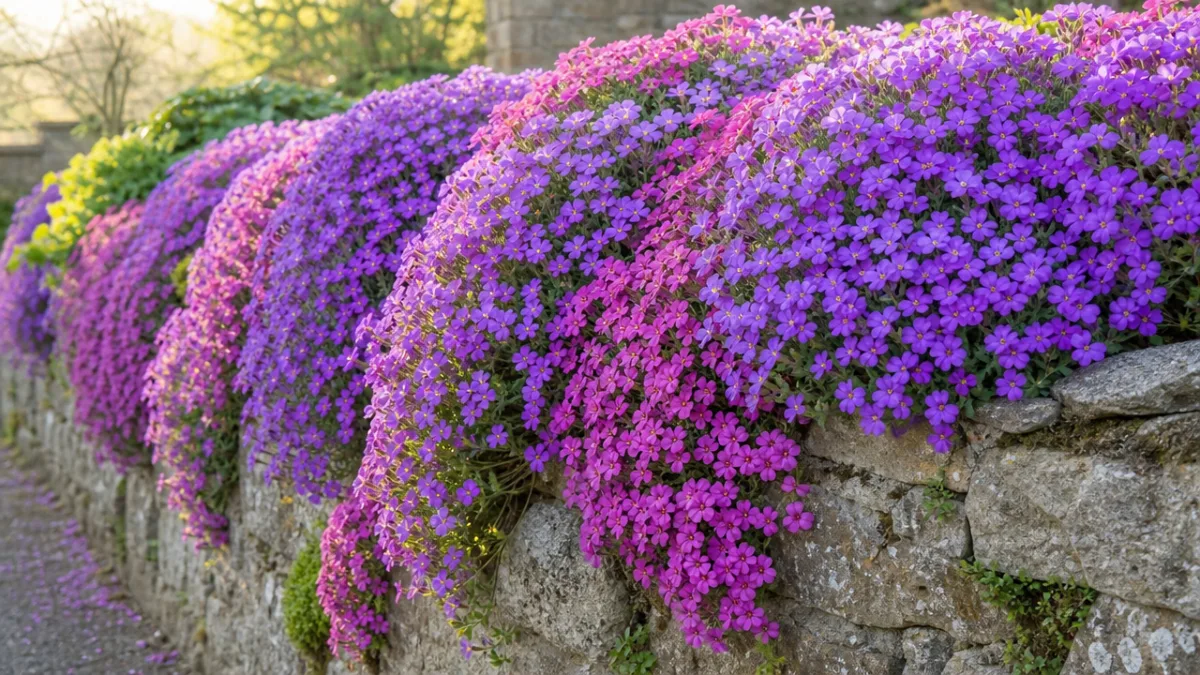
If you’ve ever walked past a garden wall absolutely smothered in purple and pink blooms in early spring and wondered what that plant was, chances are it was aubrieta. Also called rock cress or false rock cress, this cheerful little ground cover has been a staple of temperate gardens for centuries — and for good reason. It originally comes from the mountainous regions of southern Europe and southwestern Asia, and European gardeners have been putting it to work since the 1700s. Whether it’s tumbling over a dry stone wall, tucking itself between paving slabs, or blanketing a tricky slope, aubrieta has a way of making itself indispensable.
The name aubrieta is a tribute to Claude Aubriet, a French botanical illustrator who travelled through the Levant and Asia Minor in the early 1700s alongside botanist Joseph Pitton de Tournefort. Aubriet’s drawings brought a huge number of plant species to the attention of European science, and naming this vibrant flowering genus after him was a well-deserved honor. Today the genus contains around twelve species, though what most of us grow in our gardens are hybrids, usually sold under the names Aubrieta deltoidea or Aubrieta x cultorum.
What really sets aubrieta apart is how much it gives back for so little effort. It has a remarkably long blooming season and a real talent for transforming the kinds of garden spots that are otherwise hard to deal with — bare banks, awkward edges, gaps in walls — into something genuinely lovely. Gardeners of all skill levels tend to fall for it quickly, and it rarely lets them down.
Understanding Aubrieta’s Appearance and Varieties
Aubrieta stays low to the ground — typically between 5 and 15 centimeters tall — and spreads outward to form dense, soft cushions of foliage. The leaves are small, oval to spatula-shaped, and covered in fine hairs that give them a slightly grey-green, almost silvery look. It’s a lovely backdrop for the flowers, and the foliage stays semi-evergreen in most climates, so you get some ground-level interest through winter too.
When it blooms, it really goes for it. The flowers are small and four-petaled, but they come in such huge numbers that the foliage completely disappears beneath them at peak bloom. The color range in modern varieties is genuinely impressive: soft lavender and lilac, deep purple, rich magenta, cherry red, rose pink — and some cultivars have contrasting eyes or subtle veining that adds extra depth. If you want something a little more lush, double-flowered forms are widely available and look a bit like tiny roses scattered across the plant.
Some of the most popular cultivars you’ll come across include ‘Royal Blue,’ which has intense violet-blue flowers with a golden center; ‘Cascade Purple,’ known for its vigorous trailing habit and deeply saturated color; ‘Whitewell Gem,’ a reliable classic with violet-purple blooms and a great spreading habit; and ‘Bressingham Pink,’ which bears bright rose-pink double flowers. Several of these have earned the Royal Horticultural Society’s Award of Garden Merit, which is a solid sign they’ll perform well across a wide range of garden conditions.
Growing Conditions and Site Selection
Aubrieta likes conditions that echo its mountain origins — plenty of sun, sharp drainage, and soil that’s on the lean side rather than rich and fertile. This is where a lot of gardeners go wrong with it: they treat it too well. Soil that’s too rich tends to produce a lot of leafy growth and not many flowers, and the plant can end up floppy and more disease-prone. A gritty, free-draining mix suits it far better. If your soil is heavy clay, mixing in some horticultural grit or sharp sand before planting will make a real difference.
For location, aim for a spot that gets at least six hours of direct sun per day. Aubrieta will tolerate some shade, and in hotter climates a bit of afternoon shade can actually help, but the less light it gets, the fewer flowers you’ll see. South-facing walls, sunny slopes, raised beds, and rock gardens are all ideal. It’s also perfectly at home growing in the crevices of dry stone walls, where the drainage is excellent and the warmth from the stone closely mimics its natural rocky habitat.
It’s also worth thinking about soil pH. Aubrieta does best in neutral to slightly alkaline soil, ideally somewhere between 6.5 and 7.5. If your garden soil is on the acidic side, working in some garden lime or ground limestone before planting will help. Good air circulation matters too — it helps keep fungal diseases like powdery mildew at bay, which can become a nuisance in humid conditions or where plants are packed too tightly. Spacing plants around 30 to 45 centimeters apart gives them room to spread without crowding each other out.
Planting and Propagation Techniques
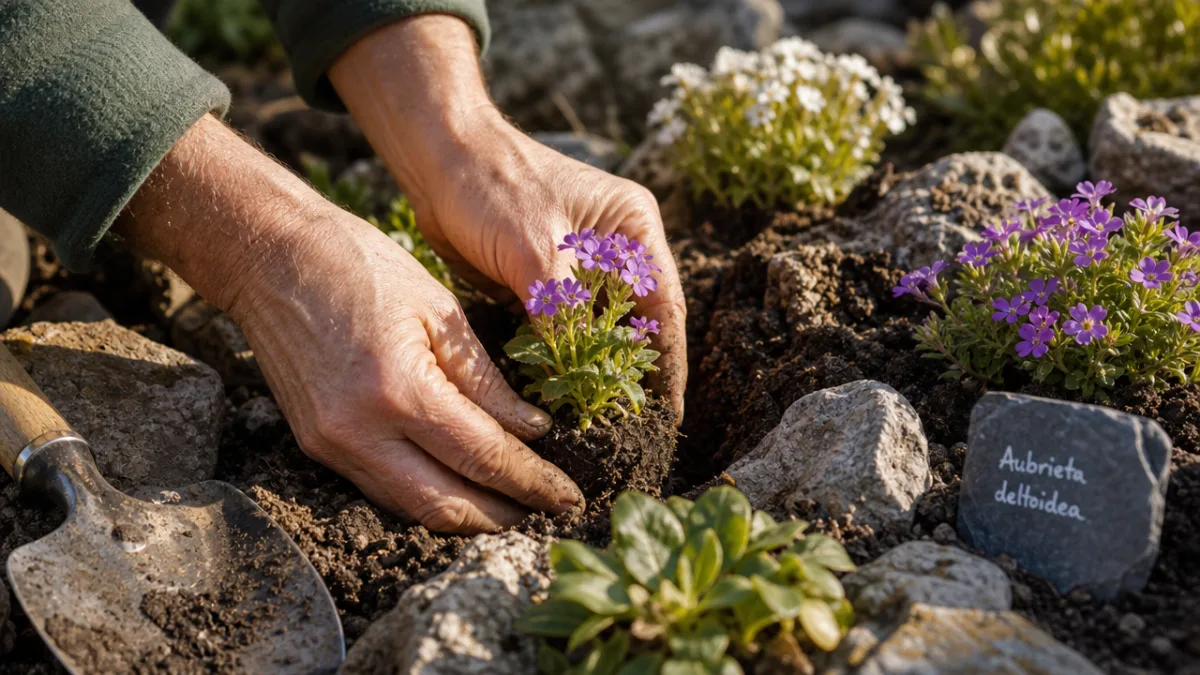
There are a few different ways to get aubrieta into your garden — seed, cuttings, division, or simply buying young plants from a nursery. Sowing from seed is the most budget-friendly option and isn’t particularly difficult, though it’s worth knowing that named cultivars usually don’t come true from seed, so you might end up with a range of flower colors rather than the specific variety you started with. Sow indoors or in a cold frame between late winter and early spring, or directly outdoors in late spring once the frost risk has passed. Germination usually takes two to three weeks at temperatures around 15 to 18 degrees Celsius.
If you want to be sure you’re getting an exact copy of a particular variety, cuttings are the way to go. Take soft or semi-ripe cuttings in late spring or early summer, once the main flush of flowers is over. Cut a piece about 7 to 10 centimeters long, strip the lower leaves, dip the base lightly in rooting hormone powder, and pop it into a mix of equal parts perlite and multipurpose compost. Keep the cuttings somewhere sheltered and partially shaded, water carefully without overdoing it, and you should see roots form within four to six weeks.
Division is another good option, and it has the added bonus of freshening up older plants that have started to go bare in the middle. Lift the whole plant carefully after flowering, split it into sections with a sharp knife or a couple of garden forks (making sure each piece has a decent root system), and replant straightaway at the right spacing. Water in well and keep things moist while they settle. Early autumn or early spring before new growth starts are the best times to do this, giving the divisions a chance to establish before the weather turns extreme in either direction.
- Seed sowing: Ideal for establishing large drifts economically; expect color variation in seedling batches.
- Stem cuttings: Best method for replicating named cultivars exactly; take in late spring after flowering.
- Division: Useful for rejuvenating older plants and expanding existing patches with identical plants.
- Nursery transplants: Quickest route to an established display; plant in spring or early autumn for best establishment.
Seasonal Care and Maintenance
Aubrieta has a well-earned reputation as an easy-going plant, but a little attention goes a long way in keeping it looking good year after year. The single most important thing you can do is cut it back hard once flowering is over in late spring or early summer. Take a pair of sharp shears and trim the whole plant back by roughly half to two-thirds of its height. It might feel drastic, but this is what keeps it from becoming woody and sprawling, encourages a fresh flush of compact new growth, and often prompts a second round of flowers later in the season.
Once it’s established in a well-draining spot, aubrieta is surprisingly drought-tolerant and doesn’t need much watering at all in most temperate climates. During a prolonged summer drought, a good deep watering now and then is helpful, but always let the soil dry out fully between waterings. Overwatering — or sitting in poorly draining soil — is actually a much bigger risk than drought, since the roots are quite vulnerable to rot in waterlogged conditions. Newly planted specimens will need more regular watering in their first season while they’re getting established.
Keep feeding simple: one application of a balanced, slow-release granular fertilizer in early spring is really all it needs. Steer clear of anything high in nitrogen, as that pushes leafy growth at the expense of flowers. In very sandy or poor soils, a light autumn mulch of well-rotted compost around the base can improve soil structure without making things too rich. Aubrieta doesn’t have many serious pest or disease issues, but it’s worth keeping an eye out for vine weevil grubs in the soil and for signs of downy mildew during humid spells.
Landscape Uses and Garden Design Ideas
Part of what makes aubrieta such a great garden plant is how many different things you can do with it. Its most iconic use — and there’s a reason it became iconic — is cascading over the top of a stone wall in a waterfall of spring color. Plant it along the edge of a dry stone retaining wall, let it spill down the face, and you’ve got one of those genuinely show-stopping spring moments that cottage gardens and Mediterranean-style landscapes are known for. Purple or magenta blooms against grey stone or warm honey-colored limestone is a combination that photographs beautifully and looks even better in person.
In rock gardens and alpine plantings, aubrieta is practically essential for the classic spring display. It sits beautifully alongside other early-season rockery plants like arabis, alyssum, iberis, phlox subulata, and saxifraga, building up a rich tapestry of color and texture at ground level. Planting it in drifts rather than as isolated specimens makes a far more natural and striking impression. The combination of deep purple aubrieta with the bright golden yellow of alyssum saxatile is a timeless pairing that never seems to get old — bold, energetic, and somehow completely at home in the garden.
Aubrieta has plenty of uses beyond the rock garden too. It’s great for stabilizing sloping ground, spreading quickly into a dense mat that holds soil in place and looks good doing it. It works well between paving slabs, softening hard landscaping and giving paths and patios a relaxed, romantic feel. In containers, hanging baskets, and window boxes, the trailing stems spill freely over the edges, creating a curtain of spring color that’s hard to beat on a balcony or terrace.
- Plant along the top of dry stone walls and allow to cascade dramatically downward for maximum visual impact.
- Use in rock gardens alongside Arabis, Alyssum, and Iberis for a classic alpine spring display.
- Grow between paving stones to soften hard landscaping and add informal charm.
- Use on sloping banks to control erosion while providing attractive seasonal color.
- Plant in containers, hanging baskets, or window boxes for trailing displays on patios and balconies.
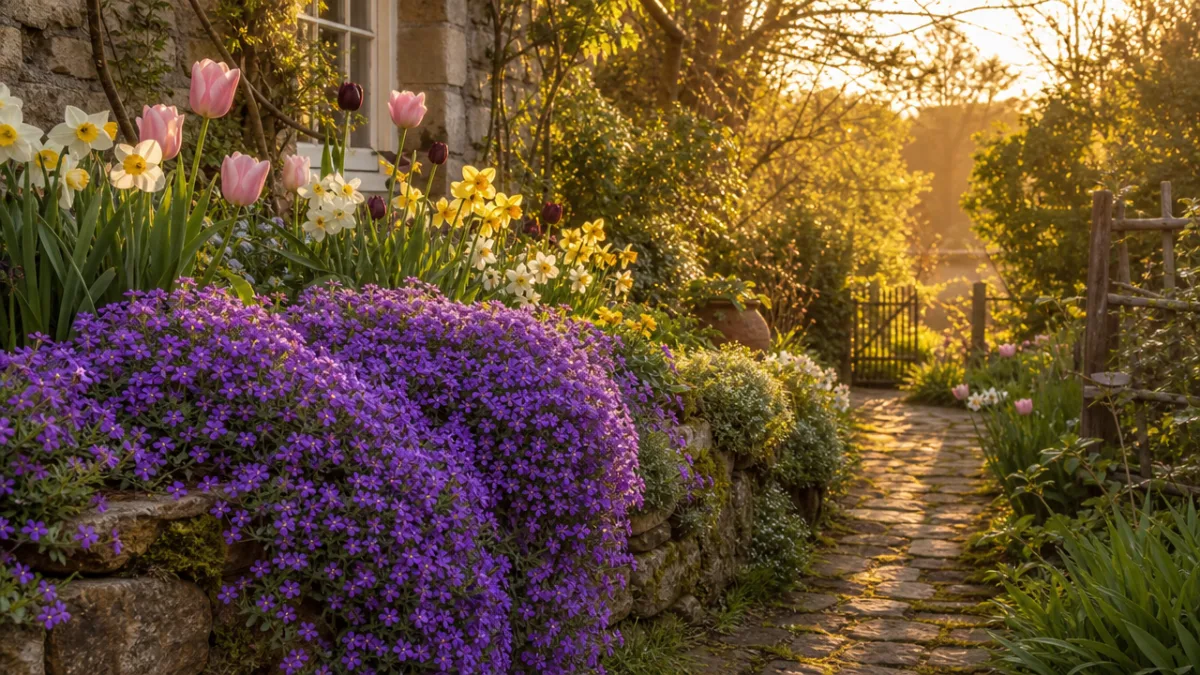
- Combine with spring bulbs such as tulips and narcissus for a layered, multi-season planting scheme.
Wildlife Benefits and Ecological Value
Aubrieta isn’t just good-looking — it’s genuinely useful for garden wildlife. It typically starts flowering in March and can keep going through to June, which makes it one of the most valuable early nectar sources available to pollinators coming out of winter. On any warm spring day, you’ll likely find honeybees, bumblebees, and various solitary bee species working their way across the flowers, stocking up on nectar at a time of year when there isn’t a huge amount else on offer in the garden.
Butterflies love it too. In gardens where aubrieta is planted generously, it’s quite common to spot several different species nectaring on the blooms in spring. Brimstone, peacock, small tortoiseshell, and orange tip butterflies are all regular visitors, and watching them settle on a carpet of purple flowers is one of those simple spring pleasures that makes gardening so worthwhile. Growing aubrieta is a straightforward, low-effort way to support local pollinator populations at exactly the time of year when they need food most.
There are broader ecological benefits too. The dense mat that aubrieta forms provides shelter for small invertebrates and beneficial insects at ground level, and its semi-evergreen foliage offers winter cover for overwintering species, including predatory beetles that help keep aphids and slugs under control naturally. When aubrieta is part of a diverse mixed planting scheme, it contributes to a well-balanced garden ecosystem that supports wildlife right through the year. It’s one of those cases where doing something that looks beautiful in the garden also turns out to be the right thing to do ecologically.
Common Problems and Troubleshooting
Aubrieta is a tough plant and doesn’t cause many headaches, but there are a few issues worth knowing about. Poor flowering is probably the most common complaint, and it almost always comes down to one of three things: not enough sun, soil that’s too rich, or forgetting to cut the plant back after it flowered the previous year. Fix whichever of those applies and you’ll typically see a big improvement the following season. Moving the plant to a sunnier spot, adding grit to improve drainage, or simply getting into the habit of trimming it back after flowering are all practical steps that really do make a difference.
Woody, sparse, or straggly growth is another thing that comes up, especially with older plants that haven’t been trimmed regularly. If aubrieta goes unpruned for a few years it tends to go bare and woody at the center, with flowers retreating to the outer edges. At that point, you have two options: cut it back really hard in late spring — removing up to two-thirds of the growth — and hope it rejuvenates, or take cuttings and divisions to raise fresh new plants and replace the old ones. Most gardeners find it much easier to just cut back promptly after flowering every year and avoid the problem altogether.
Fungal diseases like downy mildew and powdery mildew can occasionally show up, especially during humid weather or in spots with poor air circulation. You might notice a white powdery coating on the leaves, or yellowing and browning of the foliage. Thinning out crowded plants to improve airflow, avoiding overhead watering, and removing affected material usually keeps these issues manageable without reaching for chemical treatments. Root rot from waterlogged soil is more serious — once it takes hold there’s not much you can do to save the plant. The best approach is to make sure drainage is good from the start and replant in a better-prepared spot if needed.








What do you think?
It is nice to know your opinion. Leave a comment.