










Tiny Studio Living: The Complete Guide to Making the Most of Your Small Space
The Rise of Tiny Studio Living
Over the past decade, tiny studio apartments have transformed from a last resort for budget-conscious renters into a genuine lifestyle choice embraced by minimalists, urban dwellers, and design enthusiasts worldwide. What was once considered cramped and limiting is now celebrated as an opportunity for intentional living, where every square foot is purposeful and every object earns its place. The shift in perspective has been nothing short of revolutionary, driven by skyrocketing urban real estate prices, growing environmental consciousness, and a cultural movement away from the accumulation of excess.
Cities like New York, Tokyo, Hong Kong, and San Francisco have long been laboratories for compact living, producing innovations in furniture design, spatial planning, and interior aesthetics that have since influenced how people think about home across the globe. Architects and interior designers have poured creativity into these tight constraints, discovering that limitation often breeds ingenuity. The tiny studio has become a canvas for some of the most exciting residential design of the modern era, blending practicality with genuine beauty in ways that larger spaces rarely demand.
The demographic embracing tiny studio life is surprisingly diverse. Young professionals prizing city-center locations over square footage, empty nesters downsizing after decades in family homes, remote workers optimizing for travel flexibility, and environmentally motivated individuals reducing their footprint all find common ground in the compact apartment. Understanding the principles that make a tiny studio feel livable, even luxurious, starts with accepting a fundamental truth: a small space well-designed will always outperform a large space treated carelessly.
Smart Furniture Choices That Transform Small Spaces
The furniture you choose for a tiny studio is arguably the single most important design decision you will make. In a space where every inch counts, a poorly scaled sofa or an oversized dining table can render an entire room dysfunctional. The guiding principle is to seek out pieces that serve multiple purposes simultaneously, doing the work of two or three conventional items while occupying the footprint of one. This philosophy, sometimes called multifunctionality, is the cornerstone of successful compact living and has inspired an entire industry of clever, convertible furniture solutions.
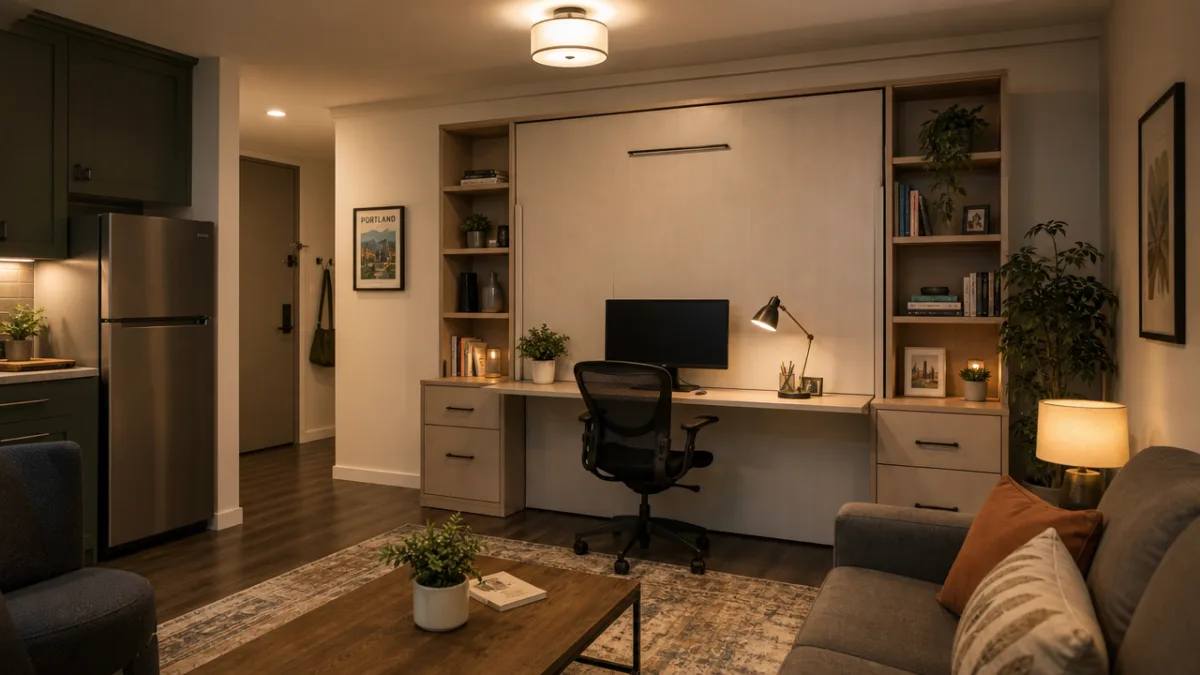
Murphy beds, also known as wall beds, remain the most transformative single investment a studio dweller can make. A quality Murphy bed system can convert a sleeping area into a fully functional home office, workout space, or living room in under thirty seconds, effectively doubling the usable area of your studio during waking hours. Modern Murphy bed designs have evolved far beyond the utilitarian fold-down cot of decades past. Today’s options integrate built-in shelving, integrated lighting, hidden cable management, and even fold-out desks that remain set up when the bed is raised, making the transition seamless and the functionality continuous.
Beyond the Murphy bed, consider these essential furniture categories for tiny studio success:
- Extendable dining tables that seat two for daily use and expand to seat six for entertaining, folding neatly against the wall when not in use
- Ottoman storage cubes that serve as coffee tables, extra seating, and hidden storage compartments for blankets, books, or seasonal items
- Nesting side tables that tuck underneath one another to free floor space when only one surface is needed
- Lift-top coffee tables with concealed storage compartments that rise to dining or work height at the push of a lever
- Modular shelving systems that reconfigure as your needs change, growing vertically to maximize wall height rather than floor space
- Sofa beds with quality mattresses for studios that occasionally host overnight guests without sacrificing daily comfort
Proportion matters as much as function. A tiny studio benefits from furniture with slender legs rather than solid bases, as visible floor space creates the visual impression of a larger room. Glass and acrylic surfaces for coffee tables or dining tables allow light to pass through unobstructed, preventing the visual heaviness that makes small rooms feel cluttered. Choosing a cohesive palette for your furniture, sticking to two or three complementary materials such as warm wood, white lacquer, and brushed metal, creates visual calm that makes even the smallest studio feel curated and intentional rather than chaotic.
Color, Light, and Visual Expansion Techniques
Color is one of the most powerful and most accessible tools available to the tiny studio resident. The conventional wisdom has long been to paint everything white, and while an all-white palette does maximize the sense of airiness, the conversation around color in small spaces has grown considerably more nuanced. The goal is not necessarily whiteness but rather visual coherence and the strategic management of contrast. A studio painted in a single deep tone, where walls, ceiling, trim, and even doors share the same color, can paradoxically feel more spacious than one with multiple competing shades, because the eye cannot detect where one surface ends and another begins.
Natural light is the single greatest asset a tiny studio can possess and should be protected at almost any cost. Avoid window treatments that block or obstruct daylight during waking hours. Instead, opt for sheer linen panels that filter harsh midday sun while maintaining luminosity, or cellular shades that insulate without sacrificing light when raised. Keep windowsills clear of objects that cast shadows inward. Mirrors placed directly opposite windows reflect natural light deep into the room, creating the effect of an additional light source and visually doubling the apparent size of the space. A large mirror leaning against a wall and angled slightly toward a window is one of the most effective and inexpensive tricks in compact interior design.
Artificial lighting deserves equal attention because most studio residents spend a significant portion of their waking hours at home after dark. A single overhead fixture is almost always insufficient and creates a flat, uninspiring quality that makes small rooms feel smaller. Instead, layer your lighting with multiple sources at varying heights: recessed ceiling lights on a dimmer for general illumination, table or floor lamps that create warm pools of light for reading or relaxing, and accent lighting such as LED strip lights under shelving or inside cabinets that adds depth and dimension. This layered approach makes a tiny studio feel atmospheric and intentional rather than institutional.
Beyond mirrors and layered lighting, several additional techniques help expand the visual boundaries of a small space. Vertical lines draw the eye upward, making ceilings feel taller, so consider floor-to-ceiling curtains hung from ceiling-mounted rods, tall bookshelves that stop just short of the ceiling, or a vertical tile or wallpaper pattern on a feature wall. Keeping pathways clear and maintaining at least one unobstructed sightline from the entrance to the far wall of the studio creates an immediate sense of openness upon entering. Clutter, even small amounts of it, visually compresses a tiny space with startling speed, making disciplined editing of possessions one of the most effective design tools of all.
Zone Creation: Making One Room Feel Like Many
The psychological challenge of studio living is that you are simultaneously occupying your bedroom, living room, dining room, and office within a single visual field. Without thoughtful zone creation, this ambiguity erodes the sense of rest in the bedroom area and the sense of focus in the work area. The good news is that zones do not require walls. They can be created through furniture arrangement, changes in flooring material or rugs, lighting differentiation, ceiling treatments, and even color variations, all without altering a single structural element of the apartment.
Area rugs are among the simplest and most effective zoning tools available. A large rug anchoring a sofa and coffee table clearly defines the living area, while a separate smaller rug under a desk and chair designates the workspace, even when these zones are only a few feet apart. The texture, pattern, and color of each rug can reinforce the function of its zone, a soft, plush rug for the living area suggesting comfort and relaxation, a flat-weave or sisal rug in the work area suggesting focus and functionality. When budget allows, using two distinct flooring materials, wood for living areas and a contrasting tile for the kitchen zone, achieves the clearest possible separation without construction.
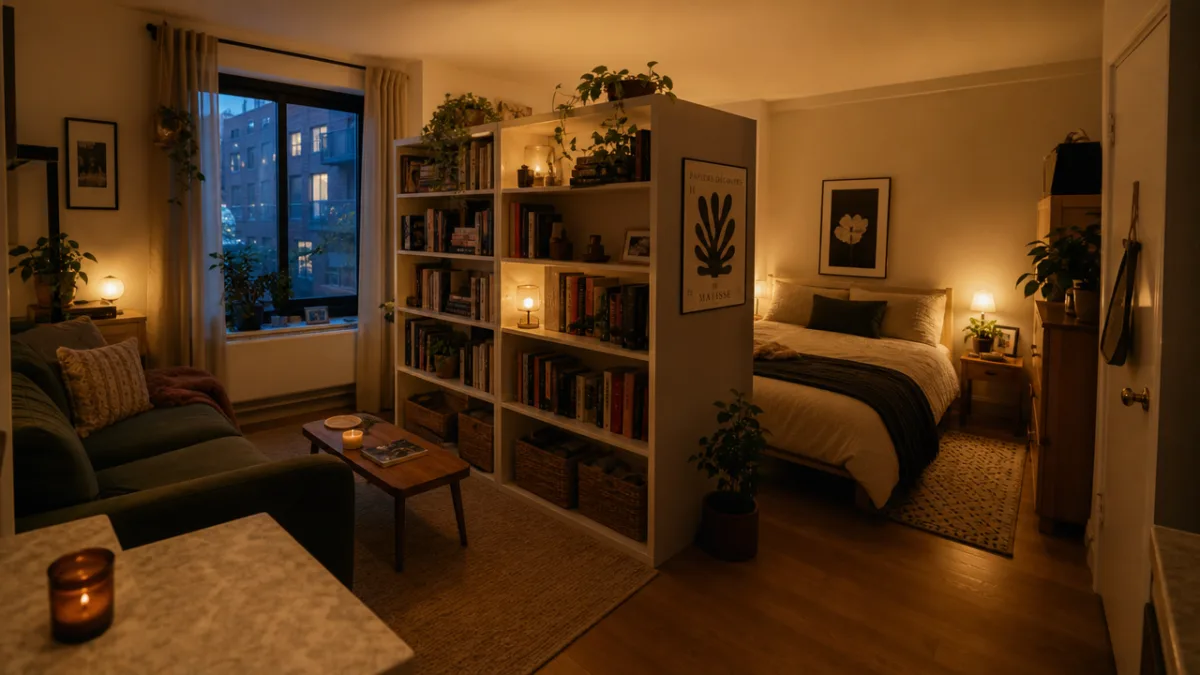
Room dividers offer a more substantial form of zone separation while remaining completely reversible. Open shelving units used as room dividers serve the dual purpose of creating a visual boundary and providing storage or display space on both sides. A bookshelf placed perpendicular to a wall, separating the sleeping area from the living area, can hold books on one side and display objects on the other, functioning beautifully in both zones. Curtain dividers suspended from ceiling-mounted tracks allow you to close off the sleeping area entirely when guests are present or open it completely during the day to maximize the feeling of space. Translucent curtains strike an ideal balance, suggesting separation while allowing light to pass freely between zones.
Consider also using ceiling differentiation to reinforce zones in a tiny studio. A canopy effect created by hanging sheer fabric above the bed area, or by painting the ceiling above the sleeping zone a slightly warmer tone than the rest of the apartment, gives the bedroom its own distinct character without any physical barrier at floor level. Similarly, a pendant light hung lower than surrounding fixtures over a small dining table signals that this spot is for gathering and eating, not working or watching television. These subtle cues are read intuitively by the human brain and go a long way toward making a studio feel like a multi-room home rather than a single undifferentiated space.
Storage Solutions That Disappear Into the Design
Storage in a tiny studio cannot be an afterthought. It must be woven into the architecture of the space from the very beginning, integrated so thoroughly that it becomes invisible as storage and simply reads as design. The objective is to eliminate visual clutter entirely while ensuring that every item you own has a designated home that is accessible and logical. Achieving this requires thinking beyond the conventional freestanding wardrobe or chest of drawers and looking instead at every surface, cavity, and structural opportunity the studio offers.
Vertical real estate is almost always underutilized in small apartments. Floor-to-ceiling built-in cabinetry along a single wall can house an entire household worth of belongings, from clothing and linens to kitchen supplies and electronics, while presenting a uniform, seamless facade to the room. When built-in cabinetry is not an option, installing open floating shelves from counter height all the way to the ceiling on a kitchen wall, or running a continuous shelf around the perimeter of the room at picture-rail height, creates enormous additional storage capacity without consuming any floor space. The key to making high shelving work visually is to store less-frequently needed items at the top in uniform, attractive boxes or baskets that maintain a clean line.
Underbed storage is one of the most valuable and most overlooked resources in a studio apartment. A bed frame elevated on legs or raised on risers creates substantial storage space for seasonal clothing, extra bedding, luggage, or archived documents, all hidden from view and entirely out of the way. Shallow rolling drawers designed specifically for under-bed storage can hold a surprising volume of clothing and can be accessed with minimal effort. If you choose a platform bed with built-in drawers, you can eliminate an entire wardrobe or chest of drawers from your floor plan, freeing that space for living rather than storing.
- Entryway storage: Install hooks, a slim bench with compartments underneath, and a wall-mounted shelf near the front door to catch keys, bags, shoes, and outerwear before they migrate into the living area and create clutter
- Kitchen cabinet doors: Mount magazine racks, spice organizers, or cleaning supply holders on the interior of cabinet doors to double cabinet storage capacity without adding a single inch to the kitchen’s footprint
- Bathroom walls: In even the tiniest bathroom, vertical shelving above the toilet and a recessed medicine cabinet built into the wall between studs can hold a remarkable quantity of toiletries and linens
- Furniture cavities: Choose a dining bench with a hinged lid over individual chairs, a coffee table with drawers over a solid base, and an upholstered headboard with built-in shelving over a blank panel
The discipline of regular editing is inseparable from successful small-space storage. No matter how clever your storage solutions, a tiny studio will feel overcrowded if you attempt to store more objects than the space is designed to hold. Many seasoned studio dwellers adopt a one-in, one-out rule, committing to donating or discarding one item whenever a new one enters the home. This practice keeps possessions at a sustainable level and ensures that the thoughtful storage systems you have invested in continue to function without becoming overwhelmed. The result is a home that feels calm and curated at all times, never one delivery box away from chaos.
Personalizing Your Tiny Studio Without Creating Visual Noise
The most common fear among those transitioning to tiny studio living is that the space constraints will force them to sacrifice personality, warmth, and self-expression in favor of cold minimalist functionality. This fear is understandable but unfounded. A thoughtfully personalized tiny studio can feel more alive and more genuinely reflective of its inhabitant than a larger apartment decorated haphazardly over time. The difference lies in the approach: instead of accumulating decorative objects casually, the studio dweller curates deliberately, choosing fewer pieces with greater intentionality and allowing each one to carry more visual weight.
A single large piece of art on a primary wall makes a far stronger and more cohesive statement than a scattered gallery wall of smaller frames in a tiny studio context. The large artwork anchors the space, gives the eye a destination, and creates the impression that the room was designed around it with confidence. Choose artwork that incorporates colors present elsewhere in the room to create visual harmony, or deliberately select a piece that introduces a single accent color not found elsewhere as a controlled pop of energy. The scale of the art should surprise slightly, slightly larger than instinct suggests, because in small rooms, people consistently underestimate how large wall art should be.
Textiles are the warmth-givers of any space but become especially important in a tiny studio, where they carry enormous responsibility for making the room feel livable and human rather than like a showroom. Layering throws, cushions, and rugs in complementary textures, velvet alongside linen, chunky knit alongside smooth cotton, creates tactile richness that elevates even simple furnishings. Changing textiles seasonally is also one of the easiest and most affordable ways to refresh the feeling of a studio without any significant effort, swapping heavy woven blankets and deep-toned cushions in winter for lightweight linen and soft neutrals in summer.
Plants bring life, color, and a dynamic quality to tiny studios that no inanimate object can replicate. A single statement plant, a large fiddle-leaf fig in a sculptural ceramic pot, a trailing pothos cascading from a high shelf, or a cluster of succulents on a sunny windowsill, adds organic warmth and filters indoor air simultaneously. For the space-conscious studio dweller, hanging planters, magnetic wall-mounted planters, and shelf-integrated plant displays keep greenery at eye level or above without consuming precious surface or floor space. Even a modest investment in plants consistently rates among the most impactful and most affordable changes studio residents report making to their homes.
Finally, scent and sound are often overlooked dimensions of personalizing a tiny studio but contribute profoundly to how the space feels during daily life. A signature candle or diffuser blend that you associate with relaxation and home makes the studio feel like a sanctuary the moment you walk through the door. A small but quality speaker system filling the space with music or ambient sound transforms the emotional quality of the air itself. In a tiny studio, where every sensory experience is concentrated by the compact surroundings, these subtle touches carry an outsized impact, turning a small apartment into a richly personal world that feels, against all spatial logic, genuinely expansive.








What do you think?
It is nice to know your opinion. Leave a comment.