










Home Media Room Ideas for Records & Film Collectors
Designing the Foundation: Choosing the Right Space
If you’re serious about building a dedicated space for your records and film collection, the first decision — and honestly one of the most important — is picking the right room. Basements and spare bedrooms tend to work best. They’re naturally more isolated from the noise and foot traffic of the rest of the house, and you have real control over the environment. That matters both for your listening experience and for keeping your collection in good shape over the long haul.
Before you settle on a room, pay attention to the dimensions. Both record players and film projectors benefit from a space with some depth to it — something at least 12 by 15 feet gives you enough room to position seating properly relative to your screen and speakers. Rooms that are nearly square tend to create standing waves, which muddies the sound in ways that even a great turntable setup can’t fully overcome. A slightly rectangular room is what most audiophiles are after when they want vinyl to sound the way it should.
Don’t overlook light control, either — it’s something a lot of collectors underestimate until they’re stuck retrofitting later. Film watching really does call for near-total darkness if you want that true cinematic feel, and direct sunlight is genuinely bad for records, warping them over time in ways you can’t undo. Blackout curtains or motorized blinds are worth putting in from the start. It helps to think of this room as two things at once: a sanctuary where you actually enjoy your collection, and a controlled environment where that collection stays safe for years to come.
Acoustic Treatment: Making Your Room Sound as Good as It Looks
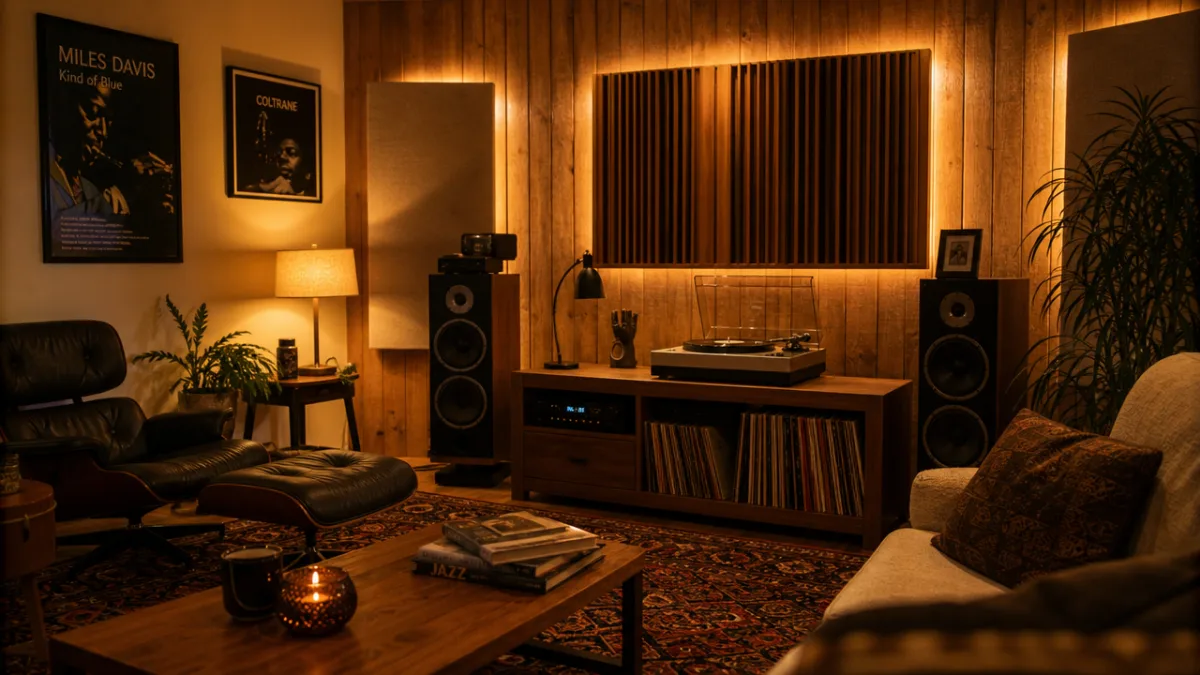
If there’s one upgrade that will make the single biggest difference in a vinyl listening room, it’s acoustic treatment — and it’s not even close. An untreated room is full of hard surfaces that bounce sound around unpredictably, leaving you with muddy bass and unwanted echoes that undercut even a really expensive turntable setup. Acoustic panels, bass traps, and diffusers each do different jobs, but together they clean up the room in a way that makes your records sound the way they were meant to.
Bass traps go in the corners, where low frequencies pile up and turn into that boomy, indistinct sound that drives audiophiles crazy. You can buy commercial foam or fiberglass traps, or build your own with rigid rockwool wrapped in acoustically transparent fabric — the DIY route lets you match the look of the rest of your room, so the treatment feels like part of the design rather than an afterthought. Custom panels can sit right alongside your record shelves and vintage film posters without looking out of place.
Diffusion panels are just as important as absorption, even though they get less attention. Where absorptive panels quiet down reflections, diffusers scatter them, and that scattering is what preserves the sense of space and air in the room — the quality that makes a great record feel like you’re in the room with the musicians. A common approach that works really well is diffusers on the rear wall behind the listening position, with absorptive panels on the side walls. A lot of collectors describe this combination as transformative: the room stops fighting the music and starts letting you actually hear it.
Record Storage and Display: Form Meets Function
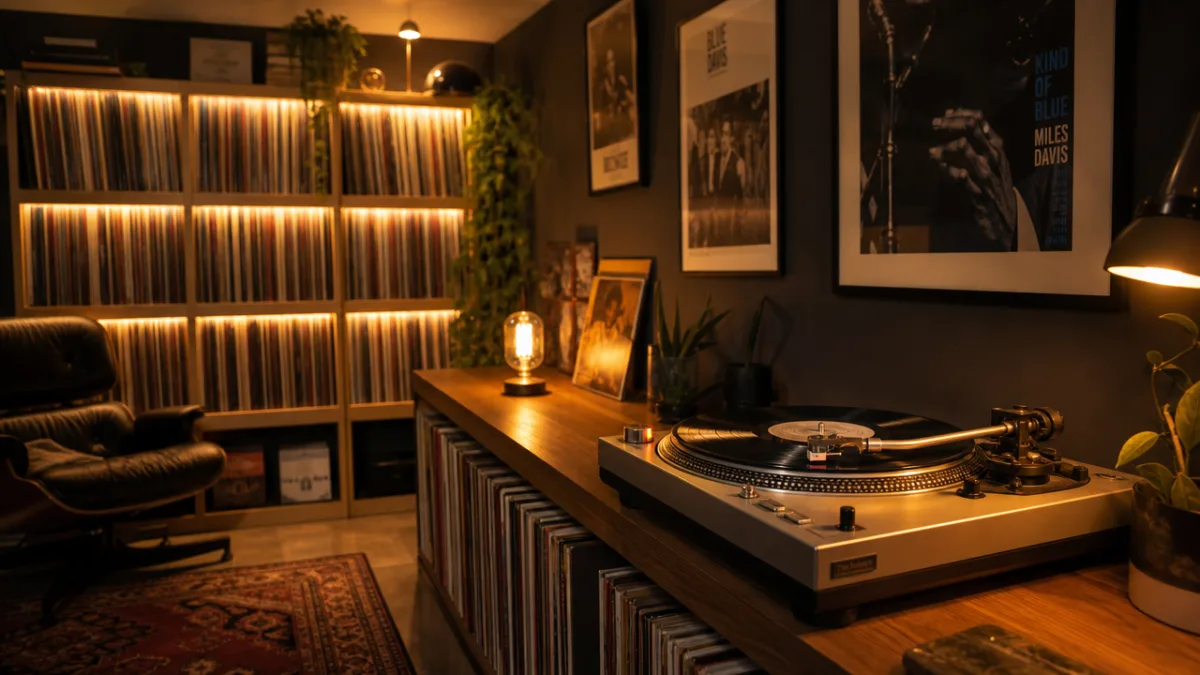
The way you store and display your vinyl collection reveals a lot about who you are as a collector — but beyond aesthetics, it matters practically. Records stored the wrong way warp, collect dust, and degrade in ways you can’t reverse. The foundational rule is simple: always store them vertically, never stacked flat, in a room where the temperature stays between 60 and 70 degrees Fahrenheit and humidity hovers around 40 to 50 percent. Get those conditions right and your collection will hold up for decades.
Custom-built shelving gives you the most flexibility and can look exactly the way you want it to. Open-faced wood shelving with cubbies around 13 inches square fits standard LP sleeves perfectly, makes browsing easy, and turns the whole wall into a living display. Many collectors skip strict alphabetical order in favor of something more personal — a jazz section that flows naturally into soul and funk, or a chronological run through a favorite artist’s entire output. The shelf becomes a kind of visual autobiography that tells a story even before you pull anything out to play.
For records that really mean something to you, wall-mounted vinyl display frames are an elegant option. They let you swap out featured albums whenever the mood strikes, turning part of your wall into a rotating gallery. Mix those in with vintage film lobby cards or original movie posters and the two sides of your collection start to feel like one coherent space. The result is a room that communicates who you are as a collector before anyone drops a needle or starts a projector.
Film Equipment and Projection Setup: Building Your Personal Cinema
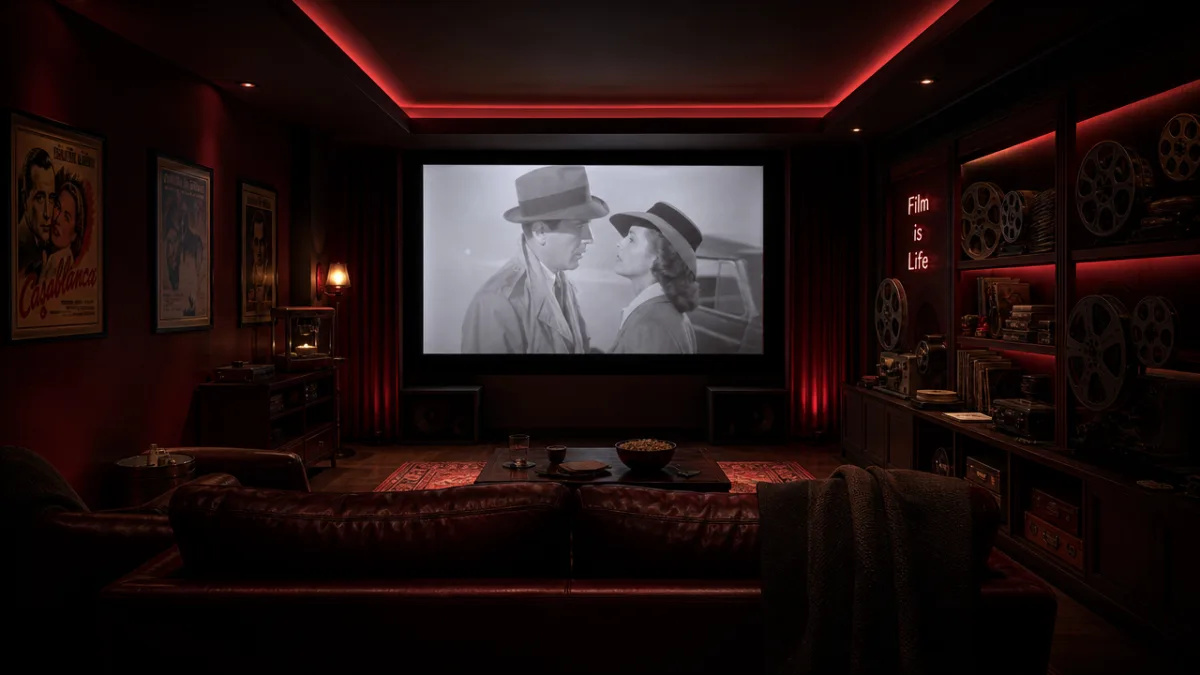
For the film collector, the projection setup is really the heart of everything. Whether you’re working with 8mm home movies, 16mm art films, or 35mm prints — or building a digital home theater around Blu-ray and 4K — the fundamentals of great projection stay the same. Throw distance, screen gain, and how well your setup handles ambient light all need to match your specific projector and room dimensions. Get those relationships right and you end up with an image that can genuinely rival a commercial cinema.
Screen selection trips up a lot of people who are new to home cinema. A quality fixed-frame screen with the right gain rating for your projector will outperform a painted wall or a basic pull-down screen by a noticeable margin. If your room has any residual light, screens with ambient light rejection (ALR) properties keep contrast and color looking good even when conditions aren’t perfectly dark. Pair that with a projector that can deliver at least 2,000 lumens on a 100-inch image and you have a genuinely solid foundation for a cinematic experience at home.
If you’re working with analog formats, carve out a section of the room specifically for your projection equipment with ventilation and fire safety in mind. Vintage 16mm and 35mm projectors run hot and need real airflow to operate safely — a rear projection booth or a well-ventilated projector shelf keeps your equipment accessible and manages that heat. The challenge is making that technical infrastructure feel warm rather than clinical, and the answer is usually the materials around it: wood, leather, and carefully chosen collectibles that keep the space feeling like a collector’s retreat rather than a rack room.
Seating and Layout: Comfort Designed for Long Sessions
When you finally find the record or film you want to lose yourself in for the next hour or two, an uncomfortable chair becomes a real problem. A serious collector’s media room needs to support long sessions properly. For stereo audio, the sweet spot sits equidistant from both speakers in an equilateral triangle arrangement. For a 100-inch screen, you’re typically looking at 10 to 15 feet of viewing distance depending on resolution. Building your seating layout around those acoustic and optical ideals means every session actually delivers what it’s capable of.
Most collectors set up one primary listening chair at the sweet spot, with secondary seating nearby for guests. A deep, high-backed armchair or a small sofa in leather or a fabric that doesn’t generate static — static is bad news for records — makes a great centerpiece. Low side tables within easy reach keep a drink and a set of liner notes handy without cluttering the space visually. In larger rooms where film viewing is a priority, tiered seating on a raised platform at the back ensures everyone has a clear sightline to the screen, which starts to feel genuinely like a small private theater.
Think about how the room flows, not just how individual pieces of furniture look. A collector’s media room needs to support the ritual of browsing — flipping through albums, reading liner notes, looking over film canisters or physical media packaging. That means open floor space in front of your shelving, with a stool or ottoman close by to sit on while you dig. The best media rooms feel like they’re inviting you to explore, not like a museum where everything’s behind glass. A layout that encourages hands-on engagement with your collection makes the whole space feel alive.
Lighting Design: Setting the Mood for Every Session
Lighting in a collector’s media room has to pull off a few things at once. It needs to be practical enough that you can handle and browse records and film prints without squinting, atmospheric enough to enhance whatever you’re watching or listening to, and easy to shift between those two modes without any fuss. A layered setup — ambient, task, and accent lighting on separate dimmers — gives you that flexibility and puts you in control of the room’s mood at any moment.
Warm-toned LEDs in the 2700 to 3000 Kelvin range are the go-to for most collectors. That warmth flatters wood shelving, vinyl sleeves, and vintage movie posters in a way that cooler light simply doesn’t, and it keeps the room feeling inviting rather than clinical. Recessed ceiling lighting handles general illumination without competing with your projection screen, while LED strips tucked behind record shelving create a beautiful backlit glow that highlights the collection and adds real depth to the room once the sun goes down. Small picture lights or directional spotlights can pick out framed records or film memorabilia and treat them with the same care you’d give gallery art.
For film watching, a smart lighting system that takes everything down to near-zero with a single tap is genuinely worth the investment. If you add motorized shades that sync with your lighting controller, a single button press closes the blinds and dims the lights as the projector warms up — a small luxury, but one that reinforces the sense of ceremony that serious film collectors are really after. When the act of dropping a needle or starting a projector feels like a ritual rather than just pressing play, the whole room takes on a different quality, and lighting is one of the biggest contributors to that feeling.
Finishing Touches: Making the Space Uniquely Yours
What separates a well-designed media room from one that feels genuinely personal is the layer of objects, artwork, and collected things that reflect your specific history with music and film. Original movie posters — especially from the films that shaped your taste or from cinema’s golden age — bring color and drama to the walls in a way that’s hard to replicate. Framed album artwork from records that actually meant something to you occupies that same territory. These aren’t decorations in the usual sense; they’re autobiographical. They tell people something true about who you are before anyone sits down.
Vintage equipment displayed thoughtfully adds tremendous character to a room like this. A retired turntable on an open shelf, a reel-to-reel deck used as a sculptural object, a grouping of antique film cameras on a sideboard — all of it communicates a relationship with the medium that goes beyond passive consumption. These pieces invite questions and open up conversations, turning the room into something social where the stories behind the collection become part of what it feels like to be in the space.
Then there are the smaller, tactile details that make a room feel truly considered. A record cleaning station near the turntable — a good brush, clean inner sleeves, an anti-static mat — makes proper care feel like a natural part of every session rather than a chore. A curated stack of film reference books and music writing on a low shelf invites reading between records. A small tray with a candle or a subtle diffuser adds a sensory note that quietly signals this is a retreat, not just a room with equipment in it. The truth is, a collector’s media room isn’t really finished when the last panel goes up or the last cable gets routed. It’s finished when every object has been considered and everything in the room has genuinely earned its place.
- Use high-quality interconnect cables and speaker wire to protect audio signal integrity between components.
- Label your film canisters and record sleeves consistently so browsing your collection is effortless even years after acquisition.
- Invest in a quality power conditioner to protect sensitive electronics and eliminate noise introduced by the electrical grid.
- Keep a logbook of listening and viewing sessions to track your impressions of records and films over time as your taste and equipment evolve.
- Revisit your acoustic treatment periodically as your furniture arrangement changes, since even minor adjustments can alter room acoustics significantly.








What do you think?
It is nice to know your opinion. Leave a comment.