










Cozy Boho Home: Easy DIY Decor Ideas to Transform Your Space
What Is Boho Style and Why Everyone Is Falling in Love With It
Bohemian design, affectionately known as “boho,” is one of the most beloved and enduring interior design styles of our time. Rooted in the free-spirited aesthetic of artists, travelers, and creatives of the 19th and 20th centuries, boho style celebrates personal expression, cultural richness, and an unapologetic love of texture, color, and handcrafted beauty. Unlike rigid design philosophies that demand matching sets and pristine order, boho invites you to collect, layer, and tell a story through your space. It is a style that feels lived in, loved, and deeply personal.
What makes boho design particularly compelling right now is its remarkable versatility. Whether you live in a sprawling farmhouse, a compact urban apartment, or a cozy studio, boho elements can be woven into any environment without requiring a complete overhaul. The style encourages you to start with what you already own and build outward, incorporating natural materials, vintage finds, and handmade pieces over time. This slow, intentional approach to decorating feels refreshing in a world of fast furniture and disposable trends. Boho is inherently sustainable because it celebrates the old, the repaired, and the reimagined.
The “cozy boho” variation, sometimes called “cozy bohemian” or “boho hygge,” blends the warmth and comfort of Scandinavian hygge philosophy with the eclectic richness of bohemian design. The result is a home that feels like a warm embrace — layered with soft blankets, glowing candlelight, trailing plants, woven textiles, and meaningful objects gathered from years of living and exploring. It prioritizes emotional comfort just as much as visual beauty, making it the perfect style for anyone who wants their home to truly feel like a sanctuary. The best part? Most of these elements can be created yourself at very little cost.
Gathering Your Materials: The Boho DIY Toolkit
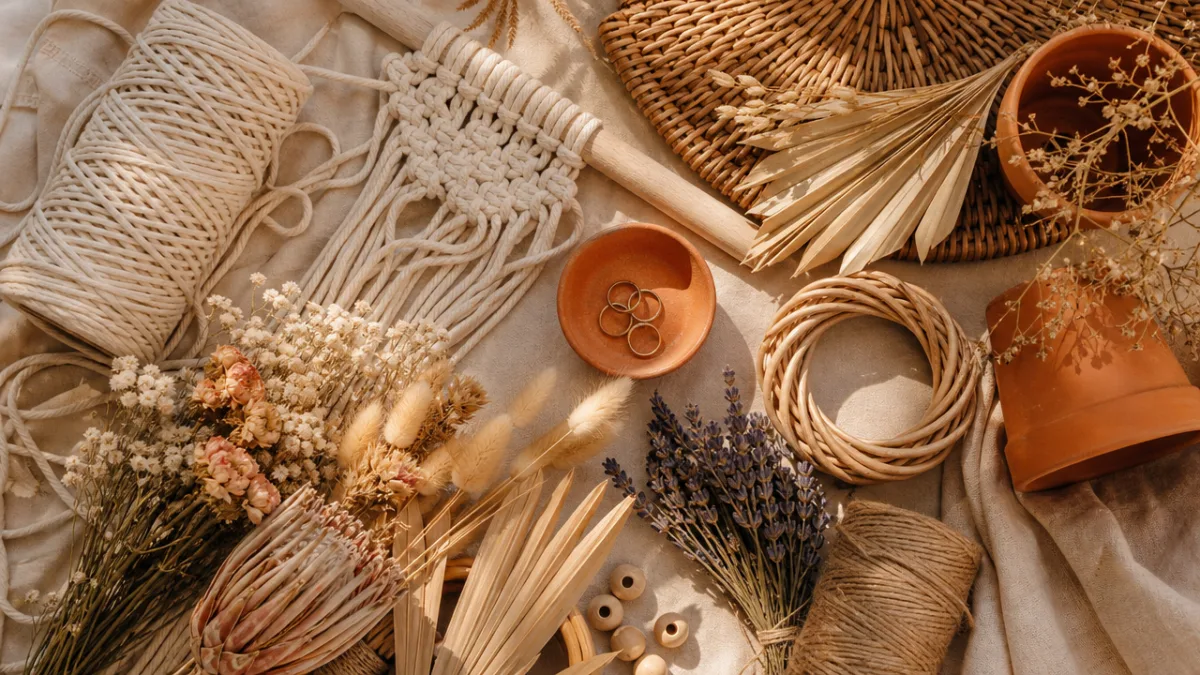
Before diving into specific projects, it helps to understand the kinds of materials that form the foundation of a boho DIY toolkit. Natural fibers are absolutely central to this aesthetic, including jute, cotton rope, macramé cord, linen, rattan, seagrass, and bamboo. These materials photograph beautifully, age gracefully, and bring an earthy warmth that synthetic alternatives simply cannot replicate. You can find them at craft stores, online marketplaces, and even repurposed from everyday items like burlap sacks or old cotton sheets. Building a small stash of these materials over time gives you an ever-ready supply for new projects.
Beyond fiber, a well-stocked boho DIY toolkit includes items like wooden dowels, driftwood, copper pipe offcuts, terra cotta pots, glass bottles, dried botanicals, and an assortment of second-hand textiles sourced from thrift stores. Paint is also a powerful tool — earthy pigments like terracotta orange, dusty sage green, warm ochre, and creamy off-white are the palette of boho design. A few cans of these colors on hand means you are always ready to refresh a thrifted frame, update a ceramic vase, or transform a plain wooden tray. The key is accumulation over time rather than a single shopping trip.
Tools you will genuinely use again and again include a hot glue gun, macramé board or foam pad, basic sewing needle and thread, scissors, sandpaper in multiple grits, and a reliable staple gun. Investing in these tools is worthwhile because they open the door to dozens of projects across every room of your home. Many DIY enthusiasts also keep a collection of natural dyes on hand, such as turmeric, indigo, and avocado skins, for tinting fabrics in the soft, organic tones that define boho textiles. With these basics assembled, you are fully equipped to create a home that looks curated and intentional without spending a fortune.
Macramé and Fiber Art: The Heart of Boho Wall Decor
Macramé has experienced a massive revival over the past decade, and for excellent reason — it is one of the most satisfying and accessible fiber arts available to beginners. At its core, macramé is simply the art of knotting cord into decorative patterns, requiring no weaving loom, no sewing machine, and no special equipment beyond your own two hands and a wooden dowel or branch to hang your work from. Even a complete beginner can create a beautiful wall hanging within a single afternoon using just three or four basic knots: the square knot, the lark’s head knot, the spiral knot, and the simple overhand knot. Countless free tutorials are available online to guide you through these foundational techniques.
For a first macramé wall hanging, begin with a length of driftwood or a sturdy wooden dowel approximately 18 to 24 inches wide. Cut lengths of 5mm natural cotton rope, each measuring roughly four times the desired finished length of your piece. Fold each cord in half and attach it to the dowel using a lark’s head knot, which is simply a loop pulled over and through itself. From there, work across in rows of square knots to create a dense, textured pattern in the upper portion of the piece, then allow the remaining cords to fall freely or trim them into a fringe for a classic boho finish. Adding a few dried pampas grass stems into the hanging as you work elevates the piece beautifully.
Beyond wall hangings, macramé techniques can be applied to an astonishing range of home decor items. Plant hangers are perhaps the most iconic boho macramé project, allowing trailing plants like pothos, string of pearls, or tradescantia to cascade at varying heights and create that lush, layered look central to boho interiors. You can also create macramé lampshade covers, table runners, curtain tiebacks, and even small shelf brackets using these same fundamental techniques. As you grow more confident, experiment with adding wooden beads, feathers, shells, or dyed cord sections to your work. Each piece you create becomes a one-of-a-kind artifact with its own character.
Bringing Nature Indoors: Plants, Dried Botanicals, and Natural Displays
No element is more essential to cozy boho design than an abundance of living and dried plant material. Plants soften hard edges, purify air, and bring a sense of vitality and growth to any room. In boho interiors, plants are never arranged with stiff formality but rather cascading, clustering, and spilling in glorious abundance. Trailing varieties like pothos, heartleaf philodendron, and devil’s ivy are particularly loved because they can drape from high shelves, hang in macramé holders, and climb along walls with minimal intervention. For those who struggle to keep plants alive, succulents and cacti are forgiving companions that still deliver significant visual impact.
Dried botanicals deserve equal attention in a cozy boho home and have the significant advantage of requiring zero maintenance once prepared. Pampas grass has become something of a boho mascot in recent years, and for good reason — its feathery plumes catch light beautifully and bring incredible softness to a room. Dried lavender, eucalyptus, lunaria, statice, and lotus seed pods are all wonderful additions that can be bundled, arranged in tall vases, or incorporated into wreaths and wall hangings. Many of these can be grown in a small garden or purchased inexpensively, then dried by hanging them upside down in a warm, ventilated space for one to two weeks. The resulting arrangements last for years with minimal care.
Creating a nature-inspired display shelf or mantle is one of the most impactful boho DIY projects you can undertake. Begin with a found or thrifted wooden shelf and layer it with objects at varying heights: a tall dried botanical arrangement in a glass bottle, a small cluster of crystals or smooth river stones, a trailing plant in a terra cotta pot, and perhaps a few meaningful objects like a small figurine or an old book with beautiful spine lettering. The key principle is odd numbers and varied heights — three items always look more interesting than two, and a tall piece paired with a medium piece paired with something low creates natural visual movement across the shelf. Rotate seasonal botanicals and objects to keep the display feeling fresh throughout the year.
Textile Layering: Rugs, Throws, and Cushions That Create the Coziness
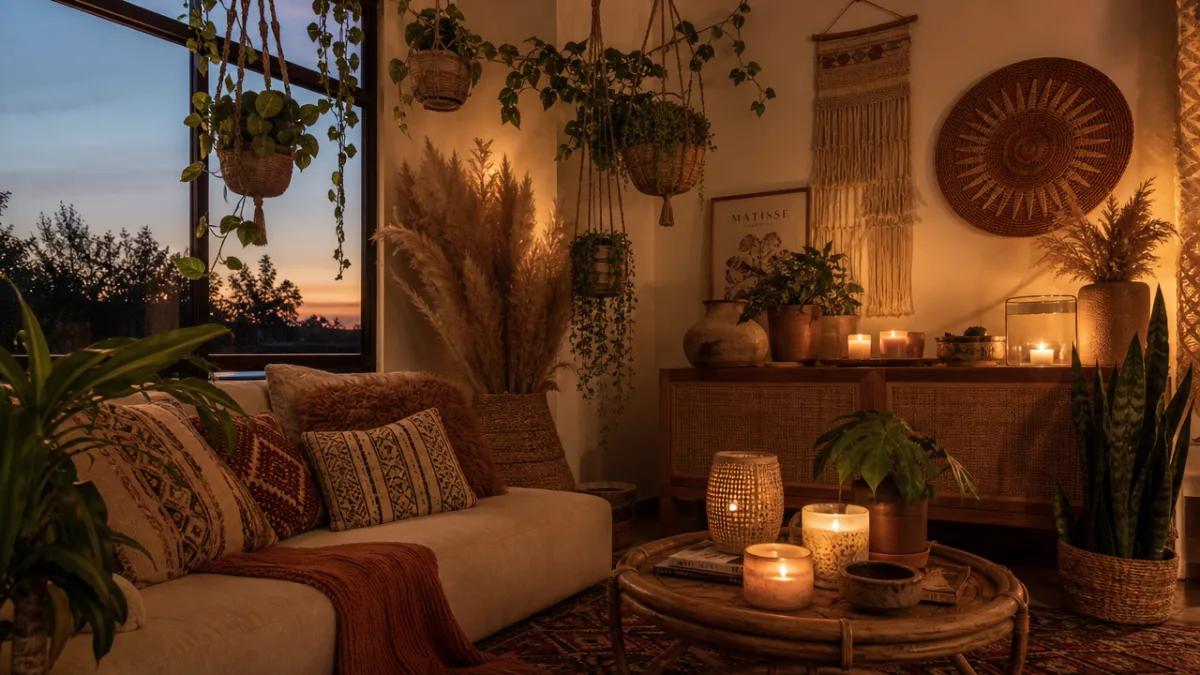
If you want to understand the secret to that irresistible cozy boho feeling, look no further than textiles. The layering of rugs, throws, blankets, cushion covers, curtains, and tapestries is what transforms a plain room into a rich, enveloping sanctuary. Boho textile philosophy is beautifully democratic — it welcomes the handwoven alongside the mass-produced, the vintage alongside the contemporary, the globally sourced alongside the locally made, as long as the pieces share a harmonious palette and an appreciation for texture. The starting point for any boho textile scheme is almost always a foundation rug: something large, flatweave or low pile, with geometric or abstract pattern in warm, earthy tones.
Layering rugs is a technique that immediately signals boho style and is simpler than it appears. Place a larger, neutral jute or sisal rug as the base layer, then layer a smaller, more decorative rug on top at a slight angle. The contrast of textures and patterns creates visual interest without chaos, provided the color palettes share at least one or two tones in common. Similarly, cushions on a sofa or bed should vary in size, texture, and pattern while relating to one another through color. A good approach is to choose one dominant color — say, terracotta — and then pull in accents of cream, sage, and mustard across different cushion covers, mixing solid colors with subtle prints and woven textures.
DIY textile projects that are particularly achievable for beginners include tie-dye or shibori-dyed cushion covers using store-bought white linen cases, simple knotted fringe pillow covers made from macramé cord, and hand-stitched patches applied to plain throw blankets. You can also create a beautiful boho tapestry without any weaving skills by using an old printed scarf, a length of vintage fabric, or a piece of batik cotton hung from a wooden dowel with small binder clips. The imperfect, handmade quality of these pieces is not a limitation but a feature — it is precisely what gives a boho home its soulful, collected-over-time character that no perfectly curated showroom can replicate.
Lighting the Boho Way: Candles, Fairy Lights, and Warm Ambient Glow
Lighting is perhaps the single most transformative and underestimated element of cozy boho design. The right lighting does not just illuminate a room — it creates atmosphere, evokes emotion, and makes even simple decor look magical. Boho lighting philosophy rejects the harsh glare of overhead fluorescent fixtures in favor of multiple layered light sources placed at low and mid levels throughout the room. The goal is a warm, amber-toned glow reminiscent of candlelight that wraps the room in softness and invites lingering. This is not difficult or expensive to achieve, and many of the most effective boho lighting solutions are delightfully DIY-friendly.
Candles are foundational to the cozy boho aesthetic, and learning to make your own adds both creativity and economy to your decor practice. Simple container candles can be made at home using soy wax flakes, cotton wicks, and essential oils, poured into repurposed glass jars, vintage teacups, or terra cotta pots. Scents like patchouli, sandalwood, cedarwood, and bergamot are particularly evocative of the boho spirit. Beeswax taper candles in earthy tones can be purchased inexpensively and arranged in a collection of mismatched candleholders for a striking focal point. Cluster several together on a tray with some dried botanicals and smooth stones for an effortless boho vignette that fills the room with warmth when lit.
String lights, sometimes called fairy lights, are another essential tool in the boho lighting arsenal. Warm white bulb string lights draped across a wall, wound around a plant, threaded through a macramé wall hanging, or hung in a canopy above a bed create a perpetual sense of magic and celebration. For a more sophisticated look, seek out Edison bulb string lights or globe lights rather than the tiny pinpoint variety, as the larger bulbs emit a more flattering, ambient glow. You can also create beautiful DIY lanterns by placing battery-operated fairy lights inside glass vases or mason jars filled with dried botanicals, pine cones, or translucent shells. The diffused light that glows through these natural materials is breathtaking and deeply evocative of the cozy boho spirit.
Pulling It All Together: Creating Cohesion in Your Boho Space
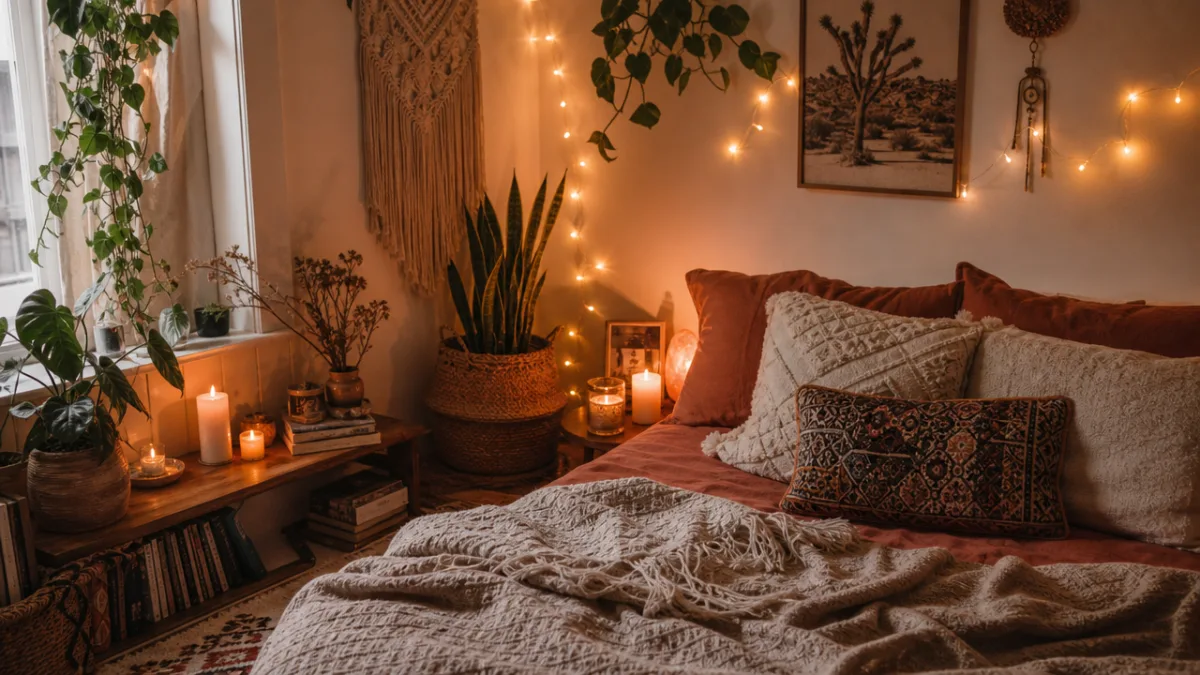
With so many wonderful individual elements available to the boho decorator, the question that naturally arises is how to bring everything together without the space feeling chaotic or overwhelming. The answer lies in the concept of a unifying color palette, which acts as an invisible thread connecting all the different textures, patterns, and objects in your room. For cozy boho design, a palette built around warm neutrals — cream, sand, linen, soft white — anchored by earthy accent tones like terracotta, dusty rose, sage green, and ochre provides enormous flexibility. Within this framework, almost any pattern, texture, or object can find a harmonious place, because the shared warmth of the palette creates cohesion automatically.
Scale and balance are equally important principles to keep in mind as your boho space evolves. A room filled entirely with small objects becomes visually restless and cluttered, while one anchored by a few larger statement pieces — a large woven wall hanging, an oversized plant, a substantial area rug — feels grounded and intentional even when layered with many smaller items. Apply the same logic to your wall arrangements: group smaller items together to create impact, intersperse framed art with three-dimensional objects like small baskets or hanging planters, and always leave some breathing room so the eye has places to rest. A useful guideline is to step back and look at your arrangement from across the room, where your eye will naturally read the overall composition rather than individual details.
Finally, remember that a cozy boho home is never truly finished — it evolves continuously as you travel, discover, create, and grow. The most authentic boho spaces are ones that accumulate meaning slowly over time: a ceramic mug from a local market, a fabric brought back from a trip abroad, a macramé piece made during a creative afternoon, a plant that has grown and thrived under your care for years. This is what separates genuine boho style from a mere aesthetic trend. It is less about achieving a particular look and more about cultivating a particular feeling — the feeling of a home that holds your history, celebrates beauty in unexpected places, and wraps around you like the coziest, most personal blanket imaginable. Begin with one small project, let it inspire the next, and trust the process of creating something beautiful at your own pace.
- Start small: Choose one room or even one corner and focus your first boho DIY efforts there before expanding to the rest of your home.
- Shop secondhand first: Thrift stores, estate sales, and online resale platforms are treasure troves of the vintage textiles, wooden objects, and ceramic pieces that form the backbone of authentic boho style.
- Embrace imperfection: Handmade items are meant to show the maker’s hand — uneven knots, irregular dye patterns, and rough edges are features, not flaws, in a boho home.
- Layer gradually: Add elements one or two at a time rather than all at once, living with each addition before deciding what comes next. This prevents overwhelm and helps you develop a more intuitive design eye.
- Prioritize scent and sound: Cozy boho living is a full sensory experience — light a candle, play ambient music, brew herbal tea, and let the atmosphere of your home engage all your senses, not just your sight.








What do you think?
It is nice to know your opinion. Leave a comment.