










21+ Genius DIY Storage Ideas You NEED to Try
Why Smart Storage Transforms Your Home
If you’ve ever found yourself tripping over clutter or spending twenty minutes hunting for something you know you own, you already understand the quiet misery of a disorganized home. Storage isn’t just about tidiness — it’s about reclaiming your time, your mental energy, and your sense of calm. A well-organized space has a measurable effect on stress levels, and countless studies confirm that visual clutter contributes to anxiety and makes it harder to focus on the things that actually matter to you.
The beautiful thing about DIY storage solutions is that they give you complete control over how your home functions. Unlike expensive built-in cabinetry or generic store-bought organizers that rarely fit your exact needs, handmade storage pieces can be customized to your dimensions, your aesthetic, and your budget. Whether you’re working with a sprawling suburban house or a compact city apartment, a creative approach to storage can unlock potential in spaces you didn’t even know existed — the area under your stairs, the gap beside your refrigerator, the unused vertical wall space above your desk.
Before diving into specific ideas, it helps to think about your home’s biggest pain points. Walk through each room and ask yourself: what items are always out of place? Where do things pile up without a designated home? Which spaces feel cramped even when they’re relatively empty? Answering these questions honestly will help you prioritize which projects to tackle first and ensure that your efforts make the biggest possible difference in your daily life.
The DIY Advantage
Building your own storage solutions doesn’t require advanced carpentry skills or a garage full of power tools. Many of the most effective and visually impressive storage projects can be completed in an afternoon using basic tools, affordable materials from your local hardware store, and a little creativity. The satisfaction of looking at a shelf you built yourself — one that fits perfectly and solves a real problem in your home — is genuinely hard to beat.
Cost savings are another major advantage. A simple floating shelf that would cost upward of eighty dollars at a furniture retailer can often be built for fifteen to twenty dollars in materials. Multiply that across a dozen projects throughout your home and you’re looking at significant savings that can be redirected toward the materials themselves, better paint finishes, or premium hardware that gives your DIY work a truly polished look. Smart shopping at thrift stores, salvage yards, and discount home improvement outlets can stretch your budget even further.
Brilliant Kitchen Storage Hacks
The kitchen is almost always the most cluttered room in any home, and for good reason — it has to accommodate an enormous variety of objects, from bulky appliances to tiny spice jars, from heavy cast iron pans to delicate glassware. Standard kitchen cabinets, while useful, almost never make the most efficient use of the space they occupy. The area inside a cabinet door, the dead space in the back of a deep drawer, and the gap between the top of your upper cabinets and the ceiling are all prime real estate waiting to be claimed.
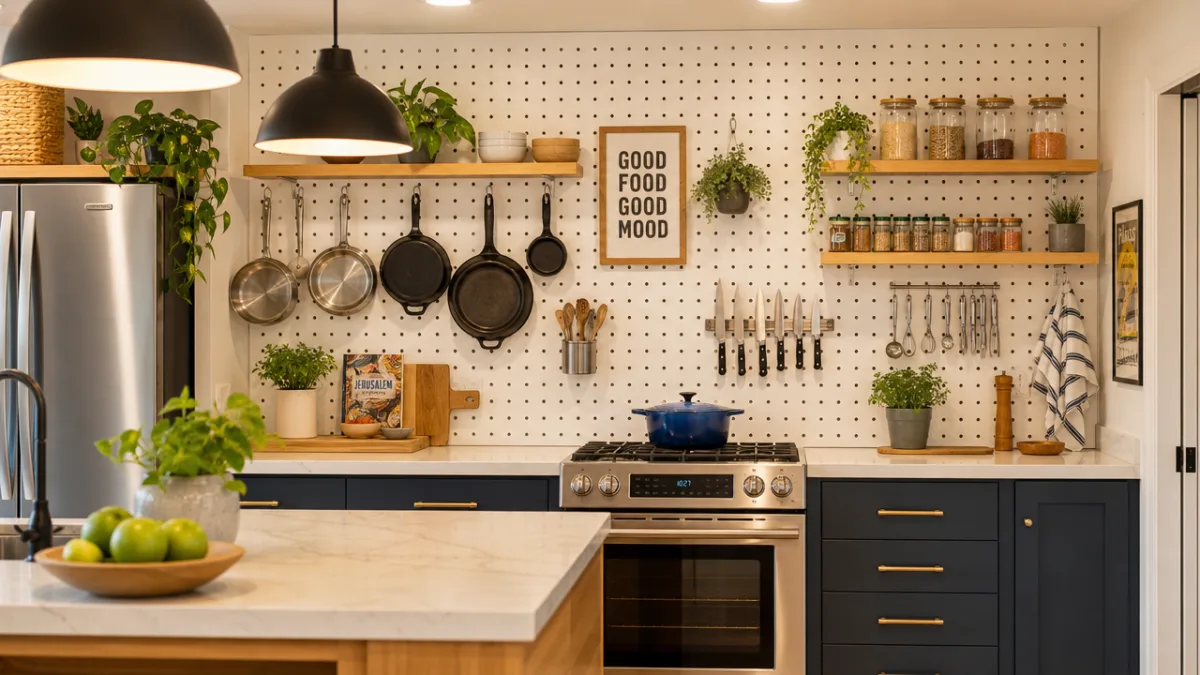
One of the most transformative kitchen projects is a DIY pegboard panel. Mount a sheet of pegboard — available at any hardware store — to the wall between your upper cabinets and your countertops, or on a blank wall near your cooking area. Using inexpensive pegboard hooks and accessories, you can hang pots, pans, utensils, cutting boards, and even spice jars in a fully customizable arrangement that keeps everything visible and within easy reach. Pegboards can be painted any color to match your kitchen’s palette, turning a purely functional piece into a genuine design feature.
Inside your cabinets, tension rods are an underutilized miracle. Installed vertically inside a cabinet, they create individual slots for storing baking sheets, cutting boards, and pan lids upright rather than stacking them in a precarious pile. Inside a drawer, a simple grid of tension rods can create a custom divider system for utensils, spice packets, or miscellaneous small items. Small wooden crates or wire baskets mounted to the inside of cabinet doors with simple L-brackets instantly create additional storage for cleaning supplies, aluminum foil boxes, or snack packages.
Maximizing Vertical Kitchen Space
Most kitchens have significant unused vertical space, and putting it to work requires only basic hardware and a willingness to look up. The area above your refrigerator is often completely empty — a simple shelf made from a plank of pine and a pair of floating shelf brackets transforms it into storage for infrequently used appliances, cookbooks, or decorative items. Similarly, the tops of upper cabinets can hold attractive baskets or bins that corral items you don’t need every day but don’t want to part with.
Magnetic knife strips are another vertical storage win that also improves kitchen safety by keeping sharp blades off the counter and out of drawers. These can be mounted on any wall surface and accommodate knives, scissors, and even metal spice tins fitted with magnetic lids — a particularly clever system that creates a beautiful, functional spice wall. If you have a small collection of frequently used spices, this approach keeps them visible, accessible, and frees up an entire cabinet shelf for other uses.
Bathroom Organization That Actually Works
Bathrooms present a unique storage challenge because they’re typically small, high-humidity environments where clutter accumulates quickly. The average bathroom counter can disappear entirely under a collection of products, tools, and accessories within days of a thorough cleaning — unless you have systems in place that make it easy to put things back where they belong. Effective bathroom storage isn’t just about having enough space; it’s about creating a system that’s intuitive enough that everyone in your household will actually use it.
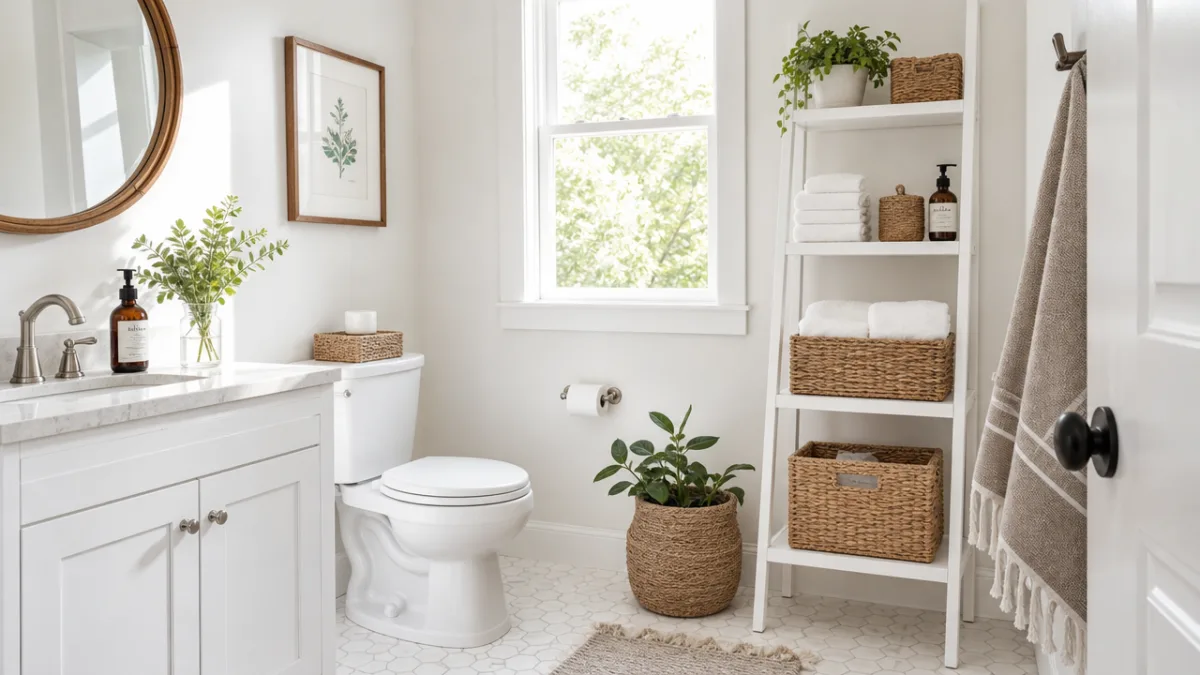
One of the most popular and effective DIY bathroom storage projects is a ladder shelf. Made from two lengths of wood and a series of horizontal rungs, a simple ladder leaned against the wall beside the toilet or bathtub provides multiple levels of storage for towels, baskets of toiletries, and decorative items. The design is open and airy, which prevents it from making a small bathroom feel more cramped, and it can be built in an afternoon for under thirty dollars. Finish it with a coat of white paint or a natural wood stain to suit your bathroom’s style.
Under-sink space is chronically underutilized in most bathrooms. The awkward plumbing configurations that run through this cabinet make standard shelving impractical, but a few clever solutions can unlock a surprising amount of useful storage. Small stackable drawers designed for this purpose fit around pipe curves. Tension rod organizers suspend spray bottles by their triggers to free up floor space. Clear bins group similar items together so nothing gets lost in the back. A coat of paint on the interior of the cabinet and a small battery-operated light make the whole system feel intentional and pleasant to use.
Over-the-Door and Wall-Mounted Solutions
The back of your bathroom door is valuable real estate that most people completely ignore. An over-the-door organizer — whether a commercial product or a simple DIY version made from a wooden frame with hooks or pockets — can hold hair tools, products, backup supplies, and small accessories without taking up any floor or counter space. For a more polished look, a row of cup hooks mounted directly to the door at different heights creates a place for hanging bags, robes, towels, and frequently used items.
Floating shelves in the bathroom serve both functional and decorative purposes. A row of small shelves above the toilet — often called an “over-toilet shelf” — can hold several baskets or bins of supplies while also displaying candles, plants, or artwork. These shelves are straightforward to install with basic wall anchors and a level, and they can be built from inexpensive pine boards finished with a moisture-resistant paint or sealant to withstand the bathroom environment. The key is to combine open display items with closed storage containers so the result looks curated rather than cluttered.
Magnetic storage solutions work beautifully in bathrooms just as they do in kitchens. A magnetic strip mounted inside a cabinet door holds bobby pins, nail files, small scissors, and tweezers in a way that makes them instantly findable. Small magnetic containers — available at craft stores or easily made by gluing small magnets to the base of repurposed tins — can hold cotton swabs, hair ties, or makeup items on a magnetic board mounted on the wall, creating a functional display that’s genuinely beautiful when done thoughtfully.
Living Room and Bedroom Storage Secrets
Living rooms and bedrooms share a common storage challenge: they need to accommodate a wide variety of items while maintaining a comfortable, aesthetically pleasing atmosphere. Nobody wants their living room to feel like a storage unit, but the reality is that these spaces need to hold books, electronics, remote controls, blankets, games, hobby supplies, and countless other things. The secret is to choose storage solutions that do double duty — pieces that are both functional and genuinely attractive.
Ottoman storage is one of the best examples of furniture that earns its footprint twice over. If you don’t already own a storage ottoman, building one is a surprisingly accessible DIY project. The basic construction involves a plywood box, foam padding, and upholstered fabric, and the finished piece can store blankets, board games, or seasonal items while serving as a coffee table, footrest, or extra seating. Similarly, a simple bench with a hinged lid placed at the foot of a bed provides bedroom storage for extra linens, off-season clothing, or bulky items that don’t fit in a standard dresser.
Built-in-looking bookshelves can be achieved without expensive carpentry work by flanking a window or doorway with freestanding IKEA-style shelving units and finishing the installation with crown molding along the top edge and baseboard trim along the bottom. When painted the same color as the surrounding walls, these arrangements look custom-built and permanent, dramatically increasing both storage capacity and visual appeal. Baskets and boxes on the lower shelves hide clutter while open upper shelves display books and decorative items in an organized way.
Bedroom-Specific Storage Wins
The space under your bed is one of the most consistently underused storage areas in any home. While commercial under-bed storage bins are available, a DIY approach allows you to create solutions sized precisely for your bed frame. Shallow wooden boxes on casters roll easily in and out for access to seasonal clothing, extra bedding, or shoes. If your bed sits low to the ground, simple bed risers — which can themselves be made from short lengths of lumber or purchased inexpensively — elevate the frame enough to accommodate standard storage containers beneath it.
Closet organization is an area where DIY projects make an especially dramatic difference. Most reach-in closets come with a single hanging rod and one shelf — a configuration that wastes roughly half the available space. Adding a second hanging rod below the first effectively doubles your hanging storage for shorter items like shirts and jackets. Adding shelves above the existing shelf makes use of the often-empty space all the way to the ceiling. These additions require only basic lumber, brackets, and wall anchors, and the transformation they produce is extraordinary.
A gallery wall that incorporates storage is a creative solution for bedrooms that are short on surface area. Floating shelves of varying depths and lengths arranged in an asymmetric pattern serve as both display space and practical storage for books, alarm clocks, jewelry, and bedside essentials. This approach eliminates the need for a traditional nightstand in small rooms, freeing up floor space and creating a visually interesting feature wall that feels intentional and designed. Small hooks added below the shelves extend the functionality further, holding headphones, bags, or frequently worn accessories.
Garage, Mudroom, and Entryway Storage Systems
The spaces where your home meets the outside world — entryways, mudrooms, and garages — are where clutter most aggressively takes hold. These areas absorb shoes, coats, bags, sports equipment, tools, seasonal gear, and everything else that doesn’t quite belong anywhere else. Without strong systems in place, they quickly become overwhelming bottlenecks that create stress every time you’re trying to leave the house or return home at the end of a long day. A thoughtful approach to these transitional spaces makes an enormous difference in how your entire home functions.
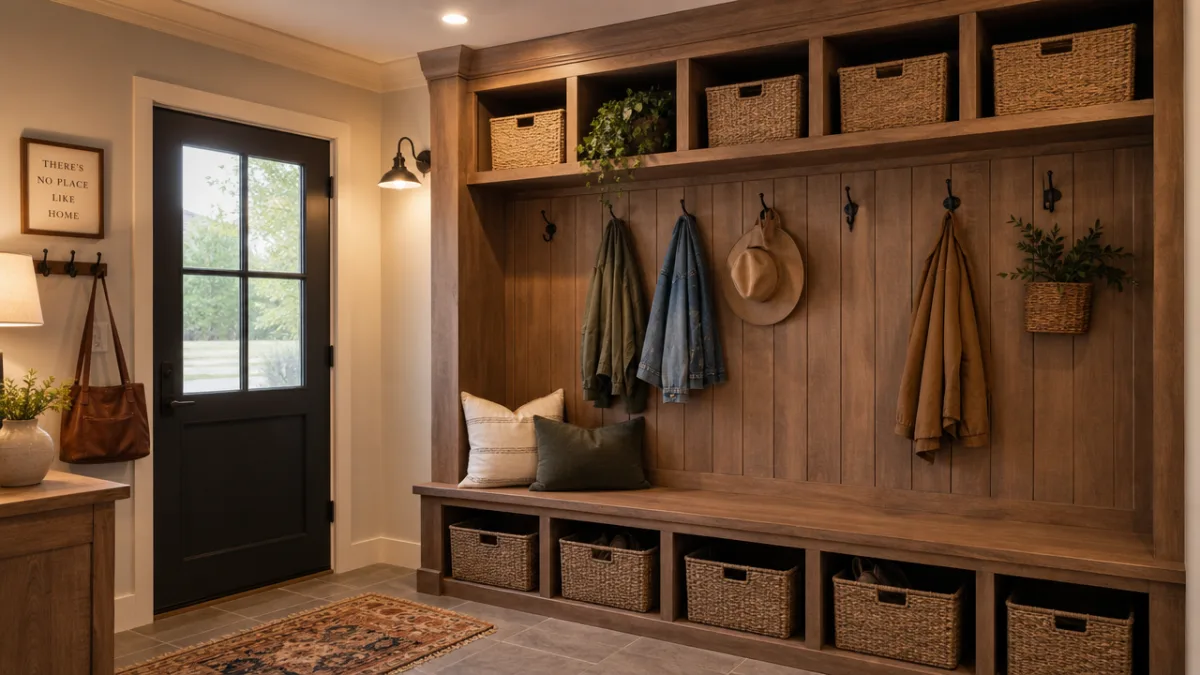
A DIY mudroom bench with cubbies is one of the most impactful projects you can undertake for an entryway. Even in a small space, a bench with individual cubbies below — each sized to hold a pair of shoes — and hooks above for coats and bags brings immediate, dramatic order to a chaotic area. The bench seat itself can incorporate a hinged lid for additional hidden storage, perfect for umbrellas, seasonal accessories, or pet supplies. This project requires basic woodworking skills and a weekend’s worth of time, but the results are genuinely life-changing for busy households.
In the garage, vertical wall storage using slotted wall panels or simple pegboard dramatically increases the amount of gear you can store without consuming floor space. Garden tools, sports equipment, extension cords, and hand tools all find natural homes on a well-organized wall system. Large items like bikes or kayaks can be hung from the ceiling using pulley systems made from basic hardware store components — a solution that keeps bulky equipment completely out of the way while remaining accessible when needed. Labeled bins on upper shelves complete the system and ensure that everything has a clear, consistent home.
Making Entryways Work Harder
Even the smallest entryway can be transformed into a functional storage space with the right approach. A slim console table with a drawer and lower shelf provides surface space for keys and mail, a drawer for miscellaneous items, and a shelf for baskets or decorative boxes. Pair it with a mirror — which can be framed simply with lumber for a custom look — and a row of hooks, and you have a complete entryway system that keeps daily essentials organized and makes departure routines smoother and less stressful.
Floating cubbies designed specifically for shoe storage can be built from simple plywood and installed in staggered rows to create a visually interesting arrangement that holds a surprising number of pairs. Angled shelves keep shoes from sliding off and make it easier to grab a specific pair at a glance. For households with children, lower hooks and cubbies sized to their smaller belongings — school bags, sports gear, smaller shoes — teach organizational habits from an early age and prevent the inevitable chaos that occurs when kids have no clear place to put their things.
The key to any successful storage system — whether it’s a single pegboard in the kitchen or a complete mudroom overhaul — is that it must be easier to use than to ignore. If putting something away requires more effort than leaving it on the counter or the floor, the system will fail no matter how beautifully designed it is. As you plan and build your DIY storage projects, always test them with the reality of daily life in mind: every item should have a home that’s accessible, logical, and simple enough that even the busiest or most distracted member of your household will use it consistently.
Repurposing and Upcycling for Unique Storage
Some of the most creative and visually striking storage solutions come not from new materials but from repurposed objects given a second life. The philosophy of upcycling — transforming discarded or undervalued items into something more useful — perfectly suits the DIY storage ethos. Not only does this approach reduce waste and save money, it produces storage pieces with character and individuality that no mass-produced product can replicate. A vintage crate, an old window frame, or a set of mismatched drawers rescued from a thrift store can become the focal point of a beautifully organized room.
Wine crates and wooden produce boxes make exceptional storage vessels for almost any room in the house. Mounted to a wall in a grid pattern, wine crates become a modular shelving system that can hold books, plants, kitchen items, or office supplies. Stacked on the floor with casters attached to the bottom, they become rolling storage units that can be rearranged as your needs change. Lined with fabric or wallpaper, painted in an accent color, or left in their natural state, these boxes adapt to virtually any interior style from rustic farmhouse to clean Scandinavian minimalism.
Old ladders — especially wooden ones with interesting patina — are among the most versatile repurposed storage items available. Leaned against a wall in the bathroom, they hold towels and baskets beautifully. Suspended horizontally from the ceiling in a kitchen using rope or chain, they become a hanging pot rack that adds warmth and character to the space. In a bedroom or living room, a vintage ladder serves as an informal bookshelf or blanket display. The appeal of these solutions lies in their authenticity: they look as though they’ve always belonged in the space, not as though they were purchased and installed last weekend.
Creative Materials You Already Own
Before purchasing any materials for a storage project, it’s worth walking through your home and garage with fresh eyes, looking for items that could be repurposed. Old picture frames can become jewelry organizers when fitted with wire mesh or pegboard. Mason jars mounted to wooden boards or magnetic strips organize bathroom supplies, craft materials, or office essentials with a charming aesthetic. Wooden pallets — available free or nearly free from garden centers and hardware stores — can be disassembled for lumber or used whole as wall-mounted planters with built-in storage pockets.
PVC pipe, typically associated with plumbing, turns out to be a surprisingly versatile storage material. Cut into short lengths and arranged in a grid inside a drawer, PVC sections create perfect individual slots for storing makeup brushes, pens and pencils, or small tools. Larger diameter sections mounted to a wall become shoe cubbies, wine bottle holders, or magazine racks. The pipe can be painted any color to disguise its industrial origins, and its smooth interior surface makes it easy to clean and maintain.
The joy of DIY storage lies not just in the organized results but in the creative process itself — the problem-solving, the satisfaction of making something with your hands, and the pleasure of living in a space that feels genuinely tailored to your life. Whether you start with a single pegboard in the kitchen or commit to a whole-house organization overhaul, every project you complete makes your home function a little better and feel a little more like a place that works for you rather than against you. Start small, think creatively, and don’t be afraid to experiment — the best storage solution is always the one you’ll actually use.








What do you think?
It is nice to know your opinion. Leave a comment.