










Easy DIY Wall Decor Ideas to Make Your Home Look Beautiful on a Budget
Why DIY Wall Decor Is the Smartest Home Upgrade You Can Make
Transforming the walls of your home doesn’t have to come with a hefty price tag or require a professional interior designer. DIY wall decor has become one of the most popular home improvement trends for a very good reason: it allows you to express your personal style, create something truly unique, and save a significant amount of money in the process. Whether you’re renting an apartment and want to add personality without permanent changes, or you own your home and are looking for creative weekend projects, there is an enormous world of wall decor possibilities waiting to be explored.
One of the most overlooked benefits of making your own wall decor is the emotional satisfaction it brings. When guests walk into your home and admire something beautiful on the wall, and you’re able to say “I made that myself,” the pride you feel is genuinely unmatched. Beyond the compliments, the act of creating something with your hands has been shown to reduce stress, boost mood, and improve overall wellbeing. Your home becomes not just a place you live, but a gallery of your own creativity and effort.
Budget-conscious decorating also forces a kind of creative discipline that often produces more interesting results than simply buying something off a store shelf. When you work within constraints, you discover materials and techniques you might never have considered. Old picture frames become botanical displays. Scrap fabric becomes a stunning tapestry. Empty wine bottles become sculpted vases. The limitation of cost becomes the engine of genuine artistic innovation, and your home ends up with a character that no catalog could ever provide.
The Budget Advantage: What You Can Save
To understand just how dramatic the savings can be, consider a simple gallery wall. Purchasing five to seven framed art prints from a mainstream home goods retailer could easily cost between $150 and $400 or more, depending on the size and brand. By contrast, printing your own artwork, collecting thrifted frames, and spray-painting them a unified color can achieve the same visual impact for under $30. That difference, multiplied across an entire home, represents thousands of dollars that stay in your pocket rather than going to a retailer.
Beyond the direct financial savings, DIY decor gives you something that store-bought items almost never can: exact customization. You choose the colors, dimensions, textures, and themes that work specifically for your space and your taste. No more settling for “close enough.” When you create your own wall art, it can match your sofa fabric perfectly, echo the tones in your rug, or reflect a memory that matters deeply to you. That level of personalization is simply not available at any price point in a conventional store.
Gallery Walls: Creating a Curated Look with Frames and Prints
Gallery walls are one of the most effective and visually striking ways to transform a blank wall into a focal point that tells a story. The beauty of a gallery wall lies in its flexibility — there are truly no hard rules. You can mix frame sizes, alternate between photographs and illustrations, combine painted canvases with printed quotes, and layer in decorative objects like mirrors or metal letters. The result is a dynamic, layered display that draws the eye and creates a sense of depth and personality in any room.
Getting started with a gallery wall is easier than most people think. Begin by collecting frames from thrift stores, yard sales, or even dollar stores. Don’t worry if they don’t match — a coat of the same spray paint in white, black, gold, or any color of your choice will unify even the most mismatched collection instantly. Once your frames are consistent in color, you can fill them with anything: printed photos, downloaded free art from public domain sites like Unsplash or the Metropolitan Museum of Art’s open access collection, watercolor washes, or meaningful quotes typed in a font you love.
Before hammering a single nail, lay your entire gallery wall arrangement on the floor first. This allows you to experiment with spacing, balance, and composition without making any holes in the wall. Take a photo of the arrangement you like best, then use paper templates (simply trace each frame onto kraft paper and cut out the shapes) to map out the exact placement on your wall with painter’s tape. This technique eliminates guesswork, prevents unnecessary nail holes, and gives you a precise road map for final installation. The whole project, including thrifted frames and printed art, can be completed for as little as $20 to $50.
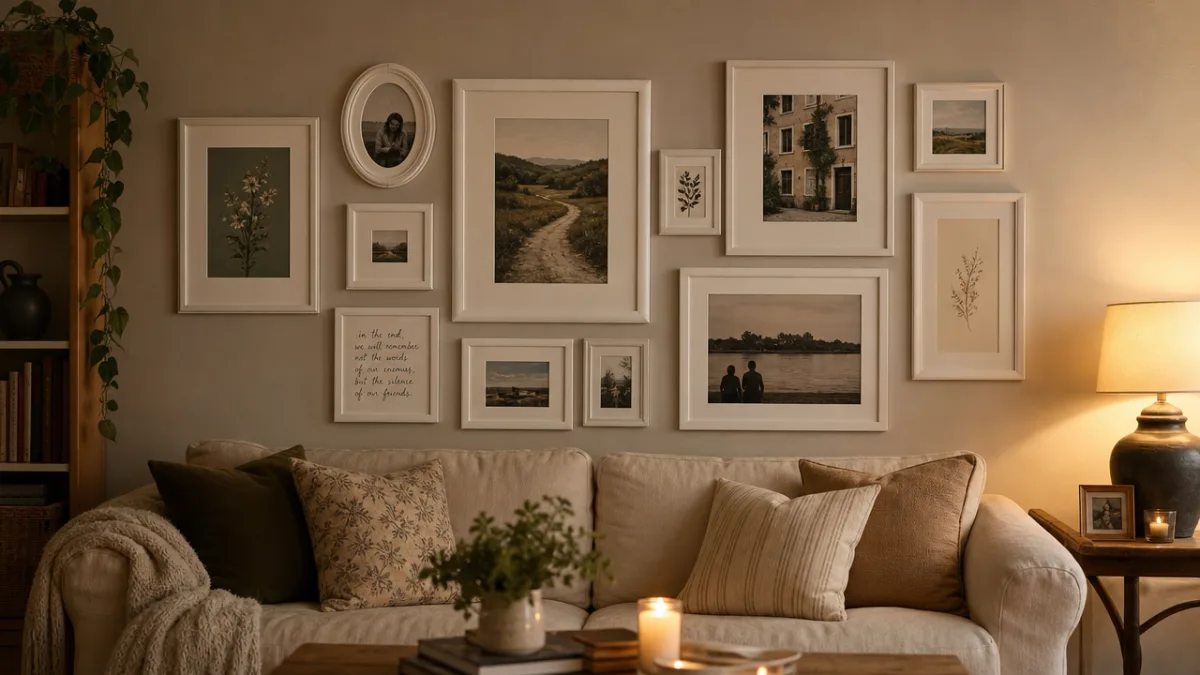
Choosing Art for Your Gallery Wall
Selecting the right art for your gallery wall doesn’t require any formal art knowledge or a large budget. Some of the most beautiful gallery walls are built entirely around free printable art, which is available in abundance online. Websites like Printables.com, Etsy (which offers many free or very affordable digital downloads), and even Pinterest itself are overflowing with botanical prints, abstract art, vintage maps, typographic quotes, and minimalist line drawings that can be downloaded, printed at home or at a local print shop, and framed immediately.
Personal photography is another wonderful source of gallery wall art that adds genuine warmth and meaning to your space. Rather than storing your favorite memories on a phone or hard drive where they’re rarely seen, print them out and give them a place of honor on your wall. Black and white printing is particularly effective because it creates a cohesive, timeless aesthetic even when the photos themselves span many different subjects, locations, and time periods. A mix of personal photos and curated prints creates a gallery wall that feels both intimate and stylish.
Textile and Fabric Wall Art: Warmth, Texture, and Color
Fabric and textile art is one of the most underrated categories in DIY wall decor, yet it offers some of the most dramatic visual results. Fabric brings warmth, softness, and texture to a wall in a way that flat canvas or paper simply cannot replicate. A large piece of beautiful fabric, stretched over a wooden frame or simply hung from a dowel rod, can fill an entire wall with color and pattern for a fraction of what a traditional piece of art would cost. This approach works beautifully in bedrooms, living rooms, nurseries, and home offices alike.
Macramé is another textile art form that has enjoyed a massive revival in recent years, and for good reason. The intricate knotted patterns of macramé wall hangings add a bohemian, handcrafted quality to any space, and the basic knots required are surprisingly easy to learn. With a simple wooden dowel, a roll of macramé cord (which is very inexpensive), and a beginner tutorial found freely on YouTube, you can create a stunning wall piece in a single afternoon. The natural, neutral tones of macramé cord work beautifully with almost any color palette, making it one of the most versatile DIY decor choices available.
Woven tapestries represent yet another beautiful textile option. A basic weaving loom can be built from a wooden picture frame and a few nails, and yarn scraps or fabric strips can be woven through it to create abstract color patterns, geometric designs, or even landscape-inspired compositions. The handmade quality of a woven tapestry adds an artisanal depth to your walls that no mass-produced product can imitate. Displaying it on a natural wood branch rather than a traditional curtain rod enhances the organic, natural feel even further.
Working with Removable Wallpaper and Peel-and-Stick Options
For renters or anyone who wants the impact of a dramatic wall treatment without permanent commitment, peel-and-stick wallpaper and removable wall decals have become game-changing products. Available in an enormous range of patterns — from marble and wood grain to floral, geometric, and abstract designs — removable wallpaper can transform an accent wall completely in just a few hours. When it’s time to move or simply refresh the look, it peels away cleanly without damaging the underlying surface, making it an ideal solution for temporary or evolving decorating schemes.
A single accent wall covered in peel-and-stick wallpaper creates an instant focal point that anchors an entire room’s design. In a bedroom, a bold botanical wallpaper behind the headboard creates the effect of a lush, layered headboard without any furniture investment. In a home office, a geometric or abstract pattern adds visual energy and creativity to what might otherwise be a bland, utilitarian space. The cost of removable wallpaper varies widely, but budget-friendly options are readily available, and covering a single accent wall typically costs between $30 and $80 in materials.

Nature-Inspired Wall Decor: Bringing the Outdoors Inside
Nature-inspired wall decor is experiencing a significant moment in interior design, and it’s one of the most accessible categories for DIY projects because many of the best materials are completely free. Pressed flowers and leaves, collected during walks or from your own garden, can be framed individually or arranged in elegant botanical compositions that look sophisticated and museum-worthy. Pressing plant material between heavy books takes only a few weeks, and the results are stunning — delicate, detailed, and completely unique to the specimens you’ve collected.
Driftwood and branches offer another freely sourced material for striking wall installations. A collection of similarly shaped branches, gathered on a beach walk or forest hike, can be arranged horizontally on a wall in ascending or descending order of length to create a dramatic sculptural piece. Branches can also be used as hanging rods for fabric art, macramé, or dried flower bundles. The unprocessed, natural quality of raw wood brings an organic authenticity to your decor that no synthetic material can replicate, and the cost is simply the time it takes to collect what nature has already provided.
Dried botanicals — including lavender, eucalyptus, pampas grass, and dried wildflowers — can be bundled together and hung directly on the wall as living art. Unlike fresh flowers, dried botanicals last for months or even years without any maintenance, slowly deepening in color as they age in a way that many people find even more beautiful than their fresh state. Bundled with twine and hung from a small hook or a decorative nail, a generous bunch of dried eucalyptus releases a subtle natural fragrance while adding extraordinary visual texture to any wall. This is truly one of the most effortless and affordable wall decor ideas available.
DIY Botanical Prints and Leaf Art
Creating your own botanical prints is a deeply satisfying project that requires almost no artistic skill yet produces results that look professionally designed. The simplest technique involves pressing leaves or flowers flat, applying a thin layer of paint to one side with a foam brush or sponge, and then pressing the painted surface firmly onto paper or canvas. When lifted, the paint transfers a beautifully detailed impression of every vein, edge, and texture in the plant material. Experimenting with different plants, different colors, and different paper backgrounds allows for endless variation.
Another approach to botanical art involves photographing plant clippings, herbs, or flowers against a plain white or black background and printing the resulting images at home or at a print shop. When printed at a larger size — such as 8×10 or 11×14 — and placed in a simple frame, these photographs have the clean, graphic quality of high-end botanical illustrations. Arranging a series of these prints in matching frames creates a cohesive, elegant set that works beautifully in kitchens, dining rooms, or hallways.
Painted Wall Treatments: Bold Transformations with a Brush
Paint is perhaps the single most powerful tool in the DIY decorator’s toolkit, and the techniques available go far beyond a simple solid color. An accent wall in a rich, deep hue — think forest green, navy blue, warm terracotta, or charcoal — can completely change the mood and perceived proportions of a room. Painting just one wall in a bold color is a relatively low-commitment project that costs very little in paint yet delivers a transformation that feels dramatic and intentional. It’s one of the highest return-on-investment improvements you can make to any space.
Beyond solid colors, techniques like color blocking, ombré gradients, and geometric patterns can turn your wall itself into a work of art. Color blocking involves painting distinct sections of a wall in two or more contrasting colors, separated by clean, precise edges created with painter’s tape. The result is a graphic, modern aesthetic that looks like it was designed by a professional. Ombré walls, which transition gradually from one color to another, require a slightly more advanced blending technique but create a soft, dreamy effect that is particularly beautiful in bedrooms and nurseries.
Stenciling is another paint technique that opens up extraordinary design possibilities at minimal cost. Stencils in geometric patterns, Moroccan motifs, damask designs, or botanical shapes can be purchased inexpensively or even cut from cardstock at home. Applied with a foam roller or stippling brush, a stenciled pattern across a full wall creates an effect nearly indistinguishable from expensive specialty wallpaper. The key to a professional-looking result is securing the stencil firmly with painter’s tape before each application and using very little paint on the roller at a time to prevent bleeding under the stencil edges.

Chalkboard and Whiteboard Paint: Functional Wall Art
Chalkboard and whiteboard paint represent a particularly clever category of wall treatment because they transform a surface into both decor and functional tool simultaneously. A chalkboard wall in a kitchen can serve as a weekly meal planner, a grocery list board, a recipe display, or simply a rotating gallery of your children’s artwork. In a home office or studio, a whiteboard wall becomes an enormous brainstorming surface that encourages creativity and organization in equal measure. Both paints are available in standard home improvement stores and are applied just like ordinary wall paint.
The aesthetic versatility of chalkboard paint is also worth noting. While the classic color is matte black, chalkboard paint is now available in a wide range of colors, meaning you can have a chalkboard surface that doubles as an attractive colored accent wall. Navy, hunter green, and slate gray are particularly popular because they look sophisticated even when the board is blank, while also accepting chalk writing and drawing beautifully. A single framed section of chalkboard paint on an otherwise neutral wall creates a striking, purposeful focal point that changes with your needs and moods.
Repurposed and Upcycled Materials: Creative Decor from Unexpected Sources
Some of the most visually interesting wall decor comes not from art supply stores or home goods retailers, but from items you might otherwise discard or donate. Old wooden pallets, for instance, can be sanded, stained, and mounted to a wall to create a rustic wood-plank backdrop that adds enormous warmth and texture. Individual pallet boards can also be cut into different lengths and arranged in a herringbone or chevron pattern for a more refined, geometric effect. The material cost is often zero if you can source pallets from local businesses, grocery stores, or construction sites, many of which give them away for free.
Vintage window frames, salvaged from architectural salvage stores or flea markets, make beautiful wall decorations when hung as art objects themselves. Their weathered paint, interesting proportions, and historical character add a layer of storytelling to your walls that brand new items simply cannot achieve. A vintage window hung above a bed or sofa creates a framing effect that echoes the architectural detail of older homes. Old doors, shutters, and ladder frames work similarly, adding height, structure, and history to your wall decor in a way that is both sustainable and deeply personal.
Repurposing maps, book pages, sheet music, or vintage newspaper pages as wall art is another wonderfully budget-friendly approach. Decoupage these materials directly onto a canvas or wood board using a mixture of equal parts craft glue and water, smoothing each piece flat and overlapping edges slightly. Once dry and sealed with a final coat of the same glue mixture, the result is a collage-style artwork with beautiful texture and visual depth. The paper materials themselves are often free — pulled from old books found at library sales, printed from public domain archives online, or salvaged from items you already own.
Sustainable Decor: Making Beauty from What You Already Have
The most sustainable form of home decor is the kind that uses materials already in your possession or sourced secondhand before buying anything new. Before starting any DIY wall decor project, take stock of what you already own: spare fabric from old projects, mismatched picture frames tucked in closets, paint cans left over from previous rooms, yarn from unfinished knitting projects, or stacks of old magazines. These materials, viewed through the lens of creative possibility rather than as clutter, contain the raw ingredients for genuinely beautiful wall art that costs almost nothing and sends nothing to landfill.
Sourcing materials from thrift stores, flea markets, and estate sales is another excellent strategy that keeps costs extremely low while supporting a more sustainable approach to consumption. A thrift store visit can yield picture frames, decorative plates for a plate wall arrangement, vintage artwork that can be painted over and repurposed, or wooden boards that can be cut and arranged into wall art. Shopping this way also means your home decor will be genuinely one-of-a-kind, because the specific combination of items you find and create with exists nowhere else in the world — a quality that no mass-produced item, at any price, can ever offer.








What do you think?
It is nice to know your opinion. Leave a comment.