










Introduction to Tree Branch Garden Gate Designs
Garden gates have long served as more than just functional entry points — they are the first impression a visitor receives of the space beyond. Among the most enchanting and organic approaches to gate design is the use of natural tree branches, which bring a sense of wildness, craftsmanship, and timeless beauty to any outdoor setting. Whether you are working with a rustic cottage garden, a woodland retreat, or a contemporary naturalistic landscape, a tree branch gate can serve as a stunning focal point that feels simultaneously ancient and fresh.
The appeal of using tree branches in gate construction lies partly in their inherent unpredictability. No two branches are identical, which means no two gates will ever be exactly alike. This uniqueness is deeply valued in a world increasingly dominated by mass-produced materials. A branch gate tells a story — of the tree it came from, the hands that shaped it, and the garden it guards. It carries with it a sense of place and authenticity that is very difficult to replicate with manufactured materials.
Beyond aesthetics, tree branch gates are also a remarkably sustainable design choice. When branches are sourced from trees that have already fallen, been pruned, or need to be removed for health reasons, the gate becomes a form of creative recycling. Rather than chipping branches into mulch or burning them, skilled craftspeople transform them into lasting, functional art. This commitment to resourcefulness resonates with gardeners and homeowners who are increasingly mindful of their environmental footprint.
Why Natural Materials Are Having a Moment in Garden Design
The broader trend in garden design over the past decade has been a steady movement away from rigid, overly formal structures and toward softer, more organic aesthetics. Gardeners are embracing the concept of rewilding, encouraging natural growth patterns, and choosing materials that age gracefully alongside the plants they frame. Tree branch gates fit perfectly within this philosophy, offering a structure that weathers, mellows, and even develops a patina over time rather than simply deteriorating.
Social media platforms and design publications have played a significant role in popularizing branch gates, exposing millions of viewers to examples from European cottage gardens, Japanese forest paths, and American woodland homesteads. When a beautifully constructed branch gate appears framed by climbing roses or framed by ferns, it creates an image that feels deeply aspirational — a sense that one’s garden could be both wild and intentionally designed at the same time.
Types of Tree Branches Best Suited for Gate Construction
Not every branch that falls in your yard is suitable for constructing a garden gate. The best branch gates are built from wood that is strong, reasonably straight (or at least consistent in its curve), and resistant to the elements. Hardwoods such as oak, chestnut, hazel, and sweet chestnut are among the most popular choices because of their density and durability. Oak in particular has been used for centuries in outdoor structures precisely because it contains natural tannins that resist rot and insect damage without the need for chemical treatment.
Hazel is especially beloved among traditional craftspeople because its coppiced stems — long, slender poles that grow back reliably after cutting — are ideally proportioned for intricate woven or lattice-style gate designs. Hazel coppice has been managed in European woodlands for thousands of years, and working with it for a gate connects a modern gardener to an extraordinarily long tradition of sustainable woodland craft. Willow is another favorite, and its flexibility makes it especially suitable for gates with curved or arched tops where rigidity might cause cracking.
Fruit tree branches, particularly from apple, pear, and cherry trees, are also excellent choices when the trees are being pruned heavily or removed. These woods tend to be dense, beautifully grained, and often have wonderfully characterful curves and knots that add visual interest. Cedar and black locust are popular in North American gardens, both being naturally rot-resistant and widely available. The key is to select branches that have been allowed to dry or season properly before construction begins, as green wood will shrink and warp unpredictably as it dries.
Sourcing Branches Responsibly and Sustainably
One of the most rewarding aspects of building a branch gate is the sourcing process itself. Many gardeners begin by surveying their own property after a storm, collecting fallen limbs that might otherwise be disposed of. Others develop relationships with local tree surgeons and arborists, who regularly have quantities of pruned or removed wood available and are often happy to pass it along rather than processing it for chipping. This kind of community connection adds another layer of meaning to the finished gate.
It is important to ensure that sourced branches are free from serious disease or pest infestation, as importing these problems into your garden could have negative consequences for surrounding trees and plants. Visually inspect all wood carefully before use, looking for signs of fungal decay, wood-boring beetle damage, or significant structural weakness. When in doubt, consult with a local arborist or woodland specialist who can advise on the suitability of particular species and specimens for outdoor construction use.
Design Styles and Aesthetic Approaches
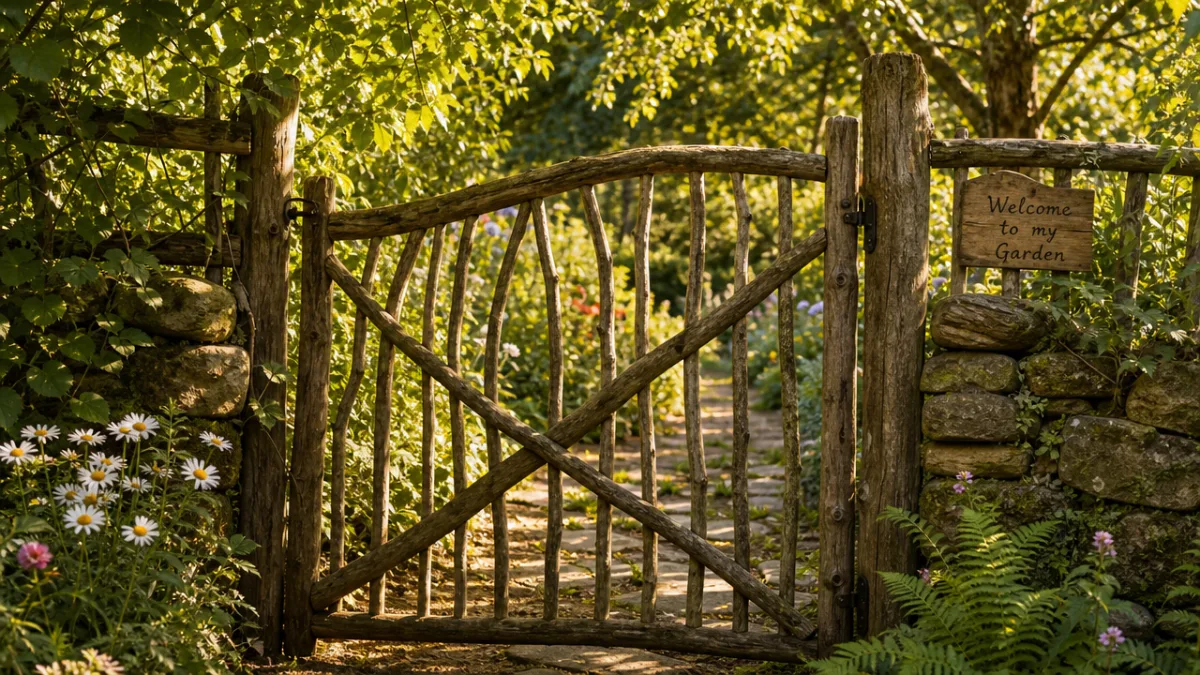
Tree branch gates can be executed in a remarkable range of styles, from the deliberately rough and primitive to the highly refined and architectural. The simplest approach involves lashing or nailing straight branches together in a basic cross-braced pattern, producing a gate that reads as entirely handmade and unapologetically rustic. This style works wonderfully in kitchen gardens, allotments, and cottage settings where imperfection is part of the charm. The irregularity of the branches is celebrated rather than hidden.
A more sophisticated approach involves carefully selecting and arranging branches to create patterns — chevrons, diamonds, sunbursts, or even representational images such as trees or animals. These mosaic-like designs require considerably more planning and patience but produce results that are genuinely extraordinary. Some craftspeople sketch out their design on paper first, then hunt specifically for branches with the right angles and dimensions to execute their vision. The finished gate in these cases is unmistakably a piece of folk art as much as a functional object.
Arched gates are among the most dramatic expressions of the branch gate tradition. By selecting branches with a natural curve or by carefully bending and lashing supple young growth, makers can create gates with gracefully arching tops that frame a view through to the garden beyond in the most inviting way imaginable. When paired with a matching arch overhead — perhaps made from trained living branches or woven wicker — the effect is of passing through a portal into another world entirely.
Incorporating Living Branches and Pleached Elements
One of the most adventurous and rewarding directions in branch gate design is the use of living wood — branches that are still actively growing and can be trained, woven, and even grafted to create a gate that is literally alive. This ancient technique, known as arborsculpture or living willow construction, involves harvesting fresh willow or dogwood wands, inserting them into the ground while still viable, and training their growth over months and years. The result is a gate that continuously changes and strengthens as the wood weaves itself together.
Living gates do require considerably more ongoing attention than their static counterparts. They must be watered during establishment, pruned to shape during the growing season, and occasionally retrained when growth heads in an undesirable direction. However, the rewards are immense — a living gate becomes a permanent garden feature that improves with age, potentially lasting for generations if properly managed. Some living gate structures in European gardens are known to be centuries old, having been passed down through families and continuously renewed through good stewardship.
Construction Techniques and Joining Methods
The structural integrity of a tree branch gate depends enormously on the quality of the connections between individual elements. Traditional craftspeople have long relied on a combination of techniques including mortise and tenon joinery, lashing with natural twine or willow bark, and wooden pegs driven into pre-drilled holes. Each of these methods has its advantages and is suited to particular types of design. Mortise and tenon joinery, for instance, produces an extremely strong and permanent connection ideal for the main structural frame of a gate.
Modern builders often supplement traditional joinery with carefully placed screws, bolts, or metal brackets, particularly at the hinge points where the gate must bear its own weight repeatedly over years of use. This is entirely acceptable and does not compromise the organic aesthetic of the gate, as fixings can be chosen in materials and finishes that blend with the wood. Brass screws, for instance, develop a warm patina that complements aged hardwood beautifully, while black-painted ironwork has its own rustic charm.
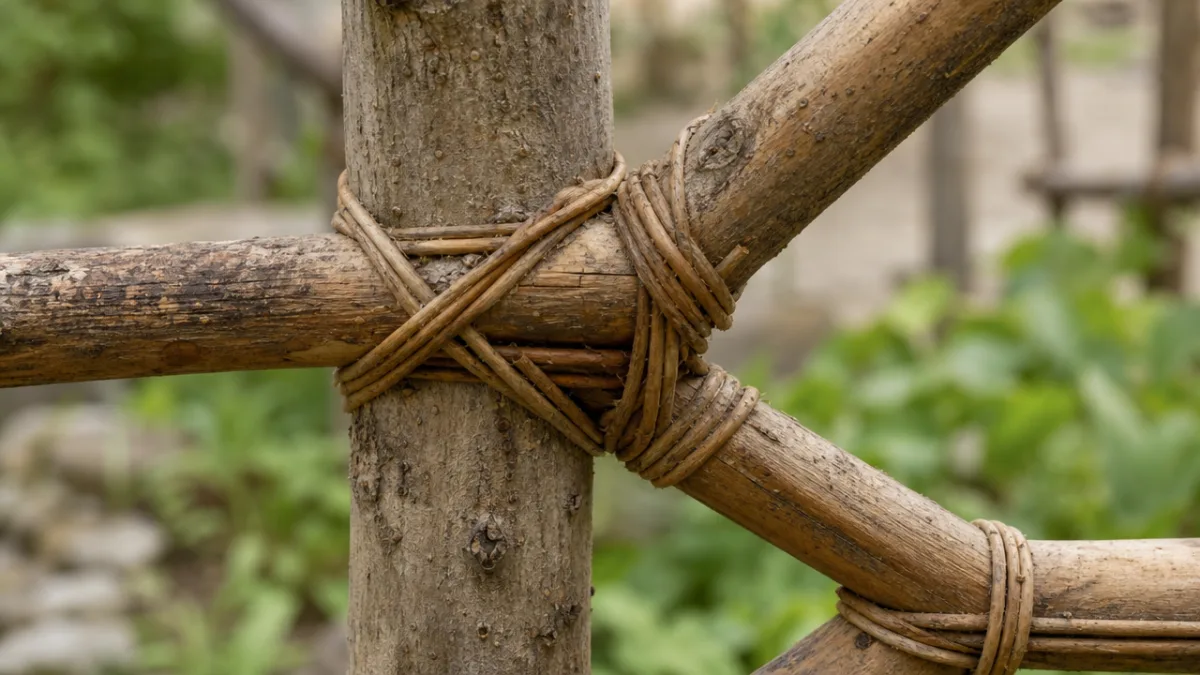
Lashing with natural twine, jute, leather, or even strips of bark is another joining method that is visually expressive as well as functional. When done carefully with consistent spacing and tension, lashed joints become decorative features in their own right, adding texture and visual rhythm to the gate surface. Some makers use colored twine or cord deliberately as a design element, creating patterns within the gate’s structure. Over time, natural lashing materials weather and may need to be replaced, but this maintenance is straightforward and gives the gate an opportunity to be refreshed.
Hanging and Installing Your Branch Gate
Installing a branch gate requires careful attention to the hanging posts, which must be robust enough to support the gate’s weight through years of use. Since branch gates are often heavier and less perfectly balanced than manufactured gates, posts must be set deeply into the ground — typically at least a third of their above-ground height — and secured in concrete or compacted gravel for stability. Hardwood posts such as oak or larch are the most appropriate choice, as they will age gracefully alongside the gate itself.
Hinge selection is another important consideration. Traditional strap hinges in wrought iron are the most aesthetically compatible choice for a branch gate, providing both strength and a visual language that harmonizes with the organic, hand-crafted nature of the gate itself. The hinges should be attached to the sturdiest, most consistent sections of the gate’s frame — typically the uprights — and positioned to distribute the gate’s weight as evenly as possible. A gate that hangs slightly out of plumb due to irregular branch shapes can often be corrected at this stage with careful shimming and adjustment.
Preserving and Maintaining Your Tree Branch Gate
Even the most durable hardwood gate will benefit enormously from appropriate finishing and ongoing maintenance. The single most important thing you can do for a branch gate is to apply a suitable wood preservative or oil before installation and to renew this treatment every year or two thereafter. Raw linseed oil has been used for centuries to protect outdoor woodwork and has the advantage of being entirely natural and non-toxic. It penetrates deeply into the wood grain, nourishing it from within and creating a degree of water resistance without forming a surface film that could crack or peel.
It is worth noting that different species of wood will weather differently and may require different maintenance approaches. Oak, for instance, develops a beautiful silver-grey patina when left untreated outdoors, and many gardeners prefer this natural weathering effect over any applied finish. Hazel and willow tend to degrade more quickly if left completely unprotected and benefit from regular oiling or treatment with a plant-based preservative. Understanding the particular needs of your wood species will help you develop an appropriate maintenance routine.
Annual inspection of all joints, lashings, and fixings is strongly advisable, particularly at the start of the spring season after the gate has been through a winter of rain, frost, and temperature fluctuations. Any lashings that have loosened or deteriorated should be replaced promptly, and any signs of rot or insect damage should be addressed before they have a chance to spread. With consistent care, a well-made tree branch gate can remain beautiful and fully functional for ten, twenty, or even thirty years — a genuine long-term investment in the character of your garden.
Seasonal Care and Repair Tips
Beyond annual oiling, there are several seasonal tasks that will keep your branch gate in prime condition. In autumn, it is worth clearing away any accumulated leaf matter or climbing plant growth from the gate’s surface, as damp organic material held against the wood for extended periods can accelerate decay. If you have encouraged climbing plants such as roses, clematis, or honeysuckle to grow through the gate’s frame — which can look absolutely magical — take time each season to gently disentangle growth that is placing undue stress on the structure.
In regions where winters bring hard frosts, it may be worth applying an additional coat of preservative in late autumn specifically to protect end-grain sections of the branches, as these are the points most vulnerable to frost damage. End grain absorbs moisture far more readily than the sides of a branch, and repeated freeze-thaw cycles can cause splitting and cracking over time. A simple application of raw linseed oil or a beeswax-based wood conditioner to these areas each autumn will dramatically extend the gate’s lifespan.
Inspiring Ideas and Garden Pairings
A tree branch gate reaches its fullest potential when it is considered as part of the wider garden composition rather than as a standalone object. The most successful branch gate installations are those where the gate feels like a natural extension of its surroundings — where the species of wood echo trees in the garden, where the gate’s style complements the planting style on either side, and where the height and proportions of the gate relate meaningfully to the walls, hedges, or fences it is set within. This kind of contextual thinking elevates a functional object into something genuinely artistic.
Cottage and naturalistic gardens are the most obvious pairing for branch gates, but the design vocabulary is more flexible than it might initially appear. A beautifully refined branch gate with clean lines and subtle geometry can work surprisingly well in a contemporary garden, particularly when paired with gravel, simple clipped hedges, and a restrained planting palette. The contrast between the organic texture of the wood and the cleaner lines of the surrounding landscape creates a productive visual tension that keeps the eye engaged and curious.
Consider also the view through the gate as much as the gate itself. The most memorable garden entrances frame something beautiful on the other side — a path winding through planting, a specimen tree, a water feature, or simply a sweep of lawn that draws the eye and the feet forward. When the gate and the view it frames work together, the overall effect can be genuinely breathtaking. Gardeners willing to think about their branch gate as part of a larger choreography of approach and arrival will find their efforts richly rewarded.
Complementary Plantings to Enhance Your Branch Gate
Choosing the right plants to accompany a tree branch gate can make an enormous difference to its overall impact. Climbing roses are perhaps the most traditional and beloved companion, their canes weaving naturally through the branch structure and their flowers bringing color and fragrance at exactly the height where it will be most appreciated — at face level as you pass through. Varieties with flexible, pliable canes such as Rosa mulliganii or the Rambling Rector are particularly well suited to this kind of informal training.
For a wilder, more woodland feel, consider allowing ivy, Virginia creeper, or climbing hydrangea to thread through the gate’s structure. These self-clinging climbers require minimal intervention once established and create a lush, tapestry-like effect that makes the gate appear to have grown organically from the surrounding landscape. In spring, a branch gate festooned with the tiny white flowers of climbing hydrangea is a sight of extraordinary delicacy and charm.
Flanking plantings — those placed on either side of the gate at ground level rather than growing through it — also deserve careful thought. Tall ornamental grasses such as Calamagrostis or Miscanthus can mirror the vertical lines of the branches while adding movement and sound in a breeze. Foxgloves, verbascums, and other stately biennials create a sense of abundance and wildness that complements the handmade quality of the gate. Whatever you choose, the goal is to create a sense that the gate and the garden around it belong together — that one could not exist without the other.









What do you think?
It is nice to know your opinion. Leave a comment.