










8 Biennials to Add Wow to Your Garden
What Are Biennials and Why Should You Grow Them?
Biennials occupy a fascinating middle ground in the plant world, completing their life cycle across two growing seasons rather than one. In their first year, they channel all their energy into establishing strong root systems and producing a rosette of foliage. It is only in their second year that they reward the patient gardener with flowers, seeds, and the full expression of their beauty. This two-year rhythm gives them a depth and presence that annuals often cannot match.
Many gardeners overlook biennials simply because the concept of waiting a full year for flowers feels counterintuitive in a world of instant garden gratification. Yet this patience is precisely what makes biennials so rewarding. The anticipation of watching a plant build its strength through one season and then explode into bloom the next creates a relationship between gardener and plant that is uniquely satisfying. Once you understand their rhythm, you begin to see the garden as a living timeline rather than a static display.
The practical beauty of biennials lies in how they fill the garden calendar. Many bloom in spring and early summer, bridging the gap between the last of the spring bulbs and the arrival of summer perennials. Others extend the season into late summer. By sowing biennials in succession across a couple of years, you can create a self-sustaining cycle where new plants are always coming into their prime, giving your garden a sense of constant renewal and movement that keeps it visually dynamic year after year.
Foxglove: The Towering Cottage Garden Classic
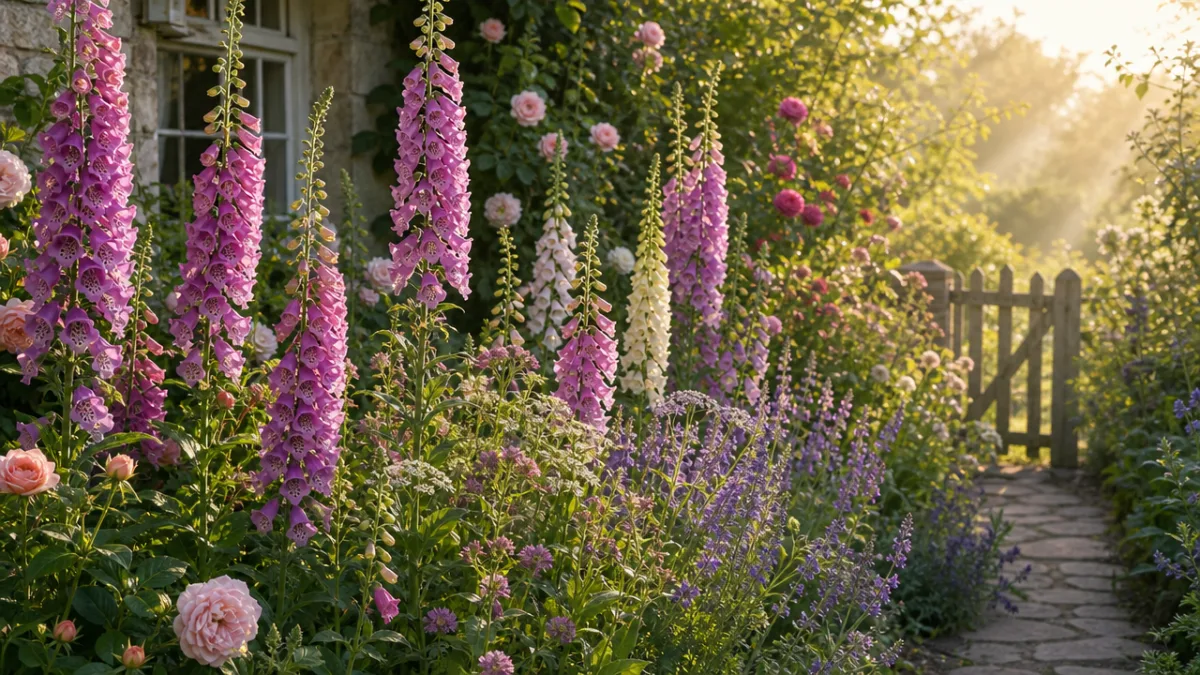
Foxglove, known botanically as Digitalis purpurea, is perhaps the most iconic biennial in the gardening world, and for very good reason. Its tall, stately spires can reach up to five or six feet in height, creating dramatic vertical interest that commands attention in any planting scheme. The tubular flowers, which march elegantly up each spike, come in shades of deep purple, pink, white, and creamy yellow, often decorated inside with intricate spotted markings that look as though they were painted by hand. Foxgloves have an undeniable magic about them, and even experienced gardeners feel a quiet thrill when those first spires emerge in early summer.
From a design perspective, foxgloves are extraordinarily versatile. They thrive in partial shade, making them invaluable for those tricky spots under trees or along the shadowed side of a fence where other plants struggle to perform. They work beautifully in naturalistic woodland gardens, massed along borders, or interspersed with roses for a classic cottage garden look. Their height adds a painterly quality to garden compositions, drawing the eye upward and creating a sense of layered depth that shorter plants simply cannot achieve on their own.
Once established in your garden, foxgloves have a wonderful habit of self-seeding freely, which means that after the initial two-year investment, you can enjoy a continuous naturalized population with very little effort. To encourage this, simply allow the spent flower spikes to set seed before removing them. Scatter a few seeds deliberately in spots where you want them to appear and let the rest fall where they will. Over time, foxgloves will weave themselves through your borders in an organic, unpredictable way that no amount of careful planning could quite replicate.
Sweet William: Color and Fragrance in One Package
Sweet William, or Dianthus barbatus, is one of those old-fashioned flowers that deserves a full and enthusiastic revival in modern gardens. Its flat-topped clusters of small, intricately patterned flowers appear in a dazzling range of colors including deep crimson, salmon, white, bicolor combinations, and every shade of pink imaginable. What sets Sweet William apart from many other biennials is its fragrance, a rich, spicy-sweet scent reminiscent of cloves that carries on the breeze and fills the surrounding area with a gentle perfume that is utterly addictive on a warm summer evening.
Sweet William is particularly effective when planted in generous drifts rather than scattered individually. A large block of mixed colors creates a tapestry effect that is visually stunning, while a single-color planting in deep scarlet or pure white can be boldly elegant and sophisticated. The flowers are also exceptional for cutting, with strong stems and long vase life that make them a favorite among flower farmers and home arrangers alike. Bringing a handful indoors is one of the small pleasures that makes a garden feel truly productive and generous.
In terms of cultivation, Sweet William is gratifyingly easy to grow. Sow seeds in late spring or early summer directly in the ground or in a nursery bed, then transplant young plants to their final flowering positions in autumn. They are reasonably hardy and will overwinter successfully in most temperate climates, emerging in spring ready to flower from late May through July. Deadheading spent blooms regularly will prolong the flowering period significantly, though leaving a few clusters to set seed ensures a fresh generation of plants for the following year.
Honesty: Silver Moons for the Autumn Garden
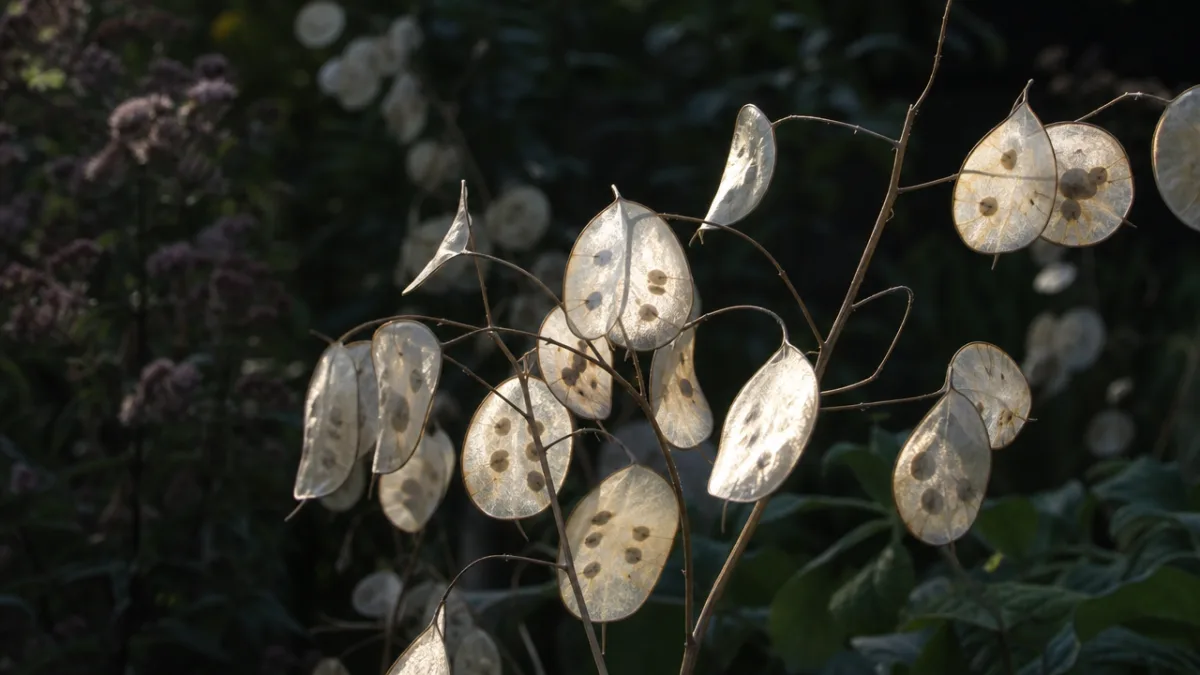
Lunaria annua, commonly known as Honesty or the Money Plant, is a biennial that offers two distinct seasons of interest, which puts it in a special category of its own. In spring, it produces clusters of small purple or white flowers that attract early pollinators and add a cheerful haze of color to borders and wild garden areas. Then, as summer progresses, the flowers give way to flat, oval seed pods that gradually dry on the plant to reveal translucent silvery discs that catch the light like scattered coins. These luminous seedheads are the plant’s crowning glory.
The dried seedheads of Honesty are among the most beautiful natural decorative materials available to any gardener or flower arranger. Cut stems in late summer before the outer casing fully disintegrates and hang them upside down in a warm, dry place to finish curing. Once dry, the remaining silvery membranes are extraordinarily delicate and beautiful, lasting for years in dried arrangements without losing their pearlescent quality. Few garden plants offer such a complete journey from living flower to lasting decoration, and this dual purpose makes Honesty exceptional value in any garden planting plan.
Honesty is wonderfully unfussy about growing conditions, tolerating shade, dry soil, and neglect with an admirable stoicism that makes it ideal for difficult corners of the garden. It self-seeds with impressive enthusiasm, and once established, you will rarely need to sow it again. The purple-flowered forms are particularly vigorous and will colonize shaded areas under trees and shrubs where little else will grow, threading their way through established plantings and providing welcome early-season interest in spots that might otherwise be overlooked until much later in the year.
Hollyhock: Stately Blooms with Old-World Charm
Few plants evoke the romance of a traditional cottage garden quite as powerfully as the hollyhock. Alcea rosea grows in towering columns that can exceed eight feet in height, covered from base to tip in large, tissue-paper-thin blooms in shades ranging from the palest blush to deepest burgundy, with single and double-flowered forms both offering their own particular beauty. Planted against a wall, fence, or at the back of a deep border, hollyhocks create an instantly recognizable backdrop that transforms any garden space into something that feels timeless and deeply rooted in horticultural tradition.
Hollyhocks are among the best plants for bringing pollinators into the garden, particularly bumblebees that are drawn irresistibly to the large, open flowers. A row of hollyhocks in full bloom on a sunny summer afternoon will be buzzing with activity, turning the garden into a sanctuary for beneficial insects. This ecological generosity adds an extra dimension of value to a plant that is already extraordinarily beautiful. Choosing hollyhocks for the garden is therefore both an aesthetic and an environmental decision, contributing to local biodiversity in a meaningful and measurable way.
One challenge that hollyhock growers commonly face is hollyhock rust, a fungal disease that produces orange pustules on the undersides of leaves and can spread rapidly in humid conditions. The most effective approach is to ensure good air circulation by giving plants adequate spacing, to remove and dispose of affected leaves promptly, and to avoid overhead watering. Selecting rust-resistant varieties where available provides an additional layer of protection. Despite this susceptibility, most gardeners find that the spectacular beauty of hollyhocks in full bloom far outweighs the modest effort required to manage the occasional disease outbreak.
Wallflower: Spring’s Most Underrated Performer
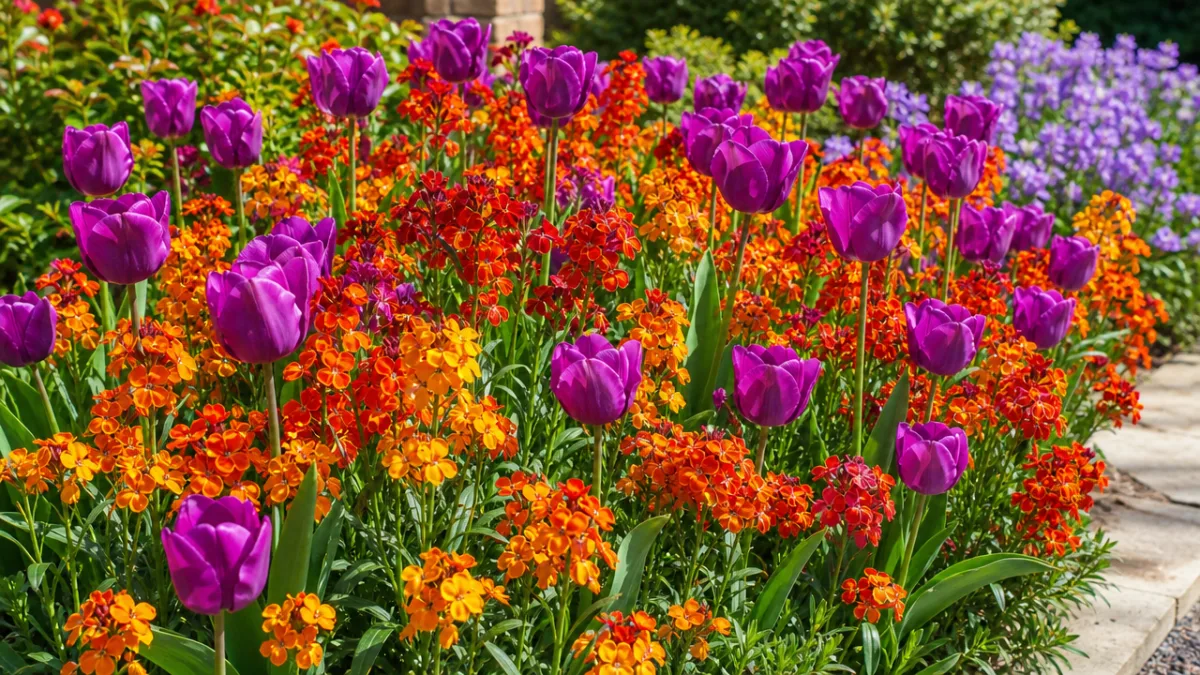
Erysimum cheiri, the common wallflower, is one of spring’s most underrated and underused garden plants. Its velvety, four-petaled flowers in shades of deep orange, amber, red, yellow, and cream appear reliably from March through May, filling a period when the garden is often still finding its feet after winter. The scent of wallflowers is one of the defining aromas of an English spring garden, sweet and slightly spicy, intensifying in warm sunshine to create an olfactory experience that is genuinely moving in the way that only strongly scented flowers can be.
Wallflowers are traditionally planted in autumn to flower the following spring, making them the perfect companion for tulips and other late-season bulbs. The combination of wallflowers and tulips is one of the great classic planting partnerships in gardening, with the cottage-warm tones of the flowers providing an ideal foil for the elegant geometry of tulip blooms rising through them. Orange wallflowers paired with deep purple tulips, or creamy yellow flowers beneath rich red tulips, create color combinations of extraordinary impact that stop visitors in their tracks and invite closer inspection.
From a practical standpoint, wallflowers are best treated as short-lived biennials and replaced with fresh plants each year, since older specimens tend to become woody and lose their vigor. Sow seeds in late spring in a nursery bed, grow on through summer, then transplant to their flowering positions in autumn after summer bedding has been cleared. Firm planting is essential as wallflowers need a secure root run to perform well. Pinching out the growing tips of young plants in their first season encourages a bushier, more floriferous habit and prevents the legginess that can sometimes make older plants look untidy.
Evening Primrose and Mullein: Bold Architectural Statements
Evening Primrose, Oenothera biennis, is one of the garden’s great nighttime performers. Its large, buttery-yellow flowers open as the sun begins to set, releasing a sweet, delicate fragrance that drifts through the evening garden and attracts moths and other night-flying pollinators. During the day, the flowers remain open but the true magic happens at dusk when fresh blooms unfurl in real time, almost visibly, a phenomenon that never fails to delight anyone fortunate enough to witness it. For gardeners who work during the day and enjoy their outdoor space primarily in the evening, Evening Primrose is an essential and thoughtfully chosen addition.
Verbascum, or Mullein, brings a completely different kind of drama to the garden through sheer architectural presence. Its enormous felted rosettes of silver-grey leaves in the first year give way in the second to towering flower spikes covered in small blooms in yellow, white, pink, or purple depending on the variety. The overall effect is monumental and slightly otherworldly, like something from a botanical illustration of an ancient medicinal garden. Mullein works particularly well in gravel gardens, dry borders, and naturalistic plantings where its sculptural quality can be fully appreciated against a simple background.
Both Evening Primrose and Mullein are highly attractive to wildlife and contribute significantly to garden ecology. Evening Primrose supports specialist moth species whose larvae feed on its foliage, while Mullein is a host plant for the striking Mullein moth caterpillar, a boldly patterned creature that is a delight to find during a garden inspection. By including these plants in the garden, you are creating habitat and food sources for a range of creatures that form part of the wider ecological web. This alignment of visual beauty with ecological function represents gardening at its most intelligent and satisfying.
Creating a Biennial Garden: Planning for Year-Round Impact
The key to getting the most from biennials is understanding how to establish a continuous succession so that you always have plants at every stage of their two-year cycle. The simplest approach is to divide your sowing into two batches in alternate years, so that while one group is flowering, another is building its root system and foliage. Over time, this creates a self-sustaining rhythm that requires only minimal intervention each year to maintain, and the garden benefits from a constant flow of new plants coming into their prime without any awkward gaps or periods of emptiness.
When planning where to place biennials in the garden, consider how they will interact with the plants around them throughout both years of their life cycle. In their first year, most biennials are relatively compact and low-growing, making them useful ground-level fillers among perennials and shrubs. In their second year, taller species like foxgloves, hollyhocks, and mullein will need space to spread upward without being crowded. Mapping out this progression in advance and choosing neighboring plants that will complement rather than compete with biennials at each stage is an enjoyable planning exercise that pays substantial dividends when the garden comes into bloom.
Self-seeding is one of the greatest gifts that biennials offer the gardener, and learning to work with it rather than against it transforms the experience of growing these plants entirely. Rather than tidying away spent plants the moment they finish flowering, allow them to set seed and disperse naturally. Thin out the resulting seedlings to prevent overcrowding, transplant desirable ones to gaps in the border, and simply enjoy the unexpected placements that nature selects. Over several seasons, a garden managed this way develops a naturalistic spontaneity and layered richness that is impossible to achieve through deliberate planting alone, and that becomes one of its most distinctive and beloved qualities.
- Foxglove (Digitalis purpurea) — Tall spires in purple, pink, and white; perfect for partial shade and woodland edges.
- Sweet William (Dianthus barbatus) — Fragrant, richly patterned clusters ideal for cutting and cottage borders.
- Honesty (Lunaria annua) — Spring flowers followed by luminous silver seedheads; thrives in shade.
- Hollyhock (Alcea rosea) — Towering old-world columns perfect for walls and fences.
- Wallflower (Erysimum cheiri) — Intensely fragrant spring blooms that partner perfectly with tulips.
- Evening Primrose (Oenothera biennis) — Evening-opening yellow flowers that attract moths and night pollinators.
- Mullein (Verbascum) — Dramatic architectural spires rising from silver felted rosettes.
- Canterbury Bells (Campanula medium) — Elegant bell-shaped blooms in blue, pink, and white for mid-summer interest.








What do you think?
It is nice to know your opinion. Leave a comment.