










Why Trellises Are the Secret Weapon of Backyard Design
When most homeowners think about creating a private, beautiful backyard, their minds jump immediately to tall wooden fences or dense hedges. But trellises offer something neither of those options can fully deliver: a living, breathing structure that grows more beautiful with every passing season. A well-placed trellis transforms an ordinary outdoor space into something that feels intentional, intimate, and genuinely personal. It gives your yard a sense of architecture without the heaviness of a solid wall.
The appeal of trellises goes far beyond simple aesthetics. They serve as a framework for nature, inviting climbing plants to weave themselves into a living tapestry that changes with the light, the season, and the year. In spring, a trellis covered in wisteria or clematis becomes a cascade of color. By summer, dense foliage creates a green privacy screen that a wooden fence simply cannot replicate. Even in winter, the skeletal structure of a trellis has a quiet elegance that keeps your garden looking designed rather than dormant.
Perhaps most importantly, trellises are among the most versatile and cost-effective landscaping investments you can make. Unlike a full fence installation, a trellis can be purchased, built, or assembled on a weekend with modest materials and basic tools. And because they work with plants rather than replacing them, trellises become more valuable over time as the greenery they support fills in and matures. This combination of affordability, beauty, and practicality makes them one of the smartest choices in backyard design today.
The History and Evolution of Garden Trellises
Trellises have a rich history stretching back thousands of years. Ancient Egyptian gardens used latticed structures to support grapevines, and Roman villa gardens were famous for their elaborate pergolas and climbing plant structures. The concept traveled through history into medieval European monastery gardens, where trelliswork helped organize productive herb and flower plots while also serving as a meditative architectural element. The tradition has never really faded — it has only grown more refined.
In the Victorian era, trellises became a symbol of cultivated taste. Elaborate ironwork trellises adorned English country gardens, and the fashion for training roses up latticed screens reached its cultural peak during this period. This era gave us many of the rose varieties — hybrid teas, climbers, ramblers — that remain trellis favorites today. The Victorian gardening tradition left behind a legacy of pairing structural beauty with natural abundance that continues to influence backyard design in the modern era.
Contemporary trellis design has evolved significantly, embracing materials and forms that earlier gardeners could not have imagined. Today you can find sleek aluminum trellises with a minimalist profile, modular systems that can be reconfigured to suit any space, and even living trellis structures made from woven willow or bamboo. The core principle, however, has never changed: give climbing plants a surface to reach for, and they will reward you with something extraordinary.
Choosing the Right Trellis Style for Your Space
Before you purchase or build a trellis, it is worth spending time considering the visual language of your existing outdoor space. A rustic cedar trellis with a hand-built quality suits a cottage garden or a farmhouse-style backyard beautifully, but might look out of place in a sleek, modern landscape where clean lines and neutral tones dominate. Conversely, a minimalist powder-coated metal trellis would look striking against a contemporary fence but might feel cold and industrial next to a traditional brick patio. Matching your trellis style to your overall aesthetic is the first and most important design decision you will make.
The scale of your trellis matters enormously and is often underestimated by first-time buyers. A small decorative trellis panel leaning against a wall might look charming in a garden center, but once it is in your yard surrounded by established shrubs and large planters, it can disappear entirely. For meaningful privacy and visual impact, most outdoor spaces benefit from trellis panels that are at least five to six feet tall. If you are trying to screen a specific sightline — a neighbor’s window, a utility area, a busy street — it pays to go taller rather than shorter and then allow the plants to do the softening work.
Consider also how the trellis will be anchored and supported. Freestanding trellis panels need sturdy posts set into the ground, ideally in concrete, to withstand wind loading once they are covered with mature plants. Wall-mounted trellises need to be fixed to appropriate surfaces with hardware rated for outdoor use. A trellis that shifts or sags will damage the plants trained onto it and can become a safety hazard. Taking the time to plan proper installation before you begin ensures that your trellis will serve you well for decades rather than seasons.
Popular Trellis Styles at a Glance
- Diamond lattice: The classic and most widely available style, excellent for traditional gardens and versatile enough for most climbing plants.
- Square grid: A more contemporary look that suits modern landscapes and works especially well with large-leafed climbers like hydrangea petiolaris.
- Fan trellis: Ideal for training fruit trees and roses against walls, creating a beautiful espalier effect with maximum visual drama.
- Lean-to arch: A freestanding curved structure that creates a natural gateway or focal point at a garden entrance.
- Modular panel systems: Flexible configurations that allow you to build privacy screens in L-shapes, U-shapes, or any custom layout your space requires.
The Best Climbing Plants for Trellis Privacy Screens
The trellis itself is only half the equation. The plants you choose to grow on it will ultimately determine whether your privacy screen succeeds or struggles, whether your garden feels lush or sparse, and how much maintenance your new feature demands each season. Choosing the right plant for your specific climate, soil type, sun exposure, and aesthetic goals is as important as any structural decision. The good news is that the range of climbing plants available to gardeners today is broader and more exciting than ever before.
For pure, fast privacy coverage, few plants rival the star jasmine in warmer climates. This vigorous evergreen twiner produces dense, glossy foliage year-round and fills the air with intoxicating fragrance during its spring flowering period. In cooler climates, Virginia creeper provides exceptional speed of growth and delivers one of the most spectacular autumn color displays in the plant kingdom, turning deep crimson before the leaves fall. For year-round coverage in cold regions, evergreen clematis varieties like Clematis armandii offer both seasonal flowers and persistent foliage that keeps the screen effective through winter.
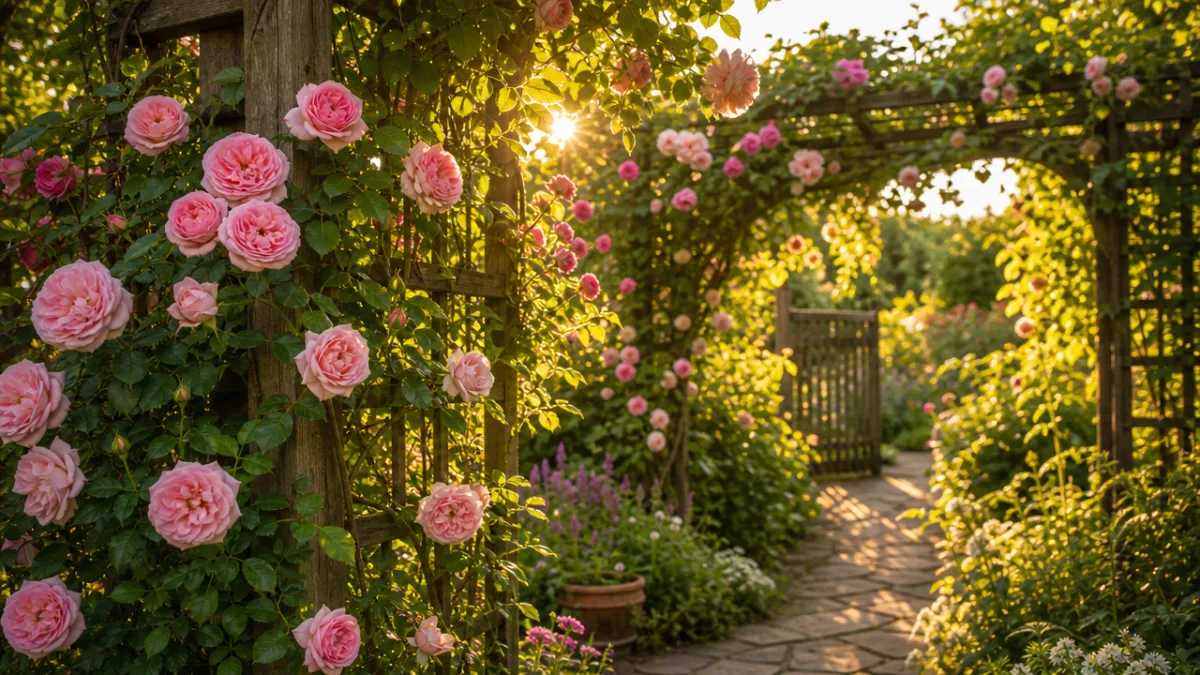
Roses deserve special mention because they bring something to a trellis that almost nothing else can match. A mature climbing rose in full summer bloom is one of the most breathtaking sights in any garden, and the range of varieties available — from delicate pale blush to deep velvety crimson — means there is a climbing rose to suit almost any color palette. They do require more care than some other climbers, including annual pruning and attention to pests like aphids and blackspot, but the payoff in beauty is extraordinary. Pairing a climbing rose with a less demanding companion like clematis, allowing the two to weave together, is a classic combination that continues to delight gardeners everywhere.
Fast-Growing Climbers for Quick Results
- Wisteria: Extraordinary beauty and vigorous growth, though it requires strong support and patient pruning to keep it well-mannered.
- Passionflower (Passiflora): Exotic-looking blooms and very fast coverage, with some varieties producing edible fruit as a bonus.
- Trumpet vine (Campsis): Explosive growth rate and brilliant orange or red flowers that attract hummingbirds and pollinators in abundance.
- Hops (Humulus lupulus): A surprisingly ornamental plant that can cover a large trellis in a single season and dies back cleanly in autumn.
- Annual sweet peas: Not a permanent solution, but unbeatable for filling in a new trellis quickly with color and fragrance while permanent plants establish.
When selecting plants, always factor in the eventual weight load they will place on your trellis. Wisteria, in particular, can become extraordinarily heavy after a decade of growth and has been known to pull down inadequately built structures. Ensure your trellis and its supports are rated for the mature weight of the plant you intend to grow on it, not just the lightweight cutting or seedling you are starting with. A conversation with a local nursery professional who understands your climate zone can save you from expensive and frustrating mistakes in the early stages of your project.
DIY Trellis Building: Materials, Tools, and Step-by-Step Planning
Building your own trellis is a deeply satisfying project that puts you in complete control of the size, style, spacing, and material of the finished structure. Even gardeners with modest carpentry skills can produce a beautiful and functional trellis with basic tools and a thoughtful approach to planning. The most important preparation you can do before you begin cutting any wood or metal is to sketch out your design to scale and calculate the exact quantities of materials you will need, including a modest allowance for waste and error.
Cedar and redwood are the traditional material choices for DIY trellises because both woods contain natural oils that resist rot and insect damage without chemical treatment. They are, however, more expensive than pressure-treated pine, which is also a viable option if you are comfortable using a wood preservative rated for ground contact. For a more modern look, powder-coated aluminum tubing or steel rebar (which develops a beautiful patina as it ages) can create sleek, industrial-style trellis structures that are virtually maintenance-free. Bamboo offers a quick, low-cost option for more informal or tropical-themed garden styles, though it does degrade faster than other materials and will need replacing every several years.
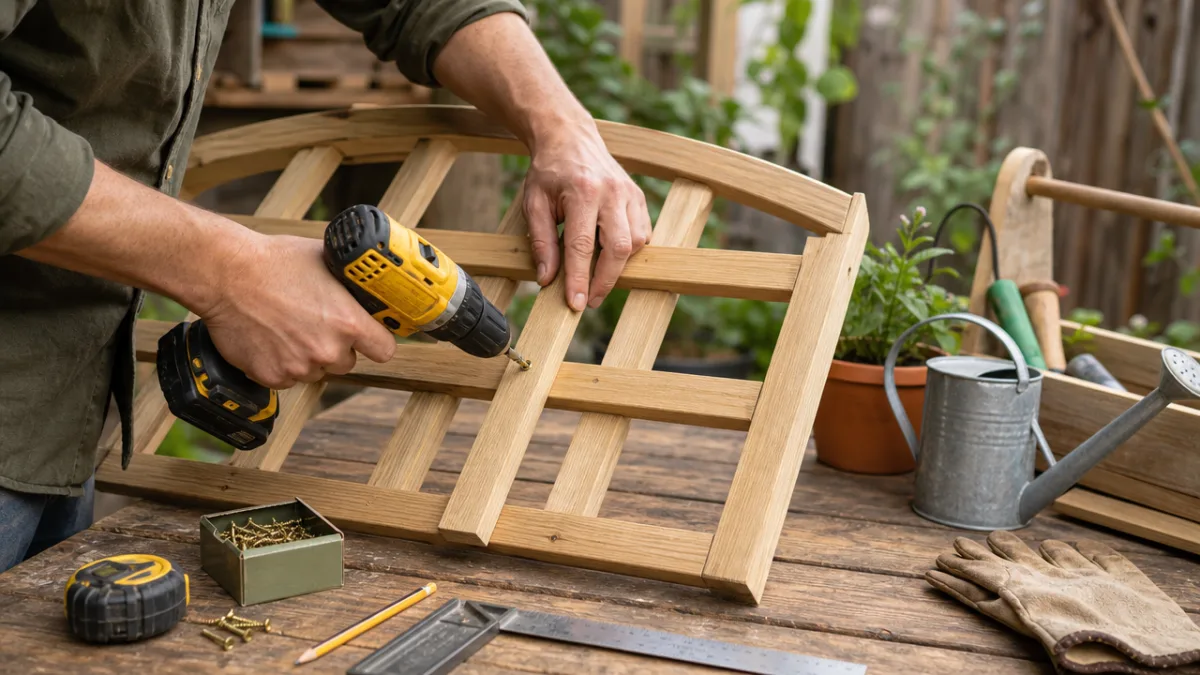
The basic construction of a lattice trellis panel involves creating a rectangular outer frame from heavier lumber — typically two-by-twos or two-by-threes — and then filling the interior with a grid of thinner slats or ready-made lattice sheeting. If you are cutting your own grid from individual slats, a simple jig clamped to your workbench makes it easy to achieve consistent spacing throughout the panel. Pre-made lattice panels available at most home improvement stores offer a faster alternative, though they are thinner and often less durable than custom-cut work. Either approach can produce an attractive result when properly painted, stained, or sealed before installation.
Essential Tools for a DIY Trellis Project
- Circular saw or miter saw for clean, accurate cuts on framing lumber
- Power drill with screwdriver bits and a drill bit set appropriate for your chosen material
- Post hole digger or auger for setting ground anchors securely
- Level and measuring tape to ensure panels are perfectly plumb and evenly spaced
- Clamps for holding pieces in position while fastening
- Sandpaper or orbital sander to smooth all cut edges before applying finish
- Exterior-grade paint, stain, or sealant appropriate for your chosen wood species
Creative Trellis Ideas to Transform Your Outdoor Space
Beyond the standard freestanding privacy screen, trellises offer an almost unlimited range of creative applications in the backyard. One of the most impactful uses is the creation of an outdoor room — a defined space within your garden that feels separate and sheltered from the rest of the yard. By arranging trellis panels in a U-shape around a seating area and training fast-growing climbers over the top of a simple pergola frame, you can create a green bower that feels genuinely magical by midsummer, a private living space that invites lingering conversation and quiet relaxation.
Trellises can also be used creatively to address common backyard problems that seem difficult to solve. An ugly utility area housing air conditioning units, recycling bins, or pool equipment can be screened quickly and attractively with a trellis panel. A narrow side yard that connects the front and back of a property can be transformed into a fragrant, flower-filled passageway using a series of arch-topped panels linked together. Even a blank garage wall or the side of a garden shed can be brought to life with a wall-mounted trellis and a vigorous climber — a solution that adds immense visual charm for very modest cost.
For those with small outdoor spaces such as urban balconies or compact courtyard gardens, trellis design takes on particular importance. In these settings, every element must work harder because space is at a premium. A single well-planted trellis panel on a balcony can provide meaningful privacy from neighboring properties, create a backdrop for container plants, reduce wind exposure for more delicate plantings, and add enough vertical greenery to make the space feel genuinely garden-like rather than merely functional. The key in small spaces is to choose compact, well-behaved climbers and to maintain them carefully so they remain assets rather than becoming unruly obstacles.
Trellis Lighting: Extending Beauty into the Evening
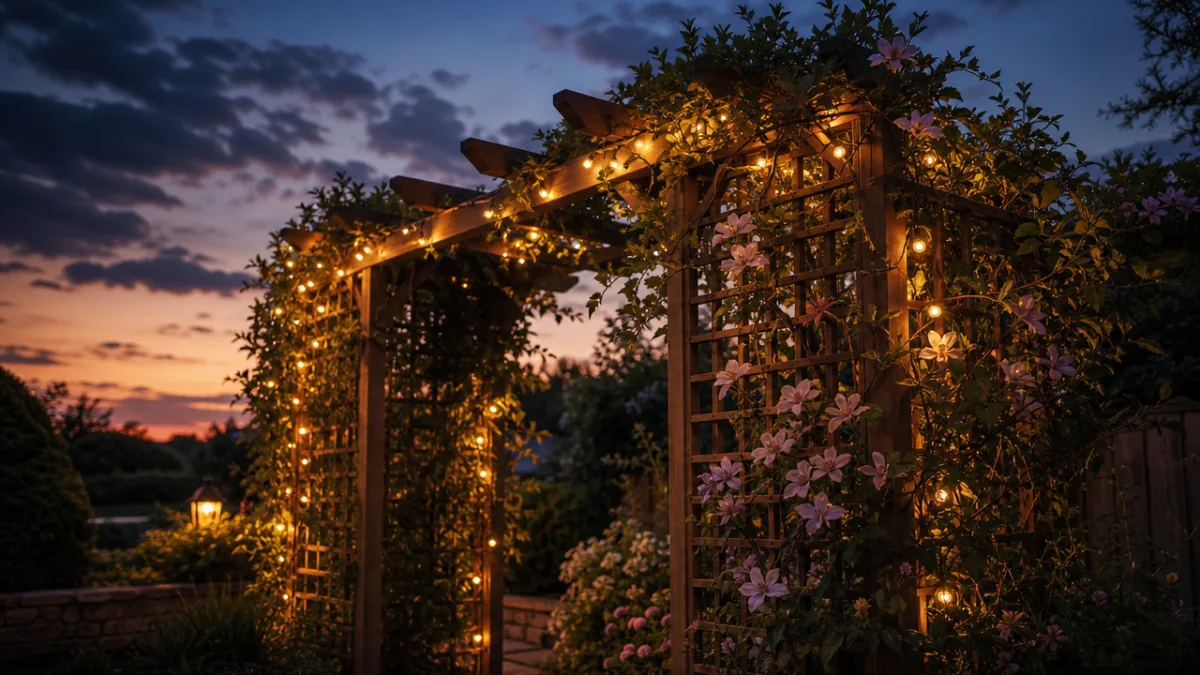
One often-overlooked aspect of trellis design is the opportunity it presents for creative outdoor lighting. A trellis woven with solar string lights or fitted with small clip-on LED spotlights becomes a completely different kind of feature after dark, casting warm, dappled light through the foliage and creating an atmosphere that no other garden structure can quite replicate. The organic, irregular shadows created by light filtering through a plant-covered trellis are among the most beautiful effects in outdoor design, and they cost very little to achieve once the trellis and plants are in place.
Solar-powered fairy lights are the simplest and most accessible option, requiring no electrical work and recharging themselves each day without any ongoing cost. For a more dramatic or theatrical effect, low-voltage LED spotlights directed upward through the base of the trellis create a sophisticated uplighting effect that highlights the architecture of the structure and the texture of the foliage simultaneously. Some homeowners choose to combine both approaches — fairy lights for ambient warmth and spotlights for feature drama — creating a layered lighting scheme that makes the garden genuinely beautiful at any time of day or night.
Consider also the color temperature of any lights you install. Warm white lights with a color temperature around 2700 to 3000 Kelvin complement the natural greens and earth tones of a planted trellis beautifully, creating an inviting glow that flatters both the plants and the people nearby. Cooler white lights above 4000 Kelvin can look harsh and slightly clinical in a garden setting and tend to work better in more architectural, contemporary outdoor spaces where their crispness suits the overall aesthetic. Taking the time to choose the right light color is a small decision that makes a surprisingly large difference in the final result.
Maintaining Your Trellis and Climbing Plants for Long-Term Success
A trellis is not a set-it-and-forget-it garden feature, but the maintenance it requires is neither demanding nor technically complex. The most important routine task is monitoring how your climbing plants are attaching themselves to the structure and intervening when necessary to guide growth in the direction you want. Most climbers will find their own way given adequate support, but occasionally a vigorous new shoot will reach in the wrong direction, or a heavy branch will hang loose from the trellis in a way that could cause damage if left unaddressed. A quick walk around your trellis every couple of weeks during the growing season is enough to catch these issues early.
Annual pruning is essential for almost every climbing plant grown on a trellis, and it serves multiple important purposes. Pruning removes dead, diseased, or damaged wood before it can cause problems. It controls the overall size and weight of the plant, preventing it from overloading the trellis structure. It encourages the production of new flowering growth, which typically produces more blooms than older, woodier stems. And it allows you to shape the plant so that it covers the trellis evenly rather than becoming lopsided, which is a common problem with vigorous climbers that are left entirely to their own devices for several seasons.
The trellis structure itself needs periodic attention to remain sound and attractive. Wooden trellises should be inspected annually for signs of rot, particularly at the base of posts and anywhere the structure is close to the soil surface. Repainting or resealing wooden trellises every two to three years dramatically extends their service life. Metal trellises should be checked for rust or corrosion, particularly at joints and attachment points, and treated with appropriate rust-inhibiting paint if necessary. These maintenance tasks are straightforward and inexpensive when performed regularly but can become costly and complicated if neglected for too many seasons.
Seasonal Trellis Care Calendar
- Early spring: Inspect structure for winter damage, clean debris from the base, apply fresh ties where needed, begin feeding plants with a balanced slow-release fertilizer.
- Late spring: Train new growth onto the trellis, watch for pest activity on emerging foliage, water consistently during dry spells as plants put on rapid new growth.
- Summer: Deadhead flowering climbers where accessible to encourage repeat blooming, continue guiding new growth, ensure the structure is bearing weight load evenly.
- Autumn: Carry out major pruning after flowering has finished, cut back annual climbers completely, apply a mulch around the base of perennial climbers to protect roots from frost.
- Winter: Inspect and repair the trellis structure while it is less obscured by foliage, repaint or reseal wooden elements as needed, plan any additions or modifications for the coming season.
Beyond the practical aspects of maintenance, tending a trellis and its climbing plants offers something that purely functional garden elements simply cannot: a genuine ongoing relationship with a living system that is always changing, always growing, and always offering something new to observe and appreciate. Whether you are training a new shoot of clematis across a bare section of lattice, watching the first buds swell on a climbing rose in early spring, or simply sitting beneath a wisteria-covered pergola on a warm summer evening surrounded by the sound of bees and the scent of flowers, a well-maintained trellis gives you a reason to be present in your garden in a way that very few other features can match. That presence — that attentive, patient engagement with a growing thing — is perhaps the greatest reward that trellis gardening has to offer.








What do you think?
It is nice to know your opinion. Leave a comment.