










9 DIY Lanterns to Illuminate Your Porch, Patio, or Garden
The Magic of Handcrafted Outdoor Lighting
There’s something really special about stepping outside on a warm evening and being greeted by the soft, flickering glow of lanterns you actually made yourself. DIY outdoor lanterns add a personal touch that no store-bought fixture can come close to matching — they turn an ordinary porch, patio, or garden into a space that feels lived-in, cozy, and intentional. When you make your own lighting, every little detail reflects your taste, your home’s character, and the kind of atmosphere you actually want out there.
Handcrafted lanterns are also a great excuse to get creative without spending much money. Honestly, some of the most stunning DIY lantern projects use stuff you probably already have lying around — mason jars, tin cans, wooden crates, old wine bottles. With a few basic tools, some string lights or candles, and a bit of patience, you can put together an outdoor lighting setup that looks like it came from a professionally designed garden and will have your guests asking where you bought it.
Beyond how they look, making your own lanterns gives you total control over scale, color, and mood. Maybe you want tall floor lanterns that anchor your seating area with some real presence. Maybe you’d rather have delicate pieces hanging from tree branches and swaying in the breeze. Or perhaps you just need some low-profile markers along a garden path to help guests find their footing after dark. Whatever you have in mind, DIY lanterns give you the flexibility to pull it off exactly the way you want.
Mason Jar Lanterns: The Classic Starter Project
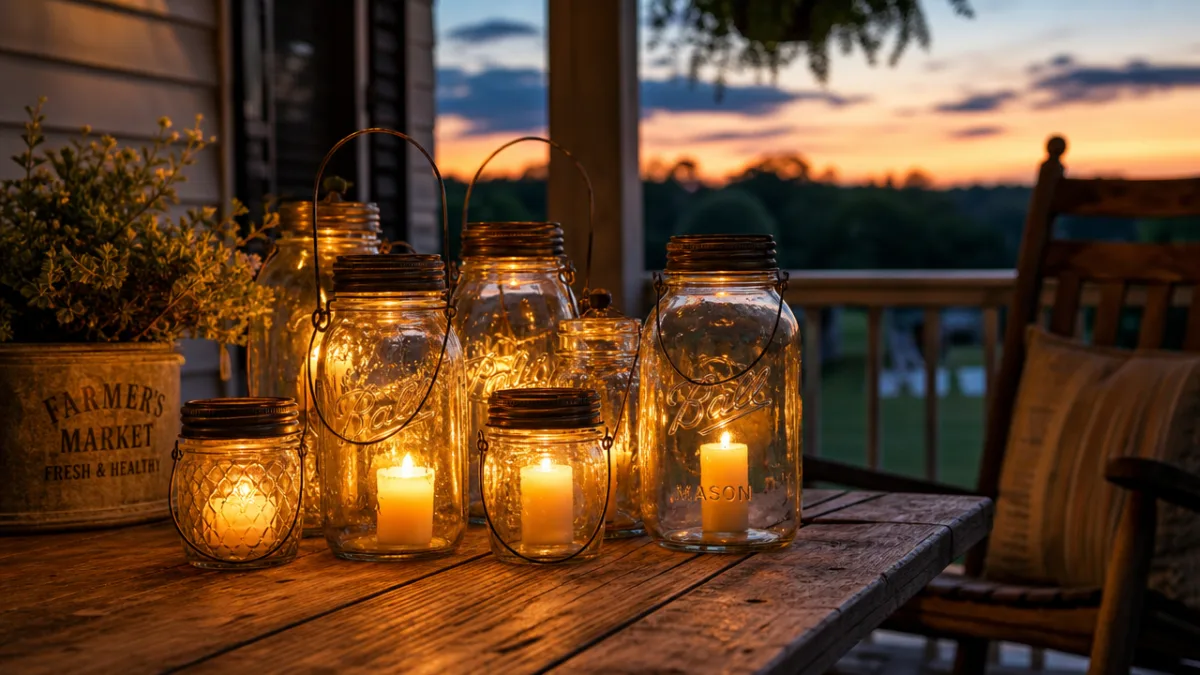
Mason jar lanterns are probably the most popular way to get started with DIY outdoor lighting, and it’s easy to see why. These simple glass jars are cheap, easy to find, and beautifully translucent — candlelight or LED fairy lights just radiate through them in the warmest way. Whether you line them along a railing, cluster them as a table centerpiece, or hang them from a pergola with wire handles, mason jar lanterns bring an instantly charming rustic feel that works with pretty much any outdoor style.
The basic build is genuinely simple. Wrap a length of sturdy wire just below the lid rim of a wide-mouth mason jar, twist it tight to form a secure collar, then extend it upward into a handle that can hold the jar’s weight once you’ve added a candle or light source. From there, you’ve got tons of options — paint the outside with translucent glass paint in amber, cobalt, or sea-glass green to cast colored light around you, or add some decorative sand, pebbles, or dried botanicals to the bottom before dropping in a tea light.
For a more finished look, try grouping mason jar lanterns in odd numbers — three or five — at different heights by varying the length of the hanging wire. The tiered effect creates nice visual depth, especially when a breeze gets them swaying a little. You can also wrap the outside of the jar in jute twine, lace ribbon, or burlap strips to add some texture and make the whole thing feel more artisan. And if you’d rather skip candles altogether, solar-powered fairy light inserts are a smart modern swap that still gives you that warm, organic glow without any fuss.
Tin Can Lanterns: Punched Metal Magic
Tin can lanterns have been part of folk craft traditions for generations, and they’re still one of the most satisfying outdoor lighting projects you can take on. The idea is wonderfully simple: fill a tin can with water, freeze it solid, then use a hammer and nail to punch a decorative pattern through the metal. Once the ice melts and you put a candle inside, light streams through all those tiny holes in the most mesmerizing way, casting intricate shadow patterns across walls, fences, and garden beds.
The secret to really beautiful tin can lanterns is in your pattern choice and keeping your nail work consistent. Before you freeze the can, tape a paper template around it with your design drawn clearly on top. Stars, spirals, geometric grids, a moon silhouette, or even a personalized monogram all work really well. Work your way methodically across the template, spacing the holes evenly for a clean finish. Once the ice has melted and everything is dry, sand down any sharp edges around the holes and hit the whole thing with rust-resistant spray paint — it makes a big difference for how long the lanterns hold up outside.
Tin can lanterns are especially effective when you use several together along a garden path or fence line. What started as an ordinary soup can becomes something completely transformed by the warm glow of candlelight filtering through the pattern — it manages to feel both ancient and surprisingly contemporary at the same time. Mixing sizes, from small tomato paste tins to big coffee canisters, gives your collection a nice variety. Add a wire handle at the top and they move easily between tabletop décor and hanging garden accents.
Wooden Frame Lanterns: Structural Elegance for Any Style
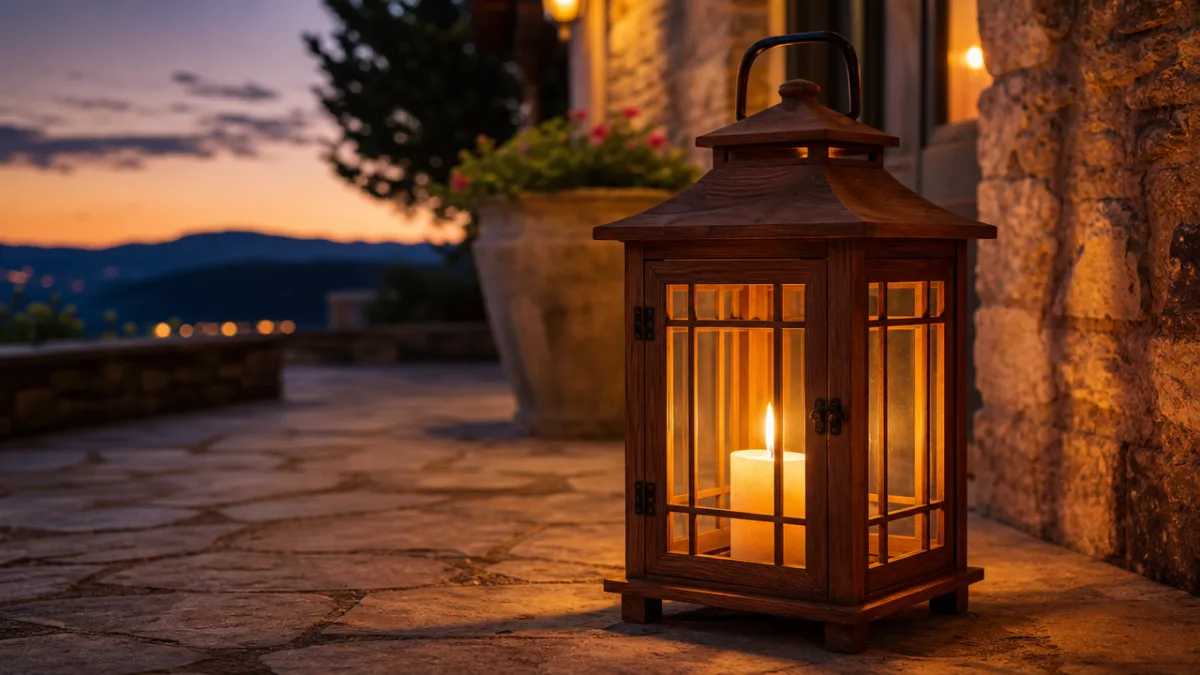
If you’re comfortable with basic woodworking, building a wooden frame lantern opens up a whole world of possibilities. These lanterns are typically made from four or six vertical posts joined by horizontal rails at the top and bottom, creating an open or glazed enclosure for a candle, LED puck light, or small nest of string lights. There’s a permanence and visual weight to a wooden frame lantern that feels genuinely architectural — they look great flanking a front door or sitting at the center of a patio dining table.
Cedar and pine are the go-to choices for outdoor lanterns because they naturally resist moisture and insects without needing a lot of extra treatment. Cut your pieces to consistent lengths, sand everything smooth, and put it together with wood glue reinforced by finishing nails or pocket screws for clean joints. If you want glazed panels, thin sheets of acrylic or glass cut to size slot nicely into routed grooves along the interior edges of the frame. If you prefer an open design, skipping the panels gives the lantern an airier look while still providing enough structure to make whatever light source is inside feel intentional.
The finishing is really where these lanterns get personal. Dark walnut stain gives you something moody and sophisticated that’s perfect for a modern farmhouse aesthetic. Whitewashed paint takes the same structure somewhere coastal or shabby-chic. Matte black exterior paint makes it feel sleek and almost Japanese in its simplicity. Add a simple peaked roof built from mitered wood pieces and you’ve got an outdoor lighting fixture that genuinely looks like it came out of a high-end garden design catalog — made entirely with your own hands.
Upcycled and Unexpected Materials: Creative Lantern Ideas
Some of the most visually striking DIY lanterns don’t come from craft store supplies at all — they come from things you were about to throw away. Wine bottles, for instance, make extraordinary outdoor lanterns when you thread a string of battery-powered LED fairy lights down through the neck. The thick glass diffuses the light into this beautiful soft, jewel-toned glow, especially when the bottles are tinted green, amber, or cobalt blue. Line a few along a garden wall or cluster them on a bistro table and the whole thing instantly has a continental café vibe that costs basically nothing.
Kitchen colanders — the kind you use to drain pasta — become weirdly magical outdoor lanterns when you put a string of lights inside. All those perforated holes project tiny points of light in every direction, creating a star-field effect that’s genuinely enchanting on a covered porch or under a pergola. Old wire cloches meant for protecting garden plants work similarly well — just drape fairy lights inside and set a pillar candle at the base, and the wire structure both keeps the flame protected and casts beautiful light patterns across everything nearby.
Wooden crates, clay pots with drainage holes, glass hurricane vases, paper lantern frames covered in translucent fabric — they all make for compelling starting points. The guiding idea behind all of these projects is the same: find any container or structure that can safely hold a light source while letting that light escape outward in some interesting or beautiful way. This approach keeps your costs low and pushes you toward a kind of creative resourcefulness that makes each lantern genuinely one of a kind — connected to the specific story of your home in a way that nothing off a shelf ever could be.
Hanging Lanterns and Overhead Lighting Installations
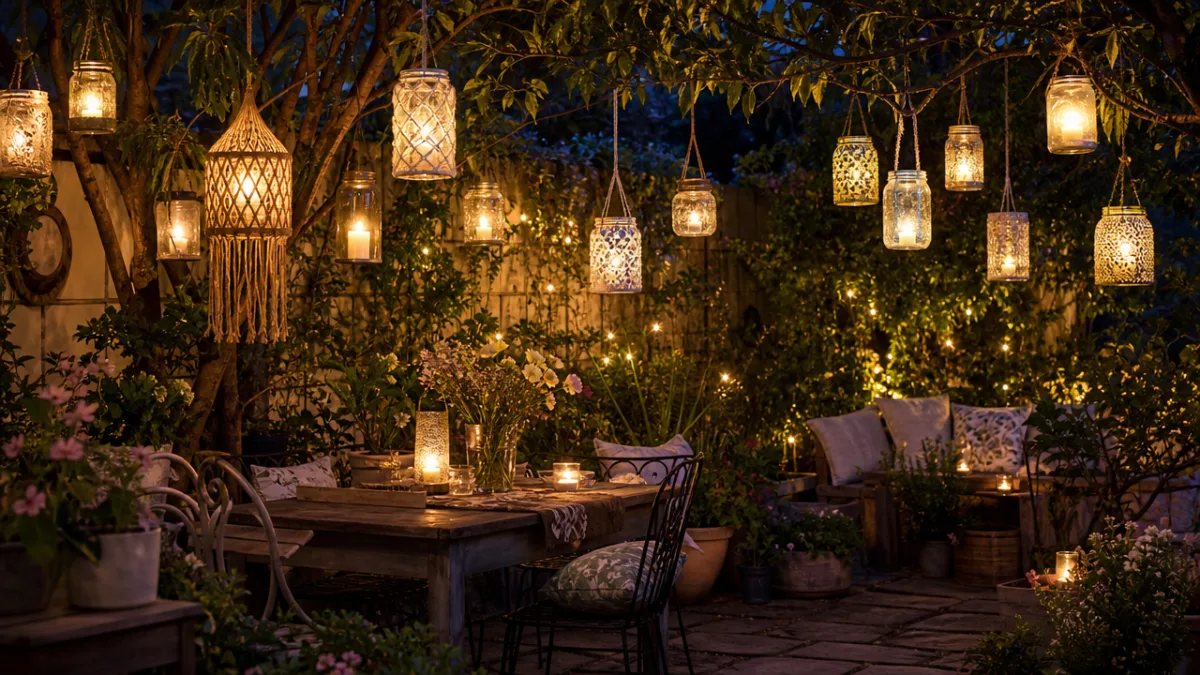
Tabletop and floor lanterns create nice intimate pools of light at eye level, but hanging lanterns and overhead installations do something different entirely — they draw the eye upward and fill the air above your seating area with warmth and texture. A single dramatic pendant lantern hung over an outdoor dining table can anchor the whole space, serving as both practical lighting and a real focal point. A collection of hanging lanterns at different heights from a pergola or tree branch creates that layered, garden-party effect that works beautifully any time of year.
Building hanging lanterns from scratch only takes a modest step up from the skills you’d use for other lantern projects. A hexagonal wooden frame lantern takes on a completely different character when it’s suspended by three equal-length chains meeting at a central hook overhead. Mason jar lanterns grouped on a shared driftwood dowel become more of an installation than a collection of individual objects — the combined effect is considerably more powerful than any one of them on its own. For something more bohemian, wrap an old hula hoop with macramé cord and hang multiple mason jar or tin can lanterns from it for a dramatic circular chandelier that’s a genuine show-stopper.
When you’re planning a hanging lantern installation, structural safety and weather resistance really do need to come first. Make sure whatever anchor point you’re using — a pergola beam, tree branch, or ceiling hook — is rated for the combined weight of your lanterns plus the extra stress that wind movement adds. Use outdoor-rated chain, galvanized wire, or UV-resistant rope for everything that hangs, and check your connections at the start of each season to make sure nothing has shifted. Get those practical details right, and a well-designed hanging lantern installation can become one of the defining features of your outdoor space for years to come.
Tips for Long-Lasting Outdoor Lanterns
Making a beautiful DIY lantern is really only half the job — getting it to survive the elements and keep looking good season after season takes a few protective steps during and after the build. The most important is choosing the right finish for your materials. Any wooden parts should be sealed with exterior-grade polyurethane, marine varnish, or outdoor paint that specifically says weather-resistant on the label. Metal elements — tin cans, wire, hardware — really benefit from a coat of rust-inhibiting spray primer followed by an exterior top coat, especially if you live somewhere humid or coastal where things oxidize fast.
Your choice of light source also matters more than you might think, both for safety and for how long the lantern holds up. Real candles create the most romantic glow imaginable, but they do need supervision outdoors where wind can make the flame unpredictable. Battery-powered LED tea lights and fairy lights have gotten remarkably good in recent years and now produce warm, convincingly flame-like light without any of the risk. Solar-powered LED inserts are even more convenient — they charge during the day and kick on at dusk automatically, with zero effort on your part.
A few other habits will go a long way toward keeping your lanterns looking their best. Bring anything made from paper, natural fibers, or unsealed wood inside during heavy rain, and store all your outdoor lanterns somewhere sheltered during winter if you get freezing temperatures. Wipe down glass and metal surfaces periodically to clear off dirt, pollen, and oxidation buildup. Give all your wire and rope connections on hanging lanterns a quick check at the start of each outdoor season. With that modest level of upkeep, your handcrafted lanterns can reward you for years — maybe even decades — with warm, personal light that tells the story of your creativity every time someone steps outside after dark.








What do you think?
It is nice to know your opinion. Leave a comment.