










Timeless Beauty of Jasmine: Fragrant Elegance for Your Garden
The Enchanting World of Jasmine: An Introduction
There aren’t many plants that inspire the kind of devotion jasmine does. Those delicate star-shaped flowers, that scent — intoxicating is almost an understatement — have been winning over gardeners, poets, and perfumers for thousands of years. Whether you picture sun-baked Mediterranean hillsides or the lush gardens of Southeast Asia, jasmine seems to belong everywhere, woven into the culture and senses of civilizations all over the world. It’s the kind of plant that feels like it’s always been part of human life, and honestly, it pretty much has.
The genus Jasminum includes over 200 species of shrubs and vines, which means there’s a genuinely impressive range to explore — different forms, different fragrances, different flowering habits. Whether you’re drawn to the classic white blooms of Jasminum officinale, the cheerful yellow of winter jasmine, or the rich tropical intensity of Jasminum sambac, there’s something in this family for nearly every garden and every climate. That variety is one of jasmine’s real strengths: it’s not a plant that asks much of you in terms of where you live.
And then there’s the cultural weight jasmine carries, which adds a whole other dimension to growing it. In India, Pakistan, and Indonesia, jasmine flowers are woven into garlands, offered at temples, and tucked into hair as symbols of purity, love, and devotion. During the Victorian era, jasmine stood for grace, elegance, and sensuality in the language of flowers. Growing jasmine connects you to something ancient and universal — something that goes far beyond just having a pretty plant in your garden.
Choosing the Right Jasmine Variety for Your Garden
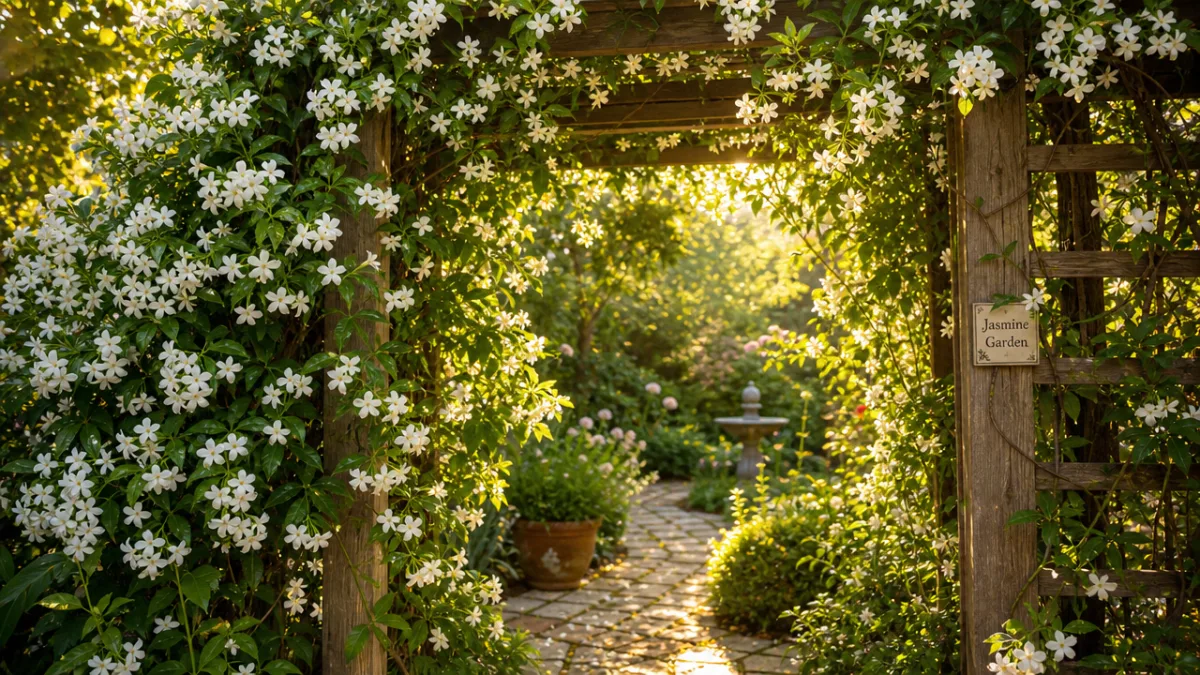
Before you fall for the first jasmine you see at the nursery, it’s worth thinking about your climate, your available space, and the effect you’re actually going for. Common jasmine, Jasminum officinale, is probably what most people picture: a vigorous climbing vine with clusters of intensely fragrant white flowers that bloom from late spring right through early autumn. It handles mild frosts reasonably well and suits USDA hardiness zones 7 through 10, making it a reliable workhorse you can train up an arch, pergola, or fence for seriously impressive results.
If you’re in a cooler climate but still want that jasmine fragrance, star jasmine — Trachelospermum jasminoides — is worth a serious look. Technically it’s not a true jasmine, but its white flowers have that same sweet, heady scent and it tolerates cold far better than many of its relatives. Winter jasmine, Jasminum nudiflorum, goes in a completely different direction: bright yellow flowers in the depths of winter, when almost nothing else is blooming. It’s not fragrant, but it’s a genuine mood-lifter on a grey January day.
Tropical gardeners and anyone growing plants in containers indoors should absolutely consider Jasminum sambac, better known as Arabian jasmine. This is the species behind traditional jasmine tea and some of the finest perfumes in the world, and its fragrance is in a league of its own. When you’re deciding between varieties, a few key things are worth thinking through:
- Your local climate zone and how cold your winters typically get
- How much wall, fence, or trellis space you have for climbers
- Whether you prefer white, yellow, or pink-tinged flowers
- When you want it to bloom — spring, summer, or winter
- Whether it’ll live outside year-round or spend time in a container
Planting and Establishing Jasmine Successfully
Getting jasmine off to a good start really comes down to picking the right spot and not rushing the planting. Most varieties want full sun to partial shade and do best with at least six hours of direct sunlight a day to flower well. For climbing varieties, a south or west-facing wall is ideal in the northern hemisphere — the warmth the masonry absorbs and radiates back encourages strong growth and generous blooming. Shelter from harsh, drying winds matters too, since those can stress the foliage and set the plant back considerably.
It’s also worth taking some time with the soil before you plant, even though it’s tempting to just get things in the ground. Jasmine likes well-draining soil with a slightly acidic to neutral pH, somewhere in the 6.0 to 7.5 range. Work in plenty of well-rotted compost or aged manure to boost both drainage and fertility. If you’re dealing with heavy clay, mix in some coarse grit or perlite — jasmine really does not like sitting in wet, waterlogged soil. Raised beds are a genuinely good option if your garden soil is particularly tricky.
Timing matters when you’re actually putting the plant in the ground. In temperate climates, spring planting after the last frost gives jasmine the most time to settle in before winter. Dig your hole about twice as wide as the root ball and the same depth, tease out any circling roots, and backfill with your amended soil. Water it in well and lay down a generous layer of organic mulch around the base — just keep it a few centimetres back from the stem to avoid rot. That mulch does a lot of good work: it holds moisture, steadies the soil temperature, and keeps the weeds down while the plant finds its feet.
Caring for Jasmine Throughout the Seasons
Once jasmine is established, it’s a pretty easygoing plant to live with — but it does reward a bit of regular attention through the seasons. In spring and summer, watering consistently is the main job, especially during dry stretches. The goal is soil that stays moist but never soggy, so water deeply and less often rather than giving it little sips that only wet the surface and encourage shallow roots. The simplest check is just pressing a finger into the top few centimetres of soil: dry means it’s time to water, still damp means you can hold off.
Feeding during the growing season makes a noticeable difference to how well jasmine blooms. A balanced general-purpose fertilizer in early spring gets the plant going and supports healthy leaf growth. Once flower buds start forming, switch to something higher in potassium — a tomato feed works well — to encourage more flowers that last longer. Go easy on nitrogen-heavy fertilizers though; they push leafy growth at the expense of blooms, which is the opposite of what you’re after.
Pruning keeps jasmine manageable and keeps it producing new flowering wood, so it’s worth getting the hang of. The approach depends on your variety. Most summer-flowering jasmines bloom on the current season’s growth and just need a light tidy after flowering to remove dead or crowded stems. Winter jasmine is the exception — prune that one right after it finishes flowering in late winter or early spring. To keep things simple, here’s a rough seasonal checklist:
- Spring: Refresh the mulch, start feeding, tie in new shoots on climbing varieties
- Summer: Keep up with watering, remove spent blooms where you can reach them, keep an eye out for pests
- Autumn: Ease back on watering, apply a slow-release fertilizer to support the roots through winter
- Winter: Protect tender varieties from frost, prune winter jasmine once it’s done flowering
Jasmine in Garden Design: Fragrance as Architecture
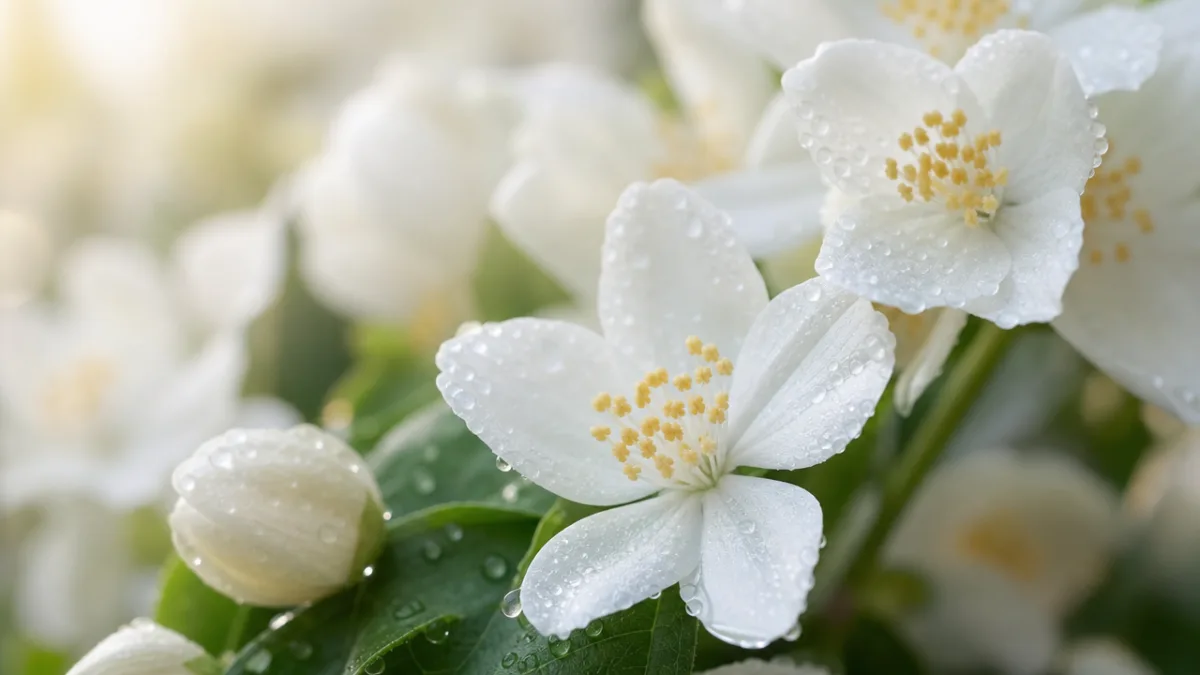
Scent is one of the most powerful tools you have as a gardener, and jasmine lets you use it deliberately. Placed near an entrance gate or front door, it gives visitors a fragrant welcome before they’ve even crossed the threshold. Trained over a pergola above a patio or outdoor dining area, it turns an ordinary evening outside into something genuinely special. It’s the kind of detail that people might not consciously notice, but they’ll always remember how the garden felt.
For smaller spaces — courtyards, balconies, or tiny gardens — jasmine in a large container is a surprisingly effective solution. A good-sized pot of Jasminum polyanthum trained up a simple obelisk can become a real focal point, and the bonus is that you can bring tender varieties indoors when cold weather arrives. When you’re pairing container jasmine with companions, think about complementary colors and textures: soft blue lavender, silvery artemisia foliage, or the loosely romantic blooms of a climbing rose all work beautifully alongside it.
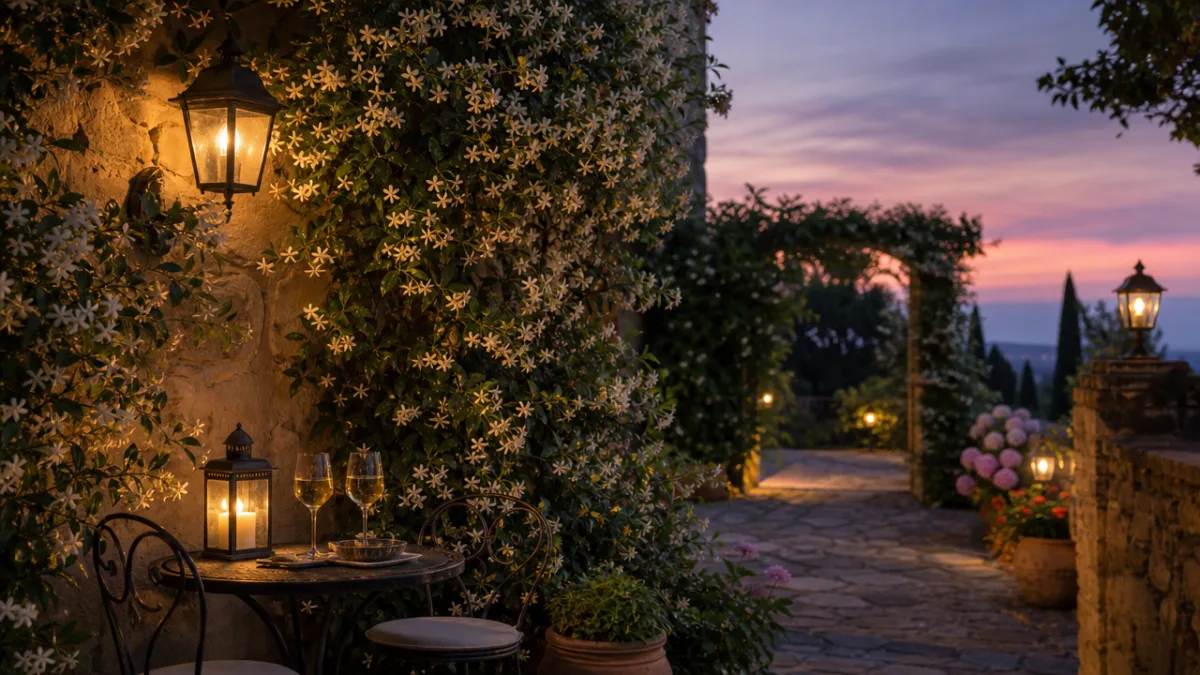
If you’ve ever come across the concept of a moonlit garden, jasmine is practically its poster plant. Many varieties release their scent most intensely in the evening, as the flowers fully open and the cooling air allows the fragrance to drift more freely. Positioning jasmine where you’ll pass it on warm summer evenings — along a path, beneath a bedroom window, beside a favorite bench — means you get to experience it at its absolute best. Pair it with other night-fragrant plants like nicotiana, evening primrose, or night-scented stock, and you’ll have a garden that practically transforms at dusk.
The Cultural Heritage and Therapeutic Benefits of Jasmine
Jasmine’s history with people goes back a very long way. Ancient records from Persia, India, China, and the Arab world all point to its cultivation and use stretching back thousands of years. The name jasmine comes from the Persian yasmin, meaning “gift from God” — which tells you a lot about how this plant was regarded long before modern horticulture existed. In traditional Ayurvedic medicine, jasmine flowers and oil were used for their calming, cooling, and anti-inflammatory properties, and similar uses appear across several Asian medical traditions, covering everything from anxiety and headaches to skin conditions.
The perfume industry has depended on jasmine for centuries, and the numbers behind it are genuinely staggering. Jasmine absolute — extracted through solvent extraction or the ancient technique of enfleurage — is one of the most expensive natural fragrance materials on the planet. It takes around eight million jasmine flowers to produce a single kilogram of the stuff, which helps explain both its value and the sheer scale of labor involved in harvesting those tiny, hand-picked blossoms. The town of Grasse in southern France built its reputation as the perfume capital of the world largely on its jasmine harvest, and the annual picking season is still a celebrated local event.
Modern aromatherapy research is starting to back up what traditional healers have claimed for centuries. Studies suggest jasmine scent has genuine anxiolytic effects — meaning it can actually help ease feelings of anxiety and promote calm — and some research points to mood-lifting benefits and possible relief from mild depression symptoms too. For those of us growing jasmine at home, that’s a genuinely lovely thing to know. Every time you stop beside a flowering vine and breathe in, you’re not just enjoying a nice smell. You’re participating in a therapeutic ritual with thousands of years of history behind it, connecting your body and mind to the natural world in the simplest possible way.
Propagating Jasmine and Expanding Your Collection
One of the real pleasures of growing jasmine is how easy most varieties are to propagate. The most reliable method is semi-hardwood cuttings taken in mid to late summer, once the current season’s growth has started to firm up but hasn’t gone fully woody yet. Look for healthy, non-flowering shoots about 10 to 15 centimetres long, cut cleanly just below a leaf node with a sharp, clean blade, strip off the lower leaves, dip the cut end in rooting hormone powder, and push it into a pot of gritty, free-draining compost. It’s a straightforward process once you’ve done it a couple of times.
Layering is another great option, especially if you want something simpler and lower-stakes than cuttings. It works with jasmine’s naturally flexible stems, which bend down to soil level without snapping. Find a long, pliable stem on the parent plant, wound the underside slightly at the point where it’ll contact the soil, dab a little rooting hormone on the wound, and peg it firmly into a pot of compost set beside the parent. Keep the compost consistently moist. Within a few months, roots will have developed at the wounded point, and you can sever the new plant from its parent and grow it on by itself.
Growing jasmine from seed is possible, but it’s slow, less predictable, and many cultivated varieties won’t come true from seed anyway. If you want to give it a go, sow fresh seeds in spring somewhere warm and consistently moist — jasmine seeds need both to germinate well. Whichever method you choose, there’s something genuinely satisfying about raising new plants from your existing jasmine. One established plant can eventually give you dozens of offspring: enough to fill a whole new corner of the garden with fragrance, or to have a generous supply on hand for friends and neighbors who’ve been quietly envying yours for years.








What do you think?
It is nice to know your opinion. Leave a comment.