










Micromeria thymifolia: A Complete Guide to the Thyme-Leaved Micromeria
Introduction to Micromeria thymifolia
Micromeria thymifolia, commonly known as thyme-leaved micromeria, is a delicate yet resilient aromatic herb belonging to the family Lamiaceae, the same botanical family that includes well-known culinary herbs such as mint, thyme, basil, and lavender. This small perennial subshrub is native to the rocky limestone habitats of the western Balkans, particularly found across Croatia, Bosnia and Herzegovina, Montenegro, and surrounding Adriatic coastal regions. Its discovery and classification have made it a subject of increasing botanical interest over the past several decades.
The genus Micromeria itself encompasses roughly 70 to 130 species of aromatic herbs and subshrubs distributed primarily across the Mediterranean basin, the Macaronesian islands, and parts of eastern Africa. Within this genus, Micromeria thymifolia occupies a particularly fascinating ecological niche, thriving in rocky, calcareous substrates where few other plants dare to compete. Its name, thymifolia, directly translates to “thyme-leaved,” an apt descriptor that captures the plant’s visual resemblance to common thyme in both leaf structure and overall growth habit.
For gardeners, herbalists, and botanists alike, Micromeria thymifolia represents an underappreciated gem of the Mediterranean flora. While it has never achieved the widespread cultivation status of its more famous relatives, increasing interest in native plantings, pollinator-friendly gardens, and drought-tolerant landscaping has brought renewed attention to this charming little herb. Its compact form, aromatic foliage, and attractive small flowers make it genuinely worthy of a place in rock gardens, herb borders, and naturalistic planting schemes throughout temperate regions.
Botanical Description and Identification
Micromeria thymifolia is a low-growing perennial subshrub that typically reaches heights of between 10 and 40 centimeters, forming dense, cushion-like mounds of woody stems topped with soft, leafy growth. The stems are characteristically four-angled, as is typical of the Lamiaceae family, and covered with fine, downy hairs that give the plant a slightly silvery or grey-green appearance. The woody base of the plant becomes increasingly gnarled and branched with age, contributing to its appeal as an ornamental specimen in rocky or alpine garden settings.
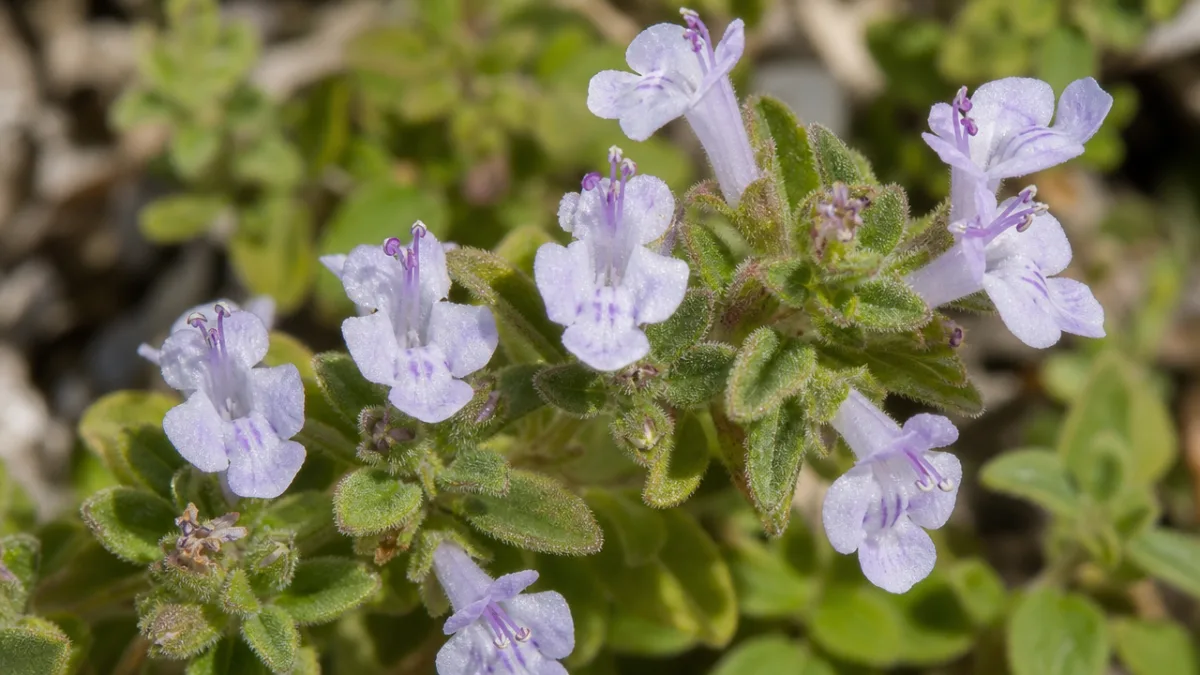
The leaves are the plant’s most distinctive identification feature. Small, ovate to elliptical in shape, they measure only a few millimeters in length and are densely packed along the stems, giving the plant its characteristic thyme-like appearance. The leaf margins are entire or very slightly revolute, meaning they curl gently backward at the edges. Both leaf surfaces are covered with tiny glandular hairs that contain and release the plant’s characteristic aromatic essential oils when touched or bruised, releasing a fragrance that blends notes of thyme, mint, and a subtle resinous quality unique to the species.
The flowers of Micromeria thymifolia are small but visually appealing, produced in whorled clusters along the upper portions of the stems during the plant’s blooming season. They are typically pale pink to lilac-purple in color, forming the classic two-lipped or bilabiate flower structure characteristic of the mint family. The upper lip is slightly hooded while the lower lip is three-lobed, forming a landing platform well suited to pollinating insects. The calyx is tubular, ribbed, and hairy, persisting after the flowers fade and contributing to the plant’s Texture even in its post-flowering state.
Native Habitat and Ecological Preferences
In its native range along the eastern Adriatic coast and the Dinaric Alps, Micromeria thymifolia has adapted remarkably well to challenging environmental conditions that would stress or kill many other herbaceous plants. It is most commonly found growing in crevices and on ledges of rocky limestone outcrops, on dry stony slopes, in garigue and maquis vegetation, and along the margins of open woodland dominated by downy oak or Aleppo pine. The plant is strongly associated with calcareous, free-draining substrates and is rarely found in heavy, moisture-retentive soils.
The climate of its native habitat is characterized by hot, dry summers and mild, moderately wet winters — a classic Mediterranean pattern that has shaped the plant’s physiological adaptations over millennia. Micromeria thymifolia tolerates extended drought periods with remarkable composure, relying on its small leaf surface area, hairy leaf coverings, and deep, exploratory root system to minimize water loss and access moisture stored deep within rock fissures. These same adaptations make it extraordinarily well suited for cultivation in regions prone to summer drought, poor soils, and challenging growing conditions.
Ecologically, Micromeria thymifolia plays an important role within its native plant communities. Its flowers serve as a nectar and pollen source for a wide range of small native bees, hoverflies, butterflies, and other beneficial insects during its summer blooming period. The dense mounding growth habit provides microhabitat for small invertebrates, and the aromatic volatile compounds the plant releases may play a role in deterring herbivory from larger grazing animals. Understanding these ecological relationships is essential for appreciating the plant’s broader value beyond mere aesthetics.
Cultivation and Growing Requirements
Growing Micromeria thymifolia successfully outside its native range is entirely achievable given the right conditions, and in many respects the plant is easier to maintain than some of its more demanding Mediterranean relatives. The single most critical requirement is excellent drainage. This plant will not tolerate waterlogged roots under any circumstances, and poorly drained soil is the most common cause of failure in cultivation. Raised beds, rock gardens, dry stone walls, and containers with generous amounts of grit or gravel mixed into the growing medium are all excellent options for providing the sharp drainage this species demands.
Soil pH is another important consideration. As a plant native to limestone habitats, Micromeria thymifolia performs best in neutral to alkaline soils with a pH between 7.0 and 8.5. Acid soils can be amended with ground limestone or horticultural grit to bring the pH into an acceptable range, though in strongly acidic regions it may be more practical to grow the plant in containers using a specifically formulated alkaline growing medium. In terms of soil fertility, this species actually prefers lean, low-nutrient conditions; excessively rich soils promote lush, soft growth that is more vulnerable to disease and frost damage.
Sun exposure is non-negotiable for this plant’s health and vigor. Micromeria thymifolia should be positioned in a location that receives full sun for the majority of the day, with at least six to eight hours of direct sunlight during the growing season. In partial shade, the plant becomes leggy, produces fewer flowers, and loses much of the compact, dense growth habit that makes it ornamentally attractive. In regions with very hot summers, some afternoon shade can be tolerated, but in temperate climates with cooler summers, maximum sun exposure is strongly recommended to encourage the best performance.
- Plant in full sun with a minimum of six hours direct sunlight daily for optimal flowering and compact growth
- Ensure exceptionally sharp drainage by incorporating coarse grit, gravel, or perlite into the planting area at a ratio of at least one part grit to two parts soil
- Maintain a neutral to slightly alkaline soil pH between 7.0 and 8.5 to mirror the plant’s native limestone habitat conditions
- Water sparingly once established, allowing the soil to dry out completely between watering sessions, particularly during cooler months
- Avoid high-nitrogen fertilizers that encourage soft, disease-prone growth; a light application of a low-nutrient slow-release fertilizer in spring is sufficient
- Trim lightly after flowering to maintain compact shape and encourage fresh aromatic growth for the following season
Propagation Methods and Techniques
Micromeria thymifolia can be propagated through several methods, each with its own advantages depending on the scale of production required and the time of year. Seed propagation is possible and represents the most economical approach when larger quantities of plants are needed. Seeds should be sown in early spring in a free-draining seed compost mixed with extra horticultural grit. Light is required for germination, so seeds should be pressed gently onto the surface of the medium rather than buried deeply. Germination typically occurs within two to four weeks at temperatures between 15 and 20 degrees Celsius, though results can be variable and germination rates are often modest.
Softwood cuttings taken in late spring to early summer offer a more reliable and faster method of propagation, and have the added advantage of producing plants genetically identical to the parent. Cuttings of approximately 5 to 8 centimeters in length should be taken from the soft, actively growing tips of non-flowering stems. Lower leaves should be removed cleanly, and the cut end dipped lightly in rooting hormone powder before being inserted into a gritty, free-draining cutting compost. Cuttings should be kept in a bright, humid environment out of direct sun until roots have formed, which typically takes three to six weeks depending on temperature and conditions.
Semi-ripe cuttings taken in midsummer to early autumn are also effective, though they may take slightly longer to root than softwood cuttings. Division of established clumps is possible but should be approached with care, as this plant does not always respond well to root disturbance. If division is attempted, it is best carried out in early spring just as new growth is beginning to emerge, and the divided sections should be replanted promptly into prepared, well-drained soil and watered in carefully. In all propagation methods, the avoidance of overwatering during the establishment phase is critical to success.
Medicinal, Aromatic, and Culinary Uses
Like many members of the Lamiaceae family, Micromeria thymifolia has a history of traditional use in the folk medicine practices of the Balkan region where it is native. Various species of Micromeria have been employed in traditional medicine across the Mediterranean for their purported antimicrobial, antispasmodic, carminative, and digestive properties. Infusions and teas prepared from the dried aerial parts of the plant have been used historically to ease digestive discomfort, relieve minor respiratory complaints, and as a general tonic herb. While Micromeria thymifolia specifically has been less studied than some other Micromeria species, its chemical profile suggests similar potential biological activities.
Scientific research into the essential oil composition of Micromeria thymifolia has revealed a complex mixture of volatile aromatic compounds that contribute both to its distinctive fragrance and its potential medicinal properties. Studies have identified significant concentrations of compounds including pulegone, isomenthone, pinocamphone, and various other monoterpenes and sesquiterpenes within the plant’s essential oil. Several of these compounds are known to possess antimicrobial activity against a range of bacterial and fungal pathogens, providing some scientific grounding for the plant’s traditional reputation as a medicinal herb. Research in this area is ongoing, and Micromeria species as a group represent a promising area of phytochemical investigation.
In culinary terms, Micromeria thymifolia can be used much as one would use common thyme, albeit with a somewhat more complex aromatic profile. Fresh or dried leaves can be added to Mediterranean-style dishes, marinades, herb-infused oils, and herbal teas. The flavour is aromatic, slightly warm, and herbaceous with mint-like undertones that complement both savory and sweet preparations. Dried bundles of the herb can be used similarly to lavender or thyme in potpourri and aromatic sachets, where the plant’s long-lasting fragrance makes it particularly valuable. As with all herbs used medicinally or in large culinary quantities, appropriate caution and moderation are advisable, and individuals with known sensitivities to the Lamiaceae family should proceed carefully.
- Harvest fresh stems and leaves in the morning after any dew has dried but before the midday heat dissipates the most volatile aromatic compounds
- Use fresh leaves sparingly in salads, herb butters, and as a garnish for Mediterranean dishes where the aromatic intensity can complement rather than overwhelm
- Dry small bundles of stems by hanging them upside down in a warm, well-ventilated space away from direct light to preserve colour and fragrance
- Prepare a simple herbal infusion by steeping one teaspoon of dried herb per cup of just-boiled water for five to ten minutes, then straining before drinking
- Incorporate dried leaves into homemade potpourri blends, combining with lavender, rosemary, and dried citrus peel for a classic Mediterranean fragrance mixture

Ornamental Value and Garden Design Applications
In the contemporary garden, Micromeria thymifolia deserves far greater recognition than it currently receives as an ornamental plant. Its compact, mounding habit, attractive aromatic foliage, and pretty pink-lilac flowers combine to create a plant of genuine beauty that earns its place in a wide range of garden styles and contexts. The plant is particularly well suited to rock gardens and alpine plantings, where its natural affinity for rocky, free-draining conditions means it will thrive with minimal intervention. Positioned in a crevice between limestone rocks or spilling over the edge of a dry stone wall, it creates a naturalistic effect of considerable charm.
Drought-tolerant and xeriscape garden designs are another ideal context for Micromeria thymifolia. As water-conscious gardening becomes increasingly relevant in a changing climate, plants that deliver beauty without demanding irrigation are of growing importance. This species fits perfectly within planting schemes that combine Mediterranean natives and analogues, working harmoniously alongside plants such as lavender, rosemary, cistus, euphorbias, ornamental grasses, and drought-tolerant bulbs. The plant’s flowering period in midsummer fills a valuable gap in many dry garden planting schemes when other species may have finished blooming or are looking stressed by heat and drought.
For gardeners interested in supporting pollinators and native wildlife, Micromeria thymifolia is an excellent addition to a pollinator-friendly planting scheme. The small but numerous flowers are highly attractive to bumblebees, solitary bees, hoverflies, and various butterfly species, providing valuable forage during the summer months. When combined with other pollinator-friendly Mediterranean herbs and subshrubs, it contributes to creating a rich and ecologically valuable garden environment. The plant is also generally resistant to deer and rabbit browsing, thanks to its strong aromatic character — a practical advantage that many gardeners working in rural or semi-rural settings will greatly appreciate.
Conservation Status and Environmental Considerations
While Micromeria thymifolia is not currently classified as globally threatened, several aspects of its conservation status and the pressures facing its native habitats warrant attention and concern. The rocky limestone habitats along the eastern Adriatic coast where the species is most abundant are increasingly subject to pressures from coastal development, tourism infrastructure expansion, invasive plant species, and the intensification of grazing in some areas. The natural garigue and maquis communities within which Micromeria thymifolia grows are among the most biodiverse but also most fragile of Mediterranean vegetation types, requiring sensitive land management to remain intact.
Climate change presents perhaps the most significant long-term threat to Micromeria thymifolia and the plant communities it belongs to. While this species is well adapted to heat and drought, the increasingly extreme and unpredictable weather patterns associated with climate change — including more severe drought episodes, higher temperatures, and changes in winter precipitation — may stress even well-adapted plants at the margins of their tolerance ranges. Additionally, the upward shift in suitable climate zones driven by warming temperatures may force populations of this and related species to migrate to higher altitudes, where suitable rocky limestone substrates may be less available or accessible.
Cultivating Micromeria thymifolia in gardens outside its native range can play a small but meaningful role in raising awareness of Balkan flora and the conservation challenges facing Mediterranean plant communities more broadly. Botanical gardens, specialist nurseries, and enthusiastic private gardeners who grow and propagate this species contribute to maintaining a cultivated genetic pool that, while not a substitute for wild population conservation, at least ensures the plant’s continued existence and accessibility should wild populations come under greater pressure. Supporting organizations that work to protect native Mediterranean habitats represents the most direct way that plant enthusiasts can contribute to the long-term survival of species like Micromeria thymifolia in their natural contexts.








What do you think?
It is nice to know your opinion. Leave a comment.