










Adorable Paper Octopuses: A Complete Guide to Kids’ Art and Craft Projects
Introduction to Paper Octopus Crafts for Children
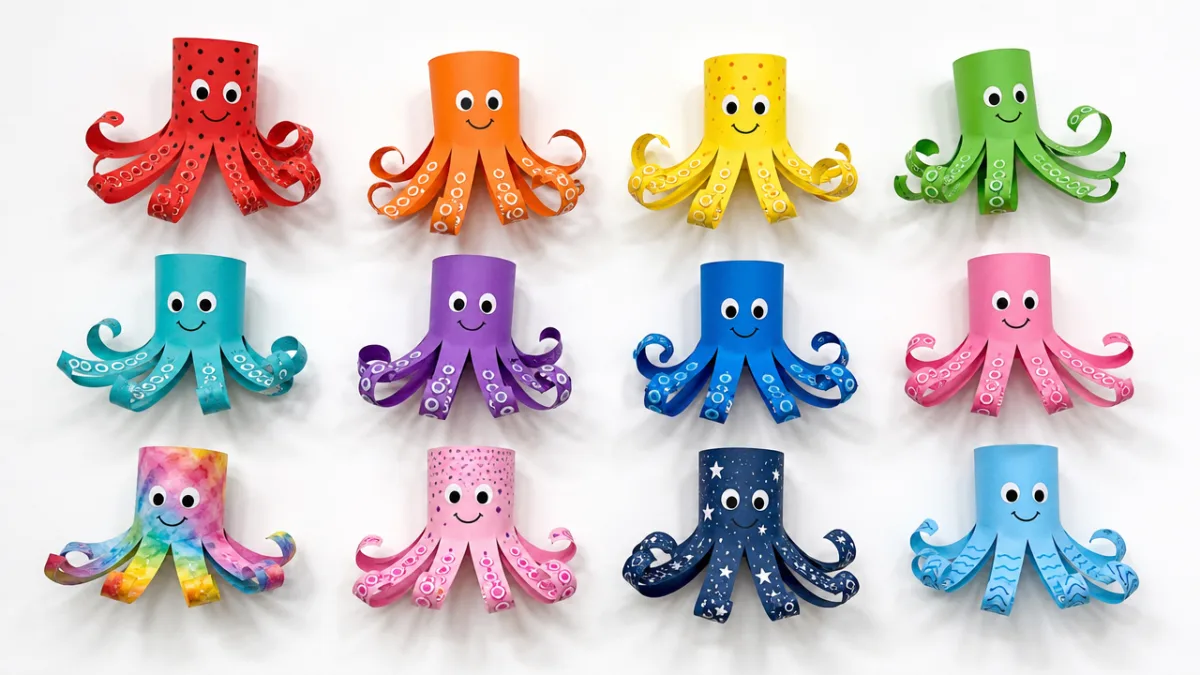
Paper octopus crafts have become one of the most beloved and enduring art projects for children of all ages. These delightful creatures, with their distinctive round heads and curling tentacles, translate beautifully into paper form and offer endless opportunities for creativity, color, and imaginative play. Whether you are a parent looking for a rainy-day activity, a teacher searching for a classroom project, or a craft enthusiast hoping to explore something new, paper octopuses offer a rewarding experience that combines simplicity with remarkable artistic potential.
What makes paper octopus crafts particularly special is their accessibility. Unlike many art projects that require expensive materials or advanced skills, a basic paper octopus can be made using just a few sheets of colored paper, some scissors, glue, and markers. Children as young as three can participate in simplified versions of the craft, while older kids and teenagers can challenge themselves with increasingly intricate designs, including origami-inspired folding techniques, layered Texture effects, and mixed-media embellishments that transform simple paper into striking works of art.
Beyond the creative satisfaction they provide, paper octopus crafts offer rich educational value. They introduce children to marine biology in a gentle, engaging way, sparking curiosity about ocean life and the fascinating real-world behavior of octopuses. Fine motor development, color theory, spatial reasoning, and following multi-step instructions are all skills naturally reinforced through the craft process. When children hold up a completed paper octopus with a beaming sense of pride, they are celebrating far more than a pretty decoration — they are celebrating their own growing capabilities and confidence as young creators.
Materials and Tools You Will Need
Gathering the right materials before you begin is key to a smooth and enjoyable crafting experience. The beauty of paper octopus projects is that most of the supplies are already likely to be found in a typical home or classroom. Construction paper is the most common starting material, available in a wide rainbow of colors that children can choose from to personalize their octopus. For a more vibrant finish, cardstock offers greater durability and holds its shape better when forming the tentacles, making it an excellent choice for display pieces or cards.
In addition to paper, you will want to have a reliable pair of child-safe scissors on hand, along with a glue stick or craft glue for assembling the different parts of the octopus. Markers, crayons, or paint can be used to add facial features, patterns, and decorative details that bring each octopus to life with its own unique personality. For added texture and dimension, materials such as tissue paper, googly eyes, foam stickers, glitter glue, and yarn can elevate a simple project into something truly extraordinary and multi-sensory.
Here is a handy list of the core materials you should prepare before starting:
- Colored construction paper or cardstock in assorted shades
- Child-safe scissors (and adult scissors for more detailed cutting)
- Glue sticks or white craft glue
- Markers, crayons, or watercolor paints
- Googly eyes in various sizes
- Pencil for light sketching and measuring
- Ruler for straight cuts when needed
- Optional embellishments: glitter, yarn, foam stickers, tissue paper
Organizing your workspace before beginning is equally important, especially when crafting with younger children. Cover your table with newspaper or a plastic mat to protect surfaces from glue and paint. Set out materials in small containers or trays so that supplies are easy to reach without chaos or confusion. A well-organized crafting environment encourages focus and creativity, and it also makes cleanup significantly easier at the end of the session, which any parent or teacher will deeply appreciate after an enthusiastic crafting afternoon.

Step-by-Step Instructions for a Classic Paper Octopus
Creating a classic paper octopus is a satisfying process that even young children can follow with a little guidance. Begin by selecting two sheets of paper — one for the octopus’s body and head, and one or more for the tentacles. Cut a large circle from the first sheet, roughly the size of your palm or slightly larger, to serve as the octopus’s rounded head. This does not need to be a perfect geometric circle; a slightly organic shape actually adds charm and character to the finished creature, reminding us that handmade art carries its own beautiful imperfections.
Next, cut eight long strips from the second sheet of paper to form the tentacles. Each strip should be approximately one to two centimeters wide and as long as possible from the paper. To give the tentacles their characteristic curled appearance, wrap each strip tightly around a pencil and then gently slide it off. The paper will naturally retain a curl, and you can adjust the tightness for varied effects. For younger children, pre-cutting and pre-curling the strips is a helpful preparation step that keeps the project moving and prevents frustration with fine motor challenges.
Attach the tentacles to the underside or back of the circular head using glue, spacing them evenly and allowing them to fan outward and downward. Once the glue has dried, flip the octopus over and add facial features using markers or by gluing on googly eyes. A wide, friendly smile drawn with a marker or cut from a small piece of white or yellow paper instantly gives the octopus a joyful expression. From here, children are encouraged to decorate freely — adding dots, stripes, or swirling patterns to make their octopus uniquely their own.
Tips for Getting the Best Results
When working with younger children, breaking the instructions into small, manageable steps works far better than presenting the entire process at once. Demonstrate each stage before asking children to attempt it themselves, and celebrate each small milestone — cutting a tentacle strip, making a successful curl, adding an eye — as its own achievement. This approach builds confidence and sustains enthusiasm throughout what can otherwise feel like an overwhelming multi-step project for little hands and short attention spans.
Drying time can be a genuine challenge when crafting with impatient children, particularly when glue is involved. Using a glue stick rather than liquid craft glue significantly reduces waiting time and minimizes the mess that comes with wet adhesives in the hands of enthusiastic young crafters. For classroom settings where time is limited, preparing some components in advance — pre-cut circles, pre-curled tentacles — allows the session to focus on the most engaging and creative parts of the project without getting bogged down in preparation steps that children may find tedious.
Creative Variations and Advanced Techniques
Once children have mastered the basic paper octopus, there is an entire world of creative variations to explore that can keep the project feeling fresh and exciting across multiple sessions. One popular variation involves using tissue paper or crepe paper instead of construction paper for the tentacles, which produces a delicate, flowing effect that looks beautiful when the finished octopus is hung as a mobile or displayed in a window with light shining through. Layering multiple colors of tissue paper adds depth and a watercolor-like quality that many children find thrilling to discover.
For older children and those with more advanced fine motor skills, origami-inspired techniques can be incorporated to create three-dimensional paper octopuses with considerably more structural complexity. The head can be formed by inflating a folded paper balloon using basic origami folds, creating a rounded, sculptural body that stands apart from the flat circle used in simpler versions. This approach introduces children to the ancient Japanese art of paper folding and provides a wonderful bridge between craft and mathematics, as origami inherently involves geometric thinking, symmetry, and precise spatial reasoning.
Mixed-media approaches offer yet another exciting direction for creative exploration. Children can paint their paper octopus with watercolors before cutting, creating beautiful wash backgrounds and blended hues that make each piece look like a miniature work of fine art. Stamping techniques using sponges, corks, or even cut vegetables can add texture and pattern to the octopus body and tentacles. Adding metallic foil, pressed flowers, or fabric scraps as decorative elements transforms the humble paper octopus into a richly layered art piece that children will be genuinely proud to display and give as gifts.
Themed and Seasonal Octopus Crafts
Paper octopuses lend themselves wonderfully to seasonal and thematic adaptations that keep the concept feeling new throughout the year. For Halloween, a paper octopus can become a spooky purple and black creation with glowing yellow eyes and a wide, gap-toothed grin. During the winter holidays, a white and silver octopus decorated with snowflake stamps and glitter becomes a charming ornament or gift tag. Valentine’s Day inspires pink and red octopuses adorned with tiny hearts along their tentacles — an especially popular variation with young children who enjoy the combination of affection and creativity.
Ocean-themed classroom units provide a natural context for paper octopus crafts, where children can create entire underwater scenes featuring not only octopuses but also paper fish, jellyfish, seahorses, and coral made from a variety of materials. Displaying these scenes together on a bulletin board or wall creates a collaborative mural that celebrates each child’s individual contribution while building a shared sense of community and achievement. This kind of group display is enormously effective at communicating the value of art within an educational setting and gives children a tangible sense of pride in their classroom environment.

Educational Benefits of Octopus Crafts for Child Development
The developmental benefits embedded within paper octopus crafts are both numerous and significant, making them far more than a simple pastime or decorative activity. Fine motor skills are perhaps the most immediately evident area of development supported by the craft process. Cutting paper with scissors, curling strips around a pencil, applying glue with precision, and drawing small facial features all require controlled, deliberate hand movements that strengthen the small muscles of the fingers and hands. These are the very same muscles children rely on when learning to write, button clothing, and perform countless other essential daily tasks.
Cognitive development is equally well-served by paper octopus crafts. Following a multi-step sequence of instructions builds working memory and the ability to plan ahead. Choosing colors and decorative elements exercises decision-making and personal expression. Counting tentacles reinforces early numeracy in a context that feels genuinely meaningful to the child, and discussing the differences between a paper octopus and a real one opens rich conversations about imagination versus reality, representation versus the actual world. These are foundational cognitive skills that support learning across every subject area children will encounter throughout their educational lives.
Social and emotional development also flourishes in crafting environments. When children work alongside one another, they naturally practice sharing materials, taking turns, offering compliments, and navigating the occasional disagreement about who gets the red paper. Completing a craft project builds resilience and frustration tolerance, particularly when a tentacle falls off and needs to be reattached or when a cut goes slightly wrong and requires creative problem-solving. These small moments of challenge and recovery are actually among the most valuable parts of the crafting experience, teaching children that mistakes are a normal and manageable part of any creative endeavor.
Connecting Crafts to Marine Science Learning
Paper octopus crafts offer a natural and compelling entry point into the world of marine science that can spark genuine curiosity and a lifelong love of learning about ocean life. Before or after making their paper octopus, children can explore fascinating facts about real octopuses — that they have three hearts, that their blood is blue, that they can change color and texture in milliseconds to camouflage themselves, and that they are considered among the most intelligent of all invertebrates. These extraordinary facts capture children’s imaginations in a way that few other animal facts can, making the octopus a particularly magnetic subject for young learners.
Integrating simple research activities alongside the craft reinforces literacy and information-gathering skills in a context that children find exciting and personally relevant. Children can look at photographs of different octopus species to inspire the colors and patterns they choose for their paper version, learning in the process about the incredible diversity of ocean life. A classroom discussion about how octopuses use their tentacles to catch food, open jars, and interact with their environment naturally extends the craft project into a rich interdisciplinary learning experience that covers science, language arts, and visual art all at once.
Displaying and Preserving Your Paper Octopus Creations
Once the creative work is complete, finding the right way to display and preserve paper octopus crafts ensures that children’s efforts are honored and celebrated in the way they deserve. Simple framing is one of the most effective and elegant display methods — a finished paper octopus mounted on a contrasting background and placed in an inexpensive photo frame becomes a genuine piece of wall art that can brighten any room. Many families create rotating gallery walls in hallways or children’s bedrooms where finished craft projects are regularly swapped in and out, providing a living record of a child’s developing artistic skills and interests over time.
For classroom settings, creating a dedicated display area for completed paper octopus projects builds community pride and communicates to children that their creative work has real value and deserves to be seen. Hanging octopuses at varying heights using thread or fishing line from the ceiling creates a striking three-dimensional display that moves gently in the air and brings the classroom to life with color and movement. Adding children’s names and a brief description of their creative choices — “I made my octopus orange because that is my favorite color and I wanted it to look like a sunset” — personalizes the display and reinforces narrative writing skills at the same time.
Preservation is worth considering for pieces that children are particularly attached to or that represent significant creative effort. Spraying finished paper crafts with a light coat of clear acrylic sealant protects them from moisture and handling damage, significantly extending their lifespan. Photographing each completed octopus before it leaves the classroom or gets stored away creates a digital archive that parents will treasure for years and that can even be compiled into a small printed photo book as a keepsake of a particular year or season of creative exploration. These small acts of preservation communicate to children that their creative work matters and is worth remembering.
Gifting and Sharing Paper Octopus Crafts
Paper octopuses make wonderfully personal and heartfelt gifts that carry far more emotional meaning than anything purchased in a store. A child who has poured care and creativity into crafting a paper octopus for a grandparent, teacher, or friend is giving something truly irreplaceable — a tangible expression of affection and effort that reflects their own developing personality and artistic sensibility. Attaching a small handwritten note or card to the finished octopus adds another layer of personal expression and reinforces the important life skill of thoughtful, intentional gift-giving.
For special occasions such as birthdays or holidays, a paper octopus can be incorporated into a larger handmade gift package that might include a hand-illustrated card, a small story the child has written about their octopus character, and perhaps a photograph of the child creating the craft. These composite gifts showcase multiple skills and forms of expression, and they are the kinds of presents that recipients genuinely cherish and keep long after more conventional gifts have been forgotten. Encouraging children to think about their creative work as something worth sharing generously is one of the most valuable lessons any craft project can quietly teach.








What do you think?
It is nice to know your opinion. Leave a comment.