










Macleaya cordata: The Majestic Plume Poppy
Introduction to Macleaya cordata
If you’re looking for a perennial that truly stops people in their tracks, Macleaya cordata — the Plume Poppy — might be exactly what your garden is missing. Originally from China and Japan, this towering herbaceous perennial belongs to the Papaveraceae family and has been finding its way into Western gardens since the early 1800s. What makes it so special? It’s that rare combination of extraordinary height, beautiful foliage, and soft, feathery flowers that you just don’t find in many other plants suited to a temperate border.
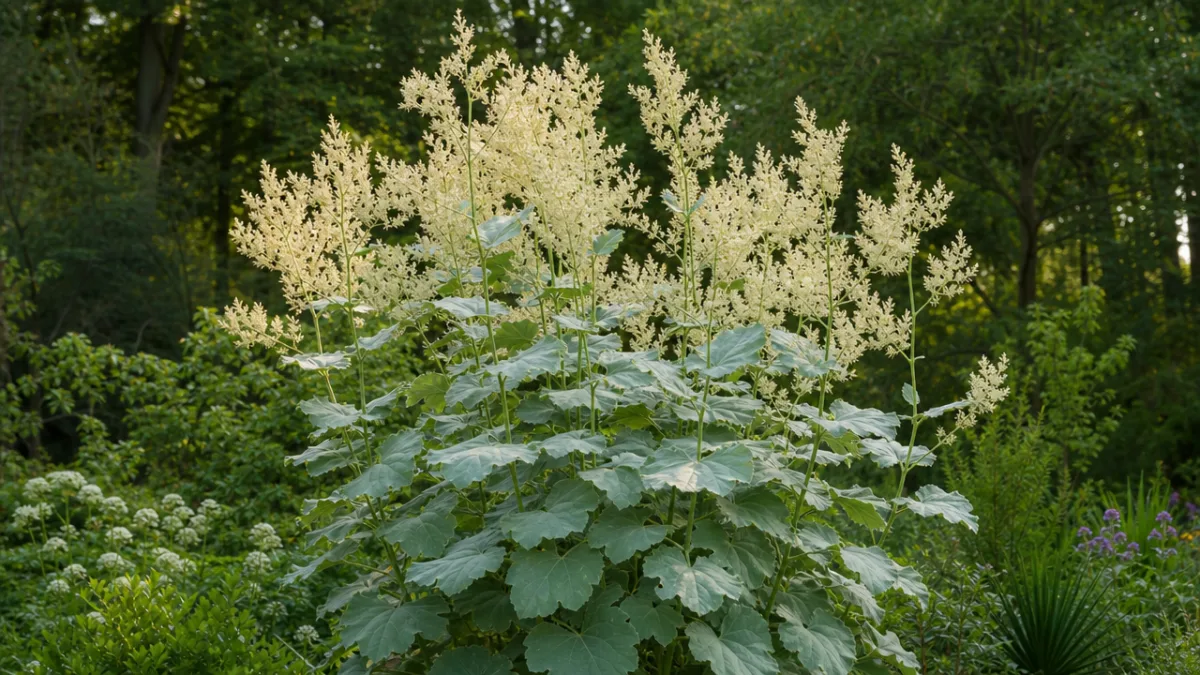
Under good conditions it can reach two to three meters tall, sending up robust, upright stems lined with large, deeply lobed leaves. Those leaves are a gorgeous blue-green on top, but flip them over and you get a silvery-white underside — and when a breeze catches them and they shimmer, the effect is genuinely theatrical. It’s the kind of plant that gives a border real backbone, anchoring a large scheme or acting as a dramatic backdrop for smaller plants in front.
Come midsummer, the whole thing tops out in feathery flower plumes — tall, branching panicles of creamy-white to pale buff flowers that individually are tiny but together create this wonderful airy, cloud-like effect. It softens all that bold structure in just the right way. The overall impression is grandeur with a light touch, which is probably why the Plume Poppy has stayed popular for so long with gardeners who want a plant that has both presence and a certain elegance.
Botanical Characteristics and Classification
Macleaya cordata sits in an interesting spot within the Papaveraceae family. The genus itself is tiny — just two species, Macleaya cordata and Macleaya microcarpa — and both share something distinctive: an orange-yellow, latex-like sap that oozes whenever a stem or leaf is damaged. That sap contains alkaloids, particularly sanguinarine and chelerythrine, which give Macleaya a unique biochemical identity even within a family already known for its milky or colored saps.
The leaves are probably the plant’s most immediately recognizable feature. They’re large — sometimes thirty centimeters or more across — with deep, palmate lobing and a rounded overall outline. The upper surface has that striking glaucous blue-green tone, while the underside carries a pale, almost white bloom that creates the silvery look. The margins are neatly scalloped, and the texture is slightly leathery, which means the foliage is just as interesting to touch as it is to look at, provided you handle it gently.
The flowers are a curious thing: each individual bloom is actually quite small and has no petals at all. What you’re seeing in those famous plumes is mostly stamens — typically twenty-five or more per flower — with just two small sepals that drop off early. Gathered into panicles that can exceed thirty centimeters in length, all those feathery stamens create that characteristic softness people love. And once flowering is done, small pendant seed capsules take over, adding yet another layer of interest that carries right through into autumn.
Growing Conditions and Site Requirements
Macleaya cordata is a tough and adaptable plant, but like anything, it performs best when you understand what it actually wants. On the light front, it’s happy in full sun to partial shade. Full sun gives you the most compact, upright growth and the best flowering, but this plant handles dappled shade surprisingly well — handy if you’re working in a larger garden with trees casting shadow over parts of the border. Deep shade is where it starts to struggle, producing lankier growth and fewer flowers.
Soil probably matters more than anything else here. Macleaya prefers deep, moderately fertile, well-drained soil with a neutral to slightly alkaline pH. Interestingly, it tolerates quite poor soil fairly well — and that can actually work in your favor, because overly rich conditions tend to make it spread more aggressively and can produce weaker, floppier stems that need staking. Good drainage is non-negotiable, especially over winter. The plant appreciates consistent moisture while it’s actively growing, but sitting in waterlogged soil in cold weather is a recipe for crown rot.
Hardiness is one of this plant’s real selling points. It’s fully hardy in USDA zones 3 through 9 and copes with equivalent European climates without complaint, surviving well below freezing as long as the drainage is decent. In very cold areas, a light mulch over the crown in late autumn gives a little extra insurance. One thing worth knowing: new growth emerges quite late in spring, which can be a bit nerve-wracking if you’re not expecting it. But don’t worry — once established, this plant comes back reliably year after year.
Propagation and Cultivation Techniques
There are a few good ways to propagate Macleaya cordata, and the right choice really depends on what you’re trying to achieve. The easiest and most reliable method is division, which plays nicely off the plant’s natural habit of spreading via underground rhizomes. In early spring, just as the first growth is beginning to show, you can dig up a clump and split it with a sharp spade — just make sure each piece has a decent section of rhizome and at least one healthy growth point. Divisions establish quickly and will usually flower in their first season, which is very satisfying.
Root cuttings are another solid option, especially if you want to multiply plants without disturbing an established clump. In late winter or early spring, take sections of root around five to ten centimeters long, insert them vertically into well-draining potting mix, and keep them somewhere cool but frost-free. Growth usually appears within a few weeks, and once the young plants are big enough you can pot them on and grow them under cover until they’re ready to go out. It’s a slightly more involved process but genuinely rewarding.
Growing from seed is possible too, though it’s a bit less predictable. Seeds do best when sown fresh in autumn, or stratified and sown in late winter — they need a cold period to break dormancy. Germination can be erratic and seedlings grow slowly in their first year, so patience is definitely required. That said, seed-raised plants can show interesting variation, and if you want to produce a large number of plants economically or you’re curious about plant breeding, it’s well worth trying. Just grow the seedlings on in individual pots before moving them to their final spots in the garden.

Garden Uses and Design Applications
There’s a lot you can do with Macleaya cordata in a garden, but it really rewards thoughtful placement. The most obvious use is at the back of a large herbaceous border, where its height and bold foliage make it a natural structural anchor and backdrop. Its blue-green and silver tones work particularly well as a foil for warm colors — think oranges, deep yellows, and rich reds. Helenium, Rudbeckia, Crocosmia, and tall dahlias are all fantastic companions that really pop against it.
It’s also a natural fit for contemporary naturalistic planting schemes in the spirit of the New Perennial movement. The combination of strong vertical structure, handsome foliage, and airy flowers sits very comfortably alongside the design principles championed by people like Piet Oudolf, who prize plants that contribute something across multiple seasons and look beautiful even as they fade. In large-scale plantings, you can afford to let Macleaya spread a little more freely, creating relaxed drifts that catch the breeze and light in a way that’s genuinely lovely to watch.
If you’re working with a smaller garden, though, a word of caution: this plant can spread assertively via its rhizomes, and left unchecked it will start muscling in on its neighbors. You have a few options — installing root barriers around the planting area, lifting and reducing the clump each spring before it gets too enthusiastic, or sinking a large bottomless container into the ground to contain the roots while still letting the plant look completely at home in the border. Any of these approaches work well and let you enjoy the plant without it taking over.
Ethnobotanical and Medicinal History
Macleaya cordata has a long and interesting history of use in its native China and Japan, going back many centuries. In traditional Chinese medicine, various parts of the plant — roots, leaves, and stems — were used for their antimicrobial and antiparasitic properties. The alkaloids in that distinctive orange sap, sanguinarine and chelerythrine in particular, are genuinely biologically active compounds that have attracted real scientific attention in recent decades. Research has confirmed antimicrobial, antifungal, and anti-inflammatory properties, which lends some solid scientific backing to what traditional practitioners have known for a long time.
Perhaps more surprisingly, Macleaya cordata has found a role in modern agriculture. Extracts from the plant are used commercially as natural feed additives, particularly in poultry and pig farming, where the alkaloid compounds have been shown to support gut health, improve feed conversion efficiency, and reduce dependence on conventional antibiotic growth promoters. Products based on these alkaloids are used in several countries as natural livestock performance enhancers — a fascinating bridge between centuries-old botanical knowledge and contemporary agricultural science.
That said, it’s important to be clear: those same alkaloids that make the plant useful also make it toxic to humans and animals if consumed in significant quantities. Sanguinarine in particular is a potent compound. As a gardener, you should wear gloves when handling cut stems or damaged foliage, since the orange sap can irritate sensitive skin. The good news is that browsing animals tend to avoid the plant instinctively, which offers some natural protection if you have livestock or pets with access to the garden — but it’s still worth being aware of the risks.

Seasonal Interest and Long-Term Garden Value
One of the things that makes Macleaya cordata such a worthwhile garden plant is just how much it gives you across the seasons. It starts earning its keep the moment those distinctive rounded shoot tips push up through the soil in late spring — the glaucous blue-green coloring and crinkled emerging leaves are sculpturally beautiful in their own right. Through early summer the stems grow rapidly, sometimes by several centimeters a day in warm, moist conditions, and the plant establishes its full architectural presence well before a single flower opens.
The flowering period — typically July through August in the Northern Hemisphere — is the undisputed highlight. The tall feathery plumes rise above the foliage and sway in any breeze, creating a dynamic, living quality that photos rarely do justice to. As the flowers fade, the developing seed capsules carry the ornamental season forward, and by autumn the whole plant takes on warm buff and tan tones as it winds down. Many gardeners leave the dead stems standing through winter, and it’s a good call: they have real skeletal beauty and the seed heads are valuable for wildlife.
As a long-term garden investment, Macleaya cordata is hard to beat. Once established, it asks very little of you beyond keeping its spreading habit in check. It doesn’t need staking in most situations, rarely suffers from serious pests or diseases, and comes back faithfully year after year. Its root system, once properly established, handles dry spells well enough that you won’t need to reach for the hose constantly. And those flowers attract a good range of beneficial insects, adding genuine ecological value on top of everything else. If you want a plant that combines real grandeur with everyday practicality, the Plume Poppy deserves a much bigger following than it currently has.








What do you think?
It is nice to know your opinion. Leave a comment.