










21 Durable Tomato Trellis Setups That Last All Season
Why a Strong Trellis System Makes or Breaks Your Tomato Harvest
Growing tomatoes successfully is one of the most rewarding experiences a gardener can have, but it comes with a serious structural challenge: tomato plants are heavy, sprawling, and relentlessly vigorous. Without a properly engineered support system, even the most carefully tended plants will collapse under the weight of their own fruit, leaving you with broken stems, rotting tomatoes, and a season of wasted effort. A durable trellis is not a luxury — it is an absolute necessity for any gardener who wants consistent, high-quality yields year after year.
The difference between a trellis that lasts all season and one that fails in mid-July often comes down to materials and planning. Cheap bamboo stakes and flimsy wire will stretch, rot, or snap under the combined weight of a mature indeterminate tomato plant, which can easily reach six to eight feet tall and carry twenty or more pounds of ripening fruit. Investing time and modest resources into a well-designed trellis system before the season begins pays extraordinary dividends in reduced labor, healthier plants, and a dramatically improved harvest.
Beyond yield, a well-constructed trellis transforms the way you interact with your garden. Properly supported tomatoes allow air to circulate freely around the foliage, which dramatically reduces fungal diseases like early blight and septoria leaf spot. They make pruning and harvesting intuitive, since you can always see exactly where each stem is headed. Over the following sections, we will explore twenty-one of the most durable, proven trellis configurations — from simple single-stake setups to elaborate multi-row Florida weave systems — so you can find the perfect fit for your space, budget, and gardening style.
Understanding Tomato Varieties and Their Structural Needs
Before building any trellis, it is critical to understand the fundamental difference between determinate and indeterminate tomato varieties, because this distinction determines everything about how much support your plants will need. Determinate varieties, sometimes called bush tomatoes, grow to a fixed height — typically two to four feet — and produce all their fruit within a relatively compact window of time. These plants need moderate support, and a single sturdy stake or a compact wire cage will usually suffice for the entire growing season without requiring adjustment.
Indeterminate varieties, on the other hand, are the ambitious climbers of the tomato world. These plants — including beloved varieties like Brandywine, Sun Gold cherry tomatoes, and most heirloom types — continue growing and producing fruit from the moment of first set until the first frost kills them. Over a long growing season in a warm climate, an indeterminate plant can easily reach eight to ten feet in height, and its lateral branches spread outward aggressively. A trellis system for indeterminate varieties must be tall, deeply anchored, and capable of bearing substantial dynamic loads as wind moves through the foliage.
Semi-determinate varieties occupy a useful middle ground, and understanding where your specific cultivar falls on this spectrum will guide every material and design decision you make. When selecting a trellis approach, also consider your row spacing, the number of plants you are growing, and whether you plan to reuse the system in future seasons. Reusability is one of the most underrated factors in trellis design — a system built from galvanized steel T-posts and high-tensile wire may cost three times as much upfront as bamboo and twine, but it will serve reliably for a decade or more, making it far more economical over time.
Single-Stake and Cage Systems: Simple Solutions That Actually Hold
The classic single-stake method is the most universally practiced tomato support technique in the world, and when executed correctly with the right materials, it remains genuinely effective through an entire growing season. The key word in that sentence is “correctly.” Most gardeners who have seen a staked tomato collapse mid-season made one of two mistakes: they used a stake that was too short — anything less than six feet above ground is inadequate for indeterminate varieties — or they used organic twine that decomposed and snapped before the season ended. A one-inch hardwood or metal conduit stake, driven at least twelve inches into the ground, paired with stretchy silicone plant ties, is a combination that will hold reliably.
Wire tomato cages are enormously popular for good reason: they are easy to deploy, require minimal training of the plant, and allow the tomato to grow in its naturally bushy form without constant pruning. However, the wire cages sold at most garden centers are genuinely inadequate. They are typically made from lightweight fourteen-gauge wire, stand only about four feet tall, and have a diameter too small to contain a healthy mature plant. Commercial-grade concrete reinforcing wire, also known as remesh or cattle panel, can be cut and formed into cages five to six feet tall with a diameter of eighteen to twenty-four inches — these homemade cages are dramatically more robust and will outlast the flimsy store-bought versions by many years.
For gardeners who prefer the cage approach but want maximum durability, consider these proven configurations that have served home growers and market gardeners season after season:
- Concrete remesh cages: Cut from a ten-foot roll of 6×6-inch concrete reinforcing wire, these cages stand five feet tall, support themselves without staking in most soils, and last fifteen or more years with minimal maintenance.
- Cattle panel half-hoops: A length of cattle panel bent into a tall arch and secured at each end creates a sturdy tunnel trellis that accommodates multiple plants and can be reused indefinitely.
- T-post and wire ring system: A galvanized T-post with wire rings attached at twelve-inch intervals gives you a cage-like structure that drives deeply into the ground and won’t tip even under the heaviest fruit load.
- Wooden stake tripods: Three stakes driven into the ground in a triangle formation and lashed together at the top provide exceptional lateral stability for large heirloom varieties.
No matter which single-stake or cage system you choose, the principle of deep anchoring applies universally. Stakes and posts that are driven only a few inches into the ground will lever out of the soil as the weight of the plant increases through the season. A minimum of twelve inches of ground penetration is recommended for any support system, and in loose or sandy soils, you should anchor even deeper — eighteen inches or more — or use crossbars and bracing wires to distribute the load across a wider footprint.
The Florida Weave: A Market Gardener’s Best Friend
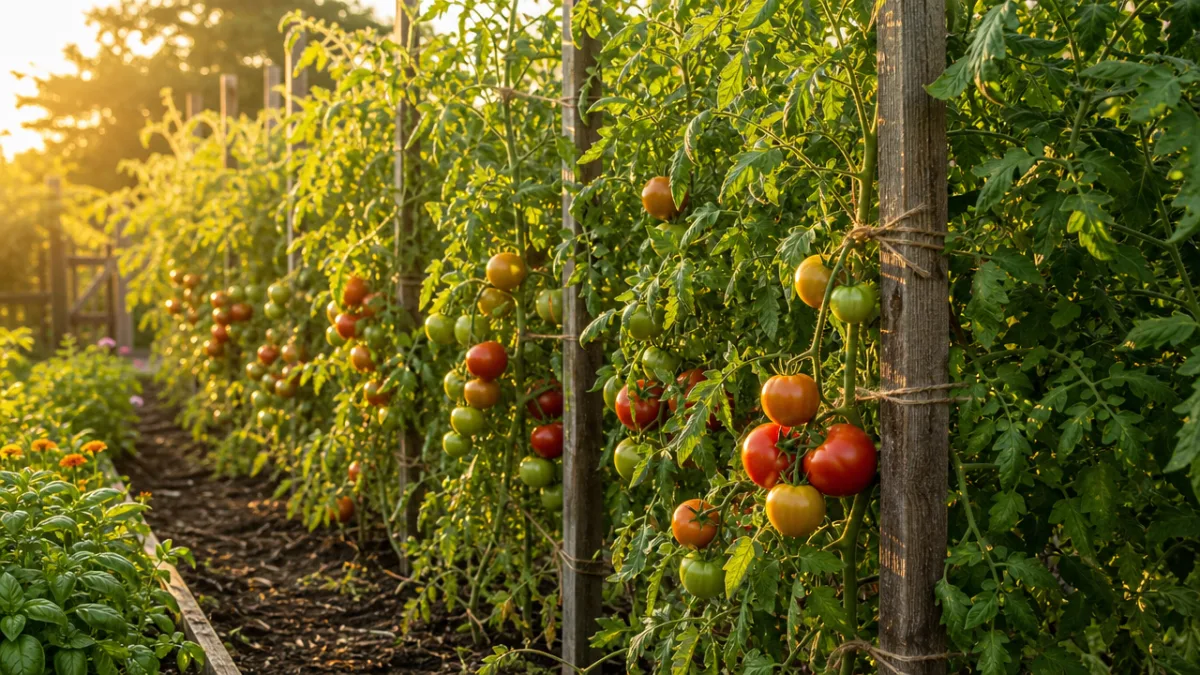
The Florida weave, also known as the basket weave or stake-and-weave method, is one of the most efficient and durable trellis systems ever developed for row-crop tomato production. It is the preferred method of countless market gardeners and small-scale commercial producers because it uses minimal materials, can be set up quickly for long rows, and provides outstanding support as the plants grow taller through repeated additions of weave lines. If you are growing more than six or eight tomato plants in a row, the Florida weave deserves serious consideration as your primary support strategy.
The system works by running a strong horizontal line of twine or wire along both sides of a row of plants, sandwiching each plant between two parallel lines that are secured to stakes positioned every four to six feet along the row. As the plants grow taller, additional horizontal lines are added at increasing heights — typically every eight to twelve inches — until the end of the season. The lateral pressure of the two opposing lines holds each plant upright far more effectively than a single stake alone, and the system becomes stronger as more lines are added because each new layer braces the ones beneath it.
Material selection is critically important for a Florida weave that holds all season. Standard sisal or jute twine will stretch when wet and can snap under heavy loads, particularly after it has weathered for several months. Polypropylene baling twine is a far superior choice — it is UV-resistant, does not absorb water, maintains consistent tension throughout the season, and can often be reused for a second year. For the stakes themselves, use metal T-posts or one-inch diameter hardwood stakes at least six feet long, driven twelve to eighteen inches into the ground. The end stakes of each row should be braced with a diagonal brace stake or an anchoring wire to prevent the entire row from bowing inward under the weight of the plants.
One of the most common mistakes growers make with the Florida weave is waiting too long between adding new weave lines. Ideally, you should add a new line every time the plant grows six to eight inches above the topmost existing line. Allowing plants to flop over before adding support means the stems bend and can develop kinks that restrict the flow of water and nutrients. Regular, proactive weaving keeps plants upright, directs new growth vertically, and makes the entire row look neat and organized — a practical benefit when you are trying to inspect for pests and diseases across dozens of plants efficiently.

Overhead String Systems and Vertical Growing Structures
Overhead string systems represent some of the most elegant and productive tomato trellis configurations available, and they are the standard approach in commercial greenhouse tomato production for good reason. In this system, a horizontal wire or conduit is installed at height — typically seven to eight feet above ground level, attached to a sturdy overhead structure such as greenhouse purlins, a purpose-built wooden frame, or a strong metal pipe run. Individual lengths of soft twine or commercial tomato clip string are then hung from the overhead wire, with the lower end secured loosely around the base of each plant. As the tomato grows, it is trained to spiral around the hanging string, climbing upward through the season.
The primary advantage of the overhead string system is its extraordinary scalability and adaptability. Because the twine bears all the weight of the plant and is hung from a fixed overhead point, there is no staking into the ground required at the plant level — the entire load is transferred upward to the overhead structure. This means you can add height to the system simply by lowering the string as the plant grows taller, a technique called “lowering and leaning” that allows commercial growers to keep a single plant producing actively for twelve months or more in a controlled environment. In an outdoor garden, the same principle can extend your season significantly by preventing the plant from running out of vertical space.
Building a durable outdoor overhead string system requires attention to the structural integrity of the supporting framework. A simple version can be constructed from two sturdy T-posts or wooden posts at each end of a row, with a length of high-tensile wire stretched tightly between them at seven or eight feet. The posts must be well-anchored and the wire tensioned properly — a saggy wire will cause all the strings to lean inward as the plants grow heavy, bunching them together and creating the disease-promoting crowded conditions you are trying to avoid. A wire tensioner or turnbuckle installed at one end of the run makes it easy to maintain appropriate tension throughout the season as the wire responds to temperature changes.
Arched Tunnel Trellises and Decorative Pergola Structures
For gardeners who want their tomato support systems to serve double duty as striking garden features, arched tunnel trellises and pergola-style structures offer a compelling combination of function and beauty. A cattle panel arch — formed by bending a sixteen-foot length of cattle panel into a high arch over a garden bed and securing the ends with stakes or T-posts — creates a dramatic growing tunnel that can support two rows of tomatoes simultaneously, one planted along each side of the arch. As the plants grow, they are trained up and over the arch, eventually meeting at the top and creating a living canopy of foliage and fruit that is genuinely spectacular.
The structural advantages of the arched form are significant. An arch distributes weight far more efficiently than a vertical wall structure, and a properly installed cattle panel arch is essentially immovable once the plants have grown up and over it and the weight is distributed symmetrically across both sides. These structures withstand significant wind loads because the curved form deflects lateral pressure rather than absorbing it directly. They are also remarkably long-lived — a galvanized cattle panel that is cleaned and stored properly at the end of the season will remain structurally sound for twenty years or more, making the initial investment extremely economical on a per-season basis.
Wooden pergola-style trellis systems bring a different aesthetic sensibility to the tomato garden, lending the vegetable patch the architectural dignity more commonly associated with ornamental gardens. A simple structure built from four-by-four pressure-treated posts, topped with a grid of two-by-two lumber or heavy-gauge wire mesh, can serve as a permanent fixture in the garden for a decade or more. The key considerations for a wooden pergola used for tomatoes are the wood treatment — untreated lumber will rot within a few seasons in contact with moist soil and organic matter — and the overhead grid spacing, which should be no larger than six inches to provide adequate anchor points for the individual plant ties and training wires that will guide the plants upward through the season.
Whichever overhead or arched structure you choose, incorporating these design elements will significantly extend its lifespan and effectiveness:
- Use galvanized or powder-coated hardware throughout, including all bolts, brackets, and wire connections, to prevent rust from weakening joints over multiple seasons.
- Install a top rail or ridgepole to prevent lateral racking of the structure when heavy wind loads hit it from the side.
- Bury posts at least one-third of their total length, and consider setting corner posts in concrete for permanent installations in areas with heavy clay or loose sandy soil.
- Add diagonal bracing at each corner of rectangular structures to prevent parallelogram racking — the common failure mode of rectangular frames under side loads.
- Plan for end-of-season disassembly if you rotate your crops, using bolted connections rather than permanent fasteners wherever the structure will need to be moved or reconfigured.

Maintenance, End-of-Season Care, and Long-Term Durability
Building a durable trellis system is only half of the equation — maintaining it properly through the season and caring for it at season’s end is what transforms a good trellis into one that serves reliably for years or even decades. During the growing season, inspect your supports weekly, paying particular attention to any ties or clips that have tightened uncomfortably around growing stems, any stakes that have begun to lean under increased plant weight, and any wire connections that show signs of rust or fraying. Catching these issues early and correcting them takes only a few minutes and prevents the more significant failures — a collapsed row of mature plants, for instance — that can cost hours to remediate and may cause irreparable damage to the plants themselves.
At the end of the growing season, the most important maintenance step for any reusable trellis system is thorough cleaning before storage. Tomato plants are hosts to numerous fungal and bacterial pathogens — early blight, late blight, bacterial speck, and fusarium wilt among them — and the stems, leaves, and roots of spent plants can leave viable pathogen spores on any surface they contact. Stakes, cages, wires, and even plastic ties that are stored without cleaning can introduce these pathogens directly into next year’s soil when you redeploy them. Washing all reusable components with a solution of one part bleach to nine parts water, allowing them to dry completely, and storing them in a dry location eliminates the vast majority of pathogen risk.
Wooden components deserve particular attention at season’s end. Even pressure-treated lumber will benefit from an annual inspection for splits, soft spots, and the early signs of rot that appear at soil contact points and horizontal surfaces where water tends to pool. Sealing any exposed cut ends with wood preservative, allowing all components to dry completely before stacking them for storage, and keeping stored wood off the ground on pallets or in a dry shed will dramatically extend the service life of wooden trellis components. A well-maintained set of wooden stakes or a pergola structure can easily last ten to fifteen years with this level of care — a worthwhile investment in time that pays back many times over in avoided replacement costs.
The long-term success of any tomato trellis program also depends on thoughtful crop rotation, which affects how you position permanent structures from year to year. Most gardening authorities recommend rotating tomatoes to a different bed location every three to four years to prevent the buildup of soil-borne pathogens and nutrient depletion. If you have installed permanent overhead wire systems or pergola structures, this rotation requirement means either building multiple permanent systems in different parts of your garden or using portable systems that can be relocated. Many experienced market gardeners solve this problem elegantly by building their permanent overhead wire infrastructure as a long-span system that runs across multiple beds, allowing them to shift which beds are planted with tomatoes while keeping the overhead wire in place and simply repositioning the hanging strings to follow the plants to their new location each season.








What do you think?
It is nice to know your opinion. Leave a comment.