










Hoodia pedicellata: The Remarkable Desert Succulent
Introduction to Hoodia pedicellata
If you’ve never heard of Hoodia pedicellata, you’re not alone — it’s one of those quietly fascinating plants that tends to fly under the radar even among succulent enthusiasts. It belongs to the family Apocynaceae (subfamily Asclepiadoideae), and like its more famous cousin Hoodia gordonii, it’s a stem succulent native to the arid regions of southern Africa. Those thick, spiny columns aren’t just for show — they’re how the plant stores water through months of punishing drought. It’s the kind of resilience that’s hard not to admire, and it’s a big part of why collectors around the world are so drawn to it.
There are roughly 17 species in the genus Hoodia, all native to southern Africa — mainly Namibia, Botswana, and South Africa. Hoodia pedicellata has its own distinct identity within that group, and the name gives you a clue as to why: “pedicellata” refers to the small stalks (pedicels) that hold the flowers. It’s a subtle detail, but once you know to look for it, it makes identifying this species a lot easier. That kind of small taxonomic discovery is one of the real pleasures of getting deeper into succulent botany.
For growers, Hoodia pedicellata is equal parts challenge and reward. It’s not the most forgiving plant outside of its native habitat, and it will let you know pretty quickly if the conditions aren’t right. But get those conditions dialed in, and you’ll be treated to a plant with genuinely striking architectural presence — and, if you’re lucky, some of the most dramatic and unusual flowers in the succulent world. Whether you’re a seasoned grower or just starting to explore the Hoodia genus, this species is well worth getting to know.
Physical Characteristics and Morphology
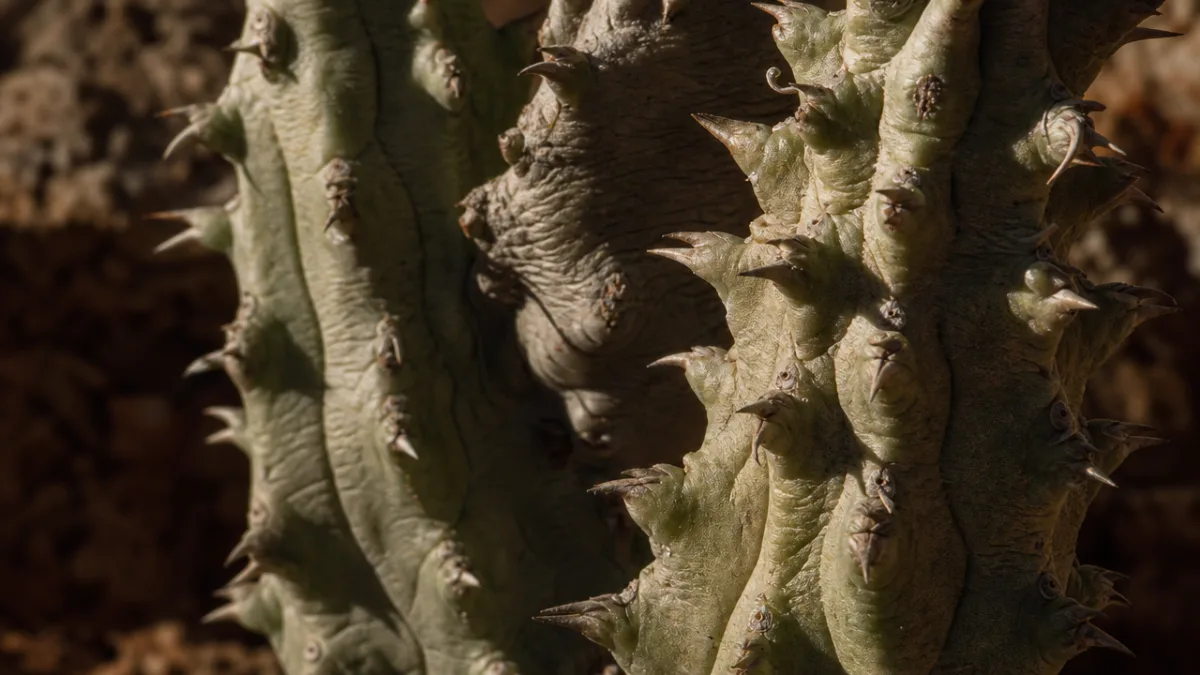
Hoodia pedicellata grows as a clump-forming, columnar succulent, reaching up to about 50 centimeters tall when it’s happy. The stems are upright and sturdy, with a greenish-gray to bluish-green color, and they’re studded with rows of tubercles — those small, wart-like bumps arranged in neat vertical lines along the stem. Each one is tipped with a sharp spine, giving the whole plant a look that most people would immediately compare to a cactus. It’s an understandable mistake, but Hoodia isn’t related to cacti at all. The resemblance is just nature finding the same answer to the same question: how do you keep hungry animals away from your water supply?
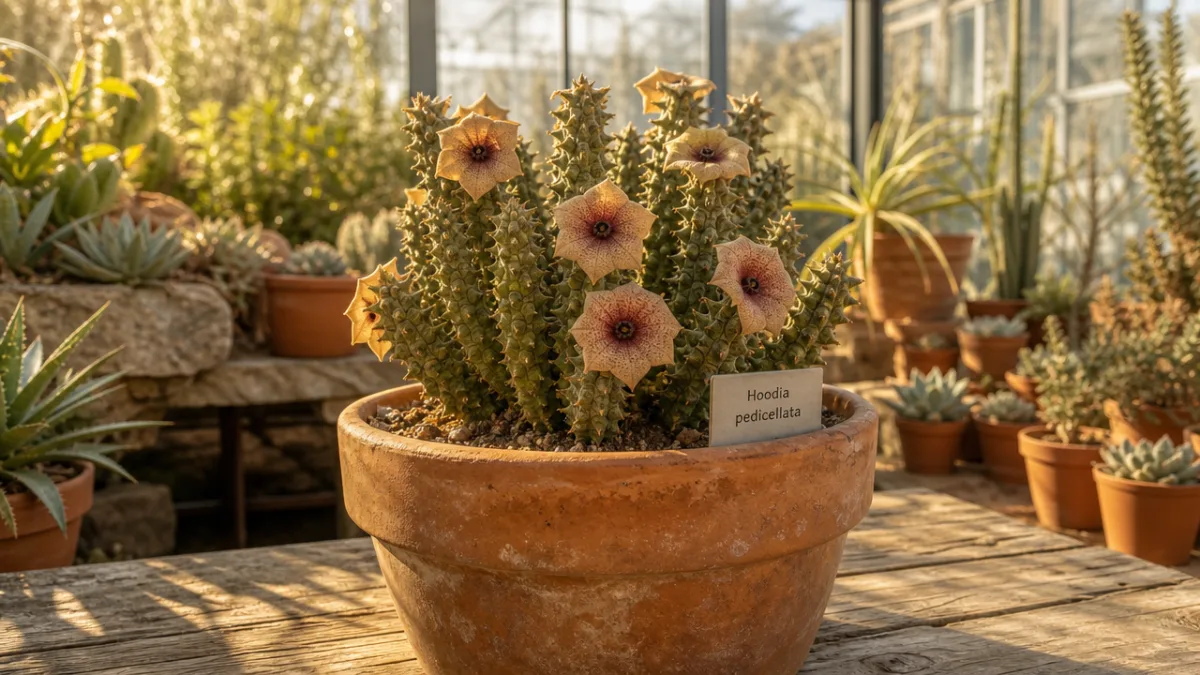
The flowers are really the main event, though, and a big reason this plant has such devoted admirers among collectors and botanical illustrators. They’re large, flat, and saucer-shaped, coming in shades of pale yellow, cream, or pinkish-brown, often with intricate patterning across the surface. The texture of the petals is famously strange — wrinkled and ridged, a bit like old leather — which gives the blooms an almost otherworldly quality. And the smell? Let’s just say it’s not something you’d want as a room fragrance. The flowers mimic the scent of rotting meat, which sounds unpleasant (because it is), but it’s a brilliantly effective strategy for attracting carrion flies, which are the plant’s main pollinators back home.
Underground, things are just as well thought-out. Hoodia pedicellata develops a deep, substantial taproot that can push down through rocky or sandy soil in search of moisture, while a network of finer lateral roots fans out near the surface to catch whatever rain happens to fall. It’s a smart dual strategy — covering both depth and breadth when it comes to water collection. For anyone growing this plant in a container, understanding that root architecture really matters. Pot depth, width, and drainage aren’t just preferences; they’re factors that can make or break the plant’s long-term health.
Natural Habitat and Geographic Distribution
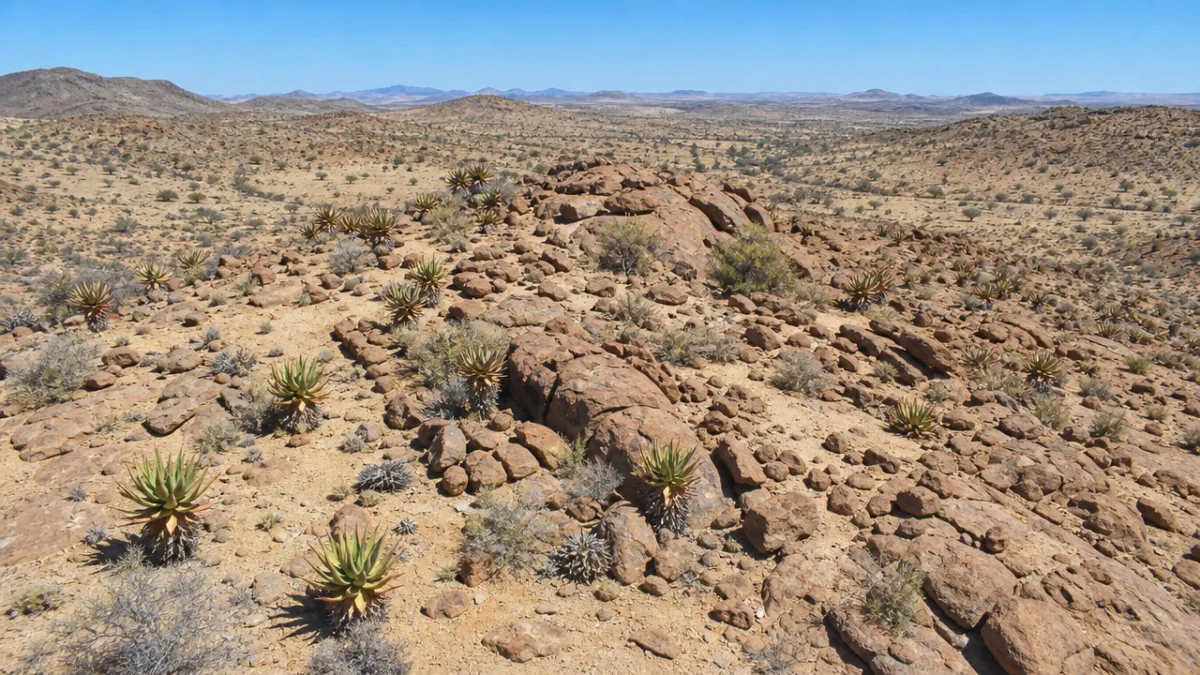
In the wild, Hoodia pedicellata is at home in the semi-arid to arid zones of southern Africa, with populations recorded in parts of Namibia and the Northern Cape province of South Africa. It tends to grow in rocky, well-drained terrain — often in quartz-rich soils — alongside other drought-adapted plants. Much of its range falls within the Succulent Karoo biome, which is recognized as one of the world’s biodiversity hotspots. It’s a landscape that looks barren at first glance, but the more you look, the more life you find. Hoodia pedicellata is one of the plants that makes that biome as botanically remarkable as it is.
The climate there is genuinely extreme. Summer daytime temperatures regularly push past 35°C, while nights — especially at higher elevations — can drop sharply. Rainfall is low and unpredictable, often arriving in short, intense bursts before the ground dries out again almost immediately. For most plants, those conditions would be a death sentence. For Hoodia pedicellata, they’re home. That’s worth keeping in mind when you’re thinking about cultivation: you’re not just trying to keep the plant alive, you’re trying to approximate a whole climate — intense sun, fast-draining soil, warm days, cool nights, and very little winter water.
Out in the wild, Hoodia pedicellata grows among aloes, euphorbias, mesembs, and various drought-tolerant shrubs and geophytes — a community of plants that has been co-evolving for thousands of years. They provide each other with shade, wind protection, and soil stability. For growers interested in creating a naturalistic display, pairing Hoodia pedicellata with some of these same companions doesn’t just look good — it can actually help moderate the microclimate around the plant. Paying attention to where a plant comes from and who it grows with is always time well spent.
Cultivation and Care Requirements
Growing Hoodia pedicellata outside of its native range isn’t impossible, but it does ask something of you. The single most important thing to get right is drainage — this plant will not tolerate sitting in wet soil, and root rot is far and away the most common way growers lose it. The growing medium needs to be genuinely gritty and mineral-heavy. A good starting point is a mix of roughly 50 to 70 percent coarse sand or perlite, a bit of fine pumice, and a small amount of lean, low-nutrient potting compost. The goal is a mix that drains fast but still holds just enough moisture for the roots to drink before it dries out completely.
Watering is where a lot of people go wrong, usually by being too generous. During the active growing season — spring and summer — you can water moderately, but always let the soil dry out completely before watering again. As autumn arrives, start pulling back, and through winter (especially if temperatures are on the lower side) the plant should be kept almost entirely dry. That winter rest isn’t optional: it’s often what triggers flowering the following season. The temptation to water a dry-looking plant in the middle of winter is real, but it’s best resisted firmly.
Light is the other non-negotiable. This plant wants as much direct sun as you can give it — in its native habitat it bakes in full sun most of the day, year-round. A south-facing windowsill works, as does a greenhouse or a warm outdoor spot in a frost-free climate. If you’re somewhere that gets frost, it needs to come inside for winter or be given solid protection. It can tolerate brief dips below 10°C if it’s kept bone dry, but it’s not a plant you want to test. Here’s a quick summary of what it needs:
- Light: Full sun, minimum 6 hours of direct sunlight per day
- Soil: Very well-draining, gritty mineral mix with low organic content
- Watering: Allow soil to dry completely between waterings; minimal water in winter
- Temperature: Prefers 20–35°C; protect from frost below 5°C
- Fertilizing: Light feeding with low-nitrogen fertilizer once or twice during the growing season
- Repotting: Every 2–3 years, or when roots become visibly pot-bound
Propagation Techniques
There are two main ways to propagate Hoodia pedicellata: from seed, or from stem cuttings. Seed is the more traditional route, and it has a real advantage — plants grown from seed develop that deep, well-formed taproot naturally, which sets them up well for the long term. Sow fresh seeds in a shallow tray of gritty, well-draining mix, cover lightly with a thin layer of fine sand, and keep the tray in a warm spot with bright indirect light. Keep it just barely moist and wait — germination usually happens somewhere between one and three weeks, depending on how fresh the seeds are and how warm the conditions. Seedlings are slow growers, so patience is genuinely required, but there’s something particularly satisfying about bringing a Hoodia up from seed.
Stem cuttings are quicker, but they come with one rule you really can’t skip: callousing. Once you’ve taken a clean cut with a sharp blade, set the cutting aside in a dry, shaded spot for several days before you do anything else with it. The wound needs to dry and seal over completely. Skipping this step and planting a fresh cutting straight into soil almost always ends in rot — the moist cut surface is just too vulnerable. Once it’s properly calloused, you can put it into a gritty propagation mix, place it somewhere warm and bright, and water very sparingly while it roots. It can take a few weeks, and the temptation to poke around checking for roots is best ignored.
One thing worth knowing before you start propagating is that Hoodia species fall under CITES regulation, which governs the international trade of plants that are vulnerable to overexploitation. Hoodia pedicellata isn’t the most threatened species in the genus, but the principle still applies: always source your plants from reputable nurseries or collectors who can confirm they’re legally and ethically obtained. And if you already have a plant, propagating from it is genuinely the most sustainable thing you can do — it keeps pressure off wild populations that are already dealing with habitat loss and collection pressure, while building your own collection at the same time.
Ecological Significance and Conservation
Hoodia pedicellata isn’t just a pretty plant to look at — it plays a real role in the ecosystem it comes from. Its flowers support carrion flies and other fly pollinators, which are an important thread in the web of life across arid southern Africa. Those pollinators don’t just serve Hoodia; they move between many different plants in the community, which means that losing Hoodia from a landscape has knock-on effects that go well beyond the plant itself. It’s a good reminder that even plants we tend to think of as isolated specimens are actually part of something much larger and more interconnected.
The broader Hoodia genus has had a rough few decades, commercially speaking. The intense interest in Hoodia gordonii as a potential appetite suppressant brought a wave of commercial attention that put real pressure on wild populations, compounding the existing threats from agricultural expansion, overgrazing, and climate change. Hoodia pedicellata isn’t the primary target of that pressure, but it shares the same fragile habitat as its more commercially valuable relatives, so it faces similar risks. Botanical gardens and conservation organizations in southern Africa are doing important work to document and protect these plants, but it’s an ongoing challenge.
For collectors outside of southern Africa, there’s actually something meaningful you can do about this, even from a distance. Growing Hoodia pedicellata well, propagating it responsibly, and sharing plants and seeds through botanical societies and specialist nurseries helps build what’s sometimes called an ex-situ population — a distributed genetic reserve that exists outside the wild. It doesn’t have the prestige of a big institutional conservation program, but this kind of community-based, grower-led effort has a long and genuinely valuable history in the succulent and cactus world. Every legally propagated plant that finds a good home is a small win.
Hoodia pedicellata in the Collector’s Garden
Among dedicated succulent collectors, Hoodia pedicellata tends to earn a particular kind of respect — not just as a good-looking specimen, but as a plant with a story. Its cactus-like silhouette is a classic example of convergent evolution: Hoodia and true cacti arrived at remarkably similar forms independently, on different continents, in response to the same environmental pressures. Displaying it alongside cacti and other stem succulents from different plant families makes for a collection that’s not just visually cohesive but botanically interesting — a physical illustration of how life finds its own similar solutions across the world. For a lot of collectors, that’s exactly the kind of depth that elevates a collection beyond a shelf of pretty plants.
For display, Hoodia pedicellata looks genuinely at home in terracotta pots — the earthy tones complement its architectural quality nicely, and the porous material helps the growing medium dry out faster between waterings, which is exactly what the plant wants. If you have the space, raised beds in a greenhouse or conservatory, filled with a mineral-rich substrate, give the plant room to develop its natural clumping habit over time into a really impressive multi-stemmed specimen. Whatever container you use, a top-dressing of coarse gravel or grit around the base of the stems is a good idea — it helps stop moisture pooling around the stem base, where the plant is most vulnerable to rot.
Interest in unusual, ethnobotanically significant succulents has been growing steadily within the collector community, and species like Hoodia pedicellata are starting to get the wider attention they’ve always deserved. Online communities, specialist societies like the Cactus and Succulent Society of America, and dedicated plant forums have made it easier than ever to find good information, track down legally propagated plants, and connect with other growers who are just as absorbed by these plants as you are. If you’ve been growing the more common succulents for a while and you’re looking for something that asks a bit more of you and gives a lot back in return, Hoodia pedicellata is a very natural next step.








What do you think?
It is nice to know your opinion. Leave a comment.