










Quiet Bedside Ritual: Embracing Soft Light and Evening Calm
There is a particular kind of magic that settles over a bedroom in the last hour before sleep. The day’s noise has finally receded, the overhead lights have been dimmed or turned off entirely, and in their place a single warm lamp casts its gentle amber glow across pillows and nightstand alike. This is the hour of the quiet bedside ritual, a practice that has become something of a lost art in our screen-saturated, always-connected world. Yet those who rediscover it find something genuinely restorative waiting for them on the other side of stillness.
The concept of an evening ritual is not new. Across cultures and centuries, human beings have marked the transition from wakefulness to sleep with intentional acts of slowing down. Whether it was the lighting of oil lamps, the reading of prayers, or simply the act of brushing hair by candlelight, these small ceremonies served a profound psychological function: they told the nervous system that safety had arrived, that the work of the day was finished, and that rest was not only permitted but welcome. We are wired, at some deep level, to respond to these signals.
What makes the modern bedside ritual so compelling is precisely its simplicity. In a world that rewards busyness and equates productivity with worth, choosing to sit quietly beside a soft lamp for thirty minutes before sleep is almost a radical act. It is a refusal to optimize every waking moment, a declaration that some hours belong only to the self, to silence, and to the slow unwinding that genuine rest requires. This article explores how to build that ritual, why it works, and what small objects and habits can anchor it night after night.
The Science of Soft Light and Its Effect on the Sleeping Mind
Light is one of the most powerful regulators of human biology. The pineal gland, a small structure deep within the brain, responds to light levels detected by specialized cells in the retina, adjusting the production of melatonin accordingly. Bright, blue-spectrum light — the kind emitted by overhead fluorescents, computer screens, and smartphones — suppresses melatonin production and keeps the brain in an alert, daytime mode long past the hour when the body would naturally begin its descent toward sleep. Understanding this mechanism is the first step toward working with it rather than against it.
Soft, warm-spectrum light operates on an entirely different register. Bulbs that emit light in the 2700K to 3000K color temperature range mimic the warm orange tones of firelight and sunset, the cues that have signaled nightfall to human brains for hundreds of thousands of years. When you replace a harsh overhead fixture with a bedside lamp fitted with a warm bulb, you are not merely creating an aesthetic atmosphere, though you are certainly doing that. You are sending a clear biological message: the day is ending, melatonin may flow, and sleep is approaching on its own natural schedule.
Research published in the field of chronobiology supports what intuition has always suggested. Studies consistently show that individuals who reduce light exposure in the ninety minutes before bed fall asleep more quickly, experience deeper slow-wave sleep, and report feeling more rested upon waking. The effect is dose-dependent, meaning that even modest reductions in evening light exposure produce measurable improvements in sleep quality. A single low-wattage lamp on a nightstand is not a small thing. It is, in physiological terms, a meaningful intervention.
Beyond melatonin, soft evening light also influences the autonomic nervous system. The shift from bright light to dim, warm illumination is associated with a corresponding shift from sympathetic nervous system dominance — the fight-or-flight state that governs our alert, reactive daytime mode — toward parasympathetic activity, often called the rest-and-digest state. Heart rate slows, breathing deepens slightly, muscles begin to release the low-level tension they hold throughout the day. The soft lamp on your nightstand is, in the most literal sense, calming your nervous system down.
Curating the Perfect Bedside Environment
The nightstand is one of the most intimate pieces of furniture in any home. It is the last surface your eyes rest upon before sleep and the first they find upon waking. What you choose to place there matters more than most interior design discussions acknowledge. The typical nightstand accumulates charger cables, half-drunk glasses of water, expired receipts, and the miscellaneous debris of daily life. Reclaiming it as a curated, intentional space is one of the simplest and most effective things you can do for your sleep environment.
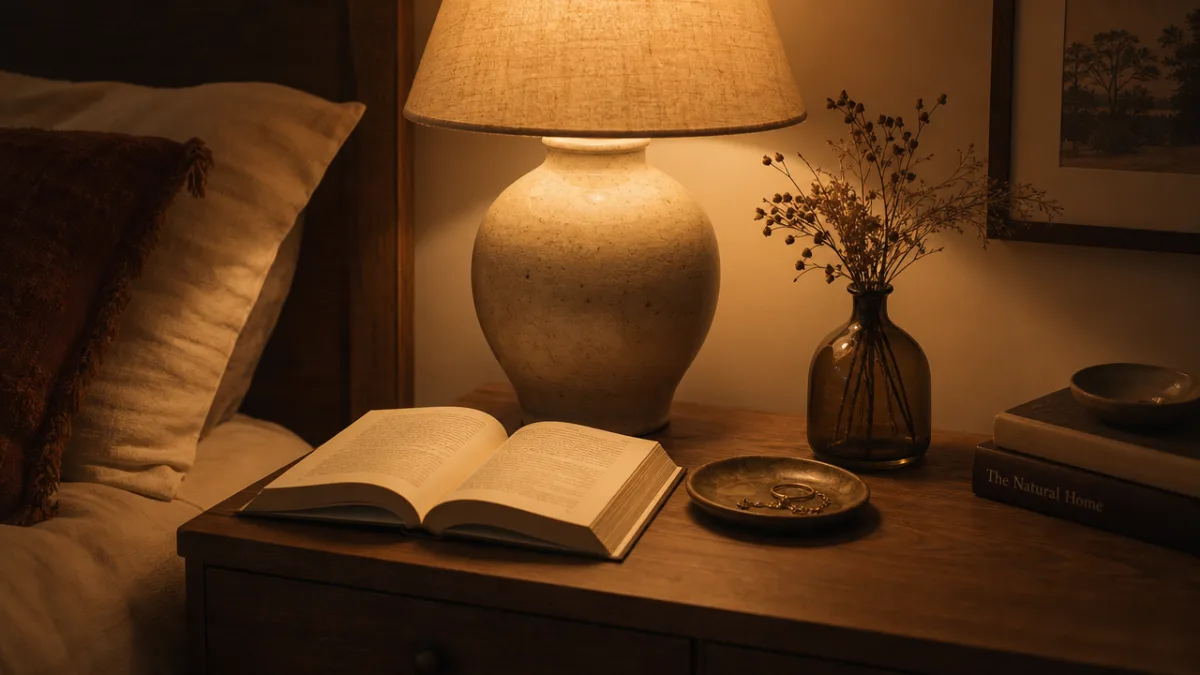
Begin with the lamp itself. Height matters: ideally, the light source should be roughly at eye level when you are sitting up in bed, so the shade diffuses the glow rather than allowing bare bulb light to hit your eyes directly. A ceramic base in a matte neutral tone, or one in soft terracotta or aged brass, will contribute to the warm atmosphere you are cultivating. The shade should be opaque or semi-opaque, casting light downward and outward rather than projecting it upward toward the ceiling. This pools the illumination where you actually need it, around your book and your hands, while leaving the rest of the room in gentle shadow.
Beyond the lamp, consider the following elements for a truly restorative bedside space. A small vessel for a single stem of dried botanicals or a sprig of eucalyptus introduces nature’s quiet presence without demanding care. A physical book — not a tablet, not a phone — signals to the brain that this is a space for unhurried absorption rather than reactive scrolling. A glass or small carafe of water acknowledges the body’s needs through the night. And perhaps a small dish for jewelry or a token object that carries personal meaning: something to set down at the end of the day as a physical act of releasing the hours just passed.
Building Your Evening Ritual: Small Practices with Large Returns
A ritual differs from a routine in one essential way: intention. Both involve repeated actions performed in a consistent sequence, but a routine is something you move through automatically, while a ritual asks you to be present for it. The evening ritual is most powerful when each element of it is performed with at least a moment of conscious attention, a brief acknowledgment that this action means something, that it marks a transition, that it belongs to you and to the quiet hour you are protecting. This quality of presence is what transforms ordinary habits into something genuinely restorative.
The structure of an effective evening ritual does not need to be complex or time-consuming. Most people find that a window of thirty to sixty minutes is both realistic and sufficient. The ritual might begin with a small act of environmental change: dimming or switching off overhead lights throughout the bedroom, perhaps lighting a candle if that feels meaningful to you, and settling into bed or into a chair near the lamp. The transition from the rest of the home to this particular pool of warmth and quiet is itself a signal, a threshold crossing that the body and mind learn to recognize over time.
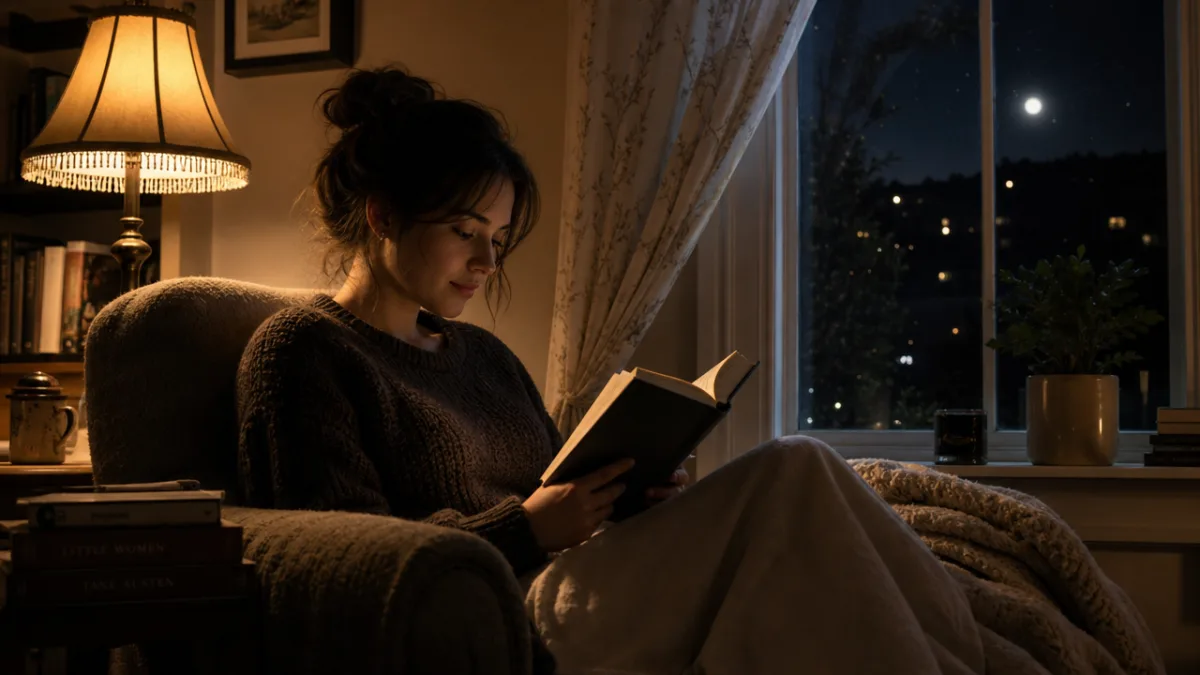
Reading is perhaps the oldest and most reliable component of the bedside ritual. There is substantial evidence that reading physical books before sleep, as opposed to reading on backlit screens, is associated with faster sleep onset and improved sleep quality. But the content of what you read matters too. This is not the hour for thrillers with cliffhanger chapter endings, or for dense nonfiction that demands intense analytical engagement. The best bedside reading is absorbing enough to gently redirect the mind from the day’s preoccupations, but not so gripping that it creates its own form of alertness. Literary fiction, poetry, essays, natural history, and travel writing all tend to serve the evening hour well.
Some people find that writing is a more effective component than reading. Keeping a small journal on the nightstand and spending ten minutes with it before sleep offers the mind an opportunity to externalize the thoughts and concerns it has been circling throughout the day. This act of containment, of placing worries and observations on paper where they will remain until morning, can be remarkably effective at quieting the mental chatter that so often lies between wakefulness and sleep. The journal does not need to be literary or even legible. Its function is to serve as a receiving vessel for the day’s residue.
Scent, Sound, and the Other Senses of Evening
Light is the most studied and perhaps the most biologically significant component of the bedside ritual, but the other senses contribute meaningfully to the atmosphere of evening calm. Scent, in particular, has an unusually direct pathway to the limbic system, the part of the brain most closely associated with emotion and memory. Certain aromatic compounds have documented effects on the nervous system, and even where the evidence remains preliminary, the subjective experience of a familiar, pleasant scent encountered consistently at bedtime creates powerful associative conditioning over time. The smell becomes the signal: when you detect it, your body begins to prepare for sleep.
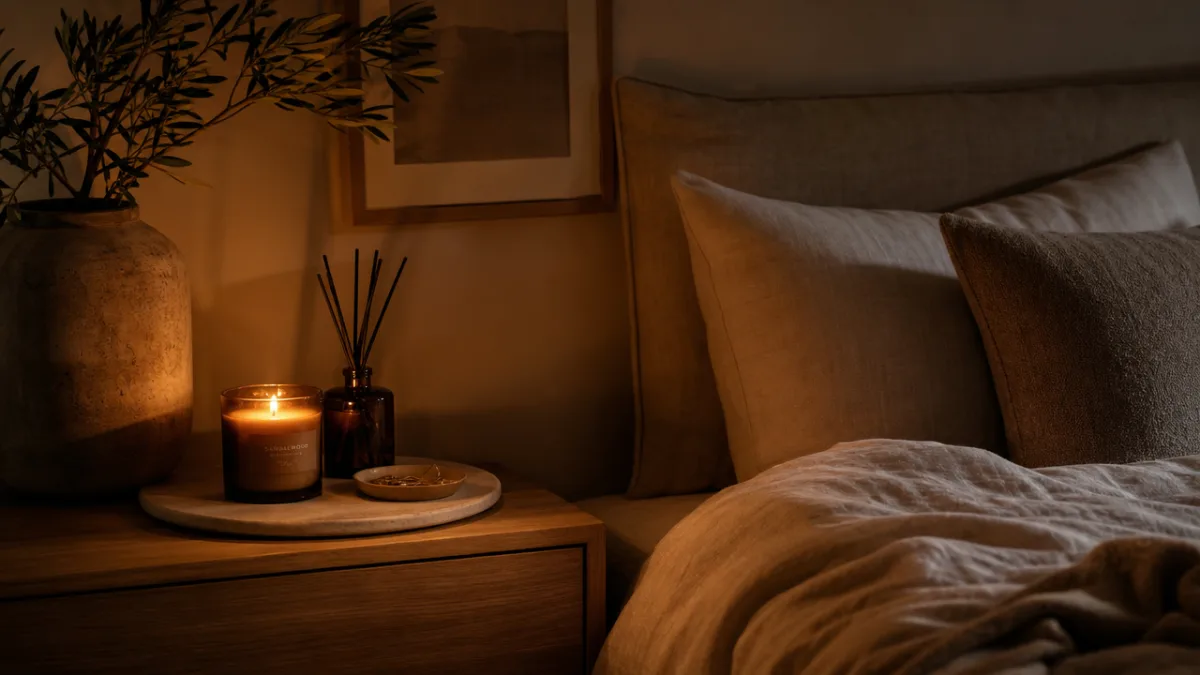
Lavender is the most researched of the sleep-associated scents, with multiple small studies suggesting it can reduce heart rate and blood pressure and improve subjective sleep quality. But sandalwood, cedarwood, vetiver, and chamomile all have long traditions of use as calming evening scents, and the most important criterion is ultimately personal preference: a scent you find genuinely pleasant and calming will serve you better than one you use only because it appears on a sleep-optimization list. A small candle, a reed diffuser, or simply a drop of essential oil on a cotton pad near the lamp can be sufficient. The scent should be present but subtle, a background note rather than a dominant fragrance.
Sound deserves equal consideration. Most people are not sleeping in silence, even when they believe they are: there is traffic, the hum of appliances, the settling of a building, the sounds of other household members. Some people sleep better with a consistent background sound that masks these irregularities, a phenomenon sometimes called auditory masking. White noise, pink noise, and brown noise all have their advocates, but many people find recordings of natural environments, gentle rain, flowing water, or distant ocean waves, more conducive to the feeling of the evening ritual. The key quality to look for in bedtime sound is consistency and lack of drama: no sudden changes in volume or tone, nothing that draws active attention.
The Ritual as an Act of Self-Respect
It is worth pausing to consider why so many people struggle to give themselves permission to have an evening ritual at all. The most common obstacle is not a lack of information about sleep hygiene or the benefits of winding down. It is something more fundamental: a deeply ingrained cultural message that rest must be earned, that time spent in quiet and stillness is time somehow wasted, that the person who reads by lamplight for forty-five minutes before sleep is being indulgent while others are still working. This message is pervasive, and it is false, but recognizing it as false does not always make it easy to act against it.
Creating and protecting an evening ritual is, at its root, an act of self-respect. It says that your sleep matters, that your nervous system deserves to be treated with care, and that the hours between productive wakefulness and sleep are not dead time to be minimized but a threshold worth inhabiting with intention. Many people find that once they begin a consistent evening ritual, they not only sleep better but carry a different quality of equanimity into their days. When the body knows that evening calm is coming, the demands of the day become slightly more bearable. The ritual reaches backward into the afternoon.
There is also something important about the relationship between the evening ritual and personal identity. We are, to a significant degree, the habits we practice consistently. A person who reads by lamplight each night, who tends a small and beautiful nightstand, who gives themselves the gift of soft light and quiet before sleep, is inhabiting a particular kind of self: one who values interiority, who knows how to be still, who has refused the culture’s insistence that every moment must be productive or stimulating. This is not a small thing. It is, over time, a form of character.
Seasonal Variations and Keeping the Ritual Alive
One of the quiet pleasures of a bedside ritual is the way it can shift with the seasons without losing its essential character. In winter, when darkness falls early and the cold outside makes the warm glow of a lamp feel particularly precious, the ritual naturally deepens and expands. There is more night to inhabit, and the contrast between the cold world outside and the soft warmth of the bedside lamp is more dramatic. Many people find their most satisfying ritual hours in the long evenings of January and February, wrapped in heavy bedding with a book and a candle and the sense of being genuinely sheltered from the elements.
Summer presents different challenges and different opportunities. Longer daylight hours mean that the natural darkness that supports melatonin production arrives later, and there can be a real tension between the body’s biological rhythms and the social and practical demands of lighter evenings. Blackout curtains or a sleep mask can help to create the necessary darkness artificially. The ritual itself might shift to incorporate more cooling elements, lighter reading, perhaps a glass of cold water infused with herbs from a garden. The lamp stays, but everything around it breathes a little differently in the warmth.
Keeping any ritual alive over months and years requires a degree of conscious renewal. The elements that felt fresh and intentional in autumn can become mechanical by spring if they are not occasionally revisited and refreshed. This does not mean abandoning what works, but rather looking at the ritual with fresh eyes from time to time and asking which elements still feel meaningful and which have become merely automatic. A new lamp, a different candle scent, a category of books not previously explored, a slight rearrangement of the nightstand: small changes can restore the quality of presence that makes a ritual different from a routine. The goal is always to arrive at the bedside lamp each night as if for the first time.
Essential Elements to Begin Your Own Quiet Ritual Tonight
If the idea of a bedside ritual appeals but the prospect of building one feels daunting, it helps to begin with the simplest possible version and allow it to grow organically from there. The following elements represent the core of a sustainable evening practice, distilled from what consistently appears in both the research on sleep hygiene and the lived experience of those who have made evening calm a genuine priority in their lives.
- A warm-spectrum lamp: Replace any cool or bright bulb in your bedside lamp with one rated between 2700K and 3000K. This single change will have an immediate and noticeable effect on the atmosphere of your bedroom in the evening hours.
- A physical book: Choose something absorbing but not agitating, and keep it beside the lamp. Commit to opening it each night, even if only for fifteen minutes.
- A consistent start time: Begin your ritual at the same time each evening, even on weekends when possible. Consistency is what allows the body to begin anticipating and preparing for sleep before the ritual even begins.
- A phone boundary: Place your phone on its charger somewhere outside the immediate orbit of your nightstand at least thirty minutes before sleep. The ritual and the phone are incompatible, and you will need to choose one.
- One scent anchor: A candle, a diffuser, or even a sachet of dried lavender placed near the lamp. Use it consistently so that the scent becomes associated with this time and place.
- A moment of intentional closing: A brief pause at the end of the ritual, before reaching for the lamp switch, to consciously mark the end of the day. This can be as simple as taking three slow breaths, or as personal as a few lines written in a journal. The form matters less than the intention.
These six elements are sufficient to begin. They do not require significant investment or elaborate preparation. What they require is the willingness to claim this hour as your own, to resist the pull of screens and the nagging sense that you should be doing something more productive, and to trust that the soft lamp and the open book and the quiet evening are doing something real and necessary for your health, your mind, and the version of yourself who will wake tomorrow morning. The ritual is waiting. The lamp is ready to be switched on.
Evening calm is not a luxury. It is not something reserved for those with large homes or quiet neighborhoods or lives free of demands. It is a choice, made in small and concrete ways, to honor the part of human experience that has always known how to be still. Wherever you are, whatever the evening has held, the nightstand and its soft circle of light represent an invitation: to arrive, to settle, to breathe, and to let the day finally, gratefully, release its hold.








What do you think?
It is nice to know your opinion. Leave a comment.