










Heteromeles arbutifolia (Toyon): California’s Native Holiday Berry
Introduction to Toyon: A California Icon
Heteromeles arbutifolia, commonly known as Toyon, is one of California’s most beloved and iconic native plants. This hardy, evergreen shrub or small tree has graced the California landscape for thousands of years, earning a place of deep cultural and ecological significance throughout the state. With its glossy, serrated leaves and spectacular clusters of brilliant red berries that appear just in time for the winter holiday season, Toyon has captured the imagination of botanists, gardeners, and nature lovers alike for generations.
The name “Toyon” itself is derived from the Ohlone language spoken by indigenous peoples of the San Francisco Bay Area, reflecting the plant’s deep roots in California’s human history long before European settlement. It is the sole species in the genus Heteromeles, placing it in the rose family (Rosaceae) alongside familiar plants like apples, pears, and hawthorns. This botanical relationship helps explain many of Toyon’s characteristics, including its showy flower clusters and fleshy, pome-type fruits that so closely resemble miniature apples or rose hips upon close inspection.
Toyon holds a particularly interesting place in California’s cultural heritage as the plant that is widely believed to have given Hollywood its name. When early settlers arrived in the Los Angeles area, they encountered hillsides blanketed in Toyon shrubs laden with brilliant red berries, reminiscent of English holly. The community that developed there was reportedly named “Hollywood” in honor of these plants, though historians continue to debate the precise connection. Today, Toyon remains so closely associated with California identity that it was officially designated the state’s Christmas berry plant.
Physical Characteristics and Growth Habits
Toyon is a highly adaptable plant that can take the form of a large, multi-stemmed shrub or a single-trunked small tree, depending on growing conditions and how it is managed. In the wild, mature specimens commonly reach heights of six to fifteen feet, though exceptional individuals growing in favorable conditions can reach twenty-five feet or more. The plant’s growth habit tends to be rounded and somewhat irregular, with a dense canopy of foliage that provides excellent cover for wildlife throughout the year.
The leaves of Toyon are one of its most recognizable features, being thick, leathery, and deep glossy green on their upper surfaces with a paler, matte underside. Each leaf is oblong to elliptical in shape, typically two to four inches in length, with sharply toothed or serrated margins that give them a slightly spiny appearance. This tough leaf structure is an adaptation to the hot, dry summers of California’s Mediterranean climate, helping the plant retain moisture and resist wilting during extended drought periods when many other plants struggle to survive.
The bark of mature Toyon plants is grayish-brown and develops an attractive, somewhat scaly or furrowed texture with age, adding visual interest to the landscape even during seasons when the plant is not in bloom or fruit. The overall structure of the plant is quite dense and somewhat rigid, with branches that become increasingly woody and substantial over time. This robust architecture makes Toyon an excellent choice for screening, windbreaks, and erosion control on steep slopes, where its deep, wide-spreading root system provides exceptional soil anchoring capability.
Bloom Season and Floral Display
One of Toyon’s most spectacular seasonal displays occurs in early to midsummer, typically from June through July, when the plant produces large, flat-topped clusters of small white flowers known botanically as corymbs. Each individual flower is quite small, measuring only about a quarter inch across, but they are produced in such extraordinary abundance that the entire plant can appear to be blanketed in white during peak bloom. A single mature Toyon can produce hundreds or even thousands of these flower clusters simultaneously, creating a breathtaking visual spectacle that is visible from considerable distances.
The flowers themselves are classic members of the rose family, with five white petals arranged around a central cluster of yellow stamens. While individually modest in size, their combined fragrance is quite noticeable and pleasantly sweet, attracting a remarkable diversity of pollinators from considerable distances. Native bees of many species are among the most frequent visitors, including bumblebees, sweat bees, and various solitary bee species. Beetles, flies, wasps, and butterflies also regularly visit the flowers, making a blooming Toyon a genuine hub of pollinator activity during the often lean summer months when few other native plants are in flower.
The timing of Toyon’s bloom is ecologically significant because it falls during the dry California summer, a period when nectar and pollen resources are scarce for many native insects. This positions Toyon as a critical food source in the midsummer gap between spring wildflower season and fall blooming plants, filling an important niche in supporting native pollinator populations through a potentially difficult period. Gardeners who include Toyon in their landscapes are essentially providing a vital ecological service, helping to sustain the populations of beneficial insects that pollinate crops and support broader ecosystem function throughout the surrounding area.
Berry Production and Wildlife Value
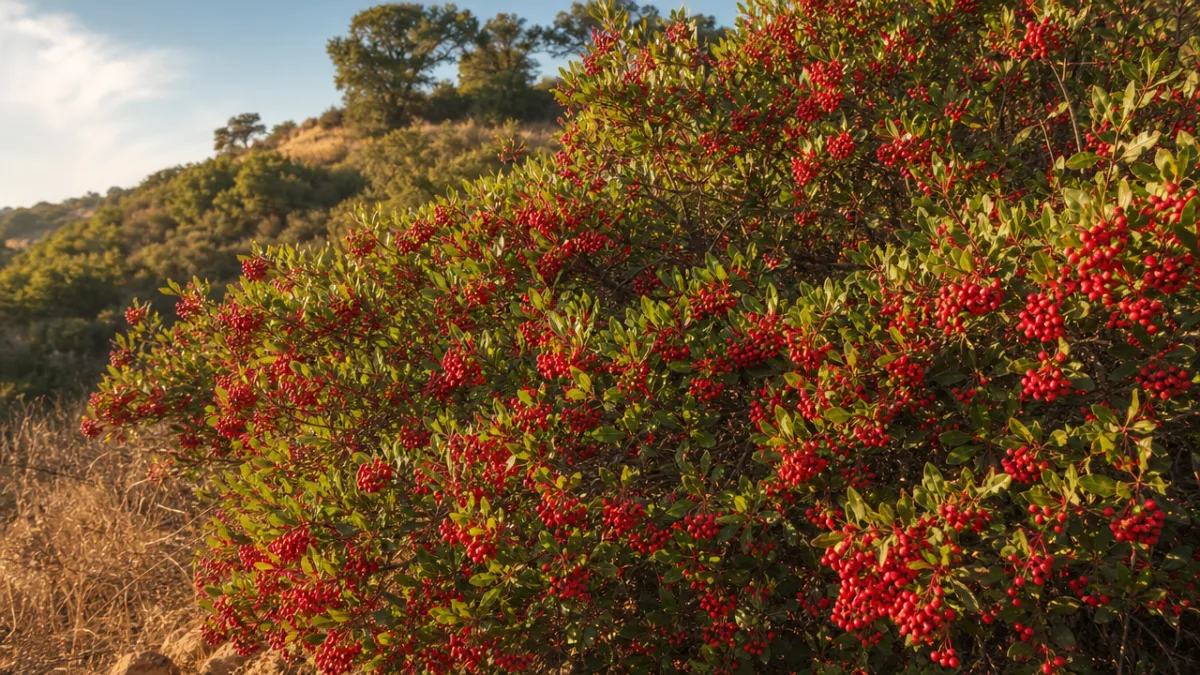
Following the summer bloom, Toyon’s tiny fertilized flowers gradually develop through late summer and fall into the plant’s most famous feature: dense clusters of small, round berries that turn from green to brilliant red or occasionally orange-red as the weather cools in autumn. By November and December, these berry clusters are fully ripe and brilliantly colored, transforming the plant into one of the most visually striking elements of the California winter landscape. The berries persist on the plant well into winter, providing a critical food resource for wildlife during the coldest months of the year when other food sources are scarce.
The wildlife value of Toyon’s berry crop is truly extraordinary and encompasses a wide range of species. Birds are among the most enthusiastic consumers, and Toyon plantings are well-known magnets for fruit-eating species. Cedar waxwings, perhaps the most famous of Toyon’s avian admirers, sometimes descend on berry-laden plants in large flocks, stripping the fruit with remarkable speed and efficiency. American robins, hermit thrushes, western bluebirds, mockingbirds, house finches, and many other species also regularly feed on the berries throughout the winter season.
Mammals are equally attracted to Toyon’s fruit, with coyotes, foxes, black bears, mule deer, and various small rodents all documented consuming the berries when available. The plant also provides important structural habitat value beyond its food contributions, with its dense, thorny branching structure offering excellent nesting sites and protective cover for birds and small mammals year-round. Toyon can be considered a cornerstone species in California’s native landscape, one that supports so many other organisms that its presence meaningfully increases local biodiversity wherever it grows.
From a human perspective, Toyon berries have a long history of use among California’s indigenous peoples. Native Californians roasted or parched the berries to reduce their bitterness, or dried and ground them into a meal used in various food preparations. The berries were an important winter food source for many tribal groups throughout the plant’s range, and some communities fermented them into a mildly alcoholic beverage. It is important to note, however, that raw Toyon berries contain compounds that can cause gastrointestinal distress and should not be eaten raw in large quantities, though small amounts are generally not harmful.

Native Range and Ecological Habitat
Toyon is endemic to the western portions of North America, with its native range centered on California and extending slightly into Baja California, Mexico, and the extreme southern portion of Oregon. Within California, the plant is remarkably widespread, occurring in suitable habitats throughout the Coast Ranges from the Oregon border south to San Diego County, across the western slopes of the Sierra Nevada foothills, throughout the Transverse and Peninsular Ranges of Southern California, and on several of the Channel Islands. This broad distribution reflects the plant’s considerable ecological adaptability and resilience.
In terms of plant communities, Toyon is most characteristically associated with California chaparral and coastal sage scrub, the iconic shrubland vegetation types that cover vast areas of hillsides and mountain slopes throughout much of the state. It also occurs commonly in oak woodland understories, along canyon margins, on north-facing slopes that retain more moisture than surrounding terrain, and at the edges of riparian corridors. This habitat versatility allows Toyon to persist in a wide range of soil types and moisture regimes, from relatively well-watered canyon bottoms to quite dry, exposed ridgelines.
Toyon thrives in the Mediterranean climate that characterizes most of its native range, characterized by warm, dry summers and cool, moist winters. This climate regime has shaped the plant’s entire biology, from the timing of its summer flowering (taking advantage of warm temperatures while competing vegetation is dormant) to its deep root system (which accesses soil moisture reserves that persist well below the surface long after surface soils have dried out). Understanding this climatic adaptation is essential for successfully cultivating Toyon outside its native range, as the plant can struggle in regions with humid summers or poorly drained soils.
Cultivation, Landscaping, and Garden Use
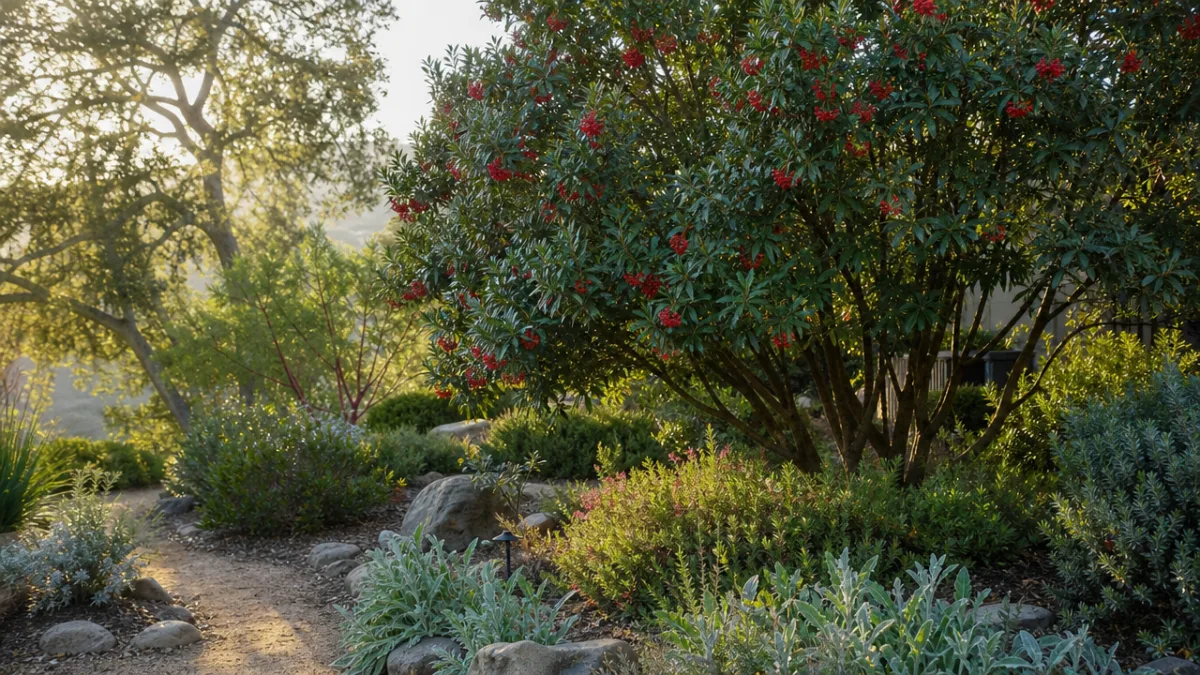
Toyon has become increasingly popular as a landscaping plant not only in California but in other Mediterranean-climate regions around the world, and for excellent reasons. Once established in an appropriate location, it is extraordinarily drought-tolerant, requiring little to no supplemental irrigation beyond what natural rainfall provides. This quality makes it an outstanding choice for water-conscious gardeners, sustainable landscaping projects, and the fire-resistant gardens that are increasingly important in California’s evolving climate reality. Its year-round visual interest, with attractive foliage, summer flowers, and winter berries, makes it a hardworking plant that earns its garden space in every season.
When selecting a site for Toyon, gardeners should prioritize good drainage above almost all other considerations, as the plant is highly intolerant of waterlogged soils and will decline rapidly if roots are kept consistently wet. Full sun to partial shade are both acceptable, though plants grown in full sun tend to produce the most abundant berry crops and the most compact, attractive growth habit. Rocky, sandy, or clay soils are all tolerated provided drainage is adequate, and the plant generally does not require amendments or fertilization once established. Spacing should allow for the plant’s eventual mature size, typically at least eight to ten feet from other large plants or structures.
Toyon can be used in numerous landscape applications, reflecting its versatility as a garden plant. Common uses and applications include:
- Wildlife gardens and habitat restoration plantings designed to attract and support native birds and pollinators throughout the year
- Screens and hedgerows that provide visual privacy, wind protection, and noise reduction while requiring minimal maintenance
- Slope stabilization and erosion control on hillsides and disturbed areas where its deep root system helps anchor soil
- Specimen plantings where its attractive form and seasonal interest can be displayed to best advantage as a focal point
- Foundation plantings against structures, where its drought tolerance reduces irrigation demands near buildings
- Fire-resistant buffer plantings in defensible space zones around structures in fire-prone areas
Pruning requirements for Toyon are minimal, and the plant is best left to develop its natural form unless specific size constraints require management. When pruning is necessary, the best time is immediately after the berry crop has been consumed by wildlife in late winter or early spring, before new growth begins. Hard pruning can rejuvenate older, overgrown specimens, and Toyon responds well to this treatment, typically resprouting vigorously from the base. The plant also responds well to coppicing as a traditional land management technique, and many populations in the wild show evidence of historical burning or cutting that has maintained them in a productive, vigorous state for generations.
Fire Ecology and Resilience
Toyon has evolved in intimate association with fire, which has been a recurring feature of California’s landscape for millions of years. The plant has developed remarkable adaptations that allow it not merely to survive fire but to benefit from it, and understanding these adaptations helps explain much about the plant’s ecology and behavior. At the base of each Toyon plant, where the main stems emerge from the soil, there is a woody, thickened structure called a lignotuber or burl. This structure contains a dense concentration of dormant buds and stored energy reserves that remain protected below the soil surface even when fire kills all the aboveground growth of the plant.
Following a fire, Toyon plants with intact lignotubers can resprout with extraordinary vigor, sending up new shoots within weeks of a burn and often reaching considerable size within just a few years. This resprouting ability means that a single Toyon individual can potentially persist at a site for many decades or even centuries, surviving repeated fire cycles that kill and regenerate its aboveground stems while the underground burl remains alive and accumulates ever-greater energy reserves. This growth strategy is shared with many other California chaparral species and represents one of the most successful adaptations to fire-prone environments found anywhere in the plant kingdom.
From a practical standpoint, Toyon’s fire ecology has important implications for homeowners and land managers in fire-prone California communities. While no plant can be considered truly fireproof, Toyon’s relatively high moisture content in its leaves, its tendency to retain relatively little dead material in its canopy, and its ability to resprout after fire all make it a reasonable choice for defensible space plantings around structures. However, like all woody shrubs, it should be managed appropriately with adequate spacing between plants and between plants and structures to minimize fire risk while still providing its many ecological and aesthetic benefits.
Conservation Status and Future Prospects
Toyon is not currently considered a threatened or endangered species and remains abundant throughout much of its native range. However, like many California native plants, it faces ongoing pressures from habitat loss, urban development, invasive species competition, and the increasing severity and frequency of wildfires associated with climate change. In some portions of its range, particularly in the heavily developed urban and suburban landscapes of the San Francisco Bay Area and Southern California, natural Toyon populations have been greatly reduced from their historical extent, making the preservation of remaining stands and the establishment of new plantings in cultivated landscapes increasingly important.
Climate change presents a complex and somewhat uncertain challenge for Toyon’s long-term future. On one hand, the plant’s extraordinary drought tolerance and heat resilience suggest that it may be well-positioned to endure the warmer, drier conditions projected for much of California in coming decades. On the other hand, changes in the timing and intensity of winter rainfall, more frequent and severe drought events, and the indirect effects of climate change on fire regimes and pest populations could all affect Toyon populations in ways that are difficult to predict with precision. Monitoring of natural populations over time will be essential for understanding how the species responds to these changing conditions.
The growing interest in native plant gardening and habitat restoration throughout California and beyond represents a genuinely positive development for Toyon. As more gardeners, landscape designers, municipalities, and land managers recognize the value of incorporating native plants into cultivated landscapes, Toyon is increasingly finding its way into settings where it can provide ecological benefits while requiring less water and maintenance than many conventional landscape plants. Conservation organizations, native plant nurseries, and botanical gardens throughout California actively promote Toyon as a model species for sustainable, ecologically responsible landscaping, and its popularity continues to grow among those seeking to connect their outdoor spaces to the broader natural heritage of the California landscape.








What do you think?
It is nice to know your opinion. Leave a comment.