










Alpine Rock Garden With Miniature Wonders: A Complete Guide to Creating Your Own Mountain Landscape
What Is an Alpine Rock Garden?
An alpine rock garden is a carefully crafted landscape that mimics the rugged, breathtaking terrain found in high-mountain environments. Originating from the horticultural traditions of nineteenth-century Europe, these gardens attempt to recreate the dramatic scenery of places like the Swiss Alps, the Rockies, or the Himalayas within the confines of a domestic outdoor space. The magic lies in their ability to compress an entire mountain ecosystem into something you can admire from just a few feet away, creating a sense of scale and wonder that few other garden styles can match.
At the heart of every alpine rock garden is an intimate relationship between stone and plant. The rocks are not merely decorative backdrops — they serve as functional infrastructure, providing drainage, thermal mass, and shelter for the delicate plants growing between and beneath them. Skilled rock garden designers choose their stones with the same care a sculptor applies to marble, selecting pieces for their shape, color, texture, and the way they catch light at different times of day. The result is something that feels simultaneously ancient and alive.
The miniature quality of alpine gardens is perhaps their most enchanting characteristic. Because the plants native to high-altitude environments have evolved to survive brutal conditions — thin air, intense UV radiation, fierce winds, and a very short growing season — they tend to grow slowly and stay compact. A plant that might reach three feet in a lowland garden may grow only three inches in an alpine setting over the same number of years. This slow, deliberate growth gives alpine rock gardens a jewel-like precision that rewards patient observation and close attention.
Choosing the Right Location and Foundation
Selecting the ideal spot for your alpine rock garden is perhaps the single most important decision you will make in the entire process, and it deserves considerably more thought than most beginners give it. Alpine plants are sun-lovers by nature — they evolved on exposed mountain slopes where the sun is intense and the day is long. A south-facing or southwest-facing slope is generally ideal in the Northern Hemisphere, ensuring your plants receive maximum sunlight throughout the growing season. Avoid placing your rock garden beneath trees, which will drop leaves onto delicate cushion plants and create unwanted shade and moisture.
Drainage is absolutely non-negotiable in an alpine rock garden. The single most common reason these gardens fail is waterlogged soil during winter and early spring, which causes the crowns of alpines to rot. Before you place a single stone, invest time in assessing and improving your site’s drainage. If your garden sits on heavy clay, you may need to excavate to a depth of twelve to eighteen inches and fill the base with rubble, broken brick, or coarse gravel before adding your growing medium. Raised beds are an excellent solution for gardens with persistently poor drainage, and they have the added benefit of bringing the plants closer to eye level where their details can be better appreciated.
The slope of your garden also plays a practical role in both drainage and aesthetics. A gentle slope of around fifteen to twenty degrees is ideal — steep enough to shed excess water quickly but not so severe that soil and small plants wash away in heavy rain. If your chosen site is naturally flat, consider building up the center with imported soil and rock to create an artificial mound. This not only improves drainage but also introduces the visual dynamism and three-dimensionality that makes alpine rock gardens so compelling to look at.
Selecting and Placing Rocks
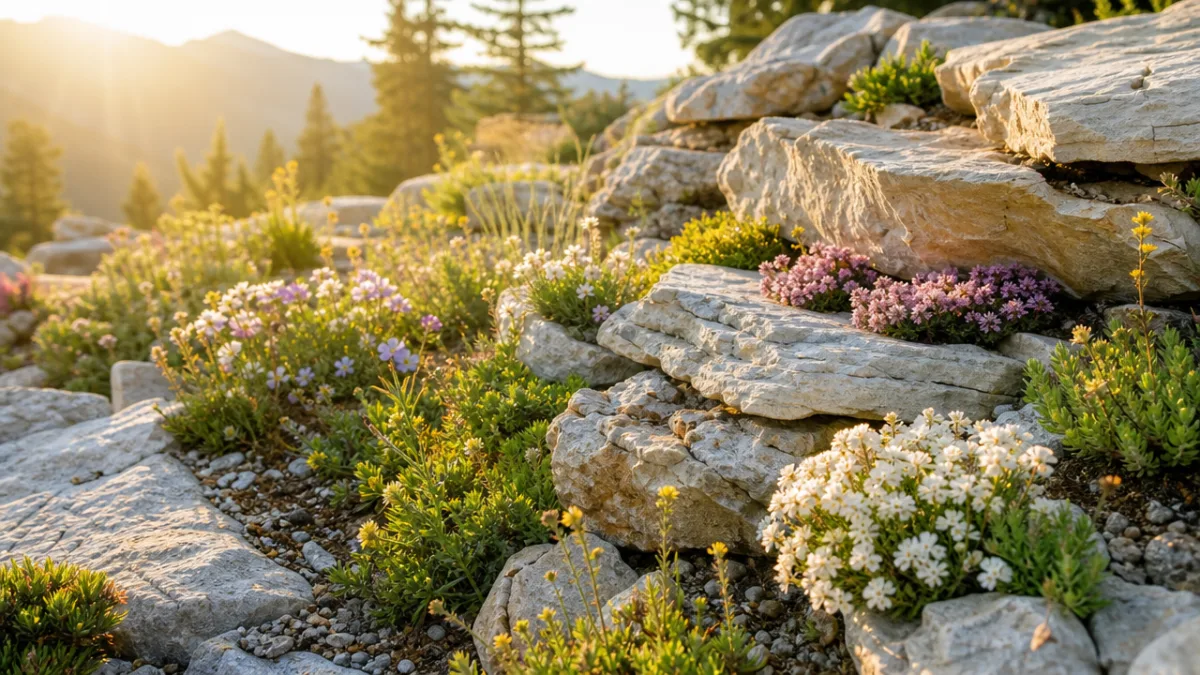
The rocks you choose will define the character and mood of your entire garden, so take time to consider your options carefully. The most successful alpine rock gardens use a single type of stone throughout, mimicking the way rock outcrops naturally appear in mountain landscapes where one geological formation dominates the terrain. Limestone is a perennial favorite because of its pale, weathered appearance and the way it becomes colonized by mosses and lichens over time. Sandstone is another excellent choice, offering warm amber and rust tones that contrast beautifully with silver-leafed alpine plants. Granite, while harder to work with due to its weight, produces a dramatic and rugged aesthetic that suits larger garden schemes.
The placement of rocks is an art that takes time to develop but follows a few guiding principles drawn from nature. In genuine mountain landscapes, exposed rock strata tend to lie at consistent angles, as if tilted by the same geological forces that shaped the entire hillside. Recreating this consistency in your garden — even subtly — creates a sense of authenticity and coherence that makes the design feel inevitable rather than contrived. Tilt your rocks slightly backward into the slope so that rainwater runs toward the plants rather than away from them, and bury at least one-third of each rock below the soil surface so it appears to emerge from the earth rather than simply sitting on top of it.
Scale and variety within your single stone type will add visual interest and a sense of natural abundance. Use a combination of large anchor stones that establish the structure of the garden, medium stones that fill in the gaps and create planting pockets, and smaller pieces that transition naturally to the surrounding ground level. Avoid arranging rocks in symmetrical patterns or straight lines, which immediately read as artificial. Instead, cluster them in irregular groups as you might find them in a natural scree field or exposed ridge, leaving generous planting crevices and pockets between them where your miniature wonders can take root and thrive.
- Limestone: Pale and porous, develops beautiful patina over time, ideal for Mediterranean and European alpine plants.
- Sandstone: Warm amber tones, relatively lightweight, works well with silvery and drought-tolerant species.
- Granite: Highly durable, dramatic appearance, best suited to larger rock gardens with bold plant combinations.
- Tufa: Lightweight volcanic rock with exceptional drainage properties, plants can even be grown directly into drilled holes.
- Slate: Dark and angular, creates a striking contrast with bright flowering alpines, particularly effective in contemporary garden designs.
The Best Alpine Plants for a Miniature Mountain Garden
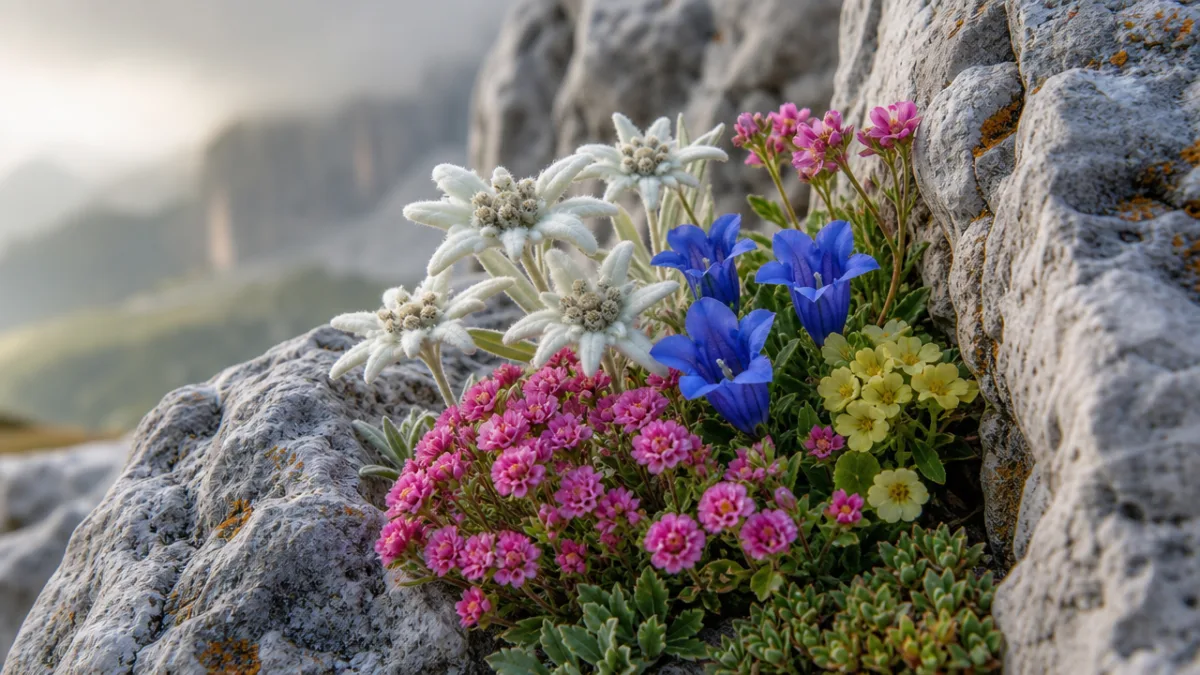
Choosing the right plants is where the real joy of alpine gardening begins, and the diversity available to the enthusiast is genuinely staggering. The plant kingdom has solved the challenges of high-altitude survival in dozens of creative ways, resulting in an extraordinary range of forms, textures, and colors. Cushion plants like Arenaria montana and Silene acaulis form tight, rounded mounds that hug the rocks, covered in tiny flowers that appear almost disproportionately large for the plant’s size. These cushions are among the most satisfying plants in the rock garden because they provide year-round structure even when not in flower.
Saxifrages represent perhaps the most important genus in alpine horticulture, offering hundreds of species and cultivars suited to virtually every rock garden situation. The encrusted saxifrages, with their silver-edged rosettes secreting lime deposits along their leaf margins, are particularly prized for the way they naturalize among rocks, spreading gradually to fill crevices with living filigree. Saxifraga cotyledon produces spectacular arching plumes of white flowers in late spring that can reach twelve inches in length from a rosette only three inches across — a breathtaking demonstration of the explosive flowering strategy many alpine plants employ to make the most of a brief growing season.
Bulbs play a surprisingly important role in the seasonal drama of an alpine rock garden, providing color at times when the perennial plants are only beginning to stir. Small species tulips like Tulipa tarda and Tulipa humilis are far better suited to rock gardens than their large hybrid relatives, thriving in the sharp drainage and summer baking that mimics their central Asian highland origins. Similarly, the many species of Crocus, Iris reticulata, and dwarf narcissus can be naturalized among the rocks to create a succession of color from late winter through to early summer, before the main flush of alpine perennials takes over.
- Androsace lanuginosa: Trailing pink flowers through summer, perfect for spilling over rock edges.
- Dianthus alpinus: Vivid pink blooms with a spicy fragrance, forms neat mats, one of the classic rock garden plants.
- Dryas octopetala: Mountain avens with white flowers and distinctive oak-shaped leaves, outstanding ground-covering value.
- Gentiana acaulis: Intensely blue trumpet flowers in spring, considered by many to be the most beautiful alpine plant of all.
- Phlox subulata: Vigorous and easy, smothers itself in flowers in spring, available in pink, white, lavender, and red forms.
- Sedum spathulifolium: Silvery succulent rosettes, excellent drought tolerance, provides winter interest and spring yellow flowers.
Dwarf conifers and miniature shrubs provide the architectural backbone that gives an alpine rock garden its year-round presence and sense of permanence. A single specimen of Picea glauca ‘Conica’ or a prostrate juniper carefully placed among the rocks provides scale and structure that unifies the entire planting. These woody plants grow so slowly — often less than an inch per year — that a specimen planted today will still be a perfect miniature twenty years from now. Combine them with compact ornamental grasses like Festuca glauca for textural contrast and movement that brings the garden to life even on still days.
Soil Preparation and Ongoing Maintenance
Getting the growing medium right is fundamental to the long-term success of your alpine rock garden. Native alpine soils are characteristically lean, gritty, and free-draining — almost the polar opposite of the rich, moisture-retentive soils we typically associate with productive gardening. Replicating these austere conditions may feel counterintuitive at first, but it is precisely what your plants need to thrive. A standard alpine growing mix consists of roughly equal parts quality loam, horticultural grit or sharp sand, and leaf mold or fine composted bark. This blend provides adequate nutrients without encouraging the lush, sappy growth that makes plants vulnerable to rot and pest damage.
Top-dressing the soil surface between plants with a layer of fine gravel or stone chippings is one of the most important finishing touches you can apply to a rock garden, and it serves multiple practical purposes simultaneously. Firstly, it prevents soil from splashing up onto the low-growing rosettes and cushions of alpine plants, which can cause rotting at the crown. Secondly, it conserves moisture during dry spells while simultaneously ensuring that the immediate surface dries out quickly after rain, exactly mimicking the fast-draining scree and rock faces where many alpines originate. Thirdly, it suppresses annual weed seedlings, which can quickly overwhelm slow-growing alpines if left unchecked. Choose a gravel that matches the color of your rock for the most natural, unified appearance.
Weeding is the most time-consuming but critically important maintenance task in an alpine rock garden. Because the plants grow slowly and compactly, even modest competition from weeds can quickly overwhelm them. Annual weeds are relatively easy to manage if addressed promptly, but perennial weeds like bindweed, couch grass, and ground elder are a serious threat that must be eradicated from the site before planting begins — once established among rocks and plants, they are almost impossible to remove. Hand-weeding with a narrow forked tool is the only practical method in an established rock garden, and it should be carried out at least once a month during the growing season.
Watering requirements for an established alpine rock garden are surprisingly modest compared to other garden styles, which is one of the many reasons these gardens are increasingly popular in regions experiencing water restrictions. During the growing season, most alpines prefer to be watered deeply but infrequently, allowing the soil to dry out somewhat between applications. The most dangerous period is not summer drought but winter and early spring wet, when cold, saturated soil can rot plant crowns even in relatively mild climates. Protecting particularly vulnerable species with a sheet of glass or a cloche during the wettest months of winter is a traditional technique that pays dividends in plant survival rates.
Seasonal Interest and Design Principles
One of the most remarkable qualities of a well-planned alpine rock garden is its ability to offer something of visual interest in every season of the year. Spring is undeniably the season of peak spectacle, when bulbs, saxifrages, primulas, and phlox combine to produce a carpet of color that seems almost improbable given the austere conditions in which it grows. But careful selection can extend interest well beyond spring’s fireworks. Early summer brings the gentians, dianthus, and thymes into flower, followed by late-summer bloomers like the sedums, diascias, and dwarf asters that carry the garden through to the first frosts.
Winter in the alpine rock garden has its own quiet beauty that rewards those who pay attention to it. The structural forms of dwarf conifers take on renewed importance against a backdrop of frost and snow, their shapes dusted in white like tiny mountains within a mountain landscape. The silver rosettes of encrusted saxifrages and the persistent seedheads of grasses add fine texture and subtle color that would be invisible during the lush growth of summer. A light snowfall, rather than destroying the garden’s appeal, actually enhances it — suddenly the rock garden becomes the landscape it was always meant to evoke, complete with its own miniature snowfields and sheltered valleys.
Successful alpine rock garden design always considers the view from multiple angles and distances. From a distance, the garden should read as a coherent composition of rock and plant that suggests a genuine fragment of mountain landscape. As you approach, individual plant associations and rock formations become more distinct and interesting. And up close — crouching down to the level of the plants — an entirely different world is revealed: the intricate structure of a saxifrage rosette, the extraordinary intensity of a gentian’s blue, the tiny perfection of a miniature conifer. This quality of rewarding sustained observation at multiple scales is what separates great rock gardens from merely competent ones.
Color harmony in the alpine rock garden deserves thoughtful consideration from the outset, though the intensely saturated colors of many alpine flowers can make this challenging. Many experienced rock gardeners prefer to work within a restricted palette — perhaps focusing on blue, white, and silver with accents of yellow — to avoid the carnival effect that can result from combining too many vivid colors in a small space. Others embrace the full polychrome riot of the alpine meadow and find it exhilarating rather than overwhelming. Whatever your preference, consider the color and texture of your chosen stone when planning your plant palette, ensuring that the two elements complement rather than fight each other across every season.
The long-term evolution of an alpine rock garden is one of the pleasures that distinguishes it from more static garden styles. As cushion plants expand to fill their allotted space and begin to merge with neighboring colonies, as mosses and lichens colonize the rocks, as self-seeding species like Erinus alpinus establish themselves in crevices you never planted, the garden develops a patina of age and naturalism that no amount of initial planting can replicate. This is a garden style that rewards patience, grows more beautiful with time, and in its best iterations comes to look as though the mountain came to the garden rather than the other way around.
Inspiring Ideas and Creative Variations
While the traditional freestanding rock garden remains the most ambitious and impressive expression of alpine horticulture, there are numerous smaller-scale variations that bring the essence of mountain landscape within reach of almost any garden or outdoor space. The alpine trough garden — created in a stone sink, hypertufa container, or reclaimed water trough — is perhaps the most accessible of these alternatives, requiring only a few cubic feet of well-drained growing medium and a handful of carefully chosen plants to create a genuinely captivating miniature landscape. A single well-planted trough positioned at a comfortable viewing height can contain more botanical interest per square inch than almost any other garden style.
The raised bed rock garden represents an excellent middle ground between the full-scale rock garden and the contained trough, offering significantly more planting space while solving drainage problems that might exist in the underlying garden soil. Constructed with walls of dry-stacked stone, reclaimed railway sleepers, or natural timber, a raised alpine bed can be designed to integrate seamlessly with terrace paving, garden walls, or the architecture of the house itself. Filling it with a generous depth of free-draining alpine mix and incorporating larger rocks as focal points transforms a functional raised bed into a genuine design feature that anchors the surrounding garden.
Contemporary designers have begun exploring ways to incorporate alpine plants into green roof installations, recognizing that the conditions on an exposed rooftop — intense sun, wind, and limited soil depth — closely replicate the mountain environments where these plants naturally thrive. A green roof planted with sedums, sempervivums, small grasses, and selected alpine perennials can be extraordinarily beautiful as well as functionally valuable, reducing rainwater runoff, insulating the building beneath, and providing a habitat for pollinating insects in an otherwise impoverished urban environment. The aesthetic of a rooftop alpine garden, viewed from adjacent windows or terraces, is genuinely striking — a patch of mountain wildness floating above the city.
For gardeners who want to push the concept of miniature wonders even further, the Japanese art of saikei — literally “planted landscape” — offers a fascinating convergence with alpine horticulture. Saikei involves creating miniature landscapes in shallow containers using carefully selected rocks, soil, mosses, and dwarf trees to evoke an entire mountain, valley, or coastal scene in miniature. While traditionally a Japanese art form with its own distinct aesthetic and philosophy, the principles of saikei translate beautifully into a Western alpine context, using European mountain plants and local stone to create container landscapes that are simultaneously botanical collections and works of art. The result is a garden you can carry indoors, examine under a magnifying glass, and rearrange as your vision evolves — the ultimate miniature mountain wonder.








What do you think?
It is nice to know your opinion. Leave a comment.